
显示器件

Search documents
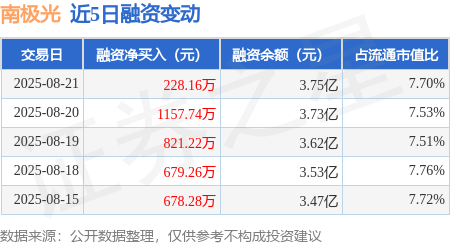
南极光:8月21日融资净买入228.16万元,连续3日累计净买入2207.11万元
Sou Hu Cai Jing· 2025-08-22 02:25
证券之星消息,8月21日,南极光(300940)融资买入5243.14万元,融资偿还5014.98万元,融资净买入 228.16万元,融资余额3.75亿元,近3个交易日已连续净买入累计2207.11万元,近20个交易日中有12个 交易日出现融资净买入。 | 交易日 | 融资净买入(元) | 融资余额(元) | 占流通市值比 | | --- | --- | --- | --- | | 2025-08-21 | 228.16万 | 3.75亿 | 7.70% | | 2025-08-20 | 1157.74万 | 3.73亿 | 7.53% | | 2025-08-19 | 821.22万 | 3.62亿 | 7.51% | | 2025-08-18 | 679.26万 | 3.53亿 | 7.76% | | 2025-08-15 | 678.28万 | 3.47亿 | 7.72% | 小知识 融资融券:融资融券交易又称"证券信用交易"或保证金交易,是指投资者向具有融资融券业务资格的证 券公司提供担保物,借入资金买入证券(融资交易)或借入证券并卖出(融券交易)的行为。包括券商 对投资者的融资、融券和金融机构对券商 ...


翰博高新: 关联交易管理制度(2025年8月)
Zheng Quan Zhi Xing· 2025-08-21 09:14
翰博高新材料(合肥)股份有限公司 关联交易管理制度 第一章 总 则 第一条 为保证翰博高新材料(合肥)股份有限公司(以下简称"公司")与 关联方之间订立的关联交易符合公平、公正、公开的原则,确保本公司的关联交 易行为不损害本公司和全体股东的利益,根据《中华人民共和国公司法》(以下 简称《公司法》)、《中华人民共和国证券法》(以下简称《证券法》)、《深圳证券 交易所创业板股票上市规则》 (以下简称《股票上市规则》)、 《深圳证券交易所上 市公司自律监管指引第 2 号——创业板上市公司规范运作》《深圳证券交易所上 市公司自律监管指引第 7 号——交易与关联交易》等有关法律、法规以及《翰博 高新材料(合肥)股份有限公司章程》 (以下简称《公司章程》)的有关规定,结 合公司实际情况,制订本制度。 第二章 关联人和关联关系 第二条 公司的关联人包括关联法人和关联自然人。 第三条 具有以下情形之一的法人或其他组织,为公司的关联法人: (一)直接或间接地控制公司的法人或其他组织; (二)由前项所述主体直接或间接控制的除公司及其控股子公司以外的法人 或其他组织; (三)由第四条所列公司的关联自然人直接或间接控制的,或担任董事 ...
南极光:公司深圳厂区与江西万载厂区共同构成了超700万片/月的规模化产能
Zheng Quan Ri Bao Wang· 2025-08-20 10:45
Core Viewpoint - The company, Nanji Guang (300940), has a combined production capacity exceeding 7 million units per month from its Shenzhen and Jiangxi Wanzai factories, which positions it well to meet the demands of key clients, including Nintendo for the Switch 2 [1] Production Capacity - The Shenzhen factory has a monthly capacity of over 2 million units, while the Jiangxi Wanzai factory has a capacity of over 5 million units, totaling more than 7 million units per month [1] - The Wanzai factory covers an area of approximately 56,700 square meters and has the capability for rapid capacity expansion [1] Client Demand and Flexibility - The production capacity is designed to effectively support core client orders and existing demand, including those from Nintendo for the Switch 2 [1] - The company possesses efficient capacity adjustment and rapid ramp-up capabilities, allowing it to respond flexibly to sudden increases in demand [1] Technological Advancements - As the exclusive supplier of backlight sources for the Nintendo Switch 2, the company continuously iterates its technology to meet the stringent requirements of end customers regarding display performance and delivery efficiency [1]
南极光:公司通过“供应链深度整合+制程技术壁垒+精益运营”铁三角构建了强成本控制能力
Zheng Quan Ri Bao Wang· 2025-08-20 08:47
Core Viewpoint - The company, Nanji Guang (300940), emphasizes its strong cost control capabilities through a combination of supply chain integration, process technology barriers, and lean operations, which are expected to support gross profit growth during the Switch2 ramp-up phase [1] Group 1 - The company has established a "supply chain deep integration + process technology barriers + lean operations" triangle to enhance cost control [1] - During the Switch2 ramp-up phase, unit costs are expected to decrease in a tiered manner as scale increases, providing certainty for gross profit growth [1]
彩虹股份获融资买入0.12亿元,近三日累计买入0.59亿元
Jin Rong Jie· 2025-08-16 01:06
Summary of Key Points Core Viewpoint - The trading activity of Rainbow Co., Ltd. shows a mixed performance in the recent three trading days, with notable financing buy-ins and net selling on a specific day [1]. Financing Activity - On August 15, Rainbow Co. recorded a financing buy-in amount of 0.12 billion, ranking 1236th in the market [1]. - The financing repayment amount on the same day was 0.18 billion, resulting in a net selling of 5.45 million [1]. - Over the last three trading days (August 13-15), the financing buy-in amounts were 0.16 billion, 0.31 billion, and 0.12 billion respectively [1]. Securities Lending - On August 15, the company had a securities lending activity with a sell-out of 0.03 thousand shares and a net buy-in of 2.51 thousand shares [1].

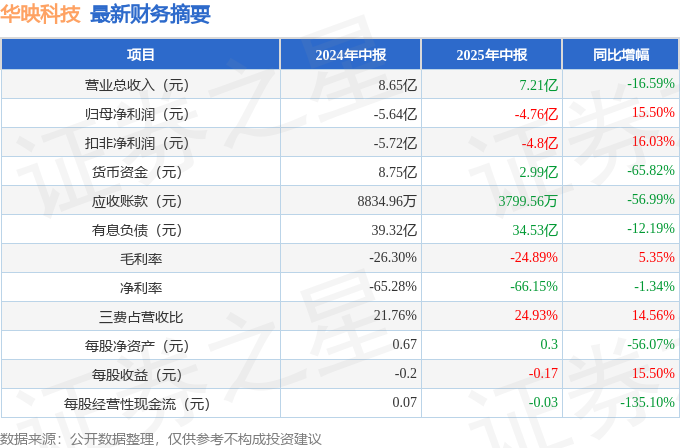
华映科技2025年中报简析:亏损收窄,短期债务压力上升
Zheng Quan Zhi Xing· 2025-08-15 23:05
Core Viewpoint - Huaying Technology (000536) reported a decline in total revenue and an increase in net loss for the first half of 2025, indicating ongoing financial challenges despite some improvements in specific metrics [1]. Financial Performance Summary - Total revenue for the first half of 2025 was 721 million yuan, a decrease of 16.59% compared to the same period in 2024 [1]. - The net profit attributable to shareholders was -476 million yuan, showing an improvement of 15.5% year-on-year [1]. - In Q2 2025, total revenue was 379 million yuan, down 14.16% year-on-year, while the net profit attributable to shareholders was -243 million yuan, up 20.74% year-on-year [1]. - The gross margin was -24.89%, an increase of 5.35% year-on-year, while the net margin was -66.15%, a decrease of 1.34% year-on-year [1]. - Total expenses (selling, administrative, and financial) amounted to 180 million yuan, accounting for 24.93% of revenue, an increase of 14.56% year-on-year [1]. Balance Sheet Highlights - Cash and cash equivalents decreased by 65.82% to 299 million yuan, primarily due to loan repayments and payment of goods [1][2]. - Accounts receivable dropped by 56.99% to 37.99 million yuan, attributed to reduced customer shipment volumes [2]. - Interest-bearing liabilities decreased by 12.19% to 3.453 billion yuan [1]. - The current ratio was reported at 0.19, indicating increased short-term debt pressure [1][4]. Cash Flow Analysis - Operating cash flow per share was -0.03 yuan, a significant decline of 135.1% year-on-year, due to reduced cash receipts from customers [1][3]. - The net cash flow from financing activities increased by 179.47%, reflecting higher cash received from borrowings compared to the previous year [3]. Business Evaluation - The company's historical return on invested capital (ROIC) has been poor, with a median of -5.77% over the past decade, and a particularly low ROIC of -27.46% in 2018 [4]. - The company has reported losses in 11 out of 31 annual reports since its listing, indicating a challenging financial history [4]. - Recommendations include monitoring cash flow and debt levels, as the interest-bearing asset-liability ratio reached 44.99% [4].

和辉光电: 上海和辉光电股份有限公司股东会议事规则(草案)
Zheng Quan Zhi Xing· 2025-08-15 16:36
General Principles - The rules are established to protect shareholders' legal rights and ensure the proper functioning of the shareholders' meeting [1][2] - The rules apply to all shareholders, their representatives, and other relevant attendees [2] - The shareholders' meeting is the highest authority of the company, responsible for major decisions [3][4] Rights and Obligations of Shareholders - Shareholders have rights proportional to their shareholding, including profit distribution, voting, and supervision of company operations [5][6] - Shareholders can request to review company documents and participate in meetings [7][8] - Shareholders must comply with laws and regulations, and misuse of rights can lead to liability [12][13] Powers of the Shareholders' Meeting - The shareholders' meeting has the authority to elect directors, approve financial reports, and make decisions on capital changes [15][16] - Certain significant transactions, such as guarantees exceeding specific thresholds, require approval from the shareholders' meeting [16][17] Convening and Notification of Shareholders' Meetings - Annual meetings must be held within six months after the end of the fiscal year, while temporary meetings can be called as needed [19][20] - Shareholders must be notified in writing at least 21 days before an annual meeting and 15 days before a temporary meeting [23][24] Proposals for Shareholders' Meetings - Proposals must fall within the powers of the shareholders' meeting and be submitted in advance [35][36] - Shareholders holding at least 1% of shares can propose items for discussion [36][37] Voting and Resolutions - Voting is conducted based on the number of shares held, with different thresholds for ordinary and special resolutions [68][69] - Certain matters require a higher voting threshold, such as capital changes and mergers [71][72]


和辉光电: 上海和辉光电股份有限公司股东会议事规则
Zheng Quan Zhi Xing· 2025-08-15 16:36
Core Points - The document outlines the rules for shareholder meetings of Shanghai Hehui Optoelectronics Co., Ltd, ensuring the protection of shareholders' rights and the proper functioning of the highest authority within the company [1][2][3] Group 1: General Provisions - The rules are established based on the Company Law and Securities Law of the People's Republic of China, applicable to all shareholders and their representatives [1][2] - The shareholder meeting is the power institution of the company, responsible for major decisions [1][3] Group 2: Rights and Obligations of Shareholders - Shareholders have rights to dividends, attend meetings, supervise operations, and access company documents [2][3] - Shareholders must provide proof of their shareholding to access company information [3][5] Group 3: Powers of the Shareholder Meeting - The shareholder meeting has the authority to elect directors, approve financial reports, and decide on profit distribution [6][7] - Major asset transactions exceeding 30% of the company's audited total assets must be approved by the shareholder meeting [6][7] Group 4: Meeting Procedures - Annual meetings must be held within six months after the end of the fiscal year, while temporary meetings can be called under specific circumstances [12][18] - Shareholders must be notified of meetings at least 20 days in advance for annual meetings and 15 days for temporary meetings [22][23] Group 5: Proposals and Voting - Proposals must be within the powers of the shareholder meeting and clearly defined [34][35] - Voting can be conducted in person or through authorized representatives, with specific rules for counting votes and announcing results [67][79]
和辉光电: 上海和辉光电股份有限公司独立董事制度
Zheng Quan Zhi Xing· 2025-08-15 16:36
Core Points - The article outlines the independent director system of Shanghai Hehui Optoelectronics Co., Ltd, aimed at improving corporate governance and protecting the interests of minority shareholders and stakeholders [1][2]. Group 1: General Principles - The independent director is defined as a board member who does not hold any other position in the company and has no direct or indirect interests that could affect their independent judgment [1][2]. - Independent directors have a duty of loyalty and diligence to the company and all shareholders, and they must perform their responsibilities in accordance with laws, regulations, and the company's articles of association [1][2]. Group 2: Independence and Qualifications - The board of directors must have three independent directors, including at least one accounting professional [2]. - Independent directors must meet specific independence criteria, including not having close relationships with major shareholders or the actual controller of the company [3][4]. - Candidates for independent directors must possess relevant qualifications, including at least five years of experience in law, accounting, or economics [6][8]. Group 3: Responsibilities and Powers - Independent directors are responsible for participating in board decisions, supervising potential conflicts of interest, and providing professional advice to enhance decision-making [20][21]. - They have the authority to independently hire external consultants for audits or consultations and can propose the convening of temporary shareholder meetings [21][22]. Group 4: Meetings and Reporting - Independent directors must attend board meetings in person and can only delegate their attendance under specific circumstances [12][13]. - They are required to submit annual reports detailing their activities, including attendance at meetings and interactions with minority shareholders [36][37]. Group 5: Legal Responsibilities - Independent directors are liable for any economic losses caused to the company due to their unauthorized departure from their duties [44]. - They must sign board resolutions and are responsible for ensuring compliance with laws and regulations [45][46].
和辉光电: 上海和辉光电股份有限公司独立董事制度(草案)
Zheng Quan Zhi Xing· 2025-08-15 16:36
Core Points - The document outlines the independent director system for Shanghai Hehui Optoelectronics Co., Ltd, aiming to enhance corporate governance and protect the interests of minority shareholders [1][2][3] - Independent directors must not hold any other positions within the company and should have no direct or indirect interests that could affect their independent judgment [1][2] - The proportion of independent directors on the board must be no less than one-third, including at least one accounting professional [2][3] Group 1 - Independent directors have a duty of loyalty and diligence to the company and all shareholders, and they must perform their roles according to relevant laws and regulations [2][3] - Independent directors must avoid situations that could compromise their independence and must disclose any conflicts of interest [2][4] - The company must establish committees such as the audit committee, nomination committee, and compensation committee, with independent directors holding a majority in these committees [2][3] Group 2 - To qualify as an independent director, candidates must meet specific criteria, including relevant work experience and a clean personal record [3][4] - Certain individuals, such as those with significant shareholdings or familial ties to major shareholders, are prohibited from serving as independent directors [4][5] - Independent directors are required to conduct annual self-assessments of their independence and report their findings to the board [5][6] Group 3 - The nomination and election process for independent directors involves proposals from the board or shareholders, with a requirement for transparency and consent from nominees [7][8] - Independent directors must attend board meetings and can only be absent with prior review of materials and delegation of authority to another independent director [12][13] - The independent directors have specific rights, including the ability to hire external advisors and propose meetings to address significant issues [20][21] Group 4 - Independent directors must submit annual reports detailing their activities, including attendance at meetings and interactions with shareholders [19][20] - The company is responsible for providing necessary resources and support to independent directors to fulfill their duties effectively [38][39] - Compensation for independent directors must be approved by the board and disclosed in the company's annual report [43][44]