光电子信息

Search documents
中国之光
Jing Ji Ri Bao· 2026-02-16 22:13
Core Viewpoint - The development of the East Lake High-tech Zone in Wuhan, known as "China's Optics Valley," has become a significant hub for technological innovation and industry integration, emphasizing the need for high-level technological self-reliance and the fusion of technological and industrial innovation [1][4]. Group 1: Technological Innovation and Achievements - The East Lake Laboratory has achieved a world record by accelerating a high-speed train model to 800 km/h in just 5.3 seconds, showcasing advancements in transportation technology [2]. - The laboratory is also developing a comprehensive electric power system for ships, addressing traditional inefficiencies in testing and ensuring reliability and safety [2]. - The Nine Peaks Mountain Laboratory focuses on compound semiconductor technology, aiming to provide foundational hardware support for future industries [3]. Group 2: Research and Development Ecosystem - The East Lake High-tech Zone has established a comprehensive innovation ecosystem with 1 national laboratory, 13 national key laboratories, and numerous innovation platforms, achieving a research and development intensity of 9.4%, ranking third among national high-tech zones [4]. - The integration of various stakeholders, including enterprises, talent, and market resources, is crucial for achieving breakthroughs and effective technology transfer [4]. Group 3: Unique Innovations in Biotechnology and Medical Devices - Wuhan Heyuan Biotechnology Co., Ltd. has developed a groundbreaking "rice blood production" technology, allowing for the production of human serum albumin from rice, marking a significant advancement in biotechnology [5]. - The innovative micro-invasive myocardial resection system, inspired by a pineapple cutting tool, has been successfully implemented in clinical settings, demonstrating the potential of cross-disciplinary collaboration in medical technology [6][7]. Group 4: Talent Development and Investment - The East Lake High-tech Zone has established a government-led investment fund of 89 billion yuan, with over 70 billion yuan allocated annually for scientific innovation, significantly exceeding the national average [12]. - The region has attracted over 40,000 master's and 8,000 doctoral graduates, emphasizing the importance of talent in driving technological and industrial innovation [12]. Group 5: Future Industry Development - The East Lake High-tech Zone is focusing on emerging industries such as artificial intelligence, humanoid robots, brain-machine interfaces, and biomanufacturing, aiming to create a trillion-yuan scale "World Optics Valley" [12]. - The integration of innovative elements and a supportive ecosystem is essential for fostering a competitive environment that encourages risk-taking and innovation [12].

今年春晚第5个分会场,藏在苏州
21世纪经济报道· 2026-02-14 01:17
Core Viewpoint - The Spring Festival Gala has evolved into a significant platform for cities to showcase their economic and industrial strengths, with the 2024 gala restoring the "1+N" model of multiple sub-venues, highlighting the transformation and achievements of various cities in China [1][3][4]. Group 1: Economic Transformation and Industrial Development - The 2025 Spring Festival Gala in Chongqing will feature a light show with 780 electric vehicles, symbolizing the city's shift from traditional fuel vehicles to new energy and smart connected cars, following a major industrial transformation initiated in 2018 [3][4]. - Chongqing's new energy vehicle production has increased 29 times over the past five years, positioning it as the leading city in automotive production in China by 2025 [4]. - Wuhan will showcase advancements in six key areas including optoelectronic information and AI during the 2025 gala, reflecting its strategic industrial layout [8]. Group 2: Regional Highlights and Innovations - The 2024 gala in Changsha will prominently feature engineering machinery, with local companies like Zoomlion and SANY representing the city's core industrial strength, as Changsha's engineering machinery sector has led the nation in asset value and revenue for 13 consecutive years [8]. - The 2024 gala in Shenyang will mark the debut of heavy-duty industrial robots on the national stage, showcasing the city's evolution from an old industrial base to a hub of innovation [8]. - The 2026 gala will include new participants like Suzhou's Wuzhong District, which is home to four robot companies, emphasizing its ambition to become a leading robotics industrial cluster in China [16]. Group 3: Investment and Economic Strategy - Hefei has successfully attracted major investments in sectors like display technology and electric vehicles, earning the title of "the most powerful venture capital city" and becoming a hub for unicorn companies [13]. - Yibin, transitioning from a traditional resource-based economy to a new energy and materials hub, has rapidly developed a complete industrial chain in the battery sector, showcasing the potential for resource-rich cities to embrace new economic opportunities [13][14].


聚焦科技成果转化“最初一公里” 湖北出台措施加快培育概念验证中心
Xin Lang Cai Jing· 2026-02-11 15:36
Core Viewpoint - Hubei Province aims to establish over 60 provincial and 100 municipal concept verification centers within three years to enhance the transformation of scientific and technological achievements, positioning itself as a significant hub for concept verification and technology transfer in China [1][2]. Group 1: Concept Verification Centers - The plan outlines 15 measures to define the roles of concept verification centers, which include principle verification, product and scenario system verification, prototype preparation, technical feasibility verification, and commercial prospect verification [1]. - The centers will be categorized into four types: university-originated, research platform-based, enterprise-vertical, and park-based, with a focus on collaborative development centered around the Wuhan metropolitan area [1]. Group 2: Talent and Financial Support - A talent support system will be developed, incorporating "technical managers, project managers, and expert advisory groups" to enhance the capabilities of the verification centers [2]. - Financial institutions are encouraged to explore credit products like "concept verification loans" and "R&D loans," along with establishing a comprehensive patent innovation navigation mechanism for concept verification projects [2]. Group 3: Focus Areas and Innovation Encouragement - Hubei aims to cultivate a number of nationally recognized benchmark concept verification centers in fields such as optoelectronic information, life health, and automotive sectors [2]. - The plan includes provisions to exempt local departments from liability for decision-making errors during the innovation process, provided they fulfill their supervisory responsibilities and do not seek illegal benefits [2].
中部六省加快构建增长新引擎
Jing Ji Wang· 2026-02-10 06:04
Group 1: Economic Growth and Investment - The GDP of the central region is expected to approach 30 trillion yuan by 2025, with Henan leading at a growth rate of 5.6% [1] - The focus for 2026 among central provinces is on "stabilizing growth and expanding domestic demand," leveraging local resources and insights into new consumption trends [1] - Effective investment is crucial for stabilizing economic growth, with provinces exploring investment potential in water conservancy and other sectors [4] Group 2: New Consumption Trends - Central provinces are focusing on "emotional value" and "emotional economy" in their government work reports, indicating a shift in consumer trends [2] - Various provinces are cultivating new consumption growth points, such as the "first launch economy" and "night economy," to enhance consumer vitality [2][3] - Specific initiatives include promoting local business innovations and developing new consumption scenarios in provinces like Henan and Shanxi [2] Group 3: Modern Manufacturing and High-Tech Industries - The central region aims to build a modern industrial system with a focus on new energy, new materials, and optoelectronic information [6] - Provinces like Hubei and Hunan are advancing projects in high-tech sectors, including lithium batteries and new energy systems [6][7] - Jiangxi is enhancing its capabilities in aircraft manufacturing and electric vehicles, while Shanxi is focusing on high-end equipment manufacturing and new materials [7]
向“新”而行 向“质”图强 向“链”聚势
Zhong Guo Zhi Liang Xin Wen Wang· 2026-02-10 05:25
Core Viewpoint - The State Administration for Market Regulation (SAMR) is focusing on enhancing quality across key industrial chains through targeted initiatives, investing 220 million yuan to tackle 289 critical tasks, and implementing ten flagship projects to improve quality and competitiveness in various sectors, including automotive and new energy [1][2]. Group 1: Quality Improvement Initiatives - SAMR has launched ten flagship projects aimed at addressing challenges in technology iteration and quality upgrades within key industrial chains, with a total investment of 220 million yuan [1][2]. - In the automotive chip sector, 25 key chips have been certified, with over 20 million units installed, reducing the selection cycle for vehicle manufacturers by an average of three months and cutting verification costs by approximately 40% [1]. - The initiative has led to the establishment of 1,420 innovation consortia, involving 5,375 chain-leading enterprises and 280,000 chain-member enterprises, successfully resolving 25,000 quality bottlenecks and enhancing the resilience and competitiveness of the industrial chain [1]. Group 2: Specific Industry Projects - The electric vehicle supercharging project has established a comprehensive standard system for design, construction, management, and evaluation, connecting 150,000 charging stations with over 90% consistency in measurement results [3]. - In the new display industry, the defect rate of core suppliers for polarizers has decreased by 60%, and the localization rate of key materials has increased from 13% in 2021 to approximately 60% [3]. - The industrial robot project has improved the quality of key components, leading to a 20% increase in overall efficiency and the development of national standards for performance requirements and testing methods [5]. Group 3: Regional and Cross-Regional Collaboration - The SAMR is promoting cross-regional quality chain projects, with 21 initial projects covering 27 provinces, focusing on both emerging and traditional industries to enhance quality and competitiveness [15][16]. - The collaboration aims to address common quality issues across regions, facilitating technology sharing, standard development, and market integration [15]. - Local initiatives, such as those in Inner Mongolia and Xinjiang, are designed to leverage regional strengths and foster cooperative quality improvement efforts [15]. Group 4: Future Industry Focus - The SAMR is prioritizing strategic emerging industries such as artificial intelligence, quantum information, and new energy vehicles, launching projects to enhance quality and support the development of new productive forces [7][11]. - The focus on future industries aims to ensure that quality improvements align with technological advancements and market demands, fostering sustainable growth [11][12].
湖北加快构建现代化产业体系 五大支柱产业均突破万亿
Chang Jiang Shang Bao· 2026-02-10 00:01
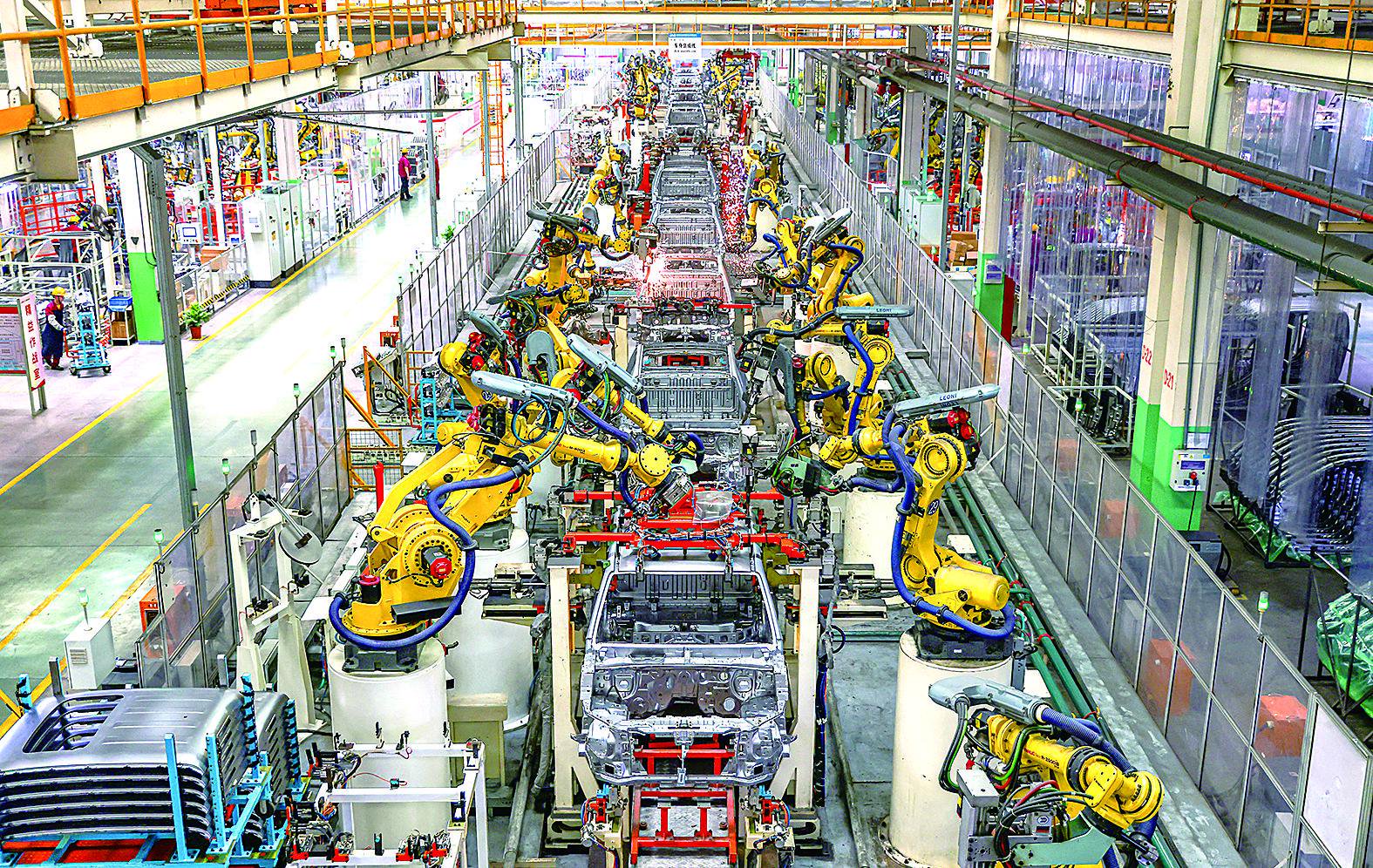
Core Insights - Hubei's industrial added value is projected to grow by 6.9% in 2025, surpassing the national average by 1 percentage point, ranking fourth among major industrial provinces [1][2] - The province aims to establish a modern industrial system with Hubei characteristics by 2026, injecting strong industrial momentum into its strategic development [1][5] Industrial Growth and Performance - In 2025, five pillar industries, including optoelectronic information and automotive manufacturing, are expected to exceed 1 trillion yuan, while six advantageous industries will surpass 500 billion yuan [2] - Ten characteristic industries are entering the billion-yuan club, and the "51020" advanced manufacturing industry cluster is undergoing a comprehensive upgrade [2][3] Policy and Investment Initiatives - Hubei is implementing a series of growth-stabilizing policies across various sectors, including automotive, steel, chemicals, and artificial intelligence, with key industries experiencing growth rates exceeding 16% [2] - The province has approved 223 national bond projects and is rolling out 4,082 technological transformation projects, with industrial investment expected to grow by 6.6% [2] Structural Optimization and Innovation - Traditional industries are revitalizing, with automobile and new energy vehicle production reaching 1.836 million and 824,000 units respectively, and new energy vehicles growing at a rate of 43.9% [3] - High-tech manufacturing's added value now accounts for 17.4% of the industrial total, contributing 35.6% to the growth of regulated industries [3] Digital Economy and Infrastructure - Hubei is advancing its digital economy, having built 188,000 5G base stations and achieving a computing power scale exceeding 18,000 P, ranking third nationally [4] - The province has achieved full coverage of provincial-level digital transformation pilot cities for small and medium-sized enterprises, with 101 companies listed as national 5G factories [4] Future Development Plans - For the "14th Five-Year Plan," Hubei aims for a 6.5% growth in industrial added value and an 8% increase in industrial investment by fast-tracking over 4,700 technological transformation projects [5] - The province plans to produce 1 million new energy vehicles and increase the proportion of high-tech manufacturing's added value to over 18% [5] Green Development Initiatives - Hubei is implementing six major green development projects, aiming for a 3% reduction in energy consumption per unit of industrial added value [7] - The province plans to establish 30 green factories and five zero-carbon factories, promoting sustainable industrial practices [7]
瞭望·治国理政纪事|加快建成中部地区崛起的重要战略支点
Xin Hua She· 2026-02-07 02:19
Core Viewpoint - Hubei is positioned as a crucial strategic support point for the rise of the central region, emphasizing its unique geographical advantages, abundant resources, and solid development foundation, as highlighted by President Xi Jinping during his visit in November 2024 [4][5][6]. Economic Growth - By 2025, Hubei's economic output is expected to stabilize at 6 trillion yuan, with a year-on-year growth of 5.5%, surpassing the national growth rate by 0.5% [5][31]. - The province has maintained a leading growth rate nationally and within the central region, playing a key role as a major economic province [5][31]. Technological Innovation - Hubei is focusing on critical technologies and future industries, aiming to establish itself as a "World Optics Valley" with significant achievements in technology, including the first urban optical remote sensing satellite and the first atomic quantum computer in China [5][10]. - The province's comprehensive technology innovation index and regional innovation capability index rank seventh nationally, with improvements noted from the previous year [10]. Manufacturing Industry - The "51020" advanced manufacturing industry cluster in Hubei is strengthening, with five pillar industries reaching a scale of one trillion yuan, and six advantageous industries approaching 500 billion yuan [17]. - Hubei's manufacturing sector is characterized by a robust industrial base, with a focus on upgrading traditional industries and fostering new and future industries [14][17]. Agricultural Development - Hubei is enhancing its supply capacity for essential agricultural products, with a projected grain output of 55.824 billion jin in 2025, maintaining a stable production level for 13 consecutive years [2][31]. - The comprehensive output value of the province's ten key agricultural industry chains is expected to reach 1.19 trillion yuan [2]. Transportation Infrastructure - Hubei has developed a comprehensive transportation network, achieving high-speed rail connectivity across cities, with significant increases in port cargo throughput and international air cargo volume [2][23]. - The province's strategic location allows it to serve as a key hub for domestic and international trade, enhancing its role in the national economy [22][24]. Environmental Sustainability - Hubei is committed to ecological protection and green transformation, with initiatives to upgrade its chemical industry and improve environmental quality [19][20]. - The province has implemented measures to ensure industrial development aligns with ecological safety, contributing to national ecological security [20]. Open Economy - Hubei is enhancing its role in domestic and international markets, with a focus on building an open economy that leverages its transportation advantages [22][25]. - The province's foreign trade is projected to reach 834.01 billion yuan in 2025, with a year-on-year growth of 18.2%, leading in both trade volume and service exports in the central region [27].
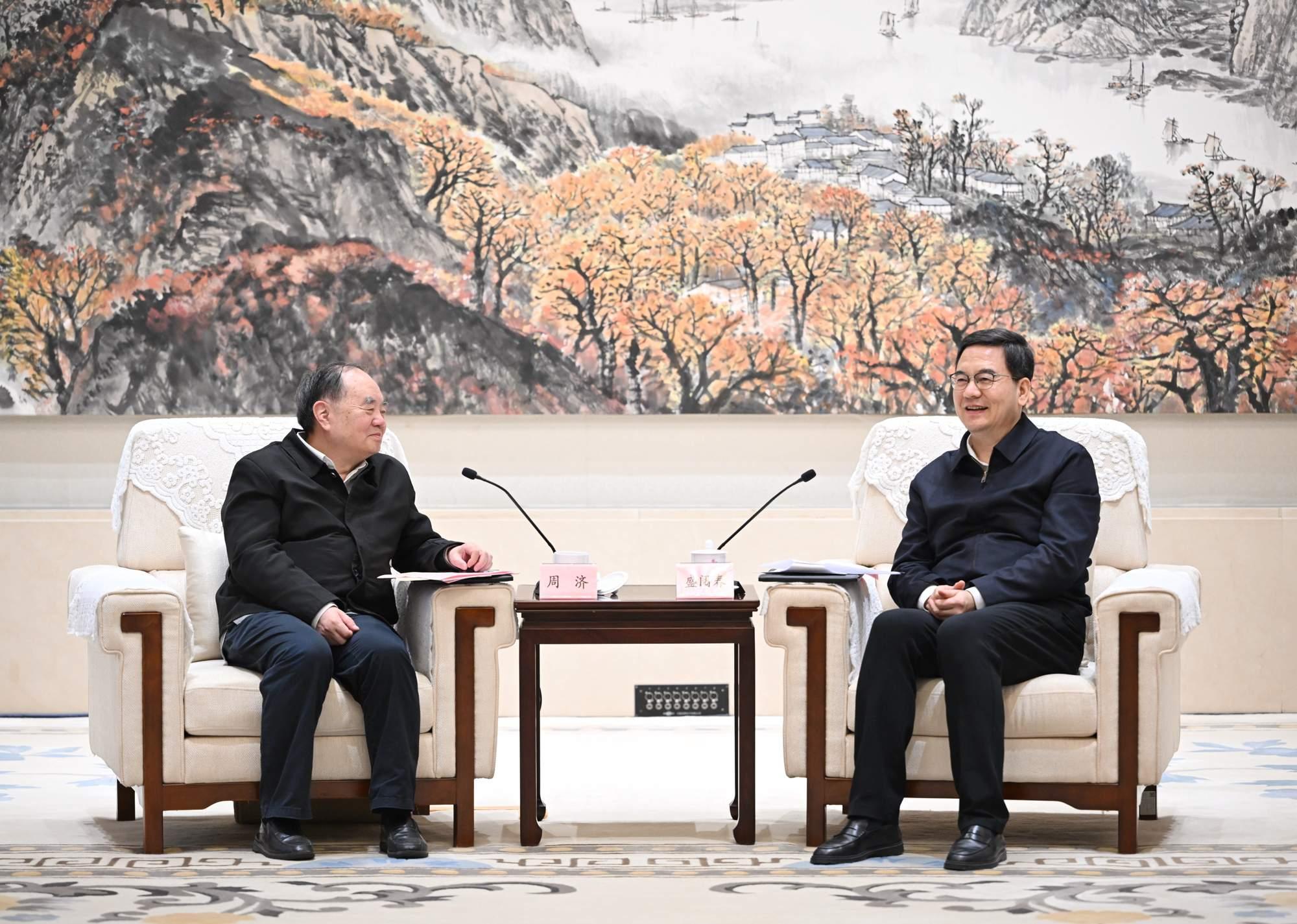
盛阅春会见中国工程院院士周济一行
Chang Jiang Ri Bao· 2026-02-06 01:02
Group 1 - The meeting held on February 5 involved prominent figures from the Chinese Academy of Engineering, including its honorary president and several academicians, indicating a strong focus on technological advancement in Wuhan [1][3]. - The Secretary of the Municipal Committee emphasized the importance of the Optoelectronic Information Industry in Wuhan, highlighting its unique position and the encouragement from President Xi Jinping for further development in this sector [3][4]. - The city aims to leverage technological innovation to foster industrial growth, aspiring to enhance the Optoelectronic Information Industry cluster and transition "China's Optics Valley" into a "World Optics Valley" [4]. Group 2 - Academicians acknowledged the new opportunities presented by the technological revolution, particularly in artificial intelligence, which could significantly benefit the development of the Optoelectronic Information Industry [7]. - The solid foundation, talent advantages, and promising growth of Wuhan's Optoelectronic Information Industry were noted, with a commitment to align with the city's 14th Five-Year Plan and industrial needs [7]. - The experts expressed their intention to contribute to the establishment of a world-class advanced manufacturing cluster in the Optoelectronic Information sector, supporting the construction of the "World Optics Valley" [7].
湖北推动工业发展提质增效
Zhong Guo Xin Wen Wang· 2026-02-05 09:19
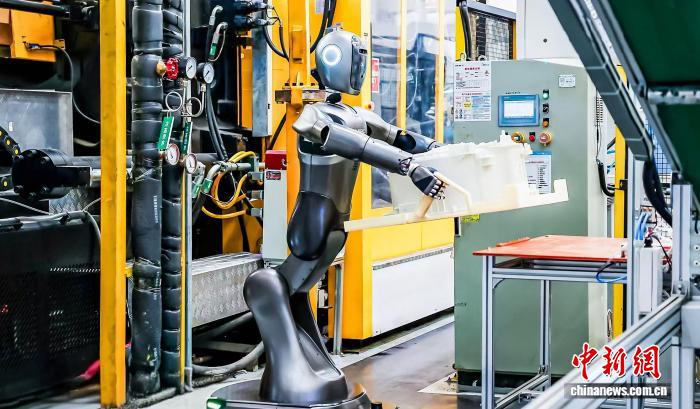
Core Insights - Hubei province aims to enhance industrial quality and efficiency, targeting a 6.9% growth in industrial added value by 2025, exceeding the national average by 1 percentage point [1] - The province's five pillar industries, including optoelectronic information and automotive manufacturing, are expected to surpass 1 trillion yuan, while six advantageous industries will exceed 500 billion yuan [1] - Hubei plans to implement 4,082 industrial technological transformation projects, with industrial investment projected to grow by 6.6% [1] Group 1: Industrial Development - Hubei is focusing on optimizing its industrial system and promoting transformation and upgrading to create new advantages [1] - The automotive sector is projected to produce 820,000 vehicles by 2025, with new energy vehicles accounting for 45% of total production [1] - The province is advancing strategic emerging industries, including humanoid robots and 6G innovation, with the AI industry expected to maintain over 20% growth [1] Group 2: Technological Integration - Hubei is promoting the integration of science and industry, with two manufacturing pilot platforms achieving national-level status, ranking third in the country and first in Central China [3] - The province is developing a digital economy, focusing on new infrastructure such as communication networks and industrial internet, with 188,000 5G base stations built [3] - By 2025, Hubei aims to add 3,023 innovative small and medium-sized enterprises, bringing the total to 13,314, and increase the number of specialized and innovative SMEs to 7,187 [3]
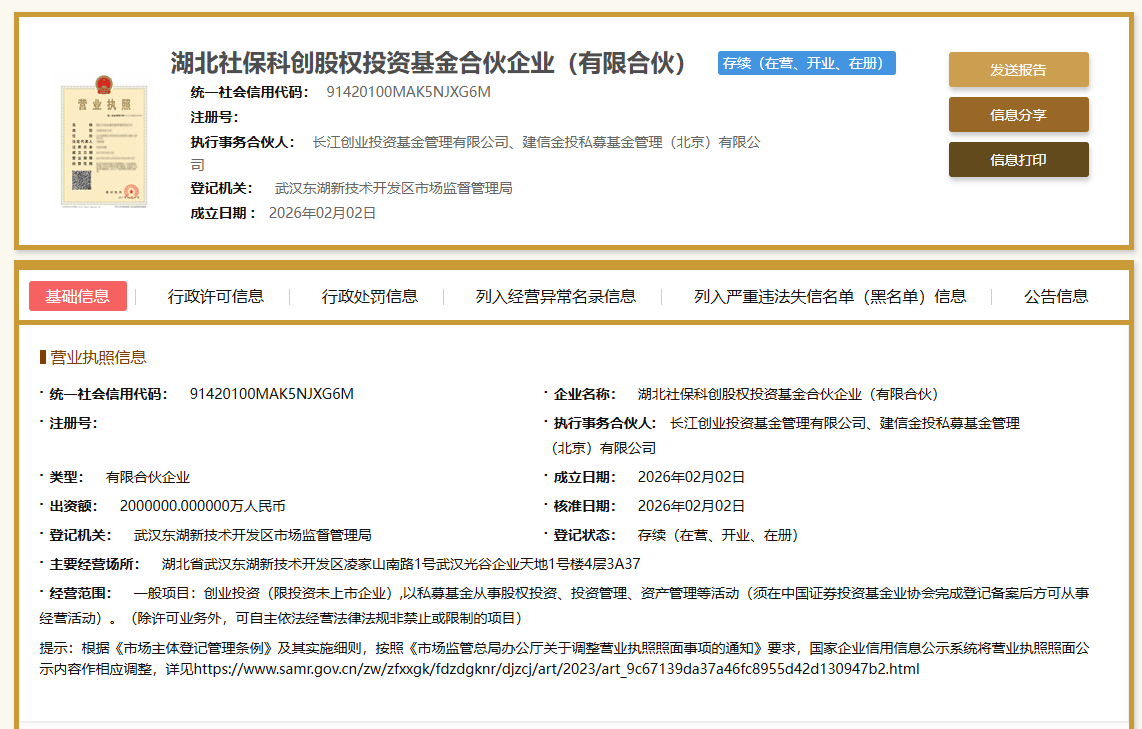
首期200亿,湖北社保科创基金落地
Sou Hu Cai Jing· 2026-02-04 06:51
Group 1 - The core viewpoint of the article is the establishment of the Hubei Social Security Science and Technology Equity Investment Fund, which aims to support strategic national initiatives and foster technological innovation in Hubei province [1] - The fund has a first-phase scale of 20 billion yuan, making it the first social security science and technology fund in Central and Western China [1] - The fund will focus on key industries such as optoelectronic information, automotive manufacturing, life health, and high-end equipment, aiming to upgrade traditional industries and cultivate emerging sectors [1] Group 2 - The fund is a collaborative effort involving the National Social Security Fund Council, Hubei Province, Wuhan City, and China Construction Bank [1] - It aims to create a long-term capital investment that balances policy objectives with investment returns, contributing to Hubei's goal of becoming a nationally influential hub for technological innovation [1] - The fund's strategy includes a three-pronged approach: upgrading traditional industries, nurturing emerging industries, and planning for future industries [1]