国债发行

Search documents
美国财政部拍卖四周期国债,得标利率4.245%(7月17日为4.230%),投标倍数2.69(前次为2.91)。拍卖八周期国债,得标利率4.265%(前次为4.270%),投标倍数2.63(前次为2.60)。
news flash· 2025-07-24 15:39
Core Viewpoint - The U.S. Treasury conducted auctions for both four-year and eight-year government bonds, with slight changes in yield rates and bid-to-cover ratios compared to previous auctions [1] Summary by Category Four-Year Treasury Auction - The awarded yield rate was 4.245%, an increase from the previous rate of 4.230% [1] - The bid-to-cover ratio was 2.69, down from the prior ratio of 2.91 [1] Eight-Year Treasury Auction - The awarded yield rate was 4.265%, slightly lower than the previous rate of 4.270% [1] - The bid-to-cover ratio was 2.63, an increase from the previous ratio of 2.60 [1]
美国财政部拍卖三个月(13周)期国债,得标利率4.245%(7月7日为4.255%),投标倍数3.10(前次为2.75)。拍卖六个月(26周)期国债,得标利率4.125%(前次为4.145%),投标倍数3.10(前次为3.00)。
news flash· 2025-07-14 15:39
Group 1 - The U.S. Treasury auctioned 13-week (3-month) bills with a winning yield of 4.245%, down from 4.255% on July 7 [1] - The bid-to-cover ratio for the 13-week bills was 3.10, an increase from the previous ratio of 2.75 [1] - The auction of 26-week (6-month) bills had a winning yield of 4.125%, slightly lower than the previous yield of 4.145% [1] Group 2 - The bid-to-cover ratio for the 26-week bills was also 3.10, up from the prior ratio of 3.00 [1]
欠债不还还想嚣张?中国撤走核心筹码,给美国沉重一击
Sou Hu Cai Jing· 2025-07-01 13:54
Core Viewpoint - The article discusses China's strategic reduction of U.S. Treasury holdings as a response to U.S. tariffs and geopolitical pressures, indicating a shift in the global financial landscape and potential challenges for the U.S. economy [7][11][40]. Group 1: U.S. Debt and China's Actions - China has reduced its holdings of U.S. Treasury bonds, with the amount falling below $800 billion, marking a significant decline over the past three years [7][9]. - This reduction is seen as a calculated financial strategy, aimed at both risk mitigation and as a countermeasure against U.S. policies [9][11]. - The U.S. national debt has surpassed $36 trillion, with interest payments projected to reach $882 billion in 2024, exceeding defense spending [13][15]. Group 2: Implications for U.S. Economy - The reduction in U.S. Treasury holdings by China and other countries signals a potential end to the era where the U.S. could easily finance its debt through foreign investments [36][40]. - The recent decline in demand for U.S. bonds, evidenced by the lowest bid-to-cover ratio in 20 years, indicates a shift in investor confidence [34][36]. - The article suggests that the U.S. may face increased borrowing costs and financial instability as a result of these changes in the bond market [11][40]. Group 3: Geopolitical Context - The article highlights the strategic importance of rare earth resources controlled by China, which are critical for U.S. military and technological industries [19][27]. - The ongoing trade tensions and tariffs have not only affected economic relations but have also led to a reevaluation of U.S. dependency on Chinese resources [25][29]. - Trump's recent overtures towards China may reflect a recognition of the precarious position the U.S. finds itself in regarding both debt and resource dependency [23][29]. Group 4: Global Financial Trends - There is a growing trend of "de-dollarization," with countries increasingly seeking alternatives to the U.S. dollar for international transactions [38][40]. - Central banks around the world are accumulating gold at unprecedented rates, indicating a shift in trust from fiat currencies to tangible assets [38][40]. - The article posits that if major creditor nations continue to reduce their U.S. bond holdings, it could lead to a financial crisis for the U.S. [40].


程实:美国3A信用时代终结的原因与影响︱实话世经
Di Yi Cai Jing· 2025-06-08 12:59
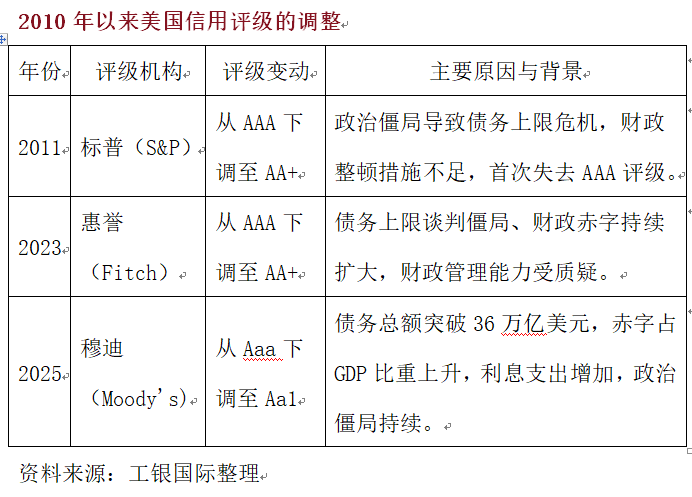
Core Viewpoint - The downgrade of the U.S. sovereign credit rating by Moody's marks the end of the AAA era, highlighting structural issues in U.S. debt sustainability and raising concerns about the country's fiscal outlook [1][3][10] Group 1: Credit Rating Downgrade - Moody's downgraded the U.S. sovereign credit rating from "Aaa" to "Aa1," the first loss of the highest rating since 1919, indicating a significant shift in the perception of U.S. fiscal health [3][4] - The downgrade is attributed to the rising total debt, structural expansion of fiscal deficits, and increased interest payments amid a higher interest rate environment [3][4] Group 2: Market Reactions - Following the downgrade, there was a poor subscription for the 20-year Treasury bond auction, indicating rising financing pressures and a shift in market sentiment [1][4] - As of May 27, the 20-year Treasury yield fluctuated around 5%, while the 10-year yield remained at approximately 4.5%, reflecting heightened market concerns [1] Group 3: Structural Challenges - The U.S. debt sustainability is increasingly reliant on short-term debt refinancing, which exposes the financial system to significant vulnerabilities amid policy uncertainty and market volatility [4][5] - The current fiscal structure shows a growing dependency on short-term debt, which, despite its lower proportion, poses a critical risk due to its frequent issuance and reliance on market confidence [4][5] Group 4: Global Implications - The downgrade signals a potential reassessment of the risk-return profile of U.S. dollar assets by long-term investors, leading to increased allocations towards non-U.S. currencies and physical safe-haven assets [2][10] - The shift in the perception of U.S. Treasury securities as a "risk-free asset" could trigger a broader re-evaluation of asset pricing and liquidity expectations in global capital markets [10][11]