
油茶种植与加工

Search documents
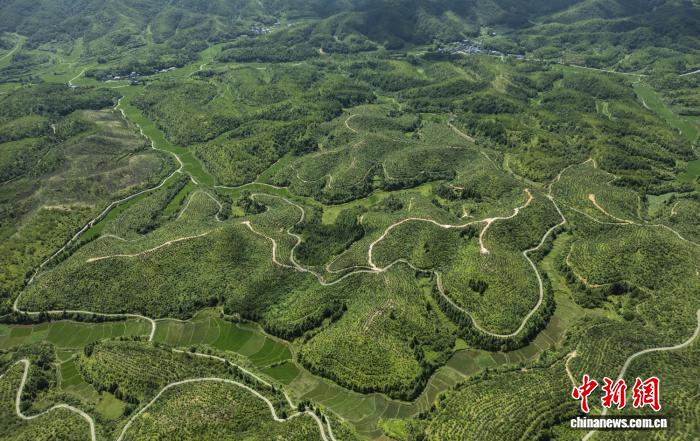
(乡村行·看振兴)福建宁化:荒山变“油”海 绿岭富农家
Zhong Guo Xin Wen Wang· 2025-10-14 06:04
Core Viewpoint - The transformation of barren mountains into productive oil tea plantations in Ninghua County, Fujian Province, showcases successful ecological restoration and economic development through government support and private investment [1][3]. Group 1: Economic Development - The oil tea industry in Ninghua County is positioned as a key sector for rural revitalization, contributing to local economic growth and poverty alleviation [4]. - The county has 204,500 mu (approximately 136,333 acres) of oil tea forest, ranking second in the province, with an annual production of 2,650 tons of tea oil, generating an estimated annual output value of around 400 million yuan (approximately 57 million USD) [4]. Group 2: Environmental Restoration - The project initiated by businessman Du Qiusheng involved the reclamation of over 5,000 mu (approximately 3,333 acres) of barren land for oil tea cultivation, significantly improving local ecology [3]. - Since 2011, Ninghua County has invested approximately 700 million yuan (about 100 million USD) in soil and water conservation efforts to combat soil erosion [4]. Group 3: Government Support and Policy - The oil tea base was included in a national soil and water conservation pilot project, receiving a total investment of 10.2 million yuan (about 1.5 million USD), with 5.7 million yuan (approximately 800,000 USD) coming from government subsidies [3]. - The county has implemented various measures to enhance oil tea production, including the cultivation of high-yield demonstration forests and support for processing enterprises [4].

金融赋能 “小小油茶果”撬动“大产业”
Zheng Quan Ri Bao Zhi Sheng· 2025-09-27 15:39
Core Insights - The oil tea industry is experiencing rapid growth due to supportive policies and financial backing, particularly from Postal Savings Bank [1][2] - Guangdong Xinghui Biotechnology Co., Ltd. has invested over 30 million yuan in oil tea cultivation, with a planting area exceeding 3,000 acres [1] - The company has adopted a comprehensive approach to enhance the oil tea industry, transforming it from a niche product to a significant industry [1][3] Financial Support and Collaboration - Postal Savings Bank's Longchuan Branch provided crucial financial support, including a 1 million yuan loan in 2023 to address seasonal funding needs [2] - The bank utilized a data-driven risk assessment model to expedite the loan approval process, allowing for same-day funding [2] - The company successfully secured an additional 2 million yuan loan in 2025 for raw material procurement and cash flow management [2] Industry Development and Future Plans - Guangdong Xinghui has become a leading player in the oil tea industry in Longchuan, promoting a collaborative model that benefits local farmers [3] - The company plans to expand its oil tea cultivation area and upgrade processing technology, aiming to develop high-value products such as skincare and health products [3] - The oil tea cultivation area in Heyuan City is approximately 989,000 acres, accounting for over 30% of the province's total, with an annual output value exceeding 3 billion yuan [3]

自贡探索油茶薄产低效破题路径 油茶产业如何量质双升?
Si Chuan Ri Bao· 2025-09-16 07:22
Core Viewpoint - The article discusses the development of the oil tea industry in Rong County, Sichuan, highlighting the implementation of various measures to enhance production, processing, and sales, ultimately aiming for high-quality growth in the sector [3][6]. Group 1: Industry Development Measures - Five major initiatives have been proposed to restructure the management system, solidify the foundation for quality improvement, deepen the integration of processing and tourism, strengthen project applications for national-level recognition, and diversify funding channels [3][6]. - The "Million Mu Oil Tea Doubling Project" is a key focus within Sichuan's strategy to build a high-quality "Tianfu Forest Granary" [3][4]. Group 2: Technological and Agricultural Innovations - A comprehensive meteorological service system has been established to provide targeted weather information throughout the entire production chain, significantly reducing the reduction rate caused by climate disasters by over 30 percentage points [5]. - The introduction of smart technology, such as soil moisture sensors, allows for real-time monitoring and digital management of oil tea growth [5]. Group 3: Economic Impact and Production Metrics - By the end of 2024, the oil tea planting area in Zigong City is expected to reach 327,900 acres, with an annual production of 15,923 tons of oil tea seeds and a total output value of 800 million yuan, leading the province in all three core indicators [5]. - The city has cultivated 19 professional cooperatives and introduced three technology-driven leading enterprises, enhancing the processing capacity to 3,500 tons of tea oil annually [6]. Group 4: Brand Development and Market Strategy - The strategy includes a dual approach of multi-brand development and geographical indication, with notable successes such as the "Shuangxi Lake" oil tea seed oil winning international awards and "Rong County Oil Tea" obtaining national geographical indication certification [6]. - The article emphasizes the shift from basic sales of fresh seeds and crude oil to value-added products, including high-end edible oils and health products, thereby increasing the economic benefits for farmers [6].

习近平总书记关切事|让油茶树变成百姓“摇钱树”——把地方特色产业做优做强之三
Xin Hua She· 2025-07-28 15:15
Core Insights - The article emphasizes the development of the oil tea industry in China, particularly in Henan province, highlighting its potential to enhance local economies and improve farmers' incomes through sustainable practices and innovative processing techniques [1][2][3]. Industry Overview - Oil tea is a unique woody oil crop in China with over 7 million acres planted and an annual production exceeding 1 million tons, contributing significantly to national grain and oil security [1][3]. - The oil tea industry has been recognized by national leadership, with President Xi Jinping advocating for its growth and integration into poverty alleviation strategies [2][3]. Economic Impact - The expansion of oil tea cultivation has led to the establishment of 2.16 million acres of oil tea plantations, generating 360 tons of tea oil annually and providing employment for over 3,000 local farmers [3][7]. - The economic benefits of oil tea cultivation are evident, with local farmers reporting additional income from related activities such as agritourism and value-added products [4][6]. Technological Advancements - The introduction of cold pressing and refining techniques has improved the quality of tea oil, allowing for better retention of nutrients and removal of harmful substances, thus enhancing the overall value of the product [4][5]. - Research and development efforts are ongoing to cultivate new oil tea varieties that are better suited for local conditions, further boosting productivity and sustainability [2][5]. Market Potential - The oil tea industry is diversifying into deep processing, with products ranging from cooking oil to cosmetics and health products, indicating a market potential that could reach 50 billion yuan [5][6]. - The ecological benefits of oil tea plantations, such as carbon trading opportunities, are also being explored, adding another layer of income for farmers [7].