股票投资

Search documents
瑞银H股投资框架更新:维持乐观看法,政策法规、盈利、创新和资金流动等影响最大
IPO早知道· 2025-07-25 02:27
Core Viewpoint - The article discusses the investment framework for H-shares in Hong Kong, highlighting the increasing allocation of southbound investors and the potential downward pressure on short-term earnings forecasts due to competition in the food delivery and other industries [3][4][5]. Group 1: Key Factors Influencing H-shares - The key factors driving H-shares, in order of importance, are: 1) policies and regulations; 2) earnings (especially earnings adjustment trends); 3) innovation; 4) capital flow (particularly from southbound investors) and interest rates; 5) valuation; 6) macro conditions; 7) geopolitical factors [4]. - The market is experiencing short-term pressure due to competition in the food delivery sector, which may lead to downward adjustments in earnings forecasts [5][8]. Group 2: Changes in H-share Investment Dynamics - The increase in southbound holdings has changed the dynamics of H-share investments, including: 1) reduced sensitivity to geopolitical issues; 2) greater impact of capital flow (especially southbound) and local liquidity (like HIBOR) on index performance; 3) decreased correlation with global markets; 4) reduced influence of economic factors due to a higher weight of technology stocks in the index [6]. - Despite the challenges, the valuation of Hong Kong stocks remains attractive compared to other domestic assets and global markets, which may support capital inflows from southbound and international investors [5][6]. Group 3: Short-term Outlook and Strategy - UBS analysts predict a 4% downside risk to market earnings forecasts for the Hang Seng China Enterprises Index, primarily due to competition in the food delivery industry [8]. - The company maintains an optimistic view on H-shares and the overall Chinese stock market, suggesting a "buy on dips" strategy due to attractive valuations, particularly in AI-related technology stocks [8]. - The focus on capital flow and innovation is expected to be crucial for market performance in the short term, with a recommendation for a barbell strategy in industry selection [8].


贝莱德:我们最坚定的信念是继续减持美国长期国债
Zhi Tong Cai Jing· 2025-06-04 15:03
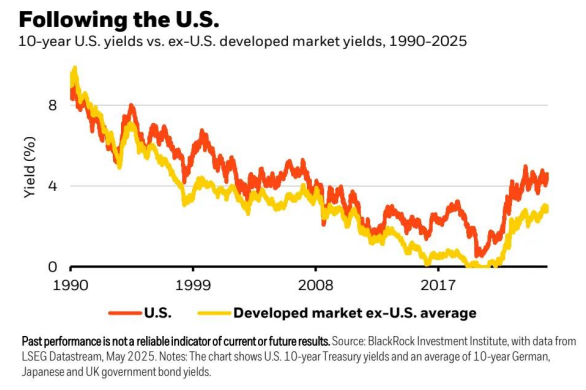
Core Viewpoint - The recent fluctuations in global bond yields indicate a shift in investor sentiment towards requiring higher risk premiums for holding long-term bonds, suggesting a return to historical norms [2][4][7]. Group 1: Market Reactions - The U.S. stock market rose nearly 2% last week, driven by gains in technology stocks [3]. - A U.S. trade court initially blocked most new tariffs, boosting the stock market, but a federal appeals court later allowed the tariffs to remain in effect pending a final decision [1][4]. Group 2: Bond Market Dynamics - The U.S. 10-year Treasury yield decreased slightly to 4.40%, yet remains 50 basis points higher than the low in April [1][3]. - Since April, there has been a significant rise in long-term bond yields, reflecting a normalization of global term premiums [4][7]. - Concerns over rising U.S. deficits are prompting a continued reduction in long-term U.S. Treasury holdings, with a preference for Eurozone bonds instead [8][9]. Group 3: Economic Indicators - Upcoming U.S. employment data is expected to provide insights into the labor market's condition [4]. - The European Central Bank is planning interest rate cuts while monitoring the impact of tariffs on the economy [4]. Group 4: Investment Strategies - The company maintains a bearish stance on U.S. long-term Treasuries due to rising deficit concerns and sticky inflation [8]. - There is a preference for short-term government bonds and European credit over U.S. bonds, attributed to lower valuations and reduced correlation with U.S. Treasury movements [9]. - Infrastructure stocks and private credit are viewed as attractive opportunities due to relative valuations and potential returns as banks withdraw from lending [13].