
资产评估

Search documents
独立性专业性缺失 年内4家资产评估机构被证监部门处罚
Zhong Guo Jing Ying Bao· 2025-12-07 10:02
Core Viewpoint - The article highlights the recent administrative penalties imposed on asset appraisal companies in China, emphasizing the critical need for independence and professionalism in asset evaluation to maintain market integrity and protect investor rights [1][5][6]. Group 1: Administrative Penalties - On December 5, the Anhui Securities Regulatory Bureau issued an administrative penalty decision against Jinzheng (Shanghai) Asset Appraisal Co., Ltd., fining them 2.5 million yuan for misleading statements in an asset appraisal report [1][2]. - Four asset appraisal companies have been penalized this year, with issues of independence and professionalism being common problems among them [1][4]. - The total fines imposed on the four appraisal firms and their responsible individuals amount to 7.32 million yuan [4]. Group 2: Specific Cases - Jinzheng Appraisal was found to have failed in due diligence during the evaluation of the shareholder equity value of Zhongke Shijie Technology Co., Ltd., leading to misleading statements in their report [2][3]. - Other penalized firms include Guorong Xinghua, Wokesen, and Zhongshui Zhiyuan, all of which exhibited similar issues of independence and professionalism [3][4]. Group 3: Expert Opinions - Experts stress that independent and diligent asset appraisal institutions are essential for alleviating information asymmetry in capital markets, thereby ensuring fair market practices and protecting investor interests [1][5]. - Common issues identified include lack of independence, low execution quality, and ethical decline among appraisal firms [5][6]. Group 4: Recommendations for Improvement - Experts recommend strengthening regulatory measures through strict filing, robust procedures, quality control, and accountability to enhance the quality of appraisal institutions [7]. - Suggestions include improving appraisal standards, establishing stricter accountability mechanisms, and enhancing transparency in appraisal methods and assumptions [6][7].
提升资产评估机构执业质量
Sou Hu Cai Jing· 2025-11-09 23:01
Core Viewpoint - The issuance of the "Management Measures for the Selection of Asset Appraisal Institutions by Administrative Institutions, State-owned Enterprises, and Listed Companies" aims to standardize the selection process and enhance the quality of asset appraisal services [1][2]. Group 1: Regulatory Framework - The new measures provide guidance for administrative institutions, state-owned enterprises, and listed companies in selecting asset appraisal institutions, emphasizing compliance and risk management [1][3]. - The measures require the selection units to enhance their information security awareness and adhere to national laws and regulations regarding information security [2]. Group 2: Evaluation Criteria - The selection process mandates that the quality control level of asset appraisal institutions should account for at least 40% of the evaluation score, while the cost of major asset appraisal projects should not exceed 15% of the score [2]. - This scoring system aims to prevent low-quality competition in the asset appraisal industry and encourages institutions to prioritize professional quality [2][3]. Group 3: Supervision and Accountability - The measures establish a clear accountability framework, allowing supervisory bodies to take corrective actions against non-compliant state-owned enterprises and listed companies [3]. - Violations of the measures by asset appraisal institutions will result in legal consequences, promoting a more standardized and transparent selection process [3]. Group 4: Industry Oversight - The Ministry of Finance has intensified oversight of the asset appraisal industry, conducting quality checks on 15 registered appraisal institutions and imposing administrative penalties on several entities [4].
【通知】三部门印发《行政事业单位、国有企业、上市公司选聘资产评估机构管理办法》的通知
Sou Hu Cai Jing· 2025-11-04 14:38
Core Points - The article outlines the management measures for selecting asset appraisal institutions by administrative and public institutions, state-owned enterprises, and listed companies, aiming to enhance the quality of asset appraisal services [2][3] - It emphasizes the need for fairness and transparency in the selection process, requiring public bidding and clear evaluation criteria [3][4] Group 1: Selection Process - The selection of asset appraisal institutions must adhere to relevant laws and regulations, with decisions made by the shareholders' meeting, board of directors, or internal departments [2][3] - Listed companies must select asset appraisal institutions that are legally registered to provide securities services [3] - The selection process should be conducted through public channels, ensuring that all potential candidates have adequate time to prepare their applications [3][4] Group 2: Evaluation Criteria - Evaluation criteria for asset appraisal institutions should include factors such as fee quotations, qualifications, integrity records, internal management, quality control, and relevant project experience [4][5] - Quality control measures must be a significant part of the evaluation, with a minimum weight of 40% in the scoring system [4][5] - The average price of compliant bids will serve as the benchmark for evaluating quotes, ensuring a fair assessment of costs [5][6] Group 3: Information Security and Compliance - Both the selecting units and asset appraisal institutions must prioritize information security, adhering to national laws and regulations [6][7] - The selection results must be publicly disclosed, including the chosen institution and associated fees [6][7] - Violations of these regulations by state-owned enterprises or listed companies may result in corrective actions from supervisory bodies [8][9]

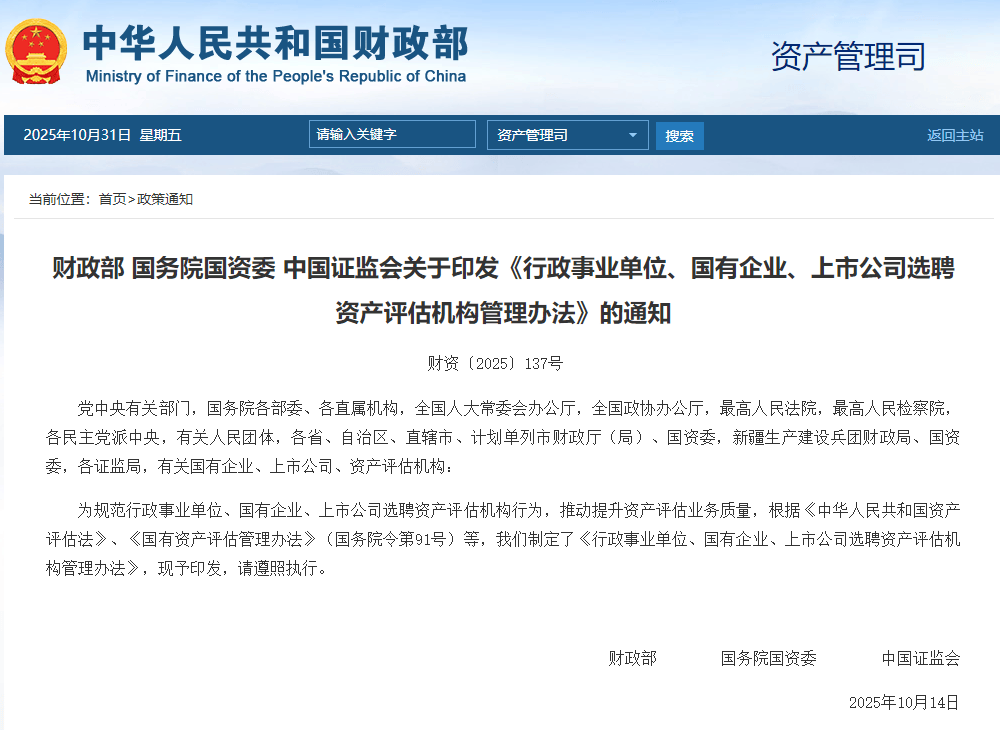
三部门印发《行政事业单位、国有企业、上市公司选聘资产评估机构管理办法》的通知
Sou Hu Cai Jing· 2025-11-03 14:18
Core Points - The regulation aims to standardize the selection of asset appraisal institutions by administrative units, state-owned enterprises, and listed companies, enhancing the quality of asset appraisal services [3] - The selection process must adhere to principles of fairness and justice, utilizing methods such as public bidding and competitive negotiation [5][6] - The evaluation criteria for asset appraisal institutions include qualifications, integrity, management quality, and project experience, with a significant emphasis on quality control [4][5] Group 1 - The selection of asset appraisal institutions must comply with relevant laws and regulations, and decisions should be made by the shareholders' meeting, board of directors, or internal departments [3] - Listed companies must select asset appraisal institutions that are legally registered to provide securities services [4] - The selection documents must include essential information such as appraisal objectives, scope, and evaluation criteria [4] Group 2 - The evaluation of asset appraisal institutions should focus on quality control systems, ethical standards, and past regulatory compliance [5][6] - The pricing evaluation will use the average bid of compliant institutions as a benchmark, with specific scoring formulas [6] - Results of the selection process must be publicly disclosed, including the chosen institution and appraisal fees [6] Group 3 - Institutions involved in the selection process must maintain proper documentation for at least ten years and ensure information security [6][7] - Regulatory bodies will oversee the selection process, and violations may lead to corrective actions or penalties [8][9] - The regulation applies to both statutory and non-statutory appraisal activities, with specific provisions for government procurement projects [12][13]
专业护航国际化 北京注册会计师资产评估行业国际化发展论坛在京举办
Zheng Quan Ri Bao Wang· 2025-10-28 12:30
Core Viewpoint - The forum highlighted the significant contributions of Beijing's accounting and asset evaluation industries in supporting national and capital-level openness, aiming to enhance their international development [1]. Group 1: Expectations from Industry Leaders - The industry should accelerate its internationalization process with a sense of urgency, focusing on collaborative intelligence and systematic development [2]. - Emphasis on enhancing professional capabilities and fostering international competitiveness through digital transformation and high-level talent cultivation [2]. - The need for a supportive ecosystem that facilitates international development, including strategic support from regulatory bodies and industry associations [2]. Group 2: Role of the Accounting and Asset Evaluation Industry - The industry serves as a "navigation instrument" for enterprises going global and a "lubricant" for cross-border cooperation [3]. - There is a call for the industry to actively engage in policy optimization and to leverage Beijing's open policies for cross-border services and talent acquisition [3]. - The industry is encouraged to integrate into the capital's open ecosystem and provide comprehensive international solutions for enterprises [3]. Group 3: Forum Highlights and Insights - The forum featured discussions on macro policies and practical experiences related to enterprises going global, emphasizing the role of professional service institutions in various initiatives [4]. - Insights were shared on the importance of collaboration between professional institutions and industrial capital for successful international projects [4]. - The need for professional partners who understand business, international standards, and local conditions was emphasized [4]. Group 4: Talent Development and Technological Integration - Future professional talent should possess digital literacy, cross-cultural communication skills, and knowledge of sustainable development [5]. - The forum also focused on the integration of technology in professional services, highlighting the importance of AI and big data in enhancing efficiency [6]. - A collaborative ecosystem is essential for resource integration and information sharing among various stakeholders in the industry [6].
深交所向江苏中企华中天资产评估有限公司及相关当事人发出监管函
Mei Ri Jing Ji Xin Wen· 2025-10-09 03:13
Group 1 - The Shenzhen Stock Exchange issued a regulatory letter to Jiangsu Zhongqi Huazhong Tian Asset Appraisal Co., Ltd. and related parties due to issues identified in their asset evaluation practices [1] - Jiangsu Zhongqi Huazhong Tian was involved in the evaluation of the equity value of Shanghai Jingxin Technology Co., Ltd. for Suzhou Hengjiu Optoelectronics Technology Co., Ltd.'s acquisition announcement [1] - The evaluation report issued on January 24, 2025, lacked sufficient objective evidence to support the forecasts of business volume, growth rates, and working capital needs, relying heavily on management's subjective judgments [1][2] Group 2 - The selection of comparable companies by Jiangsu Zhongqi Huazhong Tian was deemed inappropriate due to significant differences in business structure, operational models, company size, and growth stages compared to Jingxin Technology [1][2] - The actions of Jiangsu Zhongqi Huazhong Tian and the signing appraisers violated multiple regulations, including the Asset Appraisal Practice Standards and the Stock Listing Rules [2] - The Shenzhen Stock Exchange urged Jiangsu Zhongqi Huazhong Tian and the involved appraisers to learn from these issues and adhere strictly to relevant laws and regulations to prevent future occurrences [2]
强化知识产权资产评估规范管理
Jing Ji Ri Bao· 2025-10-08 00:24
Core Viewpoint - The recent joint notification by the Ministry of Finance, the Financial Regulatory Administration, the National Intellectual Property Administration, and the National Copyright Administration aims to strengthen the standardized management of intellectual property asset evaluation, enhance the ability to utilize and protect intellectual property, and promote the release of intellectual property asset value, thereby accelerating the construction of a strong intellectual property nation [1][2]. Group 1: Importance of Intellectual Property Asset Evaluation - Intellectual property is recognized as a significant intangible asset, and its evaluation and protection are complementary processes [1]. - Objective and fair asset evaluation can provide a pricing basis for patents, trademarks, copyrights, and other intellectual properties, facilitating market recognition and successful transformation of innovative results [3]. Group 2: Requirements for Asset Evaluation Institutions - Asset evaluation institutions must possess relevant professional competence, quality control capabilities, and risk management abilities when undertaking intellectual property asset evaluation [1]. - Institutions are required to strictly adhere to laws, regulations, and asset evaluation standards, ensuring independent, objective, and fair assessments without preset values [1][2]. Group 3: Supervision and Self-Regulation - The notification emphasizes the need for enhanced supervision and self-regulation of intellectual property asset evaluations [2]. - The China Asset Evaluation Association is tasked with strengthening self-regulation and professional guidance for institutions engaged in intellectual property asset evaluation, improving the evaluation standards, and enhancing the professional service capabilities of asset evaluation institutions [2].
中经评论:突破“知产”到“资产”瓶颈
Jing Ji Ri Bao· 2025-09-29 00:21
Core Viewpoint - The recent joint notification by the Ministry of Finance, Financial Regulatory Bureau, National Intellectual Property Administration, and National Copyright Administration emphasizes the importance of asset evaluation in the utilization and protection of intellectual property (IP) [1][2]. Group 1: Importance of Intellectual Property Evaluation - Asset evaluation plays an indispensable role in the utilization and protection of intellectual property [1]. - As of June this year, the number of valid invention patents in China reached 5.01 million, a year-on-year increase of 13.2%, with a high-value invention patent ownership rate of 15.3 per 10,000 people, marking a new high [1]. - The conversion and utilization of intellectual property are crucial for transforming scientific and technological achievements into productive forces, which is essential for realizing the value of intellectual property [1]. Group 2: Regulatory Framework and Standards - The establishment of a robust intellectual property value evaluation system is necessary to enhance the credibility and public trust in evaluation results [2]. - The China Asset Appraisal Association previously issued guidelines for intellectual property asset evaluation, which cover basic compliance, operational requirements, and disclosure requirements [2]. - The recent measures from regulatory bodies highlight the importance of standardizing intellectual property asset evaluation practices and strengthening supervision and self-regulation [2]. Group 3: Challenges and Quality Improvement - Intellectual property evaluation is often more challenging than tangible asset evaluation, requiring asset appraisal institutions to possess high professional standards and capabilities [2]. - Issues identified in previous evaluations include errors in discount period calculations and improper analysis of the reasonableness of data provided by enterprises [3]. - To improve the quality of intellectual property asset evaluations, collaboration among multiple departments and institutions is essential, creating a transparent and efficient data service platform [3].
突破“知产”到“资产”瓶颈
Jing Ji Ri Bao· 2025-09-28 21:50
Core Viewpoint - The enhancement of the scientific and accurate assessment of intellectual property (IP) assets is crucial for unlocking their full value, presenting a significant opportunity for the asset appraisal industry [1][4]. Group 1: Importance of Intellectual Property Assessment - Intellectual property assessment plays an indispensable role in the utilization and protection of IP assets, which is essential for the construction of a strong IP nation [1]. - As of June this year, the number of valid invention patents in China reached 5.01 million, a year-on-year increase of 13.2%, indicating a growing emphasis on IP [1]. Group 2: Challenges in IP Valuation - The valuation of IP is complicated due to its intangible nature, influenced by various factors such as technology, market conditions, and legal aspects, leading to difficulties in assessment and disposal [2]. - Establishing a robust IP valuation system is necessary to enhance the credibility and public trust in assessment results [2]. Group 3: Regulatory Framework and Quality Control - The regulatory bodies have emphasized the need for standardized practices in IP asset assessment, including the establishment of operational guidelines and supervision mechanisms [2][3]. - Asset appraisal institutions must possess the necessary professional competence and quality control capabilities to conduct IP assessments accurately [3]. Group 4: Collaborative Efforts for Improvement - A collaborative approach among various departments, including finance, regulatory bodies, and IP authorities, is essential to create an efficient and transparent IP asset assessment service platform [4]. - Encouraging banks to adopt internal IP valuation assessments alongside third-party evaluations can further enhance the accuracy and reliability of IP asset valuations [4].
四部门规范知识产权资产评估的有关事项
Zhong Guo Xin Wen Wang· 2025-09-21 11:28
Core Viewpoint - The recent notification issued by four government departments aims to standardize the evaluation of intellectual property assets, emphasizing the importance of professional assessment in the utilization and protection of intellectual property [1][2]. Group 1: Regulatory Framework - The notification outlines that asset evaluations related to intellectual property must comply with relevant laws and regulations, allowing parties to voluntarily commission evaluations for economic activities involving intellectual property [1][2]. - It mandates that asset evaluation institutions must possess the necessary professional competence, quality control, and risk management capabilities to conduct intellectual property asset evaluations [1]. Group 2: Supervision and Collaboration - The four departments will guide and regulate intellectual property asset evaluation work, establishing a collaborative mechanism for supervision and management [2]. - There will be a focus on timely statistics and disclosure of evaluation business conditions, along with the creation of a transparent and efficient data service platform for intellectual property asset evaluations [2]. Group 3: Quality Improvement and Training - The China Asset Evaluation Association will enhance self-regulation and professional guidance for institutions engaged in intellectual property asset evaluations, aiming to improve the evaluation standards and training for professionals in this field [2]. - The notification encourages collaboration among asset evaluation institutions, intellectual property service agencies, copyright registration bodies, and commercial banks to enhance the quality and efficiency of evaluations [2].