
Steel

Search documents
Mutual funds increase investments in PSU banks in January; weight hits 3-year high
The Economic Times· 2026-02-16 07:05
Core Insights - The report indicates a significant increase in mutual fund allocations to Public Sector Undertaking (PSU) banks, reaching a three-year high of 3.7% in January 2026, up 30 basis points from 3.4% in the previous months [10][11] - Private banks also saw their weight rise to an eight-month high of 18.2% in January 2026, reflecting a monthly increase of 60 basis points and a yearly increase of 110 basis points [10][12] - The report highlights that State Bank of India (SBI) was among the top stocks with the highest month-on-month value increase, with a rise of Rs 96.6 billion [7][12] Mutual Fund Activity - In January 2026, various mutual funds showed divergent interests in SBI, with 15 funds buying and 5 funds selling the stock [11][12] - SBI Mutual Fund purchased 62.47 lakh shares of SBI, while HDFC Mutual Fund sold 35.96 lakh shares during the same period [8][12] - The report notes that several mutual funds, including Axis Mutual Fund and Aditya Birla Sun Life Mutual Fund, also increased their holdings in SBI [8][12] Sector Performance - The allocation in the BSE 200 index was reported at 4.1%, with several fund houses exceeding this allocation [11] - The top 10 stocks that experienced the maximum rise in value included SBI, Axis Bank, and ICICI Bank, indicating strong performance in the banking sector [7][12] - Mutual funds showed increased interest in sectors such as Utilities, Technology, Capital Goods, Metals, and Cement, while sectors like Consumer, Oil & Gas, and Healthcare saw a decrease in weights [10][12] ETF and Index Fund Performance - The DSP Nifty PSU Bank ETF and Mirae Asset Nifty PSU Bank ETF reported the highest returns of 30.61% in the last six months, while the SBI BSE PSU Bank Index Fund gained 28.09% [9][12] - The NIFTY PSU BANK - TRI index increased by 30.71% over the same period, reflecting strong performance in the PSU banking sector [9][12]


X @The Wall Street Journal
The Wall Street Journal· 2026-02-16 06:29
BlueScope Steel’s plans to expand further in the U.S. by investing in midstream capacity have fallen down the agenda. https://t.co/61TFnPu6H1 ...
BlueScope Relegates Plans for U.S. Midstream Growth
WSJ· 2026-02-16 06:28
Core Viewpoint - BlueScope Steel's plans to expand in the U.S. by investing in midstream capacity have been deprioritized [1] Company Summary - BlueScope Steel is shifting focus away from its U.S. expansion plans, particularly regarding midstream capacity investments [1]


ArcelorMittal (MT) Reported Strong Q4 2025 Earnings Surprise, Expands Renewable Energy Capacity to 2.8GW by 2028
Yahoo Finance· 2026-02-15 14:11
Financial Performance - ArcelorMittal SA reported Q4 2025 earnings per share of $0.86, which is 38.71% higher than the consensus estimate of $0.62, although revenue was below expectations at $14.97 billion [1] Renewable Energy Initiatives - The company plans to create 2.8GW of renewable energy capacity by 2028, which is estimated to add $0.4 billion to EBITDA [2] - ArcelorMittal has already licensed 1.6GW of renewable energy in India, Brazil, and Argentina, with an additional 1.2GW in progress [2] Iron Ore Business Development - The iron ore business in Liberia achieved record exports of 10 million tons in 2025, contributing $0.2 billion to EBITDA [3] - An agreement with the Government of Liberia allows operations to extend until 2050, with a new concentrator expected to ramp up to full capacity in 2026, enabling an expansion to 30 million tons capacity [3] Company Overview - ArcelorMittal SA is a leading steel and mining company that produces and sells steel products for various industries, including automotive, construction, and household appliances [4]

Nucor’s Latest Dividend: What Steel’s Cycles Mean for Your Income
Yahoo Finance· 2026-02-15 13:06
Core Viewpoint - Nucor Corporation is facing significant cash flow challenges despite maintaining a long-standing dividend payout, raising concerns about the sustainability of its dividend growth trajectory [2][5]. Dividend Payment Overview - Nucor recently paid a quarterly dividend of $0.56 per share, reflecting a 1.82% increase from the previous quarter's $0.55 [3]. - For the full year 2025, the total dividend distribution was $2.21 per share, a modest increase of 1.84% from $2.17 in 2024, indicating a slowdown compared to the 4.83% growth seen between 2023 and 2024 [3]. Cash Flow Analysis - In fiscal 2025, Nucor generated $3.23 billion in operating cash flow, while capital expenditures reached $3.42 billion, resulting in negative free cash flow of $188 million, marking the first instance of negative free cash flow in the available dataset [5][9]. - This represents a significant decline from fiscal 2023, where Nucor produced $4.90 billion in free cash flow, and operating cash flow has decreased by 68% from its peak of $10.07 billion in fiscal 2022 [6][9]. Dividend Sustainability Concerns - Despite the cash flow issues, Nucor paid out $512 million in dividends in 2025, necessitating the use of its balance sheet to support both dividend payments and capital expenditures [7][9]. - The dividend payout now accounts for 25.1% of net income, a sharp increase from just 5.3% during the profitable fiscal year 2022 [7]. Financial Performance - Nucor's net income fell to $2.04 billion in fiscal 2025, a decline of 12.1% from 2024 and a staggering 75% drop from $8.08 billion in fiscal 2022 [14].

Nucor's Latest Dividend: What Steel's Cycles Mean for Your Income
247Wallst· 2026-02-15 13:06
Core Viewpoint - Nucor Corporation is facing significant challenges with negative free cash flow and declining net income, raising concerns about the sustainability of its dividend despite a strong balance sheet and a long history of dividend payments [1][2]. Financial Performance - Nucor generated negative free cash flow of $188 million in 2025, marking the first time in its history that it failed to produce positive free cash flow [1]. - The company paid out $512 million in dividends during 2025, consuming 25.1% of net income, a sharp increase from 5.3% in 2022 [1]. - Net income fell 75% to $2.04 billion in 2025, down from $8.08 billion in 2022, with operating cash flow dropping 68% from its peak [1][2]. Dividend Analysis - The latest quarterly dividend of $0.56 per share represents a modest 1.82% increase from the previous quarter, with a full-year dividend of $2.21 per share, up just 1.84% from 2024 [1]. - The current dividend yield is 1.15%, significantly below the S&P 500 average, making it less attractive for income-focused investors [1][2]. Cash Flow and Capital Expenditures - Operating cash flow for fiscal 2025 was $3.23 billion, while capital expenditures were $3.42 billion, leading to negative free cash flow [1]. - The company has a strong balance sheet with $2.70 billion in cash and a $2.25 billion undrawn credit facility, providing a cushion to support dividend payments [1][2]. Market Valuation - Nucor's stock is priced at 26 times trailing earnings and 17 times forward earnings, indicating that the market is betting on future earnings growth rather than current dividend income [2]. - The stock has appreciated 46.62% over the past year, driven by expectations of a cyclical recovery in the steel industry [2]. Economic Context - U.S. GDP growth accelerated to 4.4% in Q3 2025, which could support industrial demand and improve Nucor's cash generation in 2026 [2]. - Management is optimistic about increased earnings in Q1 2026, driven by higher volumes and prices, which could restore positive cash flow [2]. Insider Activity - Recent insider transactions show a concerning trend, with 15 disposals compared to only 2 acquisitions, indicating a lack of confidence from management [1]. - Notable sales include CEO Leon Topalian and CFO Stephen Laxton disposing of shares, which raises questions about their outlook on the company's performance [1].
The Art of the Pivot: Tariffs, Fusion Power, and the Market’s Emotional Support President
Stock Market News· 2026-02-14 06:00
Market Overview - The S&P 500 decreased by 1.4% and the DOW by 1.1%, marking the worst week of 2026, with the tech-heavy NASDAQ down 2.3% due to policy chaos from the administration [1] - The market is experiencing volatility as the administration's tariff policies shift, impacting investor sentiment and market stability [1][11] Tariff Policy Changes - The Trump administration is considering rolling back steel and aluminum tariffs due to inflation concerns, which have moderated to 2.4% in January after a year of price fluctuations caused by these tariffs [2][3] - Shares of United States Steel Corp (X) fell by 3.4% and Alcoa (AA) by 2.8% in pre-market trading as renewed foreign competition becomes a possibility [2] Deregulation Efforts - The administration repealed the EPA's "Endangerment Finding," which was crucial for regulating greenhouse gases, benefiting the traditional energy sector but creating confusion for the auto industry [6][7] - Ford (F) and General Motors (GM) saw modest gains of 0.5% and 0.2% respectively, but the long-term implications of this deregulation remain uncertain as global markets move towards electric vehicles [6][8] Trade Deals and Global Relations - Recent trade announcements include a new framework with India, tariff reductions with Taiwan, and a deal with the U.K., but market reactions have been muted due to skepticism about the effectiveness of these frameworks [9][10] - The iShares MSCI Taiwan ETF saw a small increase of 0.9%, but concerns about a potential visit to China by the President may limit market optimism [10] Conclusion on Market Sentiment - The major indices are down, with the S&P 500 experiencing a 2.1% decline for the week, reflecting market uncertainty regarding the administration's policy changes [11] - Investors are left questioning the logic behind rolling back tariffs to combat inflation that the tariffs themselves helped create, highlighting the unpredictable nature of current market conditions [12]





无锡市场平稳,佛山市场平稳丨不锈钢行情一览
Xin Lang Cai Jing· 2026-02-14 05:54
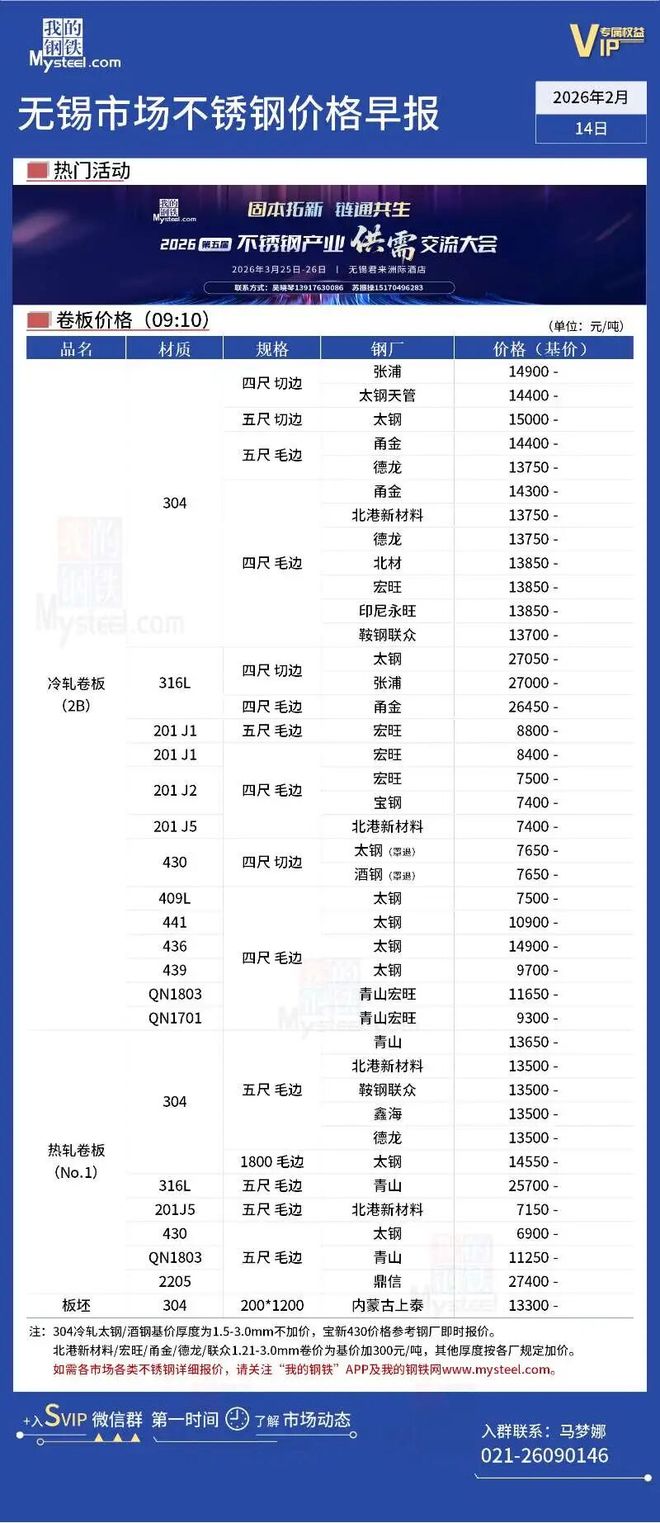
Price Overview - The stainless steel prices in Wuxi market on February 14, 2026, show a range of prices for various products, with 304 cold-rolled sheets priced between 13,750 to 27,050 yuan per ton depending on specifications and manufacturers [1][2][3]. - In the Foshan market, similar products are priced comparably, with 304 four-foot cut sheets at 14,900 yuan per ton and 316L cold-rolled sheets at 25,700 yuan per ton [2][4]. Market Activities - The "2026 Stainless Steel Industry Exchange Conference" is scheduled for March 25-26, 2026, indicating ongoing industry engagement and networking opportunities [1][2][4]. - The report highlights various promotional activities and market dynamics, suggesting a proactive approach within the industry to adapt to market conditions [1][4]. Price Variations - Price differences are noted across various cities, with specific price gaps such as -50 yuan per ton for cold-rolled sheets between Foshan and Wuxi, and +250 yuan per ton for hot-rolled sheets [7]. - The report emphasizes that prices are subject to adjustments based on thickness and specific manufacturer pricing policies, indicating a complex pricing structure in the stainless steel market [3][5]. Product Specifications - The report details various specifications for stainless steel products, including cold-rolled and hot-rolled sheets, with specific grades like 201, 304, and 316L being highlighted [1][3][5]. - Manufacturers such as Tai Steel, Hongwang, and Baosteel are mentioned, showcasing the competitive landscape among major players in the stainless steel industry [1][2][3].

US Stocks Today | S&P 500 ends up slightly as tech dips, inflation cools
The Economic Times· 2026-02-14 03:00
Market Overview - The S&P 500, Nasdaq, and Dow all experienced declines for the week, marking their largest weekly losses since November, with the S&P 500 falling 1.39%, Nasdaq declining 2.1%, and Dow decreasing 1.23% [6][12] - Heavyweight technology and communications services stocks ended lower, contributing to market jitters ahead of the Presidents Day holiday [12][13] Inflation and Interest Rates - U.S. consumer prices increased less than expected in January, leading traders to raise the probability of a 25 basis point interest-rate cut in June to 52.3% from 48.9% [12][13] Sector Performance - Large-cap tech stocks, particularly Nvidia and Apple, were significant drags on the S&P 500, while Applied Materials provided a strong boost with an 8.1% increase after positive revenue forecasts [8][12] - Defensive utilities and real estate sectors were the top gainers, with utilities up 2.69% and real estate up 1.48% [8][12] - The S&P 500 software and services index closed up 0.9%, contrasting with a 0.5% decline in the tech sector [6][12] Market Sentiment - Market sentiment remains cautious, with predictions of choppy trading ahead due to the upcoming U.S. midterm elections and the anticipated transition of Fed Chair Jerome Powell to Kevin Warsh [7][12] - Historical trends indicate that market volatility often accompanies Fed leadership changes during midterm years [7] Trading Activity - Advancing issues outnumbered decliners on both the NYSE and Nasdaq, with a ratio of 2.57-to-1 on the NYSE and 1.92-to-1 on the Nasdaq [10][11] - The S&P 500 recorded 34 new 52-week highs and 6 new lows, with a total of 18.61 billion shares traded, below the 20.75 billion moving average for the last 20 sessions [11][12]

【财经分析】拓渠道、优服务 辽宁加速金融活水润泽实体经济
Xin Hua Cai Jing· 2026-02-13 23:26
Core Viewpoint - The financial sector is crucial for the transformation and upgrading of Northeast China's old industrial base, with significant growth in various financing metrics projected for 2025, indicating a robust financial ecosystem supporting economic revitalization [1][2]. Financing Channels - In 2025, Liaoning Province's social financing scale is expected to increase by 348.2 billion yuan, the highest in seven years, with new corporate bond financing reaching 37.3 billion yuan, the highest in nine years [2]. - The balance of RMB loans is projected to reach 5.32 trillion yuan, with an increase of 121.9 billion yuan, marking the highest growth in three years [2]. - The demand for financing in the real economy is being increasingly met, particularly through corporate bond financing, which reflects a richer financing channel for the real economy [2][3]. Financing Services Optimization - China Construction Bank's Liaoning branch has provided comprehensive financial support to a technology enterprise, including 100 million yuan in fixed asset loans and 30 million yuan in working capital loans [4]. - The bank's technology loan balance is expected to reach 104.47 billion yuan by the end of 2025, with a year-to-date increase of 17.45 billion yuan, reflecting a growth rate of 20.05% [4]. - The financial services are evolving from a broad approach to a more targeted one, addressing the specific needs of enterprises at different growth stages [4][5]. Financing Ecosystem Development - The "2026 Capital Market Liaoning Action" event attracted over 80 listed companies and more than 100 potential listing companies, providing comprehensive services for enterprises seeking to go public [7]. - In 2025, direct financing in Liaoning is projected to exceed 90 billion yuan, reaching 92.78 billion yuan, a year-on-year increase of 41.3%, marking a ten-year high [7]. - Various innovative financial products, including public REITs and intellectual property securitization, are being introduced to support enterprise development [7][8]. Financial Environment Optimization - Liaoning is implementing measures to enhance the financial ecosystem, focusing on issues like financial fraud and debt evasion, to restore market confidence [8]. - The province aims to address shortcomings such as low capitalization levels and insufficient roles of leading companies in the economy, with targeted initiatives to improve the effectiveness of capital market services [8].