Consumer Finance

Search documents
Best personal loans for bad credit for February 2026
Yahoo Finance· 2025-07-30 21:14
Core Insights - Personal loans are often a more affordable option compared to credit cards, especially for unexpected expenses or debt consolidation, but finding lenders willing to work with individuals with bad credit can be challenging [1] Group 1: Lender Evaluations - LendingClub is highlighted as the best overall lender due to its simple application process, competitive rates, and fast funding, with loans disbursed as soon as one business day after approval [2][3] - Oportun stands out for offering both unsecured and secured personal loans, with accessible customer support and flexible repayment terms [4][5] - LendingPoint is noted for its straightforward application process and funding speed, with loans available from $1,000 to $36,000 and repayment terms of 24-72 months [6][10] - Upstart is recognized for high customer satisfaction ratings and fast funding, although it has limited repayment terms of 36 or 60 months [11][12] - Avant offers relatively low rates compared to competitors, with loans up to $35,000 and funding available as soon as one business day [13] - Prosper allows applications with co-applicants, which can improve approval chances and loan terms [14][15] - Best Egg provides customizable payment options through its Payment Pathways program, although it charges origination fees up to 9.99% [19][20] - Upgrade offers flexible loan terms ranging from 24-84 months, with loans from $1,000 to $50,000 [21][22] - OneMain Financial is noted for its fast funding, with loans available as soon as one hour after approval for qualifying borrowers [23][24] Group 2: Loan Characteristics - Personal loans can be secured or unsecured, with secured loans potentially offering lower interest rates due to collateral [31][32] - Borrowers with bad credit typically face higher interest rates and fewer loan options, making it essential to compare rates before applying [33][34] - Loan amounts and repayment terms vary significantly among lenders, with some offering loans as large as $100,000 and terms extending up to seven years [36][37] - Common fees associated with personal loans include origination fees, which can be a percentage of the loan amount, and late payment fees [38][40]
Regional Management(RM) - 2025 Q2 - Earnings Call Presentation
2025-07-30 21:00
Financial Performance - Net income increased by 20.1% year-over-year[12, 13] - Total revenue reached a record of $157.4 million, a 10.1% increase year-over-year[12, 13] - Diluted earnings per share (EPS) increased by 19.8% year-over-year, reaching $1.03[9, 12] - The operating expense ratio improved by 60 bps year-over-year, reaching a historic best of 13.2%[8, 12, 13] Portfolio Growth and Efficiency - Ending net finance receivables grew by $187 million, or 10.5% year-over-year, reaching $1.96 billion[8, 12] - Origination volume increased by $84 million, or 19.8% year-over-year, reaching $510 million[8] - ENR (Ending Net Receivables) per branch increased by 7.7% year-over-year, reaching $5.6 million[8] - Auto-secured portfolio increased by $66 million, or 36.9% year-over-year, reaching $246 million[8] Credit Quality - The 30+ delinquency rate improved by 30 bps year-over-year, reaching 6.6%[8] - The net credit loss rate improved by 80 bps year-over-year, reaching 11.9%[8] Capital and Liquidity - The company has $534 million in unused capacity to fund growth[9] - Fixed-rate debt represents 84% of total debt, with a WAC (weighted-average coupon) of 4.5%[8]

Navient (NAVI) Q2 Earnings: Taking a Look at Key Metrics Versus Estimates
ZACKS· 2025-07-30 14:36
Core Insights - Navient (NAVI) reported $131 million in revenue for the quarter ended June 2025, reflecting a year-over-year decline of 3.7% and an EPS of $0.21 compared to $0.48 a year ago [1] - The reported revenue fell short of the Zacks Consensus Estimate of $141.8 million, resulting in a surprise of -7.62%, while the EPS also missed the consensus estimate of $0.27 by -22.22% [1] Financial Performance Metrics - Net interest margin for the Consumer Lending segment was 2.3%, below the estimated 2.8% [4] - Net interest margin for the Federal Education Loan segment was 0.7%, slightly above the average estimate of 0.6% [4] - Total Non-Interest Income (Core) was $33 million, exceeding the estimated $25.12 million [4] - Other income reached $19 million, surpassing the average estimate of $13.44 million [4] - Servicing revenue was reported at $14 million, compared to the average estimate of $9.97 million [4] - Net Interest Income (Core) was $131 million, below the average estimate of $144.35 million [4] - Total core other income for Consumer Lending was $3 million, slightly below the estimated $3.06 million [4] - Net interest income (loss) for Federal Education Loans (Core) was $49 million, slightly above the average estimate of $48.59 million [4] - Total core other income for Federal Education Loans was $10 million, significantly above the average estimate of $4.38 million [4] - Net interest income (loss) for Other (Core) was reported at -$18 million, worse than the average estimate of -$14.87 million [4] - Net interest income (loss) for Consumer Lending (Core) was $113 million, slightly above the average estimate of $111.47 million [4] - Total core other income for Other was $20 million, exceeding the estimated $13.88 million [4] Stock Performance - Shares of Navient have returned -5.5% over the past month, contrasting with the Zacks S&P 500 composite's +3.4% change [3] - The stock currently holds a Zacks Rank 3 (Hold), indicating potential performance in line with the broader market in the near term [3]



周文龙拟出任海尔消金总经理,曾任中原消金总经理8年
news flash· 2025-07-30 12:00
近日,记者从业内获悉,原河南中原消费金融股份有限公司总经理周文龙拟出任海尔消费金融总经理一 职,中原消金总经理一职或由内部一位副总经理升任,目前二人任职资格均待监管审批。(21世纪经济 报道) ...
海尔消费金融涉不当催收多项违规被罚205万,累计投诉量超1.3万条
Sou Hu Cai Jing· 2025-07-29 20:23
Core Points - Haier Consumer Finance Co., Ltd. was fined 2.05 million yuan for multiple violations including misleading marketing, improper collection practices, and mismanagement of loan funds [1] - The company's former general manager Huang Yinghua received a two-year ban from holding any position in the financial industry and was fined 200,000 yuan [1] - The company reported a revenue of 3.168 billion yuan in 2024, a year-on-year increase of 27.28%, and a net profit of 445 million yuan, up 21.92% [5] Regulatory Actions - The Qingdao Financial Regulatory Bureau issued penalties for exaggerated marketing claims, improper collection behaviors, and mismanagement of loan funds [1] - Huang Yinghua, the former general manager, was penalized with a two-year disqualification and a fine [1] - Other executives received warnings and fines for their roles in the company's violations [1] Business Operations - Approximately 90% of Haier Consumer Finance's business is focused on online cash loans, with 66.42% of traffic coming from its own platforms [5] - The company has faced over 13,000 complaints on the Black Cat Complaint platform, highlighting issues such as aggressive collection practices and privacy violations [7] - Complaints include allegations of high-interest rates disguised as fees, which are against national regulations [9]

Pagaya vs. OneMain: Which Consumer Credit Stock is a Smarter Bet?
ZACKS· 2025-07-29 14:31
Core Insights - Pagaya Technologies Ltd. (PGY) and OneMain Holdings, Inc. (OMF) are consumer finance companies targeting subprime and non-prime borrowers, with Pagaya leveraging AI for credit underwriting and securitization, while OneMain operates through physical and digital lending channels [1][2] Group 1: Pagaya Technologies Ltd. (PGY) - Pagaya has a flexible business model that initially focused on personal loans but has since diversified into auto lending and point-of-sale financing, enhancing resilience across economic cycles [3] - The company has established a network of over 135 institutional partners and utilizes forward flow agreements to ensure funding stability during market disruptions [4] - Pagaya's proprietary technology allows lenders to present pre-approved offers to customers without formal applications, enhancing credit access with minimal marketing costs [5] - The company operates with minimal on-balance-sheet exposure, acquiring loans through asset-backed securities (ABS) or forward flow agreements, which limits credit and market risk [6] - Pagaya's model has proven effective from 2021 to 2023, maintaining liquidity and minimizing loan write-downs amid rising rates and tighter markets [7] - The Zacks Consensus Estimate for PGY's revenues indicates year-over-year growth of 23.6% in 2025 and 18.3% in 2026, with earnings expected to jump 202.4% and 26.7% in the same years [18] Group 2: OneMain Holdings, Inc. (OMF) - OneMain operates 1,300 locations across 47 states, providing unsecured and secured personal installment loans for various personal needs, along with optional insurance products [8] - The company has demonstrated strong revenue growth, with a loan mix designed for sustainability and upside potential, frequently securitizing portions of its loan book to manage funding costs [9] - OneMain's rigorous underwriting and servicing, supported by centralized data analytics, help manage credit performance, even during economic downturns [10] - The Zacks Consensus Estimate for OMF's revenues implies a modest year-over-year increase of 7.4% in 2025 and 7.5% in 2026, with earnings growth projected at 26.4% for 2025 and 29.4% for 2026 [20] Group 3: Comparative Analysis - Year-to-date, Pagaya's stock has surged 234.7%, while OneMain's has gained 13.5%, indicating stronger investor sentiment towards Pagaya [12] - In terms of valuation, Pagaya trades at a trailing 12-month price-to-book (P/B) ratio of 5.34X, compared to OneMain's 2.15X, suggesting Pagaya is more expensive [13][14] - Pagaya's return on equity (ROE) stands at 20.88%, slightly above OneMain's 20.77%, indicating marginally better efficiency in generating profits [14] - Pagaya's compelling growth trajectory and strong revenue and earnings prospects position it as a high-upside investment opportunity compared to OneMain's established marketplace model [22][23]



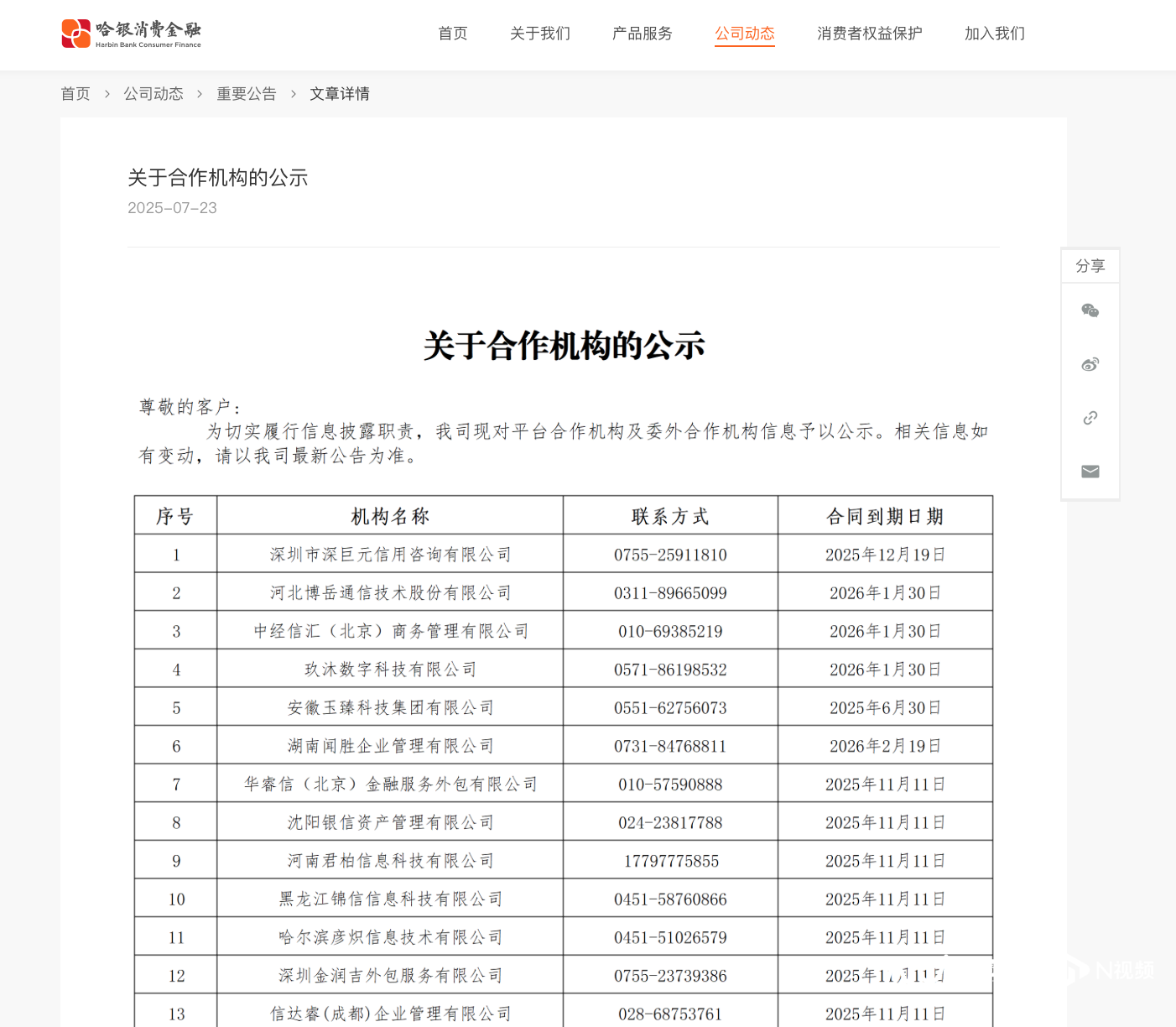
哈银、招联等9家消金公司亮明合作伙伴,传递哪些行业新信号
Nan Fang Du Shi Bao· 2025-07-29 08:35
Core Insights - Two licensed consumer finance companies, Harbin Consumer Finance and Zhaolian Consumer Finance, have disclosed their loan assistance cooperation institutions, highlighting a trend towards collaboration with major internet financial firms [1][2][3] Summary by Sections Cooperation Institutions - Harbin Consumer Finance announced partnerships with 10 loan assistance institutions and 29 collection agencies, while Zhaolian Consumer Finance revealed 11 loan assistance institutions and 18 collection agencies [1][2] - The majority of loan assistance institutions listed by Harbin are affiliated with well-known internet financial companies, including Meituan, Ctrip, and Ant Group [3] Industry Trends - A total of 9 licensed consumer finance companies have publicly disclosed their cooperation institutions this year, indicating a growing trend in the industry [2][12] - The implementation of a list-based management system for cooperation platforms is expected to intensify the "Matthew Effect" in the industry, favoring larger, compliant institutions [12][20] Market Dynamics - The cooperation institutions are primarily from leading internet financial platforms, with 10 out of 11 loan assistance institutions for Zhaolian being from top-tier internet companies [10][11] - The trend towards scene-based cooperation is emerging, as consumer finance companies seek to refine their operations and target specific customer segments more effectively [20]
Why OneMain Holdings (OMF) is a Top Value Stock for the Long-Term
ZACKS· 2025-07-28 14:41
Core Insights - Zacks Premium offers various tools to help investors make informed decisions and enhance their confidence in the stock market [1][2] Zacks Style Scores - The Zacks Style Scores are indicators that assist investors in selecting stocks likely to outperform the market within 30 days, rated from A to F based on value, growth, and momentum characteristics [2][3] - The Value Score identifies attractive and discounted stocks using ratios like P/E, PEG, and Price/Sales [3] - The Growth Score focuses on a company's financial strength and future outlook, analyzing projected and historical earnings, sales, and cash flow [4] - The Momentum Score helps investors capitalize on price trends, utilizing factors like one-week price change and monthly earnings estimate changes [5] - The VGM Score combines all three Style Scores, providing a comprehensive indicator for stock selection based on value, growth, and momentum [6] Zacks Rank - The Zacks Rank is a proprietary stock-rating model that uses earnings estimate revisions to facilitate portfolio building [7] - Stocks rated 1 (Strong Buy) have produced an average annual return of +23.75% since 1988, significantly outperforming the S&P 500 [8] - Investors are encouraged to select stocks with a Zacks Rank of 1 or 2 and Style Scores of A or B for optimal returns [9] Stock to Watch: OneMain Holdings - OneMain Holdings Inc. is a financial services company with a Zacks Rank of 3 (Hold) and a VGM Score of A [11] - The company has a Value Style Score of A, supported by a forward P/E ratio of 9.6, making it appealing to value investors [12] - Recent earnings estimates for fiscal 2025 have been revised higher, with the Zacks Consensus Estimate increasing to $6.18 per share, and an average earnings surprise of +9.3% [12]

行业首创!海尔消费金融携云闪付重构分期生态
Sou Hu Cai Jing· 2025-07-28 08:42
Core Viewpoint - The integration of Haier Consumer Finance with UnionPay Cloud Flash Payment marks a significant innovation in the home appliance retail sector, creating a new ecosystem that combines installment services with national subsidies, thereby enhancing consumer experience and driving sales growth [1][3]. Group 1: Innovations and Solutions - Haier Consumer Finance addresses traditional pain points in appliance installment plans, such as the disconnection between subsidies and installment options, by integrating national and corporate subsidies into a single platform [3]. - The company leverages financial technology to achieve "millisecond-level" credit response times, increasing installment approval efficiency by three times [3]. - The service is embedded in thousands of Haier retail stores, creating a closed-loop system that encompasses product selection, subsidies, installments, and fulfillment [3]. Group 2: Market Impact and Consumer Response - The new model has shown a strong consumer pull effect, with average transaction values at participating stores in pilot regions like Shanxi and Xi'an increasing by over 30%, and the proportion of bundled purchase users rising to 45% [3]. - A customer at the Qingdao Huaxia Home Expo reported significant savings of over 11,000 yuan from national subsidies when purchasing a full set of Haier appliances, with a manageable monthly installment plan [5]. - Sales staff noted a clear increase in sales attributed to the installment option, with more customers opting for installment purchases, enhancing the overall shopping experience [5][6]. Group 3: Strategic Advantages - Haier Consumer Finance benefits from the extensive resources of the Haier Group, allowing it to effectively meet the consumption needs of home appliance users [6]. - The integration of national subsidies and interest-free installments into a single offering enhances the shopping experience for consumers, eliminating the need to choose between different subsidy options [6].


OneMain Q2 Revenue Jumps 10 Percent
The Motley Fool· 2025-07-25 22:00
Core Insights - OneMain reported strong financial results for Q2 2025, with adjusted EPS of $1.45, exceeding the consensus forecast of $1.23, and revenue of $1.5 billion, surpassing the anticipated $1.186 billion [1][5] - The company achieved a net income of $167 million, more than doubling the prior year's quarter, driven by growth in loan originations and improved credit performance [1][5] Financial Performance - Adjusted EPS for the Consumer & Insurance Segment was $1.45, a 42.2% increase year-over-year from $1.02 [2] - Revenue for Q2 2025 was $1.5 billion, a 10% increase from $1.39 billion in Q2 2024 [2] - Net income rose to $167 million, up 135.2% from $71 million in the prior year [2] - Consumer loan originations reached $3.9 billion, a 9.2% increase from $3.58 billion in Q2 2024 [2] - Managed receivables increased to $25.2 billion, a 6.6% rise from $23.7 billion [2] Business Overview - OneMain specializes in lending to nonprime consumers, offering personal loans, auto finance, credit card products, insurance, and financial wellness platforms [3] - The company operates over 1,300 physical branches and has a strong digital presence, serving customers across 47 states [3] Strategic Focus - The company has concentrated on managing credit risk, expanding digital capabilities, and improving operational efficiency [4] - Key strategies include maintaining underwriting discipline, robust customer service, and adapting to changing economic conditions [4] Portfolio Health - The net charge-off ratio for consumer and insurance loans decreased to 7.19% from 8.29% year-over-year, indicating improved credit quality [6] - The 30+ days delinquency ratio improved to 5.17% from 5.45% [6] Product Development - OneMain invested in its product platform, with the "BrightWay" credit card portfolio reaching $752 million in receivables and the auto finance business at $2.34 billion [7] - Both segments are in a "seasoning" phase, indicating they are still establishing predictable performance patterns [7] Operational Metrics - Operating expenses rose 11% to $415 million, reflecting strategic investments for future profitability [8] - Liquidity remained strong with $769 million in cash and equivalents and unencumbered receivables of $9.7 billion [8] Shareholder Returns - The company repurchased approximately 460,000 shares for $21 million and declared a quarterly dividend of $1.04 per share [9] Future Outlook - Leadership noted no observed weakness in the customer base despite macroeconomic volatility, with conservative reserve overlays in place [10] - Investors will focus on credit risk management, efficiency in digital and branch networks, and alignment of operating expenses with receivables growth [11]