
Private Equity

Search documents
Partners Group's Anastasia Amoroso on private markets outlook for 2026
Youtube· 2025-12-12 16:01
Core Viewpoint - The private equity (PE) market is expected to experience significant growth and favorable conditions leading into 2026, with increased transaction volumes and improved exit opportunities [1]. Private Markets Activity - Transaction volumes in private markets are projected to increase by approximately 35% year-over-year, bringing US levels close to 2021 figures, while Europe is expected to surpass those levels [2]. - Global M&A volumes have risen by about 40% year-over-year, indicating a robust environment for exits [3]. - The US IPO market has rebounded by around 70%, further supporting a favorable deployment environment [4]. Valuations and Entry Points - Valuations for private equity-backed companies are significantly lower than those in public markets, with EV to EBITDA multiples around 12 in private markets compared to 17 or 18 in public markets, presenting a favorable entry point for investors [4]. Private Credit Market - The private credit market has grown from approximately $600 billion in assets under management (AUM) to about $1.7 trillion, leading to increased media attention and headlines [6]. - Concerns surrounding private credit are often idiosyncratic and not necessarily reflective of the overall market conditions [5]. - The default rate for private credit, particularly for private equity-backed companies, remains low at around 1%, indicating stability in this segment [7].


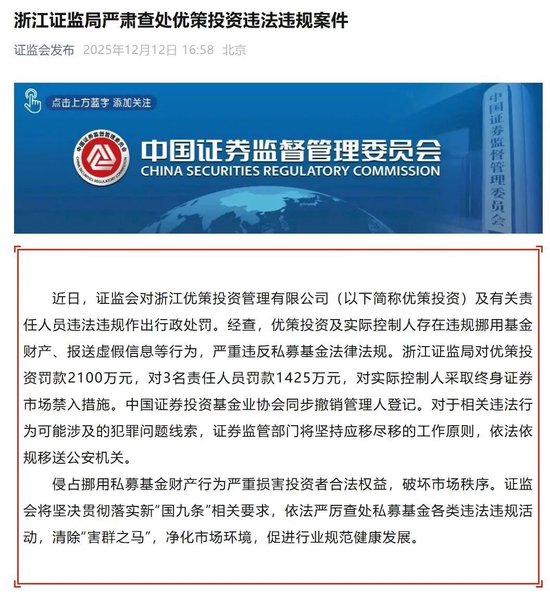
长安银行与浙江优策基金的悬案落下帷幕
Xin Lang Cai Jing· 2025-12-12 12:28
Core Viewpoint - The case involving Chang'an Bank and Zhejiang Youce Investment has seen significant developments, with the Zhejiang Securities Regulatory Commission imposing fines totaling 21 million yuan on Youce Investment and its responsible personnel, alongside a lifetime ban for the actual controller from the securities market [1][10]. Group 1: Incident Overview - In the summer of 2024, a scandal emerged regarding 1.252 billion yuan in funds that seemingly disappeared, with investors discovering that their accounts at Chang'an Bank had dwindled to only 86,000 yuan [3][12]. - The issue originated from a deposit contract signed between Youce Investment and Chang'an Bank, where three private fund products had a total deposit of 1.252 billion yuan, but by July 2024, the account balance was alarmingly low [4][13]. - Youce Investment announced a suspension of redemption for 11 products on July 10, 2024, citing Chang'an Bank's failure to provide an account balance statement as the reason [5][12]. Group 2: Dispute Between Parties - Both parties presented conflicting narratives; Youce Investment accused Chang'an Bank of illegally opening online banking, while the bank claimed the online banking was activated at the client's request [3][6]. - Chang'an Bank stated that the contract prohibited online banking, but it was later opened based on a supplementary agreement, and monthly reconciliations were completed by Youce Investment, negating claims of the bank's failure to provide account details [6][14]. - On August 20, 2024, Chang'an Bank issued a statement declaring that reports of the 1.252 billion yuan deposit being lost were severely misleading, asserting that the documents used in the reports were forged [6][14]. Group 3: Fund Flow and Relationships - Investigations revealed that the funds from the accounts were transferred to three companies, which had complex relationships with Youce Investment, facilitating the movement of funds [7][15]. - The companies involved included Baoji Phoenix Ridge Equity Investment Management Co., West Xi'an Changrong Investment Management Co., and Baoji Yuanda Asset Management Co., with ownership structures indicating significant interconnections [7][15]. Group 4: Resolution and Regulatory Actions - As investigations progressed, the truth emerged, with Youce Investment's controlling shareholder admitting to issuing false announcements and acknowledging the negative impact on Chang'an Bank's operations and reputation [8][16]. - On December 12, 2025, the regulatory authority announced penalties against Youce Investment for misappropriating fund assets and providing false information, leading to the revocation of its management registration [8][16].
Watch CNBC's full interview with KKR's David Petraeus
Youtube· 2025-12-12 09:53
Investment Landscape - The appetite for investment in the Gulf region has significantly increased, characterized as an "explosion" in interest over the past decades [1][4] - KKR has transitioned from raising funds to actively investing in the region, with a notable presence in Abu Dhabi, Dubai, and Riyadh [5][7] - KKR's assets under management have grown from $83 billion to over $725 billion in 12.5 years, with $110 billion in dry powder available for investment [7] Geopolitical Dynamics - The global investment landscape is being reshaped by new strategic alignments among Gulf States, balancing ties between Washington, Beijing, and Moscow [8] - The shift from benign globalization to a multipolar world has led to increased geopolitical tensions, affecting trade and investment flows [9][11] - Geopolitical factors are now integral to the investment diligence process, influencing decisions across various markets [13][14] Artificial Intelligence and Technology - AI is expected to have a massive impact on the global order, with significant investments in AI enablers such as data centers and chip manufacturing [15][16] - The U.S. is currently leading in AI and chip technology, but China is advancing rapidly in application development [17][18] - AI is transforming industries and military operations, with implications for future warfare and defense strategies [21][22] Military and Defense - The future of warfare is increasingly reliant on unmanned systems and algorithmic piloting, necessitating a shift in military capabilities [40][41] - The U.S. must adapt its military strategy to reflect lessons learned from conflicts like Ukraine, focusing on innovation and rapid deployment of new technologies [36][39] - The ongoing conflict in Ukraine highlights the need for robust security guarantees and financial support for Ukraine to counter Russian aggression [50][55]


量化股多也在从纯粹走向复合?
雪球· 2025-12-12 04:41
Core Viewpoint - The article discusses the evolution of quantitative long equity strategies in the private equity sector, highlighting a shift towards more diversified and composite strategies that enhance returns and manage risks more effectively [5][21]. Group 1: Strategy Evolution - Quantitative long equity strategies are transitioning from single stock selection to multi-strategy integration, indicating a broader industry trend [7][5]. - The integration of T0 trading strategies enhances returns by maintaining full stock selection while allowing for short-term trading based on price signals [8][10]. - Position management is evolving with the cautious use of timing strategies, where only a small portion of the portfolio is allocated for timing to ensure higher certainty in returns [12][15]. Group 2: Multi-Asset Approach - The shift from pure quantitative long equity to multi-asset trading models is evident, with managers incorporating convertible bonds and tactical allocations to other assets [21][22]. - Convertible bonds provide both equity-like upside and bond-like downside protection, enhancing overall portfolio resilience [22][23]. - The strategy also includes periodic allocations to gold and government bonds, which offer low correlation returns without increasing overall risk [23]. Group 3: Composite Strategies - The trend towards multi-asset and multi-strategy composite models is becoming common, allowing for the capture of diverse alpha and beta returns [24][25]. - A representative strategy combines quantitative long equity with CTA strategies, leveraging the strengths of both to enhance returns and hedge risks [26][29]. - The composite strategy allows for efficient capital utilization through the inherent leverage of CTA strategies, improving overall portfolio performance [30]. Group 4: Market Dynamics - The influx of capital into quantitative long equity since 2018-2019 has led to increased competition, making traditional sources of excess returns harder to achieve [31][34]. - As more participants adopt similar methods, the need for more diverse and sustainable sources of returns becomes paramount for quantitative managers [35].

Apollo Global is one of the best names in private equity, says Explosive Options' Lang
CNBC Television· 2025-12-11 20:17
It's that time this hour for our market navigator and with a third consecutive rate cut in the books now question is what impact that will all have on the private equity space. Our next guest says it'll be easier for companies to do their business and bring better returns to investors. He likes some of the names because of that.Bob Lang is founder and chief opt options analyst at explosive options. And Bob, you're looking specifically at Apollo. Why.>> Yeah. Hi Kelly, good to see you again. So I Apollo Glob ...


Apollo Global is one of the best names in private equity, says Explosive Options' Lang
Youtube· 2025-12-11 20:17
Core Viewpoint - The recent third consecutive rate cut by the Federal Reserve is expected to positively impact the private equity space, making it easier for companies to conduct business and potentially deliver better returns to investors [1]. Company Analysis - Apollo Global is highlighted as one of the best names in the private equity sector, particularly due to its significant holdings in real estate and diversified areas, positioning it favorably for growth in the coming year [2][3]. - Compared to other major players like Blackstone and KKR, Apollo is seen as having a better equity position and overall advantage, especially with the anticipated lower interest rates [3][4]. - Blackstone, while also holding real estate assets, is viewed as lagging behind Apollo due to its recent acquisition of HOL Logic for $18.6 billion, which required a capital raise that may hinder its performance in the short term [4][5].


Blackstone, Apollo, and Blue Owl are all in on data center bets — but there's one thing making them wary
Business Insider· 2025-12-11 17:14
Core Insights - Concerns about an AI bubble are rising, yet major private investors remain optimistic about their investments in data centers and AI technology [1][2] Investment Sentiment - Blackstone's President Jon Gray highlighted that data centers are the firm's biggest moneymaker, while Ares CEO Michael Arougheti noted that international data center investments are exceeding expectations and enhancing revenue forecasts [2] - Blue Owl co-CEO Doug Ostrover expressed strong confidence in data center investments, indicating a positive outlook for continued investment growth [2] Demand and Supply Dynamics - Apollo CEO Marc Rowan emphasized the global demand for data center capacity, stating that major users require more compute resources, but supply is constrained by natural, energy, and regulatory limits [3][4] - Ostrover pointed out an unprecedented supply-demand imbalance in the market, with demand accelerating while supply remains stagnant [4] Risk Considerations - Rowan discussed the risks associated with lease renewals for data centers, indicating a preference for lease-up risk over renewal risk, as the future of energy and compute usage remains uncertain [5] - The variability in energy usage projections for 2030 raises concerns about the reliability of long-term investments in data centers [5] Lease Quality and Investment Strategy - Blackstone focuses on long-term lease data centers, only commencing construction with a 15-plus year lease from large market cap companies, thereby mitigating risk [6] - Blue Owl's strategy includes securing favorable leases with high-quality tenants, transitioning from traditional tenants to major tech companies like Microsoft and Google, which enhances investment security [9][10] Financial Returns - Blue Owl's triple-net-lease business model, where tenants cover taxes, insurance, and maintenance, has historically yielded over 20% returns, and the firm expects similar terms with top-tier tenants [8][9] - Even in scenarios where facilities may have no residual value at the end of their lives, Ostrover believes returns can still be achieved, indicating a robust investment strategy [10]


X @Bloomberg
Bloomberg· 2025-12-11 15:22
Private equity firm EQT AB plans to deploy 10,000 humanoid robots to its portfolio companies that are made by a startup it has invested in. https://t.co/iG1E1wJlxy ...
Arcline to Sell Medical Manufacturing Technologies to Perimeter Solutions for $685 Million
Prnewswire· 2025-12-11 11:00
Core Viewpoint - Arcline Investment Management has agreed to sell its portfolio company Medical Manufacturing Technologies to Perimeter Solutions for $685 million, marking a significant transaction in the medical device manufacturing sector [1][4]. Company Overview - Medical Manufacturing Technologies (MMT), based in Charlotte, North Carolina, is a leading global provider of medical device manufacturing solutions, serving over 1,000 customers, including major medical technology OEMs and CDMOs [2]. - MMT specializes in the production of complex interventional medical devices such as catheters, guidewires, stents, and microcoils, operating with over 350 employees across 14 production facilities [2]. Investment Strategy - Since acquiring MMT in 2020, Arcline has implemented a disciplined strategy to enhance the company's capabilities, resulting in significant revenue and EBITDA growth, alongside 13 targeted acquisitions that expanded MMT's offerings in automation and specialty manufacturing [3]. - The strategy focused on building a scaled provider of mission-critical manufacturing technologies for medical device OEMs and CDMOs [3]. Transaction Details - The transaction is anticipated to close in the first quarter of 2026, pending regulatory approvals and customary closing conditions [4]. - Financial advisors for the transaction include William Blair and Houlihan Lokey, while legal advisors are Kirkland & Ellis LLP and Fredrikson & Byron P.A. [4].


X @Bloomberg
Bloomberg· 2025-12-11 08:50
A private equity veteran who joined one of London’s most prominent family offices to lead a strategy shift away from public markets has left in the latest shake-up of the firm’s senior management https://t.co/KYjKeL1sKi ...