Cloud Services

Search documents
Here's How Trump's Tariffs Could Affect Alibaba Stock
The Motley Fool· 2025-08-01 09:45
Core Viewpoint - U.S. tariffs are not expected to significantly impact Alibaba Group Holding, as the company's revenue sources are relatively insulated from these trade policies [1][11]. E-commerce - Alibaba's management did not mention tariffs during the latest quarterly earnings call, indicating a lack of concern [3]. - Approximately 57% of Alibaba's total revenue comes from e-commerce, with 75% of that revenue generated from Taobao and Tmall, which primarily serve the Chinese market and are not directly affected by U.S. tariffs [3][4]. - The international digital commerce group contributes about 14% of total revenue, but the exact portion from the U.S. is unclear, suggesting a relatively tariff-resistant e-commerce business [4]. Cloud Services - Alibaba's cloud services, a key growth driver, are not significantly impacted by U.S. tariffs, as the company does not provide cloud services to U.S. customers [6][7]. - Tariffs apply mainly to imported products, not services, which further mitigates potential impacts on Alibaba Cloud [7]. - However, U.S. tariffs could indirectly affect Alibaba's Chinese business customers, potentially leading to reduced spending on cloud services [7]. Overall Tariff Impact - Overall, while U.S. tariffs may have some effects on Alibaba, the company is expected to remain largely unscathed, assuming tariffs do not escalate beyond current proposals [11]. - The greater threat to Alibaba may come from the Chinese government rather than U.S. trade policies, as indicated in its 20-F filing to the SEC [12]. - Alibaba's shares trade at a low valuation of 14.3 times forward earnings, which may present a solid investment opportunity for long-term investors [13].



Rackspace Receives SBTi Approval for Net-Zero Targets, Reinforcing Commitment to Sustainable Operations and Innovation
Globenewswire· 2025-07-31 20:05
Core Insights - Rackspace Technology has received approval from the Science Based Targets Initiative (SBTi) for its emissions reduction goals, which include a commitment to reduce emissions by 50% by 2032 and 90% by 2045, aligning with the goal of limiting global warming to 1.5°C [1][2][3] Group 1: Sustainability Goals - The company aims to achieve net-zero carbon emissions by 2045, positioning itself ahead of many peers in the cloud services sector [1] - Rackspace currently powers approximately 80% of its global data centers with renewable energy and is working towards 100% through strategic partnerships [2] Group 2: Impact on Customers - Rackspace's Workload Aware Modernization program helps customers reduce their cloud carbon footprint by identifying wasted resources and transitioning to more sustainable cloud architectures [3] - The company emphasizes that its commitment to aggressive sustainability goals not only minimizes its own environmental impact but also aids customers in achieving their sustainability objectives [3] Group 3: Industry Context - Global energy consumption from data centers is expected to more than double by 2030, driven largely by AI, leading to increased regulatory pressure for companies to disclose and reduce carbon emissions [2]


X @Bloomberg
Bloomberg· 2025-07-31 19:00
Investment & Partnership - Salesforce and ServiceNow are in advanced talks to invest approximately $750 million each in Genesys Cloud Services [1] Cloud Services - Genesys Cloud Services is the target of the potential investment [1]


X @Bloomberg
Bloomberg· 2025-07-31 10:40
Market Regulation - UK watchdog indicates potential antitrust investigation into Microsoft and Amazon unit's dominance in the cloud services market under new digital market rules [1] Key Players - Microsoft and Amazon unit are identified as dominant players in the cloud services market [1]


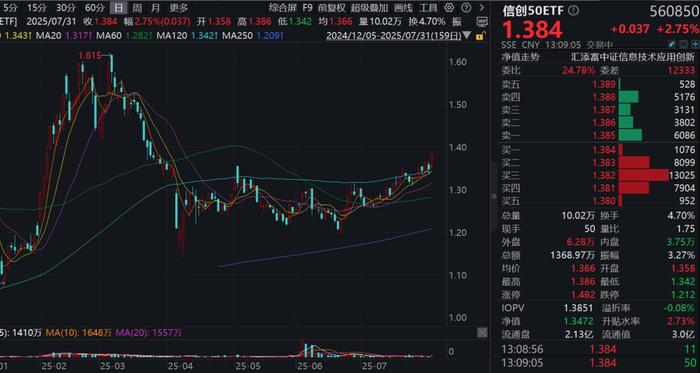
海外AI大厂业绩炸裂!AI应用再度爆发,信创50ETF(560850)大涨近3%!自主创新+AI高景气双重催化
Xin Lang Cai Jing· 2025-07-31 05:52
Group 1 - Global software leader reported Q4 FY2025 revenue of $76.44 billion, an 18% year-over-year increase, with intelligent cloud revenue at $29.9 billion, up 26%, and Azure cloud services growing by 39% [2] - The company’s quarterly capital expenditure reached $24.2 billion, a 27% increase, with expectations to exceed $30 billion in the next quarter, focusing on servers and long-term assets to support AI and cloud business [2] - Global social giant reported Q2 revenue of $47.52 billion, a 22% year-over-year increase, and net profit of $18.34 billion, up 36%, with AI chat assistant monthly active users reaching 700 million [4] Group 2 - Domestic computer sector saw significant gains, with the Xinchuang 50 ETF rising nearly 3% and the Software 50 ETF increasing over 2%, reflecting positive sentiment from overseas performance [3] - Major stocks in the Xinchuang 50 ETF, including Yonyou Network and 360, experienced substantial increases, indicating strong market performance [3] - The AI application sector is experiencing a structural shift in demand, with consumer AI applications expanding into programming and video generation, while B2B AI applications are still in early commercialization stages [5][6] Group 3 - The DeepSeek concept stock weight in the Zhongzheng Xinchuang Index is 48.1%, indicating a strong focus on computer software and cloud services, which are closely related to the "domestic substitution" trend [6] - The Software 50 ETF covers a comprehensive range of AI software across the entire industry chain, with approximately 67% of its weight in application software and over 15% in AI-related fields [7]
X @Investopedia
Investopedia· 2025-07-28 23:00
Amazon is scheduled to report second-quarter earnings after the market closes on Thursday, with analysts overwhelmingly bullish on the online retail and cloud services giant's stock. https://t.co/3o5Se6EbUW ...
美股新阶段:在AI热潮与高利率间寻找平衡
Sou Hu Cai Jing· 2025-07-28 11:56
Core Insights - The current US stock market is at a critical juncture where macroeconomic conditions and industrial transformations are intertwined, with disruptive technologies like artificial intelligence driving productivity gains while inflation and monetary policy uncertainties challenge market stability [1] Industry Opportunities - Structural opportunities are primarily found in the technology revolution, with the industrialization of generative AI extending from infrastructure to application layers, benefiting cloud services, semiconductor equipment, and specific software service providers from capital expenditure waves [3] - Certain consumer giants with pricing power and global supply chain advantages demonstrate strong cost pass-through capabilities in an inflationary environment [3] - The biotechnology sector is experiencing value reassessment opportunities due to accelerated new drug approvals and a resurgence in merger and acquisition activities, particularly for innovative companies with clear pipelines [3] Market Challenges - Major stock indices remain at historically high valuations, making them sensitive to interest rate changes, with the pace of inflation decline potentially slower than expected [3] - The timing of the Federal Reserve's policy shift is uncertain, and prolonged high-interest rate environments may suppress growth stock valuations [3] - Earnings divergence is increasing, with industries overly reliant on low-cost financing or facing weak demand experiencing downward pressure on profits [3] - Geopolitical risks pose potential disruptions to supply chains and energy prices, necessitating vigilance [3] Sector Differentiation - Technology giants maintain relative strength due to cash flow advantages and technological barriers, but regulatory policy changes and capital return efficiency should be monitored [4] - The financial sector sees marginal relief in net interest margin pressures, yet risks associated with commercial real estate remain a challenge [4] - The industrial and materials sectors are significantly influenced by the global manufacturing cycle, with increasing regional performance disparities [4] - While essential consumer goods exhibit defensive characteristics, valuation premiums may limit upside potential [4] Investment Strategy - In light of the complex landscape of the current US stock market, a "quality first, moderate diversification" core strategy is recommended, focusing on high-quality companies with stable cash flows, strong technological barriers, and relatively reasonable valuations while remaining cautious of overvalued thematic stocks [5] - Utilizing market volatility to optimize holding costs and avoiding emotional trading behaviors is advised [5] - Close monitoring of inflation data and employment market changes is essential for timely assessment of interest rate impacts on corporate valuations [5] - Portfolio construction may benefit from cross-industry and cross-market capitalization diversification to smooth volatility while retaining some liquidity to address potential risk events [5][6] - Continuous evaluation of the core competitiveness and sustainable profitability of investment targets is a pragmatic approach to navigating market uncertainties [6]

Think It's Too Late to Buy Amazon? Here's the Biggest Reason Why There's Still Time.
The Motley Fool· 2025-07-24 08:10
Group 1 - Amazon Web Services (AWS) is the largest cloud service provider globally, holding 30% of the market share and is a significant growth driver for Amazon, contributing 63% of the company's operating income in Q1 2025 [4][6] - The shift to cloud services is expected to accelerate, with 85% to 90% of IT spending currently still on-premises, indicating a substantial opportunity for growth over the next 10 to 20 years [5] - Amazon is investing over $100 billion in its AI business in 2025 to enhance its competitive edge and capitalize on the cloud transition, positioning itself favorably for future growth [7] Group 2 - Amazon's stock has shown remarkable growth, increasing over 233,000% since its market debut, highlighting its potential as a strong investment opportunity [1][2] - The increasing interest in cloud services, particularly in conjunction with generative AI advancements, is expected to drive further demand and engagement, benefiting Amazon's bottom line [6]

3 Reasons Why Investors Should Stay Away From Alibaba Stock Right Now
ZACKS· 2025-07-22 16:50
Core Insights - Alibaba Group (BABA) presents a concerning investment picture with revenue growth of 7% year over year to RMB236.5 billion and adjusted EBITA gains of 36% in the last quarter, but deeper financial analysis reveals troubling trends that suggest caution for potential investors in 2025 [1] Financial Performance - The Zacks Consensus Estimate for fiscal 2026 earnings has been revised downward by 18.1% over the past 30 days to $8.58 per share, indicating market pessimism regarding Alibaba's growth trajectory [2] - Free cash flow has dramatically deteriorated, plummeting 76% to RMB3.7 billion, raising questions about the quality of earnings and operational efficiency despite a 7% revenue growth [3][8] - Alibaba has spent $11.9 billion on share repurchases in fiscal 2025, reducing share count by 5.1%, which suggests poor capital allocation decisions as free cash flow evaporates [4] Growth Trends - The company is experiencing decelerating growth momentum, with overall revenue growth slowing to 7%, a significant decline from historical double-digit growth rates [5][8] - Despite investments in artificial intelligence and cloud infrastructure, the growth in critical revenue streams is slowing, with cloud revenue growth at 18% and customer management revenue growth at 12% [5][6] Competitive Landscape - The competitive environment in China's e-commerce and cloud markets has intensified, with rivals like ByteDance and Tencent eroding Alibaba's market share, particularly in its core platforms Taobao and Tmall [7][11] - International competition from cloud providers like Microsoft and Amazon is also increasing, further challenging Alibaba's market position [11] Valuation Concerns - Alibaba continues to trade at a premium valuation despite its challenges, with a Value Score of C indicating that the stock is not cheap relative to its fundamentals [10] - The stock has generated only 1.1% returns over the past three months, underperforming both the Zacks Internet-Commerce industry and the Zacks Retail-Wholesale sector [11] Geopolitical and Economic Factors - Geopolitical tensions between the United States and China create regulatory uncertainty for Chinese technology companies, leading to potential delisting risks and scrutiny of data practices [15] - Broader economic challenges in China, including slowing consumer spending and deflationary pressures, create a difficult operating environment for e-commerce companies [16]

CoreWeave stock climbs after company announces $1.5 billion bond sale
CNBC· 2025-07-21 13:06
CoreWeave's Financial Moves - CoreWeave plans to sell $1.5 billion worth of bonds, with the notes due in 2031, to fund general purposes including debt repayment [1] - Following the announcement of the bond sale, CoreWeave's stock rose more than 1% [1] Previous Financial Activities - In May, CoreWeave announced a $2 billion debt offering plan, which resulted in a 19% increase in shares, and the debt was five times oversubscribed [2] - Recently, shares rallied after the announcement of a $6 billion AI data center project in Pennsylvania [2]