Smartphones

Search documents
Apple (AAPL) Soared on Better Than Expected Results
Yahoo Finance· 2025-11-19 11:17
Core Insights - RiverPark Advisors reported strong performance in U.S. equity markets during Q3 2025, with the S&P 500 Total Return Index increasing by 8.12% and the Russell 1000 Growth Index rising by 10.51% [1] - The RiverPark Large Growth Fund achieved a return of 4.73% in the same quarter, with market leadership concentrated among a few mega-cap tech and consumer companies driven by AI innovation [1] - The sectors of Information Technology, Consumer Discretionary, and Communication Services outperformed, while Energy and Utilities lagged behind [1] Company Focus: Apple Inc. (NASDAQ:AAPL) - Apple Inc. reported a one-month return of 3.48% and a 52-week gain of 16.79%, closing at $267.44 per share with a market capitalization of $3.969 trillion on November 18, 2025 [2] - The company experienced a strong quarter, with total revenue of approximately $94 billion, reflecting a 10% year-over-year growth, driven by a 15% increase in iPhone sales and record Services revenue of $27 billion [3] - Apple Inc. ranked 8th among the 30 Most Popular Stocks Among Hedge Funds, with 156 hedge fund portfolios holding its shares at the end of Q2 2025, down from 159 in the previous quarter [4] - The September quarter revenue for Apple Inc. was reported at $102.5 billion, marking an 8% year-over-year increase [4]

传音控股(68036.SH):与Google Cloud深度合作,将其AI技术融入智能终端和服务
Ge Long Hui· 2025-11-19 10:12
Core Viewpoint - Transsion Holdings (68036.SH) has announced a deep collaboration with Google Cloud to integrate AI technology into its smart devices and services, resulting in the development of several user-friendly features [1] Group 1: AI Integration and Features - The collaboration has led to the creation of features such as one-click screen inquiry, smart screen recognition, AI search, call summaries, and AI writing, which are well-received by users [1] - Transsion's brands, TECNO AI and Infinix AI, have widely implemented AI in areas like image enhancement, voice assistance, and AI writing, continuously iterating to enhance the overall AI capabilities of their systems [1] - The use of AI agents is aimed at improving the mobile experience for users of smart devices [1]

荣耀手机输入法“罢工”,相关团队回应
Xi Niu Cai Jing· 2025-11-19 09:49
Group 1 - A significant number of Honor smartphone users reported issues with the built-in Baidu Input Method, which failed to display the input box, affecting messaging apps like WeChat and QQ [2] - The issue reportedly affected multiple models, including the Honor 100 Pro, with users unable to resolve the problem even after restarting their devices, leading them to clear input method data or install third-party alternatives [5] - Baidu Input Method's official announcement attributed the fault to an update in the configuration of online hot words, and they have since removed the problematic configuration [5] Group 2 - Honor's smartphone sales in Q3 2025 saw a year-on-year decline of 8.1%, marking the largest drop among major manufacturers, with market share falling to 14.4%, ranking fifth in the domestic market [5] - The decline in sales is primarily attributed to insufficient performance in the mid-to-high-end segment, with the Magic 6 series failing to meet expectations, while the budget smartphone market faces intense competition from brands like Redmi and realme [5]


传富士康为苹果折叠手机新建产线
WitsView睿智显示· 2025-11-19 08:57
Core Insights - Apple's first foldable phone has completed the "seamless" screen design, with Foxconn establishing a dedicated production line, although the hinge and battery are not yet ready for mass production [1][2] - Samsung Display is expected to be the exclusive supplier of the OLED panels for Apple's foldable phone, with a main screen size of 7.74 inches and an outer screen size of 5.49 inches, although these specifications may change during mass production [1] Hinge and Battery Developments - Apple faced significant challenges with the hinge design, which utilizes liquid metal materials to resist bending and deformation; the company has resolved the technical issues and reduced component costs, but remains cautious about large-scale production [2] - The battery capacity for the foldable phone has been tested to exceed that of the iPhone 17 Pro Max, ranging from 5400mAh to 5800mAh, but a stable supplier has not yet been found [2] - Due to the presence of numerous moving parts, any slight deviation could lead to battery puncture, prompting Apple to implement strict quality control measures for the battery [2]

Xiaomi's Strategic Expansion into EV and IoT Markets Fuels Financial Growth
Financial Modeling Prep· 2025-11-19 07:00
Core Insights - Xiaomi is a leading technology company based in Beijing, recognized as the world's third-largest smartphone maker, with diversification into the electric vehicle (EV) and Internet of Things (IoT) markets contributing to its financial performance [1] Financial Performance - On November 18, 2025, Xiaomi reported an earnings per share (EPS) of $0.06, exceeding the estimated EPS of $0.05, indicating higher profitability than analysts expected [2][6] - The company's actual revenue was approximately $15.89 billion, which fell short of the estimated $18.46 billion [2] - Xiaomi's net profit more than doubled to 12.27 billion yuan (about $1.73 billion), a significant increase from the previous year's net profit of 5.35 billion yuan, driven by robust EV and IoT businesses [3][6] - The third-quarter revenue saw a 22.3% increase, showcasing growth potential from the EV market [3] Financial Metrics - Xiaomi's price-to-earnings (P/E) ratio is approximately 27.43, indicating that investors are willing to pay a premium for its earnings [4] - The price-to-sales ratio and enterprise value to sales ratio both stand at about 2.31, reflecting the company's market value relative to its sales [4] - The enterprise value to operating cash flow ratio is around 15.25, indicating the company's valuation in relation to its cash flow from operations [4] Financial Health - The earnings yield is about 3.65%, providing a return on investment relative to earnings [5] - The debt-to-equity ratio is around 0.14, suggesting a relatively low level of debt compared to equity, which is favorable for financial stability [5][6] - The current ratio of approximately 1.29 indicates that Xiaomi has a reasonable level of liquidity to cover its short-term liabilities [5]
覆盖70+国家,Coosea酷赛智能深耕新兴市场,把握AI手机增长红利
Jin Tou Wang· 2025-11-19 04:36
Core Insights - The global smartphone market is undergoing a restructuring, with local brands in emerging markets such as South Asia, the Middle East, and Latin America accelerating their rise, becoming new growth drivers for the industry [1][2] - Coosea is positioned as a "local brand enabler," capturing the industry benefits of a 63% compound annual growth rate (CAGR) in AI smartphones, establishing itself among the top end-to-end solution providers globally [1][4] Market Potential - Emerging markets are releasing significant potential amid geopolitical and supply chain restructuring, with local brands' shipments expected to grow from 45.6 million units in 2020 to 58.1 million units in 2024, reflecting a CAGR of 6.3%, and projected to reach 68.4 million units by 2029 [2] - Local brands face challenges such as weak R&D, fragmented orders, and high customization demands, creating a market opportunity for Coosea to integrate these fragmented needs [2] Company Strengths - Coosea has built a closed-loop system encompassing product definition, R&D, supply chain, manufacturing, and after-sales service, allowing partner brands to focus on brand operation and channels [4] - The company's core advantage lies in localized insights, such as customizing offline communication features for weak network areas and optimizing AI portrait analysis for regional aesthetic preferences in South Asia [4] - By the end of 2024, Coosea is expected to rank as the second-largest end-to-end solution provider for local smartphone brands by shipment volume, aiming to reach the top position in the first quarter of 2025 [4] Financial Performance - From 2022 to 2024, Coosea's revenue is projected to grow from 1.713 billion yuan to 2.717 billion yuan, with a CAGR of 25.9%, while net profit is expected to rise from 110 million yuan to 207 million yuan, indicating a steady improvement in profitability [4] AI Smartphone Strategy - Coosea is strategically positioned to capitalize on the AI smartphone trend, with a projected global CAGR of 63% from 2023 to 2028, and an expected shipment share of 54% by 2028 [5] - The company has established a "front-end small model + back-end large model" collaborative strategy, integrating capabilities from major players like iFlytek and Google, while deploying a 6 billion parameter edge model for specific tasks [5] Future Outlook - Coosea plans to continue deepening its presence in emerging markets and enhancing AI research and development, leveraging technology to empower local brands and expand its growth boundaries in the AI smartphone wave [5]

Xiaomi warns of higher smartphone prices due to surging memory chip costs
Yahoo Finance· 2025-11-18 09:39
Core Insights - Xiaomi warns of potential smartphone price increases in 2024 due to rising memory chip costs, although these hikes may not fully cover the increased expenses [1][2][3] Company Performance - Xiaomi shipped 43.3 million smartphones in Q3, a 0.5% year-on-year increase, maintaining a 13.6% global market share [4] - Total revenue for Q3 rose 22.3% to 113.1 billion yuan ($16 billion), falling short of analyst estimates of 116.5 billion yuan [5] - Adjusted net profit surged 80.9% year-on-year to 11.3 billion yuan, exceeding the average estimate of 10.3 billion yuan [6] Revenue Drivers - Revenue growth was significantly driven by electric vehicles (EV), artificial intelligence (AI), and other new initiatives, which collectively accounted for 25% of total revenue [6] - The EV segment generated 28.3 billion yuan in revenue in Q3, up from 20.6 billion yuan in Q2 and 18.1 billion yuan in Q1 [7] - The company delivered 108,796 EVs in Q3, marking an increase from 81,300 in Q2, as it began shipping its second model, the YU7 electric SUV [7]
Xiaomi reports a 22% jump in Q3 revenue
Reuters· 2025-11-18 09:39
Core Insights - Xiaomi reported a 22.3% increase in third quarter revenue, highlighting its strong performance in the smartphone market and its strategic shift towards electric vehicles [1] Company Summary - The company is currently the world's third-largest smartphone maker, indicating its significant position in the global market [1] - Xiaomi is actively doubling down on its transition into the electric vehicle sector, which may present new growth opportunities [1]


China's Xiaomi posts first profit from EV and AI businesses as quarterly earnings surge
Yahoo Finance· 2025-11-18 09:30
Core Viewpoint - Xiaomi has achieved profitability in its electric vehicle (EV) and artificial intelligence (AI) sectors for the first time in Q3, with overall profits increasing by nearly 81% year-on-year [1]. Financial Performance - The adjusted net profit for the three months ending September 30 reached 11.3 billion yuan (US$1.6 billion), with a pre-adjustment profit increase of 129.5% year-on-year [2]. - Revenue for the quarter rose by 22.3% to 113.1 billion yuan [2]. EV and AI Business Growth - Xiaomi sold 108,796 EVs in Q3, marking an all-time high, and the revenue from its EV, AI, and other new initiatives reached 29 billion yuan, tripling from the same period last year [3]. - The surge in EV sales and profits indicates Xiaomi's increasing focus on the EV sector and its growing influence in this market, suggesting a promising growth trajectory [5]. Smartphone Segment Performance - Revenue from the smartphone segment, which constitutes about three-quarters of total revenue, grew only 1.6% to 84.1 billion yuan, partly due to the late reflection of sales from the newly launched Xiaomi 17 series [4][5]. Future Outlook - Xiaomi's president, Lu Weibing, stated that the company is on track to deliver 350,000 EVs by the end of the week, achieving its annual target ahead of schedule [6]. - Lu also mentioned that rising memory chip prices could negatively impact smartphone vendors, leading to potential market consolidation [7]. - To counteract these challenges, Xiaomi plans to optimize its product mix and increase the average selling price as it continues to target the premium segment [8].
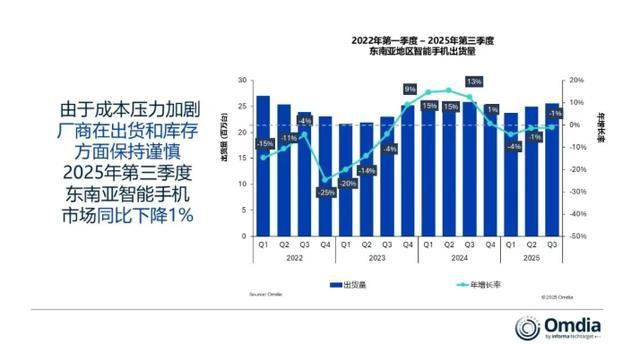
Omdia:2025年第三季度东南亚智能手机出货量下降1%
Huan Qiu Wang Zi Xun· 2025-11-18 08:16
Group 1 - The Southeast Asian smartphone market is projected to decline by 1% year-on-year in Q3 2025, with shipments reaching 25.6 million units, marking the third consecutive quarter of decline [1][3] - Entry-level smartphone shipments are experiencing increased volatility, making management more challenging, yet they remain a key factor in market share rankings [3] - OPPO and vivo are focusing on value rather than volume, while Honor and Xiaomi are increasing shipments to enhance brand penetration, with Honor's Q3 shipments doubling compared to the same period in 2024 [3] Group 2 - After a sluggish first half of 2025, manufacturers are expected to adopt more aggressive strategies in the second half, including the early launch of new products, due to healthier inventory levels [3] - Rising material costs driven by increased memory and storage prices will significantly impact low-priced devices, especially in a price-sensitive market where over 60% of smartphones are priced below $200 [3] - Manufacturers will need to balance competitive pricing with adjustments in selling prices, reductions in hardware costs, or cuts in marketing expenditures to protect profit margins [3]