供热

Search documents
新春走基层|“数智济南”的温暖答卷
Zhong Guo Jing Ji Wang· 2026-02-13 05:58
Group 1 - The article highlights the dedication of frontline heating staff at Jinan Thermal Power Group, who are committed to ensuring heating services during the Spring Festival, providing warmth to the citizens of the city [1] - The report emphasizes the meticulous inspection and scheduling efforts made by the staff to maintain heating supply, showcasing their role in safeguarding the comfort of families during the festive season [1]
工大科雅完成股份回购并签署智慧供热项目合同
Jing Ji Guan Cha Wang· 2026-02-12 10:01
Group 1 - The company, Gongda Keya, has recently completed a share repurchase plan, acquiring approximately 1.65 million shares, which represents 1.36% of its total share capital, for a total amount of about 31.61 million yuan [2] - The share repurchase was conducted at a maximum price of 20.20 yuan per share and a minimum price of 18.35 yuan per share, indicating the company's recognition of its own value [2] - Gongda Keya has signed a contract for a smart heating renovation project with the Dongying Municipal Holding Group in Shandong, which is expected to positively impact the company's future revenue and profits [3] Group 2 - The energy management contract for the smart heating project is set to begin its energy-saving benefit sharing period on October 31, 2026, and will last until March 15, 2031 [3] - The implementation of this contract is anticipated to have a favorable effect on the company's annual revenue and profit in the coming years [3]
惠天热电:拟租赁供热管线
Ge Long Hui· 2026-02-12 08:41
Core Viewpoint - Huadian Thermal Power (000692.SZ) aims to expand its heating market share and improve operational efficiency by engaging in heating business projects in the automotive city area of Shenyang [1] Group 1: Business Expansion - The automotive city area in Shenyang is one of the concentrated regions for real estate development [1] - The company has initiated discussions with several project units in the area to undertake heating business [1] Group 2: Lease Agreement - The company plans to sign a heating pipeline lease agreement with Shenyang Dongqi Urban Construction Engineering Co., Ltd. to utilize existing heating pipeline assets in the automotive city area [1] - The lease term will commence from the signing date until the end of the 20th heating season (i.e., the heating season of 2045-2046) [1] - The annual rent is set at RMB 1.14 million (including tax), with a total lease amount of RMB 22.8 million over the lease period [1] Group 3: Transaction Details - Dongqi Construction is not a related party to the company, and this transaction does not constitute a related party transaction [1] - The transaction also does not qualify as a major asset restructuring as defined by the regulations for listed companies, thus no approval from relevant authorities is required [1]

惠天热电:拟2280万元租赁供热管线拓展市场
Xin Lang Cai Jing· 2026-02-12 08:35
Core Viewpoint - The company aims to expand its heating market share and improve operational efficiency by signing a heating pipeline lease agreement with Dongqi Construction, which will enhance revenue and effectiveness [1] Group 1: Lease Agreement Details - The company plans to lease the heating pipelines already constructed in the Automotive City area from Dongqi Construction [1] - The lease term will last from the signing of the agreement until the end of the 2045-2046 heating season [1] - The annual rent is set at 1.14 million yuan, totaling 22.8 million yuan over the lease period [1] Group 2: Strategic Implications - This lease is expected to help the company expand its heating coverage area [1] - The agreement is anticipated to increase the company's revenue and operational efficiency [1] - Dongqi Construction is a non-related party, and the transaction does not constitute a major asset restructuring [1]
加“数”向“智”,济南正在悄悄变“聪明”!
Feng Huang Wang Cai Jing· 2026-02-12 07:38
Core Viewpoint - Jinan is transitioning from a "digital" phase to a "smart" phase in its urban development, emphasizing the integration of intelligent systems that enable decision-making and proactive management [1] Group 1: Infrastructure Transformation - The intelligent transformation of urban infrastructure is foundational for the implementation of "smart" initiatives, shifting from remote monitoring to autonomous analysis and decision-making [3] - The introduction of the "black lamp heat exchange station" in Jinan represents a significant advancement, allowing for autonomous operation without human oversight, thus enhancing efficiency and reliability in heating services [4] - This innovation fills a gap in the heating industry for unmanned, intelligent operations, leading to improved energy efficiency and consistent heating for residents [4] Group 2: Service Process Reengineering - The "smart heating manager" device, a pioneering technology in Jinan, enhances service delivery by addressing common citizen concerns and streamlining communication [6] - Features such as intelligent customer service and remote troubleshooting capabilities significantly improve response times and service quality for heating issues [7] - The system prioritizes requests from elderly citizens, ensuring that their needs are addressed promptly, thus enhancing overall service efficiency [7] Group 3: Urban Governance Enhancement - The application of smart technologies is expanding from underground networks to broader urban governance, enabling a shift from static to dynamic management approaches [9] - The deployment of "smart lamp posts" integrated with drone technology allows for real-time traffic monitoring and incident management, significantly improving response times and operational efficiency [10][11] - This innovative governance model represents a transformation in urban management, facilitating a transition from manual oversight to automated, intelligent monitoring systems [11] Group 4: Ecosystem Integration - The integration of smart technologies across various urban services and infrastructure is creating a cohesive ecosystem that enhances the overall functionality of the city [12] - The combination of intelligent heating systems, responsive service tools, and aerial monitoring capabilities exemplifies a comprehensive approach to urban management [13]

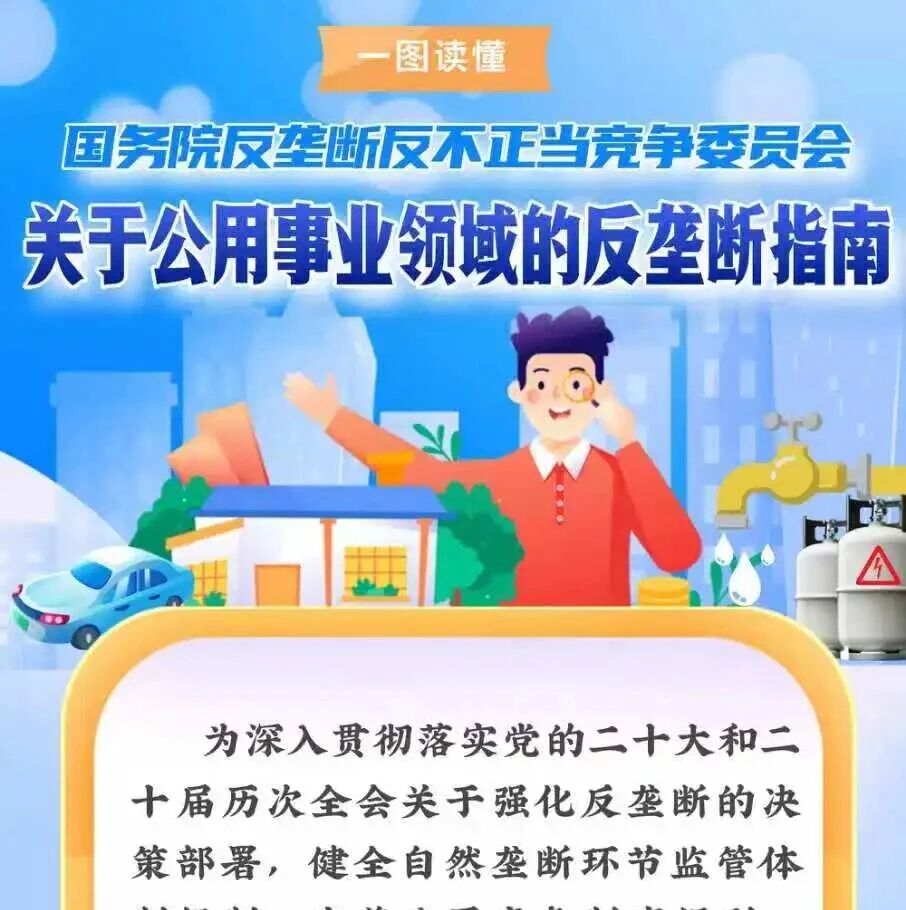
细化垄断行为认定规则
Xin Lang Cai Jing· 2026-02-11 18:46
Core Viewpoint - The State Administration for Market Regulation has issued the "Antitrust Guidelines for the Public Utilities Sector" to prevent and curb monopolistic behaviors in public utilities, ensuring fair market competition and protecting consumer and public interests [1][2]. Group 1: Overview of the Guidelines - The guidelines consist of seven chapters and 50 articles, systematically summarizing enforcement experiences and accurately grasping the characteristics of the public utilities sector and market competition rules [1]. - The guidelines provide clearer and more explicit instructions for antitrust enforcement and compliance for operators in the public utilities sector [1]. Group 2: Specific Provisions - The guidelines specifically address monopolistic behaviors in the public utilities sector, including market definition, recognition of market dominance, antitrust agreements, and abuse of market dominance [2]. - They further detail the manifestations of monopolistic agreements, particularly in industries like bottled liquefied gas, and abusive practices such as restrictive trading, bundling, and imposing unreasonable trading conditions in sectors like water, electricity, gas, and heating [2]. Group 3: Compliance and Oversight - The guidelines encourage public utility operators to strengthen compliance efforts, promote the active role of associations, enhance positive compliance guidance, and maintain open channels for social supervision [2].
公用事业领域反垄断指南出台 细化垄断行为认定规则
Shang Hai Zheng Quan Bao· 2026-02-11 17:54
Core Viewpoint - The State Administration for Market Regulation has issued the "Antitrust Guidelines for the Public Utilities Sector," aimed at clarifying antitrust enforcement and compliance in the public utilities sector to prevent monopolistic behaviors and maintain fair market competition [1][2]. Group 1: Guidelines Overview - The guidelines consist of seven chapters with 50 articles covering general principles, monopolistic agreements, abuse of market dominance, operator concentration, fair competition review, abuse of administrative power to eliminate competition, and applicable legal responsibilities [1]. - The identification of market dominance in the public utilities sector will consider the natural monopoly characteristics and franchise operating models, focusing on the operators' control over physical networks or other critical infrastructure [1][2]. Group 2: Monopolistic Behaviors - The guidelines detail common monopolistic behaviors in industries such as bottled liquefied gas, and the public utilities sectors (water, electricity, gas, heating) that often involve restrictive trading, bundling, and unreasonable trading conditions [2]. - The guidelines emphasize that public utility operators may extend their monopolistic advantages to competitive sectors, which necessitates a systematic approach to enhance the scientific, targeted, and effective nature of antitrust enforcement [2]. Group 3: Compliance and Risk Management - The guidelines encourage public utility operators to strengthen antitrust compliance frameworks, establish effective management systems to identify potential antitrust legal risks, and implement corresponding preventive and remedial measures [3].
中国官方出台公用事业领域反垄断指南
Zhong Guo Xin Wen Wang· 2026-02-11 15:22
Core Viewpoint - The Chinese State Council Anti-Monopoly and Anti-Unfair Competition Committee has issued guidelines aimed at preventing and curbing monopolistic behaviors in the public utility sector, ensuring fair market competition and protecting consumer and public interests [1][2] Group 1: Guidelines Overview - The guidelines address the unique characteristics and market competition rules of the public utility sector, which includes water supply, electricity, gas, and heating, where natural monopolies are prevalent [1] - They provide a systematic summary of enforcement experiences and clarify the rules for identifying monopolistic behaviors in the public utility sector [1] Group 2: Specific Monopolistic Behaviors - The guidelines detail common monopolistic agreements in industries such as bottled liquefied gas, as well as abusive practices like limiting transactions, tying sales, and imposing unreasonable trading conditions in sectors like water, electricity, gas, and heating [1] - They also specify that monopolistic agreements and abuses of market dominance related to pricing must be assessed in the context of government-mandated pricing and fee standards [1] Group 3: Additional Restrictions - The guidelines further elaborate on practices that restrict competition, such as limiting transactions, hindering market entry for other operators, and forcing local public utility operators to invest or establish branches in specific areas [2] - They clarify the standards for identifying these anti-competitive behaviors, ensuring a comprehensive approach to enforcement in the public utility sector [2]
加强公用事业反垄断 有力服务高质量发展 ——解读《关于公用事业领域的反垄断指南》
Zhong Guo Jing Ji Wang· 2026-02-11 12:14
Core Viewpoint - The newly released "Antitrust Guidelines for Public Utilities" marks a significant step in China's antitrust legal framework, specifically targeting essential public services such as water, electricity, gas, heating, sewage treatment, waste management, and public transportation, aiming to enhance regulatory precision and support high-quality development [1] Group 1: Need for the Guidelines - Public utilities exhibit significant public, foundational, and network-dependent characteristics, with natural monopoly attributes primarily in infrastructure sectors [2] - Some public utility companies have misused their market power in natural monopoly sectors to extend monopolistic advantages into competitive areas, harming consumer rights [2] - Since the implementation of the Antitrust Law, 43 antitrust cases in the public utility sector have been investigated, highlighting both the accumulation of enforcement experience and existing challenges in the regulatory landscape [2] Group 2: Institutional Innovations - The Guidelines consist of seven chapters and 50 articles, emphasizing four major innovations: - A modern governance approach of "differentiated regulation and precise measures," focusing on distinguishing between natural monopoly and competitive sectors [4] - Clear analysis factors for identifying abuse of market dominance in public utilities, detailing specific behaviors and legitimate justifications [5] - Systematic regulation of fair competition reviews and the abuse of administrative power to eliminate competition [6] - A "flexible and multi-faceted" incentive and constraint mechanism encouraging companies to comply proactively [7] Group 3: Practical Significance - The implementation of the Guidelines will provide a professional and clear enforcement toolbox for regulatory agencies, enhancing case handling quality and efficiency [8] - For public utility operators, the Guidelines serve as an authoritative compliance guide, helping them identify risks associated with extending monopolistic advantages into competitive areas [8] - The Guidelines aim to enhance consumer welfare by regulating unfair pricing, refusal to deal, and other practices that harm public interests, ensuring better access to essential services [8] Group 4: Future Outlook - The release of the Guidelines signifies a solid step in China's antitrust legal system, with a mission to support high-quality development and common prosperity [9] - Strengthening antitrust enforcement in public utilities is crucial for building a unified national market, addressing hidden barriers that hinder free flow of resources [9] - Antitrust enforcement must adapt to emerging trends in digitalization, addressing potential new forms of monopolistic behavior in smart utilities and platform services [10]
事关水电气热等领域,公用事业领域反垄断指南出台
证券时报· 2026-02-11 12:14
Core Viewpoint - The article discusses the issuance of the "Antitrust Guidelines for the Public Utilities Sector" by the State Council, aimed at preventing and curbing monopolistic behaviors in public utilities, ensuring fair market competition, and protecting consumer and public interests [1][4]. Group 1: Background and Purpose - The public utilities sector, which includes water supply, electricity, gas, heating, sewage treatment, waste disposal, and public transportation, often exhibits natural monopolistic characteristics [7]. - Recent years have seen a rise in monopolistic behaviors within this sector, where operators extend their monopolistic advantages to upstream and downstream competitive segments, limiting market competition [2][8]. - The guidelines consist of seven chapters and 50 articles, summarizing enforcement experiences and providing clear rules for identifying monopolistic behaviors in public utilities [2][9]. Group 2: Key Contents of the Guidelines - The guidelines outline the overall principles for antitrust enforcement in the public utilities sector, emphasizing the need for operators and industry associations to establish compliance management systems to prevent risks [12][14]. - Specific provisions include the clarification of the rights and procedures for whistleblowers, and the prohibition of monopolistic behaviors through data algorithms [15][16]. - The guidelines detail the forms of monopolistic agreements and the conditions under which certain agreements may be exempt from prohibition [18][21]. Group 3: Market Dominance and Abuse - The guidelines provide a framework for analyzing the abuse of market dominance, including factors for determining whether a public utility operator holds a dominant market position [22][24]. - They specify considerations for identifying unfair pricing, refusal to deal, and other abusive practices, along with common justifications that may not be accepted as valid [26][27]. - The guidelines also address the review of operator concentrations, particularly in natural monopoly segments, and the potential requirement for operators to report concentrations that may restrict competition [27][28]. Group 4: Legal Responsibilities and Enforcement - The guidelines clarify the legal responsibilities of public utility operators and industry associations in cases of antitrust law violations, including the consequences of aiding in monopolistic agreements [32][34]. - They emphasize the importance of compliance with antitrust regulations and the potential for penalties to be recorded in credit histories, highlighting the collaborative enforcement approach among regulatory bodies [34].