
供气

Search documents
促常态、抓落实、提质效全力优化发展环境
Xin Lang Cai Jing· 2026-02-24 22:23
Group 1 - The core viewpoint emphasizes the effective implementation of price regulation and management in Luoyang City, Henan Province, leading to significant improvements in price stability and support for people's livelihoods [1][2][3] Group 2 - The city has established a regular coordination mechanism involving 14 departments to ensure the supply and price stability of essential goods, with a focus on monitoring CPI and food price fluctuations [1] - The city has dynamically adjusted agricultural water pricing standards, maintaining wheat yields at around 570 kg per mu, even during drought conditions, thus promoting both water conservation and food security [2] - The government has implemented differentiated pricing policies to support green and low-carbon development, while also ensuring the stability of price order through special governance measures [3]
确保水电气暖设施安全高效运行 保障人民群众温暖度冬平安过节
Zheng Zhou Ri Bao· 2026-02-15 01:13
Group 1 - The provincial leaders emphasized the importance of ensuring stable energy supply and public services during the upcoming Spring Festival, highlighting the need for effective management of coal, electricity, oil, and gas resources [1][2][3] - Liu Ning and Wang Kai inspected various facilities, including gas boiler rooms and water treatment plants, to assess the readiness for heating and water supply during the holiday period, stressing the need for enhanced monitoring and rapid response to user feedback [2][3] - The leaders called for a comprehensive approach to public transportation, urging for optimized scheduling and improved service quality to accommodate increased passenger demand during the holiday season [3] Group 2 - The provincial government aims to strengthen market supply and price stability for essential goods, including food and daily necessities, to meet the heightened consumer demand during the Spring Festival [3] - Emphasis was placed on the implementation of safety measures and emergency response protocols to ensure the safety and well-being of the public during the holiday [3] - The leaders highlighted the importance of supporting frontline workers and maintaining effective communication channels to ensure a smooth operation of city services [3]
刘宁王凯调研检查春节期间民生保障工作 确保水电气暖设施安全高效运行 保障人民群众温暖度冬平安过节
He Nan Ri Bao· 2026-02-14 10:57
Group 1 - The provincial leaders conducted inspections in Zhengzhou to ensure the stability of essential services such as heating, water supply, electricity, and gas ahead of the Spring Festival [2][3] - Emphasis was placed on optimizing heating network layouts and exploring green technologies like geothermal heating to enhance service delivery during the holiday [3] - The leaders highlighted the importance of improving water supply capacity and emergency repair capabilities to ensure clean and safe drinking water for the public [3] Group 2 - The leaders reviewed electricity supply strategies, focusing on analyzing winter peak electricity demand and adjusting resources accordingly to ensure reliable power supply during the festive season [3] - Safety measures for gas storage and supply were reinforced, with a call for systematic thinking and detailed management to address potential risks [3] - The need for enhanced public transportation services during the holiday was discussed, with a focus on optimizing capacity and improving service quality [4] Group 3 - The leaders reiterated the importance of prioritizing public welfare and safety, aligning with national directives on urban governance and service provision [4] - There is a commitment to ensuring the supply of essential goods and maintaining price stability during the holiday period, alongside increased food safety enforcement [4] - Emergency response protocols were emphasized, including 24-hour duty systems and effective communication channels to ensure city safety [4]

《互联网平台反垄断合规指引》发布:列明“全网最低价”等风险示例
Guan Cha Zhe Wang· 2026-02-13 08:38
Group 1 - The core viewpoint of the news is the introduction of the "Antitrust Guidelines for Public Utilities" by the State Administration for Market Regulation to strengthen antitrust measures in the public utility sector and ensure fair competition [1][2] - The guidelines focus on four types of antitrust risks: monopoly agreements, abuse of market dominance, operator concentration, and abuse of administrative power to exclude or restrict competition [1][2] - The guidelines provide specific behavioral boundaries based on the core provisions of the Anti-Monopoly Law of the People's Republic of China, identifying new types of monopoly risks in eight scenarios relevant to platform operators [1][3] Group 2 - The significance of the guidelines lies in addressing the frequent occurrence of monopolistic behaviors in the public utility sector, which includes essential services like water, electricity, gas, and public transportation [2] - The guidelines aim to enhance the scientific, targeted, and effective nature of antitrust enforcement, while also establishing a long-term regulatory mechanism for the public utility sector [2][3] - The guidelines consist of seven chapters and 50 articles, covering general principles, monopoly agreements, abuse of market dominance, operator concentration, fair competition review, legal responsibilities, and supplementary provisions [3] Group 3 - The guidelines emphasize a problem-oriented approach, focusing on monopolistic issues in the public utility sector and providing clear definitions and considerations for various monopolistic behaviors [3] - They take into account the specific operational models and competitive characteristics of the public utility sector, making targeted provisions for market definition, dominance recognition, and behavior assessment [3][4] - The guidelines encourage compliance construction among public utility operators, promoting the establishment of antitrust compliance management systems to identify and mitigate potential legal risks [8] Group 4 - The guidelines specify the criteria for defining relevant markets in the public utility sector, considering the public, regional, and policy characteristics of these services [4] - They outline the recognition of market dominance, focusing on the operators' control over physical networks or key infrastructure as a critical factor [4][5] - The guidelines detail the recognition of monopoly agreements and abuse of market dominance, particularly in industries like bottled liquefied gas and essential utilities [5][6] Group 5 - The guidelines address the defenses that operators may use, particularly in relation to public safety and supply guarantees, and specify conditions under which monopolistic agreements may be exempted [6][7] - They highlight the scrutiny of operator concentration, especially concerning the acquisition of control over physical networks or key infrastructure, to prevent the extension of monopolistic advantages [6][7] - The guidelines also detail the recognition of behaviors that abuse administrative power to exclude or restrict competition, providing clear standards for identification [7][10] Group 6 - The guidelines support the establishment of compliance management systems among public utility operators and encourage industry associations to promote self-regulation and compliance [8][9] - They emphasize the importance of social supervision, allowing any individual or organization to report suspected monopolistic behaviors, which will be investigated by antitrust enforcement agencies [9] - The guidelines outline measures for enhancing collaborative regulation, including pre-communication with industry authorities and post-incident credit penalties for violations [10][11]
细化垄断行为认定规则
Xin Lang Cai Jing· 2026-02-11 18:46
Core Viewpoint - The State Administration for Market Regulation has issued the "Antitrust Guidelines for the Public Utilities Sector" to prevent and curb monopolistic behaviors in public utilities, ensuring fair market competition and protecting consumer and public interests [1][2]. Group 1: Overview of the Guidelines - The guidelines consist of seven chapters and 50 articles, systematically summarizing enforcement experiences and accurately grasping the characteristics of the public utilities sector and market competition rules [1]. - The guidelines provide clearer and more explicit instructions for antitrust enforcement and compliance for operators in the public utilities sector [1]. Group 2: Specific Provisions - The guidelines specifically address monopolistic behaviors in the public utilities sector, including market definition, recognition of market dominance, antitrust agreements, and abuse of market dominance [2]. - They further detail the manifestations of monopolistic agreements, particularly in industries like bottled liquefied gas, and abusive practices such as restrictive trading, bundling, and imposing unreasonable trading conditions in sectors like water, electricity, gas, and heating [2]. Group 3: Compliance and Oversight - The guidelines encourage public utility operators to strengthen compliance efforts, promote the active role of associations, enhance positive compliance guidance, and maintain open channels for social supervision [2].
公用事业领域反垄断指南出台 细化垄断行为认定规则
Shang Hai Zheng Quan Bao· 2026-02-11 17:54
Core Viewpoint - The State Administration for Market Regulation has issued the "Antitrust Guidelines for the Public Utilities Sector," aimed at clarifying antitrust enforcement and compliance in the public utilities sector to prevent monopolistic behaviors and maintain fair market competition [1][2]. Group 1: Guidelines Overview - The guidelines consist of seven chapters with 50 articles covering general principles, monopolistic agreements, abuse of market dominance, operator concentration, fair competition review, abuse of administrative power to eliminate competition, and applicable legal responsibilities [1]. - The identification of market dominance in the public utilities sector will consider the natural monopoly characteristics and franchise operating models, focusing on the operators' control over physical networks or other critical infrastructure [1][2]. Group 2: Monopolistic Behaviors - The guidelines detail common monopolistic behaviors in industries such as bottled liquefied gas, and the public utilities sectors (water, electricity, gas, heating) that often involve restrictive trading, bundling, and unreasonable trading conditions [2]. - The guidelines emphasize that public utility operators may extend their monopolistic advantages to competitive sectors, which necessitates a systematic approach to enhance the scientific, targeted, and effective nature of antitrust enforcement [2]. Group 3: Compliance and Risk Management - The guidelines encourage public utility operators to strengthen antitrust compliance frameworks, establish effective management systems to identify potential antitrust legal risks, and implement corresponding preventive and remedial measures [3].
中国官方出台公用事业领域反垄断指南
Zhong Guo Xin Wen Wang· 2026-02-11 15:22
Core Viewpoint - The Chinese State Council Anti-Monopoly and Anti-Unfair Competition Committee has issued guidelines aimed at preventing and curbing monopolistic behaviors in the public utility sector, ensuring fair market competition and protecting consumer and public interests [1][2] Group 1: Guidelines Overview - The guidelines address the unique characteristics and market competition rules of the public utility sector, which includes water supply, electricity, gas, and heating, where natural monopolies are prevalent [1] - They provide a systematic summary of enforcement experiences and clarify the rules for identifying monopolistic behaviors in the public utility sector [1] Group 2: Specific Monopolistic Behaviors - The guidelines detail common monopolistic agreements in industries such as bottled liquefied gas, as well as abusive practices like limiting transactions, tying sales, and imposing unreasonable trading conditions in sectors like water, electricity, gas, and heating [1] - They also specify that monopolistic agreements and abuses of market dominance related to pricing must be assessed in the context of government-mandated pricing and fee standards [1] Group 3: Additional Restrictions - The guidelines further elaborate on practices that restrict competition, such as limiting transactions, hindering market entry for other operators, and forcing local public utility operators to invest or establish branches in specific areas [2] - They clarify the standards for identifying these anti-competitive behaviors, ensuring a comprehensive approach to enforcement in the public utility sector [2]
加强公用事业反垄断 有力服务高质量发展 ——解读《关于公用事业领域的反垄断指南》
Zhong Guo Jing Ji Wang· 2026-02-11 12:14
Core Viewpoint - The newly released "Antitrust Guidelines for Public Utilities" marks a significant step in China's antitrust legal framework, specifically targeting essential public services such as water, electricity, gas, heating, sewage treatment, waste management, and public transportation, aiming to enhance regulatory precision and support high-quality development [1] Group 1: Need for the Guidelines - Public utilities exhibit significant public, foundational, and network-dependent characteristics, with natural monopoly attributes primarily in infrastructure sectors [2] - Some public utility companies have misused their market power in natural monopoly sectors to extend monopolistic advantages into competitive areas, harming consumer rights [2] - Since the implementation of the Antitrust Law, 43 antitrust cases in the public utility sector have been investigated, highlighting both the accumulation of enforcement experience and existing challenges in the regulatory landscape [2] Group 2: Institutional Innovations - The Guidelines consist of seven chapters and 50 articles, emphasizing four major innovations: - A modern governance approach of "differentiated regulation and precise measures," focusing on distinguishing between natural monopoly and competitive sectors [4] - Clear analysis factors for identifying abuse of market dominance in public utilities, detailing specific behaviors and legitimate justifications [5] - Systematic regulation of fair competition reviews and the abuse of administrative power to eliminate competition [6] - A "flexible and multi-faceted" incentive and constraint mechanism encouraging companies to comply proactively [7] Group 3: Practical Significance - The implementation of the Guidelines will provide a professional and clear enforcement toolbox for regulatory agencies, enhancing case handling quality and efficiency [8] - For public utility operators, the Guidelines serve as an authoritative compliance guide, helping them identify risks associated with extending monopolistic advantages into competitive areas [8] - The Guidelines aim to enhance consumer welfare by regulating unfair pricing, refusal to deal, and other practices that harm public interests, ensuring better access to essential services [8] Group 4: Future Outlook - The release of the Guidelines signifies a solid step in China's antitrust legal system, with a mission to support high-quality development and common prosperity [9] - Strengthening antitrust enforcement in public utilities is crucial for building a unified national market, addressing hidden barriers that hinder free flow of resources [9] - Antitrust enforcement must adapt to emerging trends in digitalization, addressing potential new forms of monopolistic behavior in smart utilities and platform services [10]
事关水电气热等领域,公用事业领域反垄断指南出台
证券时报· 2026-02-11 12:14
Core Viewpoint - The article discusses the issuance of the "Antitrust Guidelines for the Public Utilities Sector" by the State Council, aimed at preventing and curbing monopolistic behaviors in public utilities, ensuring fair market competition, and protecting consumer and public interests [1][4]. Group 1: Background and Purpose - The public utilities sector, which includes water supply, electricity, gas, heating, sewage treatment, waste disposal, and public transportation, often exhibits natural monopolistic characteristics [7]. - Recent years have seen a rise in monopolistic behaviors within this sector, where operators extend their monopolistic advantages to upstream and downstream competitive segments, limiting market competition [2][8]. - The guidelines consist of seven chapters and 50 articles, summarizing enforcement experiences and providing clear rules for identifying monopolistic behaviors in public utilities [2][9]. Group 2: Key Contents of the Guidelines - The guidelines outline the overall principles for antitrust enforcement in the public utilities sector, emphasizing the need for operators and industry associations to establish compliance management systems to prevent risks [12][14]. - Specific provisions include the clarification of the rights and procedures for whistleblowers, and the prohibition of monopolistic behaviors through data algorithms [15][16]. - The guidelines detail the forms of monopolistic agreements and the conditions under which certain agreements may be exempt from prohibition [18][21]. Group 3: Market Dominance and Abuse - The guidelines provide a framework for analyzing the abuse of market dominance, including factors for determining whether a public utility operator holds a dominant market position [22][24]. - They specify considerations for identifying unfair pricing, refusal to deal, and other abusive practices, along with common justifications that may not be accepted as valid [26][27]. - The guidelines also address the review of operator concentrations, particularly in natural monopoly segments, and the potential requirement for operators to report concentrations that may restrict competition [27][28]. Group 4: Legal Responsibilities and Enforcement - The guidelines clarify the legal responsibilities of public utility operators and industry associations in cases of antitrust law violations, including the consequences of aiding in monopolistic agreements [32][34]. - They emphasize the importance of compliance with antitrust regulations and the potential for penalties to be recorded in credit histories, highlighting the collaborative enforcement approach among regulatory bodies [34].
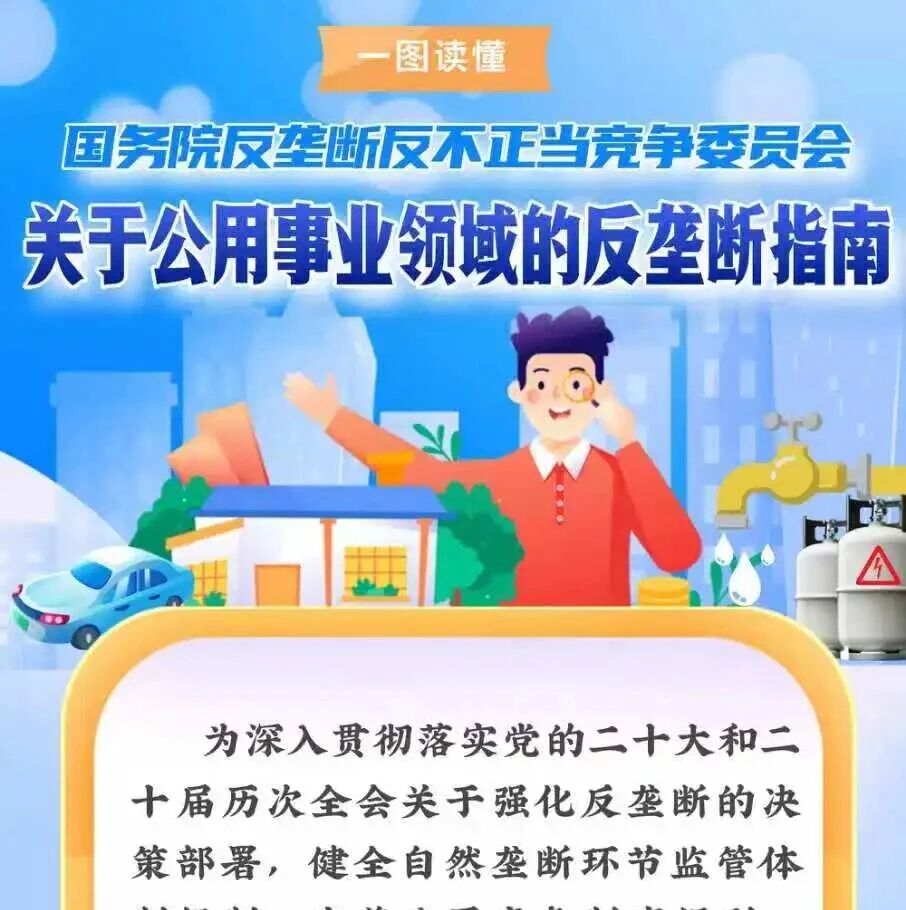
公用事业领域反垄断指南出炉 细化垄断行为认定规则
Xin Hua She· 2026-02-11 11:01
Core Viewpoint - The State Council's Anti-Monopoly and Anti-Unfair Competition Committee has issued guidelines aimed at preventing and curbing monopolistic behaviors in the public utility sector, ensuring fair market competition and protecting consumer and public interests [1][2]. Group 1: Guidelines Overview - The guidelines consist of seven chapters and 50 articles, systematically summarizing enforcement experiences and accurately grasping the characteristics of the public utility sector and market competition rules [1]. - The guidelines provide clearer and more explicit directives for anti-monopoly enforcement and compliance for operators in the public utility sector [1]. Group 2: Specific Provisions - The guidelines specifically address monopolistic behaviors in the public utility sector, including market definition, recognition of market dominance, and identification of monopolistic agreements and abuse of market dominance [2]. - The guidelines further detail the forms of monopolistic agreements and abusive behaviors, particularly in industries like bottled liquefied gas, as well as in water, electricity, gas, and heating sectors [2]. Group 3: Compliance and Industry Support - The guidelines encourage public utility operators to strengthen compliance measures and promote the active role of associations in compliance guidance [2]. - There is an emphasis on maintaining open channels for social supervision to ensure ongoing compliance and accountability within the industry [2].