生命科学

Search documents
【新华社】生命发育“黑匣子”、半导体新材料……这些重要科技创新有哪些秘密
Xin Hua She· 2026-01-29 03:44
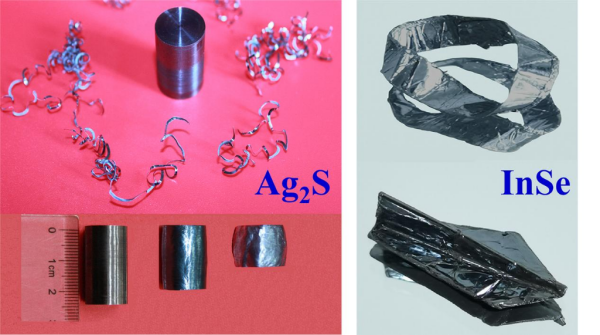
Core Insights - The article highlights significant technological advancements recognized by the Chinese Academy of Sciences, showcasing innovations across various fields that contribute to industrial applications and societal benefits [4] Group 1: Material Innovations - The research on plastic inorganic semiconductors has transformed traditional perceptions, demonstrating that materials like indium sulfide and silver sulfide can be bent and stretched, which reduces waste and lowers costs in semiconductor production [5] - A new "universal ion knife" technology has been developed to produce high-precision silicon-based piezoelectric substrates, which are now in mass production, addressing the domestic demand for RF filters in smartphones [5] Group 2: Energy Innovations - A breakthrough in ethanol production using non-food resources has been achieved, allowing for the conversion of coal and industrial waste gases into ethanol, thus avoiding the use of food resources [7][8] - The technology has already signed 15 licensing agreements, with a cumulative production capacity of 5.15 million tons per year and an investment boost of 30 billion yuan [8] Group 3: Life Sciences - Research on primate embryonic development has unlocked critical insights into early human development, addressing previously unexplored phases that are crucial for understanding birth defects [9] - The team has successfully developed a model for simulating embryonic development and is working on personalized treatment options for reproductive health issues [9] Group 4: Overall Trends - The advancements reflect a comprehensive innovation pathway in China's material science, focusing on strategic material needs to support high-quality manufacturing development [6]

“十五五”开局 西湖区要从五个方面发力
Mei Ri Shang Bao· 2026-01-28 23:32
Core Insights - The West Lake District aims for a GDP growth of 5.5% to 5.8% in 2026, with a focus on high-quality development and enhancing the overall effectiveness of its science and education sector [1][2] Economic Goals - The district's public budget revenue is expected to achieve positive growth, maintaining a scale similar to the previous year [1] - Per capita disposable income for residents is targeted to grow in line with economic growth [1] Industrial Development - The district is accelerating the construction of a modern industrial system integrating cloud innovation, scientific innovation, and cultural innovation, with a focus on advancing platform economy projects and digital economy growth [2] - Five new platform economy projects with over 100 million yuan are planned, with a target of 6.5% growth in the core digital economy sector [2] Science and Technology Initiatives - Over 30 major national, provincial, and municipal technology projects will be implemented, aiming for more than 200 project outcomes and a technology transaction volume exceeding 30 billion yuan [2] - The district plans to enhance its robotics industry service hub and establish a ten-meter EMC laboratory [2] Cultural and Creative Industry - The district is focused on branding its cultural and creative highland, with initiatives to upgrade consumption carriers and innovate business formats [3] - Key projects include the expansion of the Black Myth IP influence, the creation of a "3A game highland," and the introduction of new retail and cultural formats in various districts [3]
科学与健康 | 生命发育“黑匣子”、半导体新材料……这些重要科技创新有哪些秘密
Xin Hua She· 2026-01-28 16:23
Group 1 - The 2025 China Academy of Sciences Outstanding Scientific Achievement Awards recognized 14 achievements across various fields, highlighting China's technological advancements in original innovation and industrial application [2] - The "Plastic Inorganic Semiconductor Research" project has broken the traditional notion of brittle inorganic semiconductors, discovering bendable and stretchable materials, which could significantly reduce costs and processing waste in semiconductor manufacturing [3][5] - The "Universal Ion Knife" technology developed for 5G/6G communication has enabled the mass production of silicon-based piezoelectric heterostructures, with nearly 50,000 units expected to be supplied in 2025, marking a significant step in domestic chip production [6] Group 2 - A new ethanol production technology using non-food resources has been developed, allowing for the conversion of coal and industrial waste gases into ethanol, with an annual production capacity of 5.15 million tons and an investment of 30 billion yuan [7] - Research on primate embryonic development has unlocked critical insights into early human development, potentially leading to advancements in reproductive health and the understanding of pregnancy-related diseases [8][10] - The awarded achievements reflect the persistent professional spirit of scientists, indicating a future focus on foundational research, strategic needs, and improvements in public welfare within key sectors [12]

光通信业务强劲拉动,康宁Q4核心营收同比增14%创新高,利润双位数增长,预计一季度加速扩张|财报见闻
Sou Hu Cai Jing· 2026-01-28 14:31
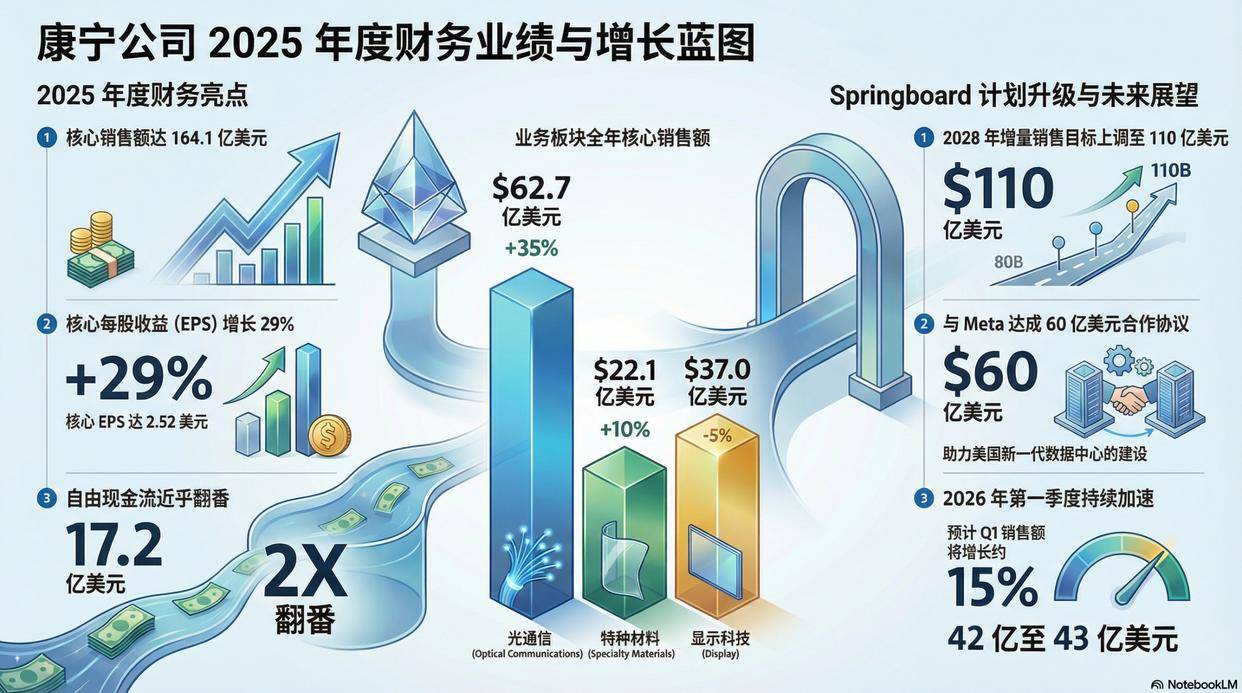
Core Viewpoint - Corning reported record core performance for Q4 and the full year, driven by strong growth in optical communications and optimistic guidance for its long-term "Springboard" growth plan [1] Financial Performance - For Q4, core sales reached $4.412 billion, a 14% year-over-year increase, while GAAP revenue was $4.215 billion, up 20% [7] - Full-year core sales totaled $16.408 billion, reflecting a 13% increase, with GAAP revenue at $15.629 billion, up 19% [7] - Core EPS for Q4 was $0.72, a 26% increase year-over-year, while GAAP EPS was $0.62, up 72% [7] - For the full year, core EPS was $2.52, a 29% increase, and GAAP EPS was $1.83, up 216% [7] Business Segment Performance - Optical Communications: Sales increased by 35% for the year, becoming the strongest growth driver and showing significant profit elasticity [5] - Display Technology: Revenue declined, but profit resilience remains, contributing less to growth in 2025 [6] - Specialty Materials: Moderate revenue growth with faster profit improvement, indicating strong operational leverage [9] - Automotive: Newly established segment faced revenue pressure but saw slight profit growth [10] - Life Sciences: Stable scale but profit decline, with Hemlock contributing to revenue growth but remaining unprofitable [10] Cash Flow and Profitability - Operating cash flow for 2025 was $2.7 billion, with adjusted free cash flow at $1.717 billion, up from $1.253 billion in 2024 [7] - Core operating profit margin rose to 20.2% in Q4, with an annual margin of 19.3%, indicating strong support from expense management and operational leverage [7] Future Guidance - For Q1 2026, the company expects core sales of $4.2 to $4.3 billion, a year-over-year increase of approximately 15%, and core EPS of $0.66 to $0.70 [11] - The Springboard growth plan's annualized sales target was raised from $8 billion to $11 billion by the end of 2028, with internal plans for 2026 increased from $6 billion to $6.5 billion [11] - The partnership with Meta, involving up to $6 billion for next-generation data center technologies, is expected to provide a strong order pipeline [11]
出海已是必答题,中国新势力如何带领产业“再全球化”?
创业邦· 2026-01-24 04:10
Core Viewpoint - The current wave of international expansion for Chinese technology companies has shifted from "lightweight" consumer products to hard technology breakthroughs, focusing on high-end manufacturing tools, software, and core materials, necessitating a comprehensive relocation of supply chains and production processes overseas [2][5]. Group 1: Industry Insights - The globalization logic for Chinese companies has fundamentally changed, making international expansion a mandatory strategy rather than an option [5]. - Companies like Dassault Systemes are pivotal in supporting Chinese enterprises by providing software that helps simulate and validate manufacturing processes before they are implemented abroad [8]. - The domestic market for high-end equipment, such as pick-and-place machines, is still largely dominated by international brands, indicating a significant opportunity for local companies to innovate and expand internationally [6]. Group 2: Strategic Considerations - Companies are considering international expansion primarily for two reasons: to complete the technology loop and to enhance industry resilience against market shocks [6][10]. - The strategy of companies like Nali New Materials involves not just selling materials but also providing technical services to ensure successful integration with international clients [10]. - The logistics and automation sector, represented by companies like RoboVan, emphasizes the importance of leveraging local partnerships and adapting to regulatory environments in target markets [12]. Group 3: Challenges and Solutions - Companies face significant challenges in adapting to local regulations and operational practices when entering foreign markets, which can lead to operational inefficiencies [15][16]. - The need for a skilled labor force in new markets is critical, and companies must negotiate labor agreements to ensure access to qualified workers [16]. - Compliance with international standards, such as carbon emissions regulations, is essential, and companies can utilize simulation technologies to preemptively address these challenges [18]. Group 4: Future Outlook - The future of international expansion for Chinese companies will rely on a combination of technological innovation and localized service offerings to create unique value propositions in global markets [20]. - Companies are encouraged to prioritize partnerships with established local firms to navigate regulatory landscapes effectively and enhance their market entry strategies [20].

穿越周期的力量:在“双高地”验证专精特新“小巨人”的进化逻辑
Xin Lang Cai Jing· 2026-01-23 04:27
Core Insights - The Ministry of Industry and Information Technology has issued a revised management approach for cultivating high-quality small and medium-sized enterprises (SMEs), expanding the scope to include technology-based SMEs and refining the criteria for specialized and innovative SMEs and "little giant" enterprises [1] - The new regulations aim to enhance the demonstration and foundational roles of quality SMEs, promoting a more scientific and standardized cultivation process [1] - As of October 2025, Shanghai has surpassed 1,000 "little giant" enterprises, contributing nearly 14% of profits despite representing only 3.5% of the total number of industrial SMEs in China [1] Group 1: Company Highlights - Feixi Technology is pioneering a new category of adaptive robots, focusing on flexible manufacturing challenges by integrating industrial-grade force control, computer vision, and advanced AI [2][4] - Benyao Technology has rapidly evolved into a key player in intelligent research transformation, utilizing laboratory robots to enhance efficiency in life sciences and new materials research [5][6] - Shuli Innovation has developed a non-invasive brain-machine interface technology that has shown potential in clinical applications, marking a significant advancement in the field [10][12] Group 2: Industry Trends - The cultivation of "little giant" enterprises is a response to the evolving industrial landscape, emphasizing quality over quantity during a critical transition period [1] - The integration of AI and automation in various sectors, such as healthcare and manufacturing, is driving significant efficiency improvements and redefining traditional processes [6][14] - Shanghai's robust industrial ecosystem and supportive policies are fostering the growth of high-tech SMEs, positioning them as key players in the global value chain [15][16]
直击达沃斯|对话陈茂波:香港是一个生机勃勃的投资目的地
Xin Lang Cai Jing· 2026-01-23 00:10
Core Viewpoint - The Hong Kong Financial Secretary, Paul Chan, emphasizes the city's competitive advantages in various sectors, including artificial intelligence, life sciences, and financial technology, while acknowledging the complexities of the current international landscape and the dual nature of technological change as both a risk and an opportunity [3][10]. Group 1: Competitive Advantages - Hong Kong possesses inherent competitive advantages supported by national backing, particularly in artificial intelligence, life sciences, and financial technology [3][11]. - The city ranks in the top 25 globally for artificial intelligence and data science, as well as for its two medical schools, showcasing its strengths in research and talent [3][10]. - Collaboration with the Greater Bay Area enhances Hong Kong's advantages, providing a robust application environment for technological advancements [3][10]. Group 2: Financial Market Performance - Since 2025, Hong Kong's IPO market has been thriving, raising over 280 billion HKD, with daily trading volumes exceeding 250 billion HKD, nearly doubling from the previous year [5][12]. - The market has attracted significant overseas and mainland investments, with many cornerstone investors from the Middle East and Western institutions [5][12]. - There are over 400 companies waiting to go public, indicating a strong pipeline for future IPOs, which is a positive sign for the financial market's outlook [5][12]. Group 3: Future Outlook - The Financial Secretary expresses a cautiously optimistic view for 2026, balancing concerns over geopolitical risks and market volatility with the strong demand for IPOs [5][12]. - The growing income levels of the 1.4 billion population in China present a significant market opportunity for investors [5][12]. - Hong Kong is portrayed as a safe and vibrant destination, inviting international investors to explore its potential firsthand [6][13].

【科技日报】基础研究进入“从0到1”突破期
Ke Ji Ri Bao· 2026-01-22 02:11
Core Insights - In 2025, China's fundamental research is entering a breakthrough phase characterized by significant original achievements and increased funding, with basic research funding reaching a historical high of 7.08% of total R&D expenditure [1][7]. Group 1: Breakthroughs in Fundamental Research - China has made notable advancements in various fields, including the first successful thorium-uranium nuclear fuel conversion, solidifying its leadership in molten salt reactor research [2]. - The country continues to lead globally in high-quality scientific output, with multiple achievements setting international records and filling gaps in various fields [2]. - In space science, significant discoveries regarding the moon's evolution have been made, marking China's progress from isolated breakthroughs to systematic enhancements in research capabilities [3]. Group 2: Support from Major Scientific Facilities - The number of major scientific facilities in China exceeds 70, positioning the country among the world's leaders in both quantity and technology [5]. - Facilities like the Jiangmen Neutrino Experiment and the LHAASO cosmic ray observatory have produced groundbreaking results, enhancing the precision of neutrino oscillation measurements and solving long-standing cosmic mysteries [5]. - Major scientific infrastructures are recognized as crucial platforms for advancing fundamental research and driving innovation in particle physics and other fields [5]. Group 3: Strengthening the Research System - The Chinese government has prioritized enhancing fundamental research and original innovation capabilities as part of its economic and social development goals [6]. - Continuous improvements in the research system, a growing pool of young scientific talent, and stable funding are identified as key factors driving original innovation [6]. - The revised National Natural Science Foundation regulations aim to encourage original research and support the cultivation of young scientific talent [6]. Group 4: Investment in Research and Development - In 2025, total R&D expenditure in China reached 39,262 billion yuan, maintaining the second position globally, with basic research funding increasing from 6.91% to 7.08% of total R&D expenditure [7]. - Local governments are implementing policies to enhance basic research funding, incentivizing enterprises to increase their investment in fundamental research [7]. - The continuous optimization of the research system, increased funding, and the establishment of high-level support platforms are propelling China's fundamental research into a rapid development phase [7].
三省“双城德比”透视区域经济新格局
Xin Lang Cai Jing· 2026-01-20 22:59
Group 1: Economic Competition Overview - The competition among cities in China is intensifying, with notable "provincial derbies" emerging in various regions, reflecting strategic adjustments and economic dynamics [2] - In Northeast China, the competition between Shenyang and Dalian is highlighted, with Shenyang narrowing the GDP gap to less than 500 billion yuan in 2024 [3][4] - In Southeast China, Fuzhou and Quanzhou have been engaged in a long-standing economic rivalry, with Fuzhou reclaiming its position as the leading city after 22 years [6][7] Group 2: Shenyang vs. Dalian - In 2024, Dalian's GDP reached 9516.9 billion yuan, while Shenyang's GDP was 9027.1 billion yuan, marking a significant competition in the Northeast region [3] - Shenyang's economic growth rate of 6.1% in 2023 allowed it to slightly surpass Dalian's 6.0% growth, reducing the GDP gap by 245 billion yuan over two years [3][4] - Dalian's strengths lie in its industrial base and port advantages, while Shenyang focuses on transforming its economy through innovation and high-end manufacturing [4][5] Group 3: Fuzhou vs. Quanzhou - Fuzhou's economic resurgence is attributed to its strategic initiatives, including the development of digital economy, which reached over 450 billion yuan by 2020 [6][7] - The GDP gap between Fuzhou and Quanzhou has shifted from 600 billion yuan in 2018 to a lead of 1142 billion yuan for Fuzhou by 2024 [7] - Quanzhou is undergoing industrial upgrades to maintain its competitiveness, focusing on high-end manufacturing and emerging industries [7][8] Group 4: Tangshan vs. Shijiazhuang - Tangshan became the first city in Hebei to surpass the trillion yuan GDP mark in 2024, while Shijiazhuang's GDP reached 8203.4 billion yuan, indicating a narrowing gap [8][9] - The economic strategies of both cities emphasize integration with the Beijing-Tianjin-Hebei region and the development of their respective urban areas [9][10] - Both cities are focusing on leveraging digital economy and emerging industries to enhance their economic prospects in the coming years [10]

三省“双子星”抢龙头,透视区域经济新格局|城市论
Sou Hu Cai Jing· 2026-01-20 10:23
Group 1: Economic Competition in Northeast China - In 2024, the GDP of Dalian and Shenyang surpassed 900 billion yuan, with Dalian reaching 951.69 billion yuan and Shenyang at 902.71 billion yuan, marking a significant competition for the title of "Northeast Champion" [3] - The gap between Shenyang and Dalian has narrowed to 489.8 billion yuan, with Shenyang showing a growth rate of 6.1% compared to Dalian's 6.0%, indicating a strong catching-up momentum [3][6] - Dalian's economic strength is rooted in its industrial base and port advantages, while Shenyang is leveraging its transportation hub status and rich educational resources to transition towards high-end manufacturing [5][6] Group 2: Economic Dynamics in Southeast China - The competition between Fuzhou and Quanzhou has been ongoing for over 20 years, with Fuzhou recently reclaiming its position as the leading city in Fujian province [7][8] - Fuzhou's economic growth has been bolstered by its digital economy, which exceeded 450 billion yuan, accounting for over 45% of its GDP by 2020 [7][8] - Quanzhou, while facing challenges in traditional manufacturing, is focusing on upgrading its industries and developing strategic emerging sectors such as artificial intelligence and new materials [8] Group 3: Economic Developments in Hebei Province - The competition between Shijiazhuang and Tangshan has lasted for 20 years, with Tangshan initially surpassing Shijiazhuang in GDP due to its strong industrial base [12][13] - In 2024, Tangshan's GDP reached over 1 trillion yuan, while Shijiazhuang's GDP was 820.34 billion yuan, indicating a shift towards a "dual trillion city" dynamic in Hebei [13][15] - Both cities are focusing on integrating with the Beijing-Tianjin-Hebei region and developing new industries, with a shared goal of enhancing their economic growth potential [15][16]