
Commodities Trading

Search documents
13 Ways To Invest That Don’t Involve the Stock Market
Yahoo Finance· 2025-10-11 18:26
Investment Options Overview - The article discusses various investment options outside of the stock market, emphasizing the importance of diversification to mitigate risks associated with market volatility [6] - It highlights that investments can range from very safe to highly volatile, suggesting that investors should conduct thorough research before committing funds [6] Savings Bonds - Savings bonds, such as Series EE and Series I bonds, are low-risk investments backed by the government, with Series I bonds offering interest rates linked to inflation [1] - These bonds provide stable interest payments over a specified period, making them suitable for conservative investors [1] Peer-to-Peer Lending - Peer-to-peer lending platforms like Prosper and Lending Club allow investors to fund loans with small amounts, starting as low as $25, and earn interest as borrowers repay their loans [3] Real Estate Investment Trusts (REITs) - REITs enable investors to gain exposure to real estate without needing significant capital or extensive research, as they invest in various properties and distribute rental income to shareholders [4][5] Gold Investments - Investors can diversify their portfolios by investing in gold through various means, including bullion, coins, mining companies, and mutual funds [7] - It is crucial to ensure the reputation of companies involved in gold transactions, especially if they offer storage services [8] Certificates of Deposit (CDs) - CDs are bank accounts that provide fixed interest rates for a set term, insured by the FDIC, offering a safe investment option with predictable returns [9] Corporate Bonds - Corporate bonds are issued by companies to raise capital, paying interest over time and returning the principal at maturity, with interest rates reflecting the borrower's risk level [11][12] Commodities Futures - Investing in commodities futures involves contracts for future delivery of goods, which can be profitable but also carries significant risk due to market volatility [13] Vacation Rentals - Purchasing vacation homes for rental purposes can provide both personal enjoyment and investment returns, although liquidity may be a concern in urgent financial situations [14] Cryptocurrencies - Cryptocurrencies are highly volatile digital currencies, with Bitcoin being the most recognized, appealing primarily to risk-tolerant investors [15] Municipal Bonds - Municipal bonds, issued by state and local governments, offer tax-exempt interest, making them attractive despite typically lower rates compared to corporate bonds [16] Private Equity and Venture Capital - Private equity funds invest in privately held companies, often requiring high net worth for participation, while venture capital focuses on funding startups, typically available to accredited investors [17][19] Annuities - Annuities are contracts with insurance companies that provide a series of payments in exchange for an upfront investment, offering tax-deferred growth but potentially high fees [20][21]
X @Bloomberg
Bloomberg· 2025-10-09 19:46
Jane Street is looking to expand its trading unit for physical natural gas, a market that requires manual and quantitative prowess as banks and investment firms have shied away from trading the commodity in recent years https://t.co/NXYbuWSKj3 ...
Gold hits $4,000 for the first time ever
Yahoo Finance· 2025-10-07 17:47
Core Insights - The price of gold has surpassed $4,000 for the first time, driven by a weakening U.S. dollar and persistent inflation [1][2] - Gold is up 50% year to date, reflecting its appeal as a hedge against inflation and economic uncertainty [1][2] Gold Price Dynamics - The U.S. dollar has decreased by 10% year to date, while inflation currently stands at 2.9%, exceeding the Federal Reserve's target of 2% [2] - Investors are increasingly turning to gold as a protective measure for their portfolios amid concerns about inflation eroding purchasing power [2] Investor Behavior - There is a notable increase in gold purchases by banks and retail investors, with countries like China reducing their holdings in U.S. Treasurys due to geopolitical tensions [3] - Ray Dalio, founder of Bridgewater Associates, recommends that gold should constitute about 15% of investment portfolios, highlighting its role as a diversifier [4] Retail Demand - Retailers such as Costco and Walmart are experiencing high demand for gold bars, with Costco struggling to keep up with sales since entering the gold market in 2023 [5] - Gold bars listed at Costco were priced just under $2,000 in October 2023, rising to over $3,000 by May 2025, indicating significant price appreciation [6] Investment Returns - Investors who purchased gold bars at the initial sale have seen gains of 100%, while those who bought a year ago have experienced over 50% returns [7]
Update On The Harbor Commodity All-Weather Strategy ETF
Seeking Alpha· 2025-10-06 19:34
Core Insights - The Hecht Commodity Report is recognized as one of the most comprehensive commodities reports available, focusing on market movements of over 29 different commodities [1] - The report provides various market calls including bullish, bearish, and neutral, along with directional trading recommendations and actionable ideas for traders and investors [1][2] Group 1 - The report covers market movements of 20 different commodities, offering insights and recommendations for traders [2] - The author maintains positions in commodities markets through futures, options, ETF/ETN products, and commodity equities, with positions changing on an intraday basis [3]

黄金期权风险溢价飙升,交易员狂买看涨期权以对冲尾部风险
Jin Shi Shu Ju· 2025-10-06 05:11
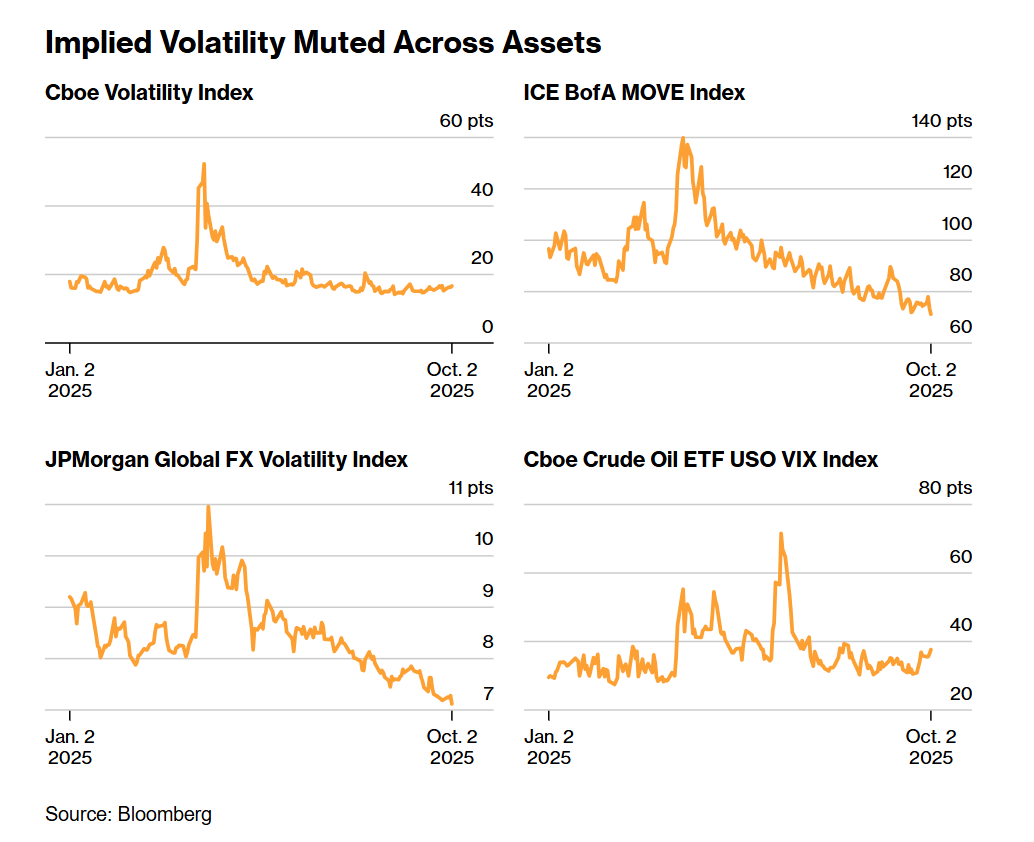
Core Viewpoint - Despite the implied volatility of market benchmark indices remaining stable or declining throughout the year, the risk premium for options across various assets, including stocks and gold, has been rising due to the subdued actual market volatility [1][5]. Group 1: Market Dynamics - The increase in risk premium is attributed to the difference between expected market volatility and actual volatility, driven by various factors such as interest rate expectations affecting gold, supply-demand outlooks limiting oil price fluctuations, and uncertainties surrounding Federal Reserve policies impacting stock market performance [5]. - The S&P 500 index has experienced low correlation among individual stocks, which has suppressed overall volatility, even as earnings season approaches [8][10]. Group 2: Options Market Insights - September saw record trading volumes in options, as investors began to hedge against year-end market movements, leading to heightened expectations of volatility [5]. - Fixed strike volatility has significantly increased, with implied volatility remaining high relative to actual volatility metrics [5][7]. Group 3: Oil Market Analysis - Oil prices have been trapped in a narrow range due to conflicting market expectations of oversupply and geopolitical tensions affecting short-term supply [9]. - The implied volatility of the United States Oil Fund is currently at the 77th percentile of the past year, indicating a high level of risk premium despite limited price movements [9]. Group 4: Gold Market Trends - Gold's implied volatility has been rising, pushing the risk premium for options to a five-year high, primarily due to record-high gold prices and uncertainties surrounding a potential U.S. government shutdown [11][14]. - The fear of missing out (FOMO) among investors has led to a significant increase in option premiums during periods of price surges, although a stabilization in gold prices could lead to a decrease in these premiums [14].
Commodity Market Roundup- September’s Top Performers and Underperformers
Yahoo Finance· 2025-10-01 15:02
Commodity Prices - Agricultural commodity prices in the grain/oilseed, soft, and animal protein sectors experienced losses in September, with the exception of October lean hog futures, which gained 5.08% [1] - Cooperative weather conditions contributed to lower prices for soybean, corn, and wheat, as indicated in the September WASDE report, which remained bullish on supplies but bearish on prices [6] - Soft commodities saw declines across the board, with cocoa futures leading with a 12.46% price drop, while coffee, cocoa, and orange juice prices remained elevated due to previous price surges [7] - The end of the 2025 grilling season led to lower prices for live and feeder cattle, although beef futures remained near record highs [8] Precious Metals - Gold reached a record high of nearly $3,900 per ounce, marking its eighth consecutive record quarterly peak, despite being the worst-performing precious metal in September [2] - Silver futures saw a significant increase, reaching their highest level since 2011, approaching the $49.82 high from that year and the all-time peak of $50.36 from 1980 [3] - Palladium outperformed silver with a 14.54% gain in September, while platinum futures also surged by 15.62%, reaching their highest price since February 2014 [4] - Precious metals significantly outperformed other commodities in September, with all four trading on the CME's COMEX and NYMEX divisions posting double-digit percentage gains [5] Energy Sector - In September, WTI and Brent futures prices were slightly lower due to increased OPEC+ production and U.S. energy policy, although geopolitical tensions provided some support [9] - Oil products reflected seasonal trends, with gasoline futures showing a marginal gain and heating oil futures posting a more significant increase [10] - Natural gas prices experienced a slight decline of under 1% in September, but are expected to rise as the peak demand season approaches [16] Stock Market and Economic Indicators - The stock market saw gains, with the S&P 500 rising 3.53% and reaching record highs in September, while the U.S. dollar index posted a marginal gain despite concerns over tariffs and rising debt levels [12][13][14] - The Federal Reserve cut the short-term Fed Funds Rate by 25 basis points in September, marking the first rate cut in 2025 [12] Future Outlook - Factors to watch in October include the potential for gold to reach $4,000 and silver's approach to new record highs, while livestock futures remain elevated despite expected price weakness in meats and gasoline [15] - The commodities market is anticipated to experience continued volatility in October and beyond, influenced by geopolitical events and seasonal demand changes [19]
Worthington Enterprises Post Earnings: A Buying Opportunity
Seeking Alpha· 2025-09-24 23:38
Core Insights - The Hecht Commodity Report is recognized as one of the most comprehensive commodities reports available, covering market movements of over 29 different commodities [1] - The report provides various market calls including bullish, bearish, and neutral, along with directional trading recommendations and actionable ideas for traders and investors [1][2] Group 1 - The Hecht Commodity Report includes analysis on 20 different commodities, offering insights that cater to both traders and investors [2] - The author maintains positions in commodities markets through futures, options, ETF/ETN products, and commodity equities, with these positions subject to change on an intraday basis [3] Group 2 - The report emphasizes the importance of market movements and provides actionable trading ideas, which can be beneficial for market participants [1][2]


The Dollar Index At A Critical Level: The UUP And UDN ETFs
Seeking Alpha· 2025-09-18 18:56
Group 1 - The Hecht Commodity Report is a comprehensive source for commodities analysis, covering over 29 different commodities and providing various market calls and trading recommendations [1][2] - The US Dollar Index (DXY) is currently near the lower end of its trading range for 2025 as of September 2025, indicating potential market movements [2] - The report includes actionable ideas for traders and investors, focusing on bullish, bearish, and neutral market conditions [1][2] Group 2 - The author maintains positions in commodities markets, including futures, options, ETFs, and commodity equities, which can change on an intraday basis [3] - The report emphasizes that past performance does not guarantee future results, and no specific investment advice is provided [4]

全球宏观展望与策略:全球利率、大宗商品、货币与新兴市场-Global Macro Outlook and Strategy_ Global Rates, Commodities, Currencies and Emerging Markets
2025-09-26 02:28
Summary of Key Points from the Conference Call Industry Overview - The conference call primarily discusses the **Global Macro Outlook**, focusing on **US Rates**, **International Rates**, **Commodities**, **Currencies**, and **Emerging Markets** [3][4][8]. Core Insights and Arguments US Rates - Risks to the front end of the yield curve are biased lower due to labor market weakness, while concerns about Fed independence are pushing long-end rates higher [3][15]. - The first Fed cut is projected for **September 2025**, with expectations of **four sequential cuts**, bringing the funds rate target range to **3.25-3.5%** by **1Q26** [12][11]. - Anticipated **2-year Treasury yields** are expected to reach **3.50%** and **10-year yields** to **4.20%** by the end of **2025** [12][11]. International Rates - Developed market (DM) curves have steepened, particularly in the US, amid renewed focus on the long end of the curve [4][36]. - The European policy easing is losing momentum, impacting the overall yield curve dynamics [36]. Commodities - The oil market is expected to face a significant surplus, with price forecasts remaining unchanged for now due to uncertainties surrounding China's stock build [8][88]. - The European natural gas market is entering winter with historically low storage levels, leading to a bullish stance for **4Q25** and a price target of **42 EUR/MWh** [8][93]. - Copper prices are anticipated to face bearish pressure, potentially dropping to **$9,000/mt** due to unwinding demand from the US and China [8]. Currencies - The US dollar has not weakened despite recent yield curve steepening, attributed to domestic growth factors [56][58]. - Concerns regarding Fed independence and fiscal excesses are influencing the dollar's performance, with expectations of a bearish outlook [58][63]. - Fiscal policy is expected to be a key differentiator for FX, with the hypothesis that fiscal easing supports currencies in low-debt countries [63][59]. Emerging Markets - The resilience of global growth and downside risks in the US are supporting emerging market (EM) local markets [8]. - A recommendation to stay overweight (OW) in EM FX and local rates, while maintaining a market weight (MW) in EM corporates and underweight (UW) in EM sovereigns [8]. Additional Important Insights - The US Treasury is well-funded through **FY25**, but a significant funding gap is expected to emerge in **FY26**, prompting coupon auction size increases starting in **May 2026** [19][22]. - The passage of the **OBBBA** is projected to lead to a surge in T-bill issuance, with an estimated **$529 billion** of net T-bill issuance expected in the current quarter [25][23]. - Demand from foreign investors remains weak, with expectations of a shift towards more price-insensitive demand in the Treasury market [29][31]. This summary encapsulates the critical insights and projections discussed during the conference call, providing a comprehensive overview of the current macroeconomic landscape and its implications for various markets.
中国经济评论 - 出口增速放缓但仍具韧性,全年预期存在上行风险-China Economic Comment_ Moderated but still resilient export growth, upside risk to full year projection
2025-09-11 12:11
Summary of Key Points from the Conference Call Industry Overview - The report focuses on the **China Economic** landscape, particularly regarding **export and import trends** as of August 2024. Key Insights on Exports - **Export Growth Moderation**: China's export growth slowed to **4.4%** in August from **7.2%** previously, falling short of the **5.5%** expected by Bloomberg consensus. This marks the slowest year-over-year growth since January-February [1] - **Real Terms Adjustment**: In real terms, export growth moderated to **7.1%** year-over-year from **10.2%** previously, indicating a softening momentum despite stable shipment levels [1] - **US Shipments Decline**: Shipments to the US contracted by **13%** month-over-month in August, with a **33%** year-over-year decline, reflecting the impact of elevated tariffs compared to other exporters [2] - **Positive Trends in Other Markets**: Shipments to the EU and Japan improved, with ASEAN exports, particularly to Vietnam, reaching historic highs [2] - **Tech Goods Performance**: Export growth of tech products accelerated to **6.2%** in August, driven by component-type products like ICs and panels, while consumer goods continued to drag overall export growth [3] Import Trends - **Import Growth**: Import growth moderated to **1.3%** year-over-year from **4.1%**, marking three consecutive months of year-over-year growth, a rare occurrence since the second half of 2022 [4] - **Commodity Imports Decline**: The major commodities basket saw a year-over-year import value decline of **9.6%**, contributing to slower overall import growth [4] - **Tech Component Imports**: Growth in imports of tech components moderated, raising concerns about the sustainability of China's tech export growth acceleration [4] Economic Outlook - **Upside Risk to Projections**: Despite moderating export growth expectations, the year-to-date export growth stands at **5.9%**, suggesting significant upside risk to the full-year 2025 export growth projection of **1%** [6] - **Improving Demand Indicators**: Soft data, including improvements in new export orders from China's official PMI and RatingDog PMI, indicate potential resilience in export levels [6] Additional Observations - **Consumer Goods Impact**: The wider year-over-year contraction in the consumer goods basket was identified as the biggest drag on overall export growth deceleration [3] - **RMB Performance**: The RMB appreciated modestly against the USD over August, which may influence trade dynamics [28] This summary encapsulates the critical insights from the conference call, highlighting the current state of China's export and import activities, along with economic projections and market dynamics.