实际波动率

Search documents
期权交易中常用的波动率类型
申万宏源证券上海北京西路营业部· 2025-11-26 03:24
Core Viewpoint - Volatility plays a crucial role in options pricing, trading, and risk management, and understanding different types of volatility can enhance trading effectiveness [1][2]. Summary by Categories Types of Volatility - There are three commonly used types of volatility: historical volatility, implied volatility, and actual volatility [1]. - Historical volatility refers to the standard deviation of price changes of the underlying asset over a past period, representing past volatility patterns [1]. - Implied volatility is derived from the option price using an options pricing model, reflecting the market's expectations of future price fluctuations of the underlying security [2]. - Actual volatility indicates the true volatility of stock prices over a future period, which is unknown at the time of trading and can only be estimated using historical volatility and current market information [2]. Trading Implications - In actual trading, implied volatility can be used to assess whether the option price is reasonable. If implied volatility is lower than the predicted actual volatility, the option is considered undervalued and can be bought. Conversely, if implied volatility is higher than the predicted actual volatility, the option is deemed overvalued and can be sold [2]. - The core of volatility trading is to profit from the price difference between implied volatility and future actual volatility [2].


波动率在期权交易中的特性
申万宏源证券上海北京西路营业部· 2025-11-19 07:05
Core Viewpoint - Volatility plays a crucial role in options pricing, trading, and risk management, and understanding its characteristics can enhance trading effectiveness [1][2]. Group 1: Characteristics of Volatility - Mean Reversion: Volatility typically oscillates within a certain range, such as the S&P 500's implied volatility usually between 10 to 20. A sudden spike to 30 suggests a likely return to the 10 to 20 range, allowing investors to profit by selling options [1]. - Event-Driven: Significant political and economic events can lead to substantial market volatility. Investors can anticipate these events and employ straddle strategies in the options market to capitalize on expected volatility [2]. - Overestimation of Implied Volatility: Research indicates that implied volatility often exceeds actual volatility, likely due to risk premiums paid by investors to mitigate uncertainty. Thus, selling options can yield stable returns unless a black swan event occurs [2]. - No-Arbitrage Condition: There are correlations between implied volatilities of different options contracts. Investors can create a portfolio by selling a contract with high implied volatility while buying those with lower volatility, potentially achieving risk-free profits [2].

贸易紧张局势升温!华尔街“恐慌指数”飙至近五个月来新高
智通财经网· 2025-10-14 22:30
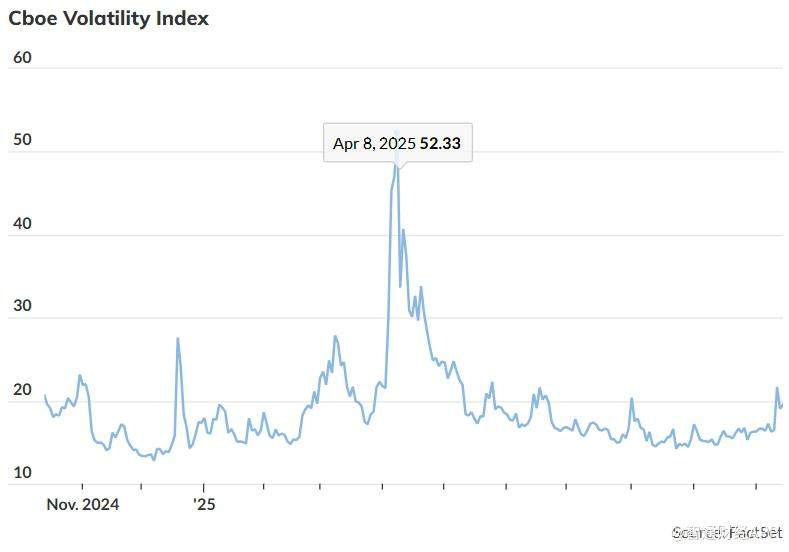
Group 1 - The VIX, known as the "fear index," surged to 22.94 points, the highest level since May 23, indicating increased investor anxiety over potential escalation in US-China trade tensions [1][4] - The long-term average of the VIX is slightly below 20 points, marking a critical threshold for market sentiment transitioning from calm to tense [4] - Since early September, a divergence between implied volatility and actual volatility has emerged, suggesting that some investors are adopting defensive strategies through options [4] Group 2 - Recent US-China trade tensions have reignited concerns, with President Trump threatening to impose 100% tariffs on all Chinese imports [7] - JPMorgan's CEO warned of credit risks expanding due to losses on loans to a subprime auto lender, indicating instability in the credit market [7] - Institutional investors, including BlackRock, have requested redemptions from a Jefferies fund that suffered significant losses due to the bankruptcy of an auto parts supplier [7]
黄金期权风险溢价飙升,交易员狂买看涨期权以对冲尾部风险
Jin Shi Shu Ju· 2025-10-06 05:11
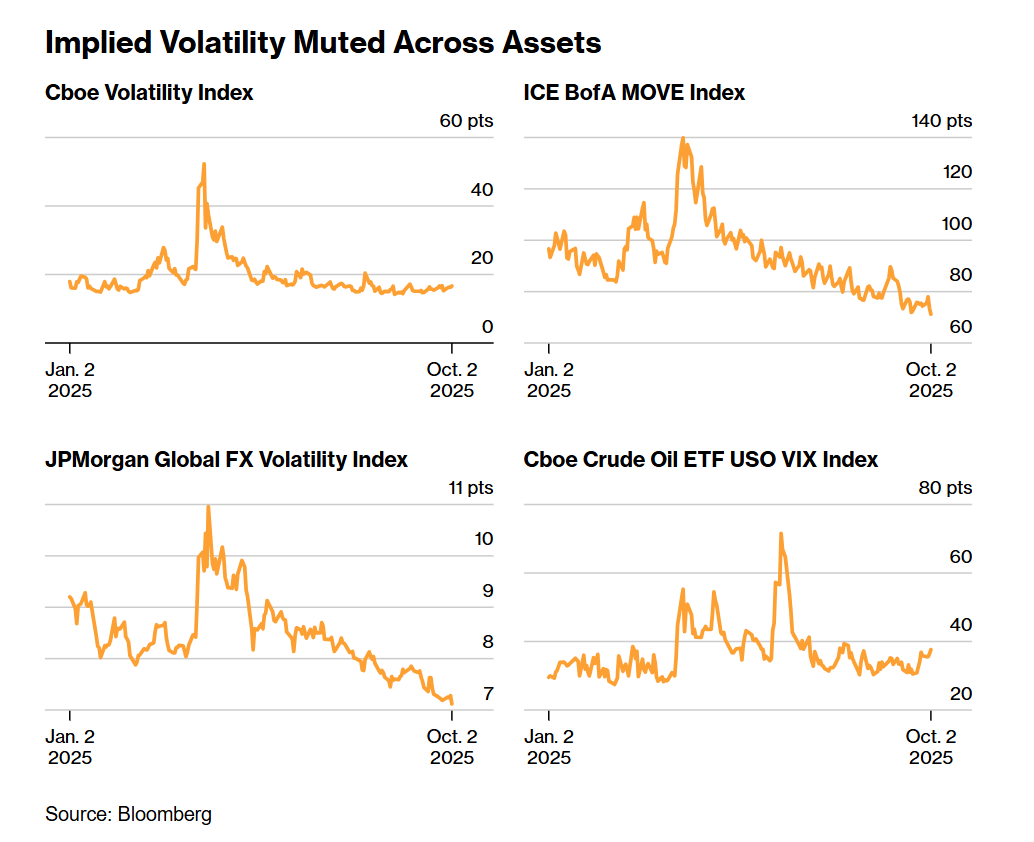
Core Viewpoint - Despite the implied volatility of market benchmark indices remaining stable or declining throughout the year, the risk premium for options across various assets, including stocks and gold, has been rising due to the subdued actual market volatility [1][5]. Group 1: Market Dynamics - The increase in risk premium is attributed to the difference between expected market volatility and actual volatility, driven by various factors such as interest rate expectations affecting gold, supply-demand outlooks limiting oil price fluctuations, and uncertainties surrounding Federal Reserve policies impacting stock market performance [5]. - The S&P 500 index has experienced low correlation among individual stocks, which has suppressed overall volatility, even as earnings season approaches [8][10]. Group 2: Options Market Insights - September saw record trading volumes in options, as investors began to hedge against year-end market movements, leading to heightened expectations of volatility [5]. - Fixed strike volatility has significantly increased, with implied volatility remaining high relative to actual volatility metrics [5][7]. Group 3: Oil Market Analysis - Oil prices have been trapped in a narrow range due to conflicting market expectations of oversupply and geopolitical tensions affecting short-term supply [9]. - The implied volatility of the United States Oil Fund is currently at the 77th percentile of the past year, indicating a high level of risk premium despite limited price movements [9]. Group 4: Gold Market Trends - Gold's implied volatility has been rising, pushing the risk premium for options to a five-year high, primarily due to record-high gold prices and uncertainties surrounding a potential U.S. government shutdown [11][14]. - The fear of missing out (FOMO) among investors has led to a significant increase in option premiums during periods of price surges, although a stabilization in gold prices could lead to a decrease in these premiums [14].
美国就业报告公布前 货币对冲成本再次攀升
Sou Hu Cai Jing· 2025-09-04 09:51
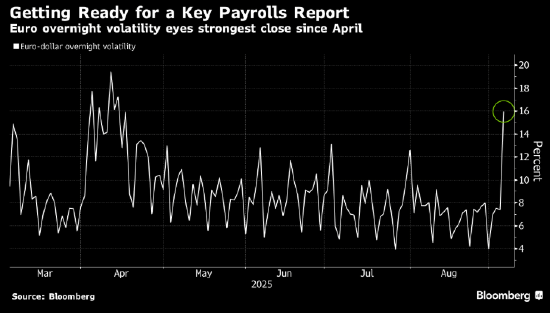
Group 1 - The cost of hedging in the foreign exchange market has risen again after a summer lull, as traders prepare for potential volatility from the upcoming U.S. employment report [1] - The implied volatility of the euro against the dollar reached its highest level since June, indicating increased market sensitivity to employment data and its implications for Federal Reserve policy [1] - A significant drop in U.S. job vacancies to a 10-month low has heightened the focus on the employment report, with expectations that weak data could lead to greater market bets on a more aggressive easing policy from the Federal Reserve [1] Group 2 - The one-week volatility of the euro has surged to a two-month high, coinciding with the upcoming European Central Bank meeting and U.S. inflation data release [2] - An options indicator tracking the difference between implied and realized volatility has shown that contract premiums have reached their highest level since January [2]
油市翻腾,股市“静默”! 战火阴云之下 期权策略深陷两难困局
智通财经网· 2025-06-23 00:18
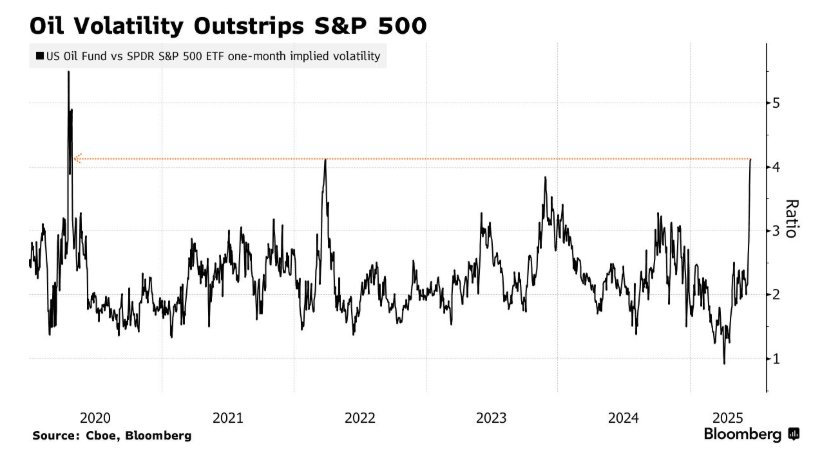
Core Viewpoint - The global geopolitical risks have significantly increased, yet the stock market remains relatively calm, creating a dilemma for options traders who are caught between selling volatility and the potential for sudden conflict escalation [1][6][12] Group 1: Market Dynamics - Since Israel's airstrikes on Iran, oil prices have surged by 11%, with oil market volatility reaching its highest level since the 2022 Russia-Ukraine conflict [1][3][7] - The implied volatility (IV) has dropped significantly from its spring highs, while the actual volatility (RV) remains low, leading to a situation where IV appears expensive despite its decline [2][10] - The S&P 500 index has only decreased by 1.3%, while the implied volatility gap has widened to its highest level in about a year [3][7] Group 2: Options Trading Strategies - Options traders are currently in a precarious position, balancing between the fear of sudden geopolitical events causing IV to spike and the risk of time decay (theta) eroding the value of bought volatility [2][6][8] - Selling volatility typically involves strategies like selling straddles or strangles, with profits dependent on actual volatility being lower than implied volatility [2][10] - The current market environment has led to a chaotic global options market, where implied volatility has decreased significantly, but premiums remain high, complicating profitable trading strategies [10][12] Group 3: Investor Sentiment and Strategy Shifts - Investor sentiment has shifted from a "Buy America" strategy to a more mixed stance, reflecting fatigue with headline news and uncertainty regarding geopolitical developments [7][11] - Some traders are adopting "stock replacement" strategies, using options to hedge against market risks while maintaining their positions [12][13] - The Cboe VVIX index, which measures the volatility of the VIX, has risen to a high level, indicating increased market willingness to purchase options for hedging against significant volatility [12]