PCs

Search documents
Canalys:二季度全球PC出货量同比增长7%
news flash· 2025-07-10 06:44
Core Insights - The total shipment volume of desktops, laptops, and workstations is projected to grow by 7.4% year-on-year in Q2 2025, reaching 67.6 million units [1] Summary by Category Laptops - Laptop shipments, including mobile workstations, are expected to reach 53.9 million units, reflecting a year-on-year growth of 7% [1] Desktops - Desktop shipments, including desktop workstations, are anticipated to grow by 9%, reaching 13.7 million units [1]
高盛:台湾 ODM 品牌_3 个月前瞻_ASIC 人工智能服务器呈上升趋势;2025 年下半年机架级模型转换;关税拉动带来高基数
Goldman Sachs· 2025-07-01 02:24
Investment Rating - Buy: Hon Hai, Wiwynn, Wistron, Gigabyte, ASUS, AVC; Neutral: Quanta, Inventec [8] Core Insights - The average year-over-year revenue growth for ten companies in the AI servers and AI PCs supply chain is expected to be +37% in June 2025, +27% in July 2025, and +18% in August 2025, driven by the ramp-up of AI servers and new product launches [1] - Rack-level AI servers are transitioning models, which may impact revenue growth in the second half of 2025 [1] - Geopolitical uncertainties are causing changes in end market demand, leading to a slower month-over-month growth forecast of -6% in June, -8% in July, and +2% in August 2025 [1] Company Summaries Hon Hai - Expected 2Q25 revenues to grow 17% YoY to NT$1,813 billion, driven by AI server demand and tariff-related consumption pull-ins [13] - May revenues were 6% below estimates, affected by slower customer pull-in momentum and negative exchange rate impacts [13] - Maintain Buy rating with a target price of NT$242 based on a 14.9x 2026E P/E multiple [15] Quanta - Anticipated 2Q25 revenues to grow 57% YoY to NT$488 billion, supported by AI server ramp-up [20] - May revenues were 13% below estimates, with a decline in notebook shipments [20] - Maintain Neutral rating with a target price of NT$273 based on a 12.8x 2026E P/E [23] Wiwynn - Expected 2Q25 revenues to grow 161% YoY to NT$202 billion, driven by strong demand for ASIC AI servers [38] - May revenues were 34% higher than estimates, reflecting continued strong demand [39] - Maintain Buy rating with a target price of NT$3,838 based on a 20.5x 2026E P/E [42] Wistron - Expected June revenues to grow 123% YoY to NT$198 billion, driven by AI server demand [47] - Strong revenue in May, up 162% YoY, supported by new product cycles [44] - Maintain Buy rating with a target price of NT$152 based on a 14.8x 2026E P/E [49] Gigabyte - Expected 2Q25 revenues to grow 32% YoY to NT$97 billion, supported by AI servers and VGAs [50] - May revenues were 79% above estimates, reflecting tariff-related pull-ins [51] - Maintain Buy rating with a target price of NT$344 based on a 14.0x 2026E P/E [55] AVC - Expected 2Q25 revenues to grow 67% YoY to NT$27 billion, driven by liquid cooling business [27] - May revenues were higher than estimates, reflecting the rising trend in liquid cooling [27] - Maintain Buy rating with a target price of NT$878 based on a 20.0x 2026E P/E [37] ASUS - Expected 2Q25 revenues to grow 21% YoY to NT$175 billion, supported by AI and gaming PCs [57] - May revenues were up 41% YoY, exceeding estimates [62] - Maintain Buy rating with a target price of NT$849 based on a 14.6x 2026E P/E [63] Inventec - Expected June revenues to be similar to May, supported by AI server ramp-up [65] - Maintain Neutral rating with a focus on AI server revenue contribution [65]
Apple's Powerful Macs Gaining Market Share: What's the Path Ahead?
ZACKS· 2025-06-30 17:35
Group 1: Company Performance - Apple has gained market share in the PC market, with Mac sales reaching $7.95 billion in Q2 FY25, a 6.7% year-over-year increase, accounting for 8.3% of total sales [1][10] - Mac shipments increased by 14.1% to 5.5 million units in Q1 2025, boosting Apple's market share to 8.7% according to IDC [2][10] - Gartner reported a year-over-year market share increase of 20 basis points for Apple, reaching 10.1% with shipments of 5.933 million units, while competitors Lenovo, HP, and Dell hold larger shares [3] Group 2: Product Innovations - The launch of the M3 Ultra chip on March 5, 2024, is expected to enhance Mac growth, featuring a powerful CPU and GPU, and a 32-core neural engine for AI applications [4][10] - The upcoming macOS Tahoe 26 will introduce new design features and personalization options, with expectations for M5 chip-powered MacBooks to further drive shipment volumes [5] Group 3: Competitive Landscape - The PC market is expected to see increased demand due to generative AI-enabled PCs and Windows 11 upgrades, benefiting competitors like Lenovo, HP, and Dell [6] - Dell Technologies is focusing on the commercial market, which constitutes 80% of its PC revenue, positioning itself as a strong competitor in the enterprise sector where Apple is gaining traction [7] Group 4: Stock Performance and Valuation - Apple shares have declined 19.7% year-to-date, underperforming the broader Zacks Computer & Technology sector, which has returned 6.2% [8] - The forward 12-month Price/Earnings ratio for Apple is 26.7X, slightly above the industry average of 26.16X, indicating a premium valuation [11]


The Canton Fair in the Eyes of a British Scholar: Let the World Share China's Opportunities
Shang Wu Bu Wang Zhan· 2025-06-25 15:47
Core Insights - The Canton Fair, established in 1957, is a significant biannual event that showcases the internationalization of China's trade [2][3] - The current edition has attracted nearly 43,000 exhibitors and around 250,000 visitors, covering an area of 1.55 million square meters [3][4] Global Reach and Promotion - The fair has expanded its international reach through promotional events in various cities, including Vienna, Budapest, and Amsterdam, as well as in African countries like Nigeria, Ethiopia, and Kenya [5] - The Canton Fair has been instrumental in helping Chinese brands, such as BYD, Huawei, Haier, and Lenovo, gain global recognition and market penetration [6] Opportunities for Businesses - The fair provides a platform for both large and small businesses to network and expand beyond major Chinese cities [8] - It accommodates a diverse range of sectors, with the spring fair focusing on electronics and home appliances, while the autumn fair emphasizes textiles and consumer goods [9] Changing Business Mindset - The participation of big companies aims to enhance international exposure and experience, reflecting a shift in the business mindset of Chinese exhibitors towards more proactive engagement in international trade [11][12] - The rise of Chinese fashion brands and designers illustrates the evolving outlook of Chinese enterprises in the global market [13] Cultural Appeal - The fair is complemented by the cultural attractions of Guangzhou, enhancing the overall experience for visitors [14] Future Prospects - The latest edition of the Canton Fair is expected to be larger and more impactful, aligning with the growing importance of international trading opportunities [15][16]
DELL's CSG Revenues Rise: Is an Improving PC Market the Catalyst?
ZACKS· 2025-06-20 17:00
Core Insights - Dell Technologies (DELL) is well-positioned to capitalize on the strong demand for AI-capable PCs driven by the Windows 11 refresh cycle and enterprise upgrades [2][11] - The company is expanding its partnerships with major players like NVIDIA and Microsoft to enhance its AI capabilities and enterprise solutions [3][5][11] - Dell faces significant competition in the PC market from HP and Apple, which are also focusing on AI-enabled products [6][8] Group 1: AI and Market Demand - Dell's AI prospects are strong, with expansion from cloud service providers to enterprise deployments and edge computing [1] - The company reported CSG revenues of $12.50 billion in Q1 FY26, reflecting a 5% year-over-year increase, driven by strong demand in the commercial segment [2][11] - Dell's partnership with Lowe's aims to enhance customer experiences through advanced AI and PC technologies, optimizing inventory and streamlining operations [4] Group 2: Competitive Landscape - Dell faces stiff competition from HP, which is launching innovative AI PCs and expects 40-60% of all PCs to be AI-enabled within three years [6][7] - Apple's Mac business is thriving due to strong demand for its M4 chip products, further intensifying competition in the PC market [8] Group 3: Financial Performance and Valuation - DELL's stock has risen 1.1% year to date, underperforming the broader Zacks Computer & Technology sector's return of 1.6% [9] - The forward 12-month Price/Sales ratio for DELL is 0.77X, significantly lower than the sector's 6.36X, indicating a premium valuation [12] - The Zacks Consensus Estimate for Q2 FY26 earnings is $2.26 per share, reflecting an 11.5% increase in the past 30 days and a year-over-year growth of 19.58% [14]

惠普公司-2025 财年第二季度初步评估:业绩未达预期,个人电脑需求和利润率下降
2025-06-02 15:44
Summary of HP Inc. (HPQ) Conference Call Company Overview - **Company**: HP Inc. (HPQ) - **Industry**: Personal Computers and Printing Key Financial Metrics - **F2Q25 EPS**: $0.71, missing Goldman Sachs (GS) estimate of $0.82 and consensus of $0.80 [2][3] - **Revenue**: $13.2 billion, in line with GS estimate of $13.2 billion but slightly below consensus of $13.1 billion [2][5] - **EBIT**: $961 million with a margin of 7.3%, missing GS estimate of $1.1 billion and consensus of $1.1 billion [2][9] - **Personal Systems Group Revenue**: $9.024 billion, above GS estimate of $9.019 billion [5] - **Printing Revenue**: $4.181 billion, below GS estimate of $4.221 billion [5] Guidance and Outlook - **F3Q25 EPS Guidance**: $0.68-$0.80, below consensus of $0.90 [6] - **F2025 EPS Guidance**: Lowered to $3.00-$3.30 from $3.45-$3.75, reflecting moderated demand and tariff impacts [2][7] - **Free Cash Flow Guidance**: Lowered to $2.6-$3.0 billion from $3.2-$3.6 billion [2][7] - **PC Industry Outlook**: Now expects low single-digit percentage (LSD%) unit growth year-over-year, down from mid-single-digit percentage (MSD%) [1][7] Performance Analysis - **PC Margins**: Weakness attributed to supply chain resiliency initiatives and competitive dynamics [1] - **Printing Margins**: Improved to 19.5%, above GS estimate of 19.0% [2][9] - **Cost of Revenue**: Increased to $10.481 billion, reflecting a 7% year-over-year increase [10] Risks and Challenges - **Demand Risks**: Slower-than-expected consumer demand and potential increases in hybrid work could negatively impact commercial PC demand [12] - **Pricing Pressure**: High levels of industry channel inventory and declining component costs may lead to lower margins [12] - **Market Competition**: Increased competition in both commercial and consumer printing markets [13] Strategic Initiatives - **Focus on Higher-Margin Products**: HPQ is shifting towards higher-margin hardware and ink subscription services to mitigate headwinds in the printing segment [13] - **Capital Allocation Policy**: HPQ aims to return 100% of free cash flow to shareholders through dividends and buybacks [14] Investment Thesis - **Neutral Rating**: Goldman Sachs maintains a neutral rating on HPQ with a 12-month price target of $27, indicating a downside potential of 4.7% from the current price of $28.34 [11][15] Conclusion HPQ's recent performance reflects challenges in the PC market due to macroeconomic factors and competitive pressures, leading to lowered guidance and expectations. The company's strategic focus on higher-margin products and commitment to returning capital to shareholders may provide some support in navigating these challenges.

HP Inc.:惠普公司(HPQ):2025财年第二季度初步评估:个人电脑需求和利润率未达预期且下调-20250530
Goldman Sachs· 2025-05-30 02:50
Investment Rating - The report assigns a Neutral rating to HP Inc. (HPQ) with a 12-month target price of $27, indicating a downside potential of 4.7% from the current price of $28.34 [11][15]. Core Insights - HPQ's F2Q25 earnings per share (EPS) of $0.71 missed Goldman Sachs (GS) estimates of $0.82 and consensus of $0.80, while revenue of $13.2 billion was largely in line with estimates [2][3]. - The company lowered its guidance for F2025 EPS to $3.00-$3.30 from a previous range of $3.45-$3.75, reflecting moderated demand and the impact of tariffs [2][7]. - The outlook for the PC industry has been adjusted to low single-digit percentage (LSD%) unit growth year-over-year, down from mid-single-digit percentage (MSD%) growth previously expected [7][13]. Financial Performance - HPQ's F2Q25 revenue of $13,220 million was slightly below GS estimates of $13,241 million but above consensus of $13,132 million, showing a year-over-year increase of 3% [8][10]. - The Personal Systems Group revenue was $9,024 million, exceeding GS estimates, with a 6% year-over-year increase in units [5][10]. - Printing revenue was $4,181 million, which fell short of GS estimates and consensus, with total units up 1% [5][10]. Margin Analysis - The non-GAAP operating income for F2Q25 was $961 million, missing GS estimates of $1,076 million, with a margin of 7.3% [9][10]. - Personal Systems Group EBIT margins were reported at 4.5%, significantly below the GS estimate of 5.7% [9][10]. - Printing EBIT margins improved to 19.5%, slightly above GS estimates of 19.0% [9][10]. Future Guidance - For F3Q25, HPQ provided guidance for GAAP diluted EPS of $0.57-$0.69 and non-GAAP diluted EPS of $0.68-$0.80, which is below the consensus estimate of $0.90 [6][11]. - The company anticipates free cash flow for F2025 to be in the range of $2.6-$3.0 billion, down from a previous estimate of $3.2-$3.6 billion [2][7]. Investment Thesis - The report suggests that HPQ's growth may be impacted by softer near-term demand for PCs and printing due to macroeconomic factors and excess channel inventory [13]. - However, HPQ's focus on higher-end PCs and initiatives in the printing segment, such as ink subscription services, may provide a competitive edge [13][14].
DELL Set to Report Q1 Earnings: Buy, Sell or Hold the Stock?
ZACKS· 2025-05-26 17:51
Core Insights - Dell Technologies is set to report its first-quarter fiscal 2026 results on May 29, with expected revenues between $22.5 billion and $23.5 billion, indicating a 3% year-over-year growth at the midpoint of $23 billion [1] - The Zacks Consensus Estimate for revenues is $23.10 billion, suggesting a 3.86% growth from the previous year, while the consensus for earnings is $1.71 per share, reflecting a year-over-year growth of 34.65% [2] Financial Performance - Dell Technologies has consistently beaten the Zacks Consensus Estimate in the last four quarters, with an average earnings surprise of 5.13% [3] - The anticipated revenue growth for the combined Infrastructure Solutions Group (ISG) and Client Solutions Group (CSG) is 6% year-over-year at the midpoint, with ISG expected to grow in the low teens and CSG revenues expected to remain flat [5] Market Dynamics - The ISG revenues are estimated at $10.379 billion, indicating an 11.2% year-over-year growth, while CSG revenues are pegged at $12.237 billion, suggesting a 2.25% year-over-year growth [6] - The demand for AI-optimized servers is expected to have positively impacted Dell's fiscal first-quarter results, driven by digital transformation and interest in generative AI applications [4][7] Competitive Position - Dell Technologies' leadership in AI-optimized servers, including the PowerEdge 9680, has contributed to its growth, with a reported increase of $1.7 billion in AI server orders in the previous quarter [7] - The company's shares have underperformed the broader Zacks Computer & Technology sector year-to-date, losing 2.7% compared to the sector's 3.6% return, attributed to macroeconomic challenges and trade tensions [8] Valuation Metrics - Dell Technologies shares are considered undervalued, with a Value Score of B and a forward 12-month price-to-sales ratio of 0.75X, significantly lower than the sector's average of 6.12X [11] Strategic Partnerships - Dell's expanding partner base, including collaborations with NVIDIA, Microsoft, and Meta Platforms, is likely to have driven growth during the fiscal first quarter [13][14][15] - The partnership with NVIDIA aims to accelerate enterprise AI adoption, which is expected to reflect positively in the upcoming quarter's performance [14]

联想(00992)Q1在美市场增速达20.7% 强势抢占商用PC赛道
智通财经网· 2025-04-14 11:31
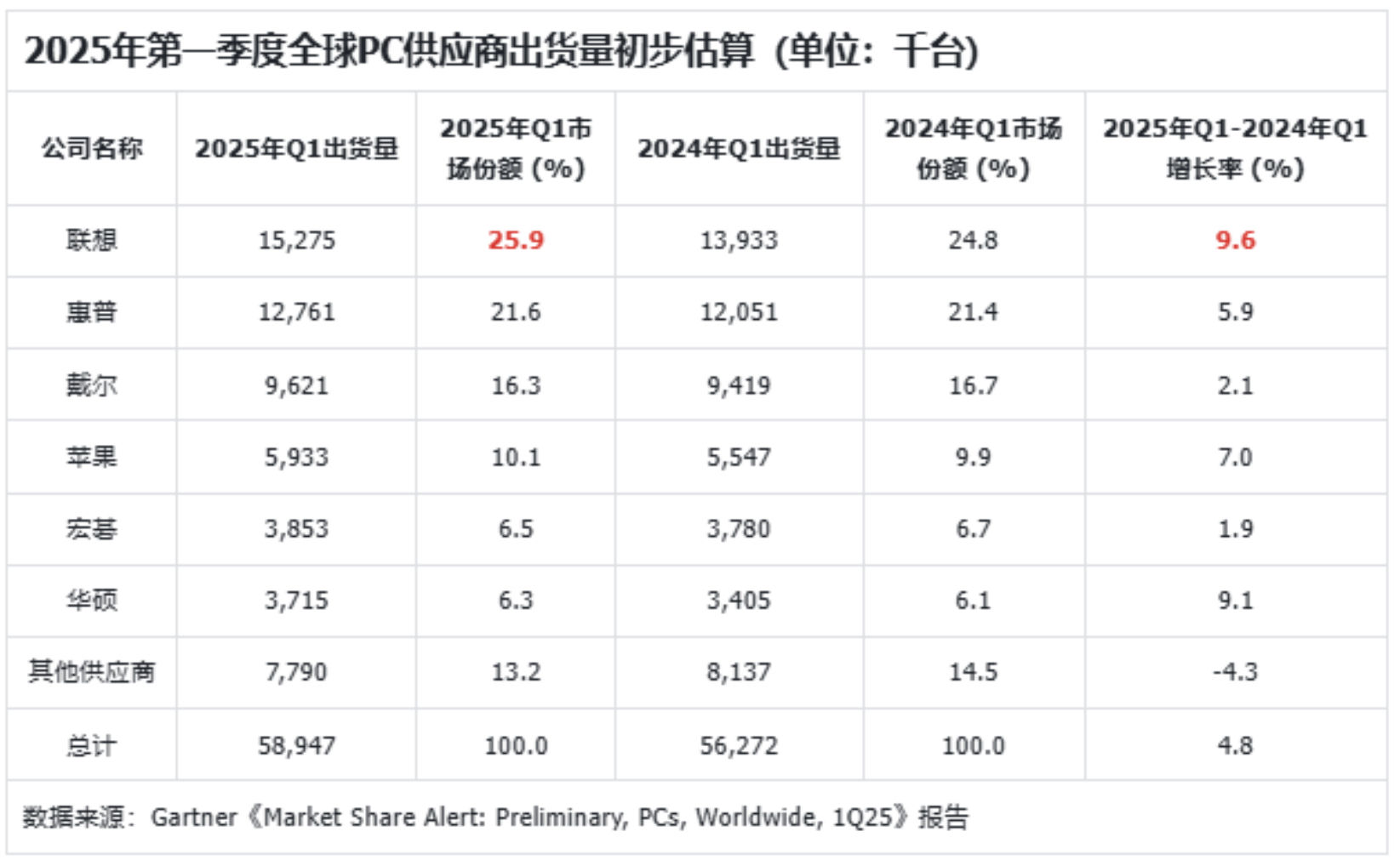
Core Insights - The global PC market is experiencing growth for the sixth consecutive quarter, with a year-on-year increase of 4.8% in Q1 2025 [1] - Lenovo leads the market with a remarkable year-on-year growth rate of 9.6%, solidifying its position as the top PC supplier globally [1] Group 1: Lenovo's Performance - In Q1 2025, Lenovo shipped 15.275 million units, capturing a market share of 25.9%, up from 24.8% in the same period last year [2] - Lenovo's performance in the U.S. market is also strong, with shipments reaching 314.7 thousand units, a year-on-year increase of 20.7%, and market share rising from 17.9% to 19.2% [2] Group 2: Market Dynamics - The growth in the global PC market is primarily driven by significant increases in shipments in the U.S. and Japan, with the U.S. seeing a 12.6% rise and Japan experiencing a 15.6% increase [4] - The EMEA market shows a growing interest in AI PCs, which now account for approximately 15% of the market, indicating a willingness among buyers to invest in higher-priced future-proof devices [4] - The APAC region's shipment volume remained flat, with a 4% decline in demand from the Chinese market, while the Indian market shows positive signals with expected recovery in commercial demand [4] Group 3: Future Outlook - Gartner forecasts continued growth in the global PC market for 2025 and 2026, driven by Windows 11 upgrades and AI PC demand [4] - Despite potential short-term impacts from tariff policies, the commercial PC market's upgrade needs and consumer replacement cycles are expected to provide sustained momentum for the market [4]

PC Market Starts 2025 With Solid Growth, Tariff Turbulence Looms
ZACKS· 2025-04-09 15:21
Core Insights - The global PC market experienced a 4.9% year-over-year increase in first-quarter shipments, totaling 63.2 million units, marking six consecutive quarters of growth [1] - However, the growth is largely attributed to pre-tariff stockpiling by vendors and buyers, raising concerns about future demand due to new U.S. tariffs [2][3] Market Dynamics - The first-quarter performance was artificially inflated due to strategic decisions by supply chain players to accelerate shipments ahead of tariff impacts [3] - Despite the pre-tariff boost, underlying demand for commercial PCs remains strong, driven by the upcoming end of Windows 10 support and interest in AI-enabled devices [4][5] Vendor Performance - Lenovo maintained its market leadership with 15.2 million shipments and a 24.1% market share, an increase from 22.8% year-over-year [6] - HP and Dell followed with 12.8 million and 9.6 million shipments, respectively, while Apple saw a significant 14.1% year-over-year growth, reaching 5.5 million units [6][7] Future Outlook - The introduction of new U.S. tariffs has created uncertainty, with potential strategies for vendors including relocating manufacturing and adjusting inventories [8] - Cost increases from tariffs are expected to impact consumers and enterprise buyers, potentially delaying purchases and affecting demand levels [9] - Overall, while the PC market showed strong early traction in 2025, the outlook remains unstable due to inflation and macroeconomic risks [10]