
电商服务

Search documents
壹网壹创(300792.SZ):2025年中报净利润为7070.71万元
Xin Lang Cai Jing· 2025-08-29 02:27
Core Insights - The company reported a total revenue of 533 million yuan for the first half of 2025, ranking 11th among disclosed peers, which represents a decrease of 88.90 million yuan or 14.30% compared to the same period last year [1] - The net profit attributable to shareholders was 70.71 million yuan, with a net cash inflow from operating activities of 183 million yuan [1] Financial Metrics - The latest debt-to-asset ratio is 5.44%, an increase of 1.42 percentage points from the previous quarter [3] - The latest gross profit margin stands at 29.80%, ranking 8th among disclosed peers [3] - The return on equity (ROE) is 2.44% [3] - The diluted earnings per share (EPS) is 0.30 yuan [3] - The total asset turnover ratio is 0.17 times, ranking 13th among disclosed peers, which is a decrease of 0.03 times or 14.64% compared to the same period last year [3] - The inventory turnover ratio is 1.46 times, also ranking 13th among disclosed peers [3]


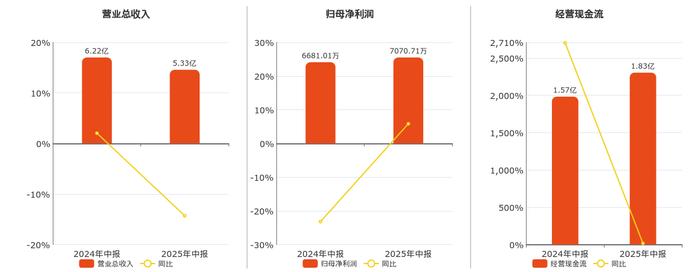
壹网壹创:2025年半年度净利润约7071万元,同比增加5.83%
Mei Ri Jing Ji Xin Wen· 2025-08-28 18:47
(记者 张喜威) 每经头条(nbdtoutiao)——申请超2万份,已开出41家,加盟海底捞,你要准备多少钱?1000万元不算 多,真实"账单"公布 每经AI快讯,壹网壹创(SZ 300792,收盘价:29.4元)8月29日发布半年度业绩报告称,2025年上半年 营业收入约5.33亿元,同比减少14.3%;归属于上市公司股东的净利润约7071万元,同比增加5.83%;基 本每股收益0.3元,同比增加7.14%。 ...
宝尊2025第二季度调整后经营利润达5900万 同比增长489%
Zhi Tong Cai Jing· 2025-08-28 18:23
Group 1 - The core viewpoint of the article highlights the financial performance of Baozun E-commerce in the second quarter, showcasing growth in various segments [1][2] - In Q2, the e-commerce segment generated product sales revenue of 600 million, a year-on-year increase of 3% [1] - Online store operation revenue reached 480 million, reflecting an 8% year-on-year growth [1] - Digital marketing and technology service revenue amounted to 580 million, with a 12% year-on-year increase [1] - The overall net revenue for Baozun in Q2 was 2.6 billion, representing a 7% year-on-year growth [2] - The brand management segment achieved net revenue of 400 million, showing a significant year-on-year growth of 35% [2] - The gross profit from comprehensive product sales was 280 million, which is a 28% increase compared to the previous year [2] - Adjusted operating profit for the group was 59 million, marking a substantial year-on-year increase of 489% [2] Group 2 - The company continues to implement a high-quality distribution strategy, leading to sustained revenue growth and improved gross margins [1] - New product categories contributed to revenue growth, while service capabilities were continuously enhanced [1] - The digital marketing and technology services segment achieved double-digit growth, indicating strong performance in these areas [1]

宝尊电商中期净营收增加5.63%
Bei Jing Shang Bao· 2025-08-28 14:53
Group 1 - The core viewpoint of the article is that Baozun E-commerce reported its interim financial results for the six months ending June 30, 2025, showing a revenue increase but also a significant loss [1] Group 2 - The company achieved a net revenue of 4.617 billion yuan, representing a year-on-year increase of 5.63% [1] - The company incurred a loss of 97.04 million yuan during the reporting period [1]
宝尊电商-W(09991)发布中期业绩 总净营收46.17亿元 同比增加5.63%
Xin Lang Cai Jing· 2025-08-28 11:44
Group 1 - The core viewpoint of the article is that Baozun E-commerce (09991) reported a total net revenue of 4.617 billion RMB for the six months ending June 30, 2025, representing a year-on-year increase of 5.63% [1] - Service revenue grew by 1.8% during the same period, driven by strong digital marketing demand from brand partners and robust performance in the sports apparel and accessories category [1] - The company continues to enhance its omnichannel capabilities, with approximately 48.5% of brand partners operating stores in at least two channels in collaboration with the company, up from 45.8% in the same period last year [1]
宝尊电商-W发布中期业绩 总净营收46.17亿元 同比增加5.63%
Zhi Tong Cai Jing· 2025-08-28 11:38
Core Insights - The company reported total net revenue of 4.617 billion RMB for the six months ending June 30, 2025, representing a year-on-year increase of 5.63% [1] - Service revenue grew by 1.8%, driven by strong digital marketing demand from brand partners and robust performance in the sports apparel and accessories category [1] - The company continues to enhance its omnichannel capabilities, with approximately 48.5% of brand partners operating stores through at least two channels in collaboration with the company, up from 45.8% in the same period last year [1]
BAOZUN(BZUN) - 2025 Q2 - Earnings Call Presentation
2025-08-28 11:30
Financial Performance - The company's total net revenue reached RMB 2.6 billion, a year-over-year increase of 7%[7] - E-Commerce net revenue was RMB 2.2 billion, up 3% year-over-year[7] - Brand Management (BBM) net revenue reached RMB 398 million, showing a significant year-over-year growth of 35%[5] - Group product sales gross profit margin increased to 28.4% in 2Q25 from 25.4% in 2Q24[10] - Non-GAAP operating income for the group was RMB 6.1 million, a decrease of 38.9% year-over-year[5] - Adjusted Non-GAAP operating income for the group was RMB 59.1 million, a substantial increase of 489.2% year-over-year, excluding a one-time provision[5, 6] Business Segments - BBM net revenue was RMB 536 million, representing a 17% year-over-year increase[7] - E-Commerce product sales gross margin improved to 12.8% in 2Q25 from 11.7% in 2Q24[12, 30] - Brand Management gross profit margin remained relatively stable at 52%, with net revenues growing by 35% year-over-year[14, 36] Operational Expenses - Fulfillment expenses decreased to RMB 606 million in 2Q25 from RMB 627 million in 2Q24[17] - Sales and marketing expenses increased to RMB 938 million in 2Q25 from RMB 845 million in 2Q24[19] - General and administrative expenses decreased to RMB 115 million in 2Q25 from RMB 130 million in 2Q24[21]
宝尊(09991)2025第二季度调整后经营利润达5900万 同比增长489%
智通财经网· 2025-08-28 10:14
Core Insights - Baozun E-commerce (BZUN.US, 09991) reported its Q2 2025 unaudited financial results, showing a net revenue of 2.6 billion, a year-on-year increase of 7% [1] Revenue Breakdown - E-commerce segment net revenue reached 2.2 billion, up 3% year-on-year [1] - Brand management segment net revenue was 400 million, reflecting a significant year-on-year growth of 35% [1] Profitability Metrics - Gross profit from total product sales was 280 million, representing a year-on-year increase of 28% [1] - Adjusted operating profit for the group was 59 million, showing a remarkable year-on-year growth of 489% [1] Segment Performance - E-commerce segment product sales revenue was 600 million, with a year-on-year growth of 3% [1] - Online store operation revenue reached 480 million, increasing by 8% year-on-year [1] - Digital marketing and technology services revenue was 580 million, reflecting a year-on-year growth of 12% [1] Strategic Initiatives - The company continued to advance its high-quality distribution strategy in the e-commerce segment, leading to sustained gross margin improvement [1] - New product categories contributed to revenue growth, while service capabilities were continuously enhanced [1] - Digital marketing and technology services achieved double-digit growth [1]
若羽臣跌2.06%,成交额1.30亿元,主力资金净流出583.65万元
Xin Lang Cai Jing· 2025-08-28 03:04
Core Viewpoint - The stock of Ruoyuchen has experienced a significant increase of 204.77% year-to-date, despite a recent decline of 2.06% on August 28, 2023, indicating volatility in its trading performance [1]. Company Overview - Ruoyuchen Technology Co., Ltd. was established on May 10, 2011, and went public on September 25, 2020. The company is based in Guangzhou, Guangdong Province, and specializes in online operations, channel distribution, and brand planning [1]. - The main business revenue composition includes: self-owned brand - Zhanjia (33.63%), agency operation business (28.83%), brand management business (25.42%), self-owned brand - Feicui (12.12%), and other self-owned brands (0.01%) [1]. Financial Performance - For the first half of 2025, Ruoyuchen achieved operating revenue of 1.319 billion yuan, representing a year-on-year growth of 67.55%. The net profit attributable to the parent company was 72.26 million yuan, reflecting an increase of 85.60% [2]. - Since its A-share listing, Ruoyuchen has distributed a total of 178 million yuan in dividends, with 144 million yuan distributed in the last three years [3]. Shareholder Information - As of June 30, 2025, the number of shareholders for Ruoyuchen reached 27,200, an increase of 83.01% compared to the previous period. The average circulating shares per person decreased by 24.47% to 6,154 shares [2]. - Notable new institutional shareholders include Dongfanghong Qiheng Mixed A, Huahuan New Consumption Mixed A, and Dongfanghong Qidong Mixed, all of which have recently entered the top ten circulating shareholders [3].

若羽臣: 关于部分股票期权注销完成的公告
Zheng Quan Zhi Xing· 2025-08-27 16:18
Core Viewpoint - The company has completed the cancellation of stock options as part of its 2022 stock option incentive plan, which will not materially affect its financial status or operational results [1][5]. Summary of Stock Option Cancellation - The company held meetings on August 12, 2025, where it approved the cancellation of stock options due to various reasons, including one individual failing to meet payment deadlines and others leaving the company [1][2]. - A total of 44.6488 thousand stock options from the initial grant and 26.2248 thousand from the reserved grant were canceled, adjusting the number of incentive recipients from 86 to 73 for the initial grant and from 50 to 39 for the reserved grant [3][4]. Completion of Cancellation - The cancellation of stock options was confirmed by the China Securities Depository and Clearing Corporation on August 26, 2025, and these options had not been exercised, thus not impacting the company's share capital [4]. Impact on the Company - The cancellation aligns with relevant regulations and will not have a substantial impact on the company's financial condition or operational performance, nor will it affect the diligence of the management team [5].