
智能汽车

Search documents
邢自强:AI在中国不是泡沫,值得全球投资者大书特书来投资
和讯· 2025-12-17 09:41
" 特别是在去年9月24日之后政策转向,政策活了、企业活了,资金也就随之活跃,这是我们深度认 可的。 " 邢自强认为, 在整体经济面临低物价循环、房地产调整、消费复苏乏力等多重挑战的背景 正 如市场 所 预期,北京时间12月11日凌晨,美联储以降息25个基点为其年内利率决议收官。 在 这一背景下, 中国资产受全球资金青睐程度或将再 度 提升。 " 即便是整体宏观经济的挑战 、 低物价循环的风险还在,但中国出现的以人工智能 等等 为代表的 新型行业的赛道 , 已经足以让全球投资者和中国自身的资产管理者找到一定的投资机会 。" 摩根 士丹利中国首席经济学家邢自强 认为。 文/ 董映颉 12月7日,由联办集团、和讯共同主办、财经中国会承办的财经中国2025年会暨第23届财经风云榜 在北京圆满落幕。在"巅峰对话:全球变局下的资产配置"环节中,邢自强 表达了上述观点。 邢自强 用"经过跳跃般的一年之后会进入整固稳定的阶段"来概括对中国股市的展望。 他认为 ,在 经历了信心修复和估值重估后,市场可能会进入一个由企业盈利温和增长主导的、更具结构性的阶 段。 01 AI 在中国 " 显然不是泡沫 " 在风险再定价、资产再平衡 ...

11月深圳篇:2025年主流车企城市NOA试驾报告
Soochow Securities· 2025-12-17 09:00
Investment Rating - The report does not provide specific investment recommendations for individual companies or suppliers in the smart driving sector [2][5][7]. Core Insights - 2025 marks a pivotal year for automotive intelligence, initiating a three-year cycle that will elevate the domestic electrification penetration rate to 50%-80%+ [2]. - Leading smart driving manufacturers have successfully implemented urban NOA (Navigation on Autopilot) experiences, enhancing complex scenario handling and passenger experience [2]. - The report evaluates the smart driving experiences of seven manufacturers through both large sample and small sample road tests, focusing on various dimensions such as scenario implementation and comfort [2][4]. - The performance gap among manufacturers is narrowing, with second-tier manufacturers improving their capabilities significantly compared to Q1 [2]. Summary by Sections Road Test Overview - The report includes both large sample concentrated road tests and small sample in-depth road tests to assess the smart driving capabilities of various models [4][28]. - The concentrated road test was conducted on a fixed route in Shenzhen, covering complex scenarios such as narrow passages and busy intersections [31][67]. Performance Evaluation - The average takeover frequency across the tests was noted, with specific scores assigned to each vehicle based on their performance in various driving scenarios [36][37]. - The report highlights that the Wanjie M7 achieved the highest overall evaluation score, with an average takeover frequency of 0.47, indicating excellent smart driving performance [36][37]. - The performance of the Wei brand Lanshan and Xiaopeng models was also noted, with average takeover frequencies of 1.83 and 2.40, respectively, showcasing their capabilities in complex scenarios [40][42]. Model-Specific Insights - The report details the specific smart driving versions tested, including Huawei ADS 4.0, Xiaopeng XOS 5.7.8, and others, along with their respective performance metrics [12][14][18][19]. - Each model's strengths and weaknesses in handling various driving scenarios were analyzed, with particular attention to their ability to manage complex urban environments [2][67]. Future Outlook - The report anticipates that the advancements in smart driving technology will continue to evolve, with manufacturers focusing on enhancing their systems to better handle complex driving conditions [2][22].






小米明年预计研发投入约400亿元
Cai Jing Wang· 2025-12-17 08:32
Core Insights - Xiaomi Group plans to invest 200 billion yuan in research and development over the next five years, aiming to become a global leader in hard technology [1] - For the current year, Xiaomi's R&D investment is expected to reach between 32 billion and 33 billion yuan, with an estimated investment of around 40 billion yuan in 2026 [1] - The company will focus on core technologies, specifically in the areas of chips, operating systems, and artificial intelligence, while collaborating with global developers to enhance its "human-vehicle-home ecosystem" [1]

四维图新(002405.SZ):和北汽蓝谷在智能座舱、智能驾驶方面有合作,且均斩获订单
Ge Long Hui· 2025-12-17 06:57
Group 1 - The core viewpoint of the article is that Siwei Tuxin (002405.SZ) has announced a collaboration with BAIC Blue Valley in the areas of intelligent cockpit and intelligent driving, and both companies have secured orders [1] Group 2 - The collaboration focuses on advancements in intelligent cockpit technology and intelligent driving solutions [1] - Both companies have successfully obtained orders related to their partnership [1]


四维图新:和北汽蓝谷在智能座舱、智能驾驶方面有合作,且均斩获订单
Ge Long Hui· 2025-12-17 06:55
格隆汇12月17日丨四维图新(002405.SZ)在互动平台表示,公司和北汽蓝谷在智能座舱、智能驾驶方面 有合作,且均斩获订单。 ...
孟晚舟卸任大反转,后续来了
Xin Lang Cai Jing· 2025-12-17 05:23
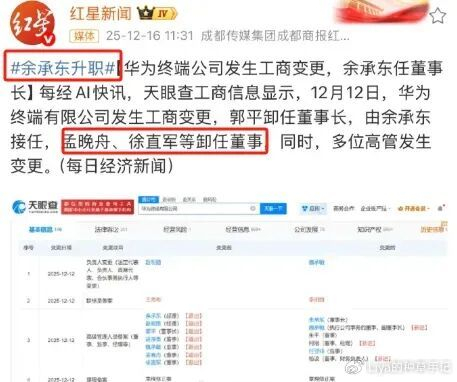
Group 1 - Huawei Terminal has undergone significant leadership changes, with Yu Chengdong officially taking over as chairman from Guo Ping, alongside the departure of other key executives like Meng Wanzhou and Xu Zhijun [1][2][5] - This leadership transition is viewed as a strategic move in response to intensified competition in the technology sector, rather than a mere personnel shuffle [5][6] - Yu Chengdong, known for his decisive leadership style, has been instrumental in establishing Huawei's terminal business and has a track record of making bold decisions to prioritize the company's core products [7][8][9] Group 2 - The recent changes in leadership are seen as a preparation for Yu Chengdong to take full control of Huawei's key business areas, including smartphones, the HarmonyOS ecosystem, and smart vehicles, enhancing decision-making efficiency [10][11][13] - Meng Wanzhou's transition to the rotating chairman role allows her to focus on broader strategic initiatives for Huawei, while Yu will manage the terminal business directly [14] - Huawei's terminal division is currently at a critical juncture, with its smartphone market share declining from 18% in Q1 2025 to 15.2% in Q3 2025, indicating challenges in maintaining its competitive position [15][16] Group 3 - The decline in market share is attributed to Huawei's push for the "pure HarmonyOS," which is a long-term strategic choice that may incur short-term costs [16][17] - The next one to two years are crucial for the success of the HarmonyOS ecosystem, as its acceptance in the market will significantly impact Huawei's terminal business future [17] - The adjustments in leadership and strategy mark the beginning of a new phase for Huawei, with a focus on overcoming challenges in the AI and smart vehicle sectors while aiming for a resurgence in the competitive landscape [17]
四维图新:公司和北汽蓝谷在智能座舱、智能驾驶方面有合作,且均斩获订单
Mei Ri Jing Ji Xin Wen· 2025-12-17 04:07
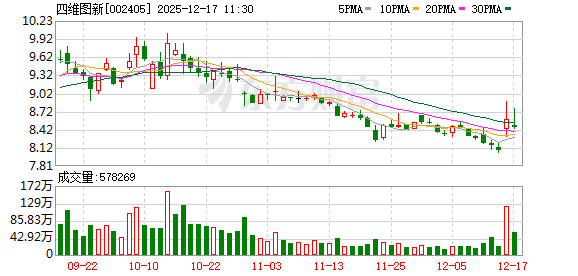
每经AI快讯,有投资者在投资者互动平台提问:请问贵公司和北汽蓝谷有哪些合作? 四维图新(002405.SZ)12月17日在投资者互动平台表示,公司和北汽蓝谷在智能座舱、智能驾驶方面 有合作,且均斩获订单。 (文章来源:每日经济新闻) ...
“鸿蒙大饭店”真的要取消了!
Sou Hu Cai Jing· 2025-12-17 03:16
Core Viewpoint - The company, Hongmeng Zhixing, has decided to stop all promotional activities related to "Hongmeng Zhixing Grand Hotel" and to standardize terminal service projects, which includes the cessation of free charging, car washing, and dining services to reduce dealer operating costs and optimize the market environment [2][4]. Summary by Sections Policy Changes - The company will cease all promotions related to "Hongmeng Zhixing Grand Hotel" and remove historical promotional materials from all platforms [4]. - Free charging, car washing, and dining services will no longer be provided at stores [4]. - The policy of free use of supercharging and fast charging stations will be canceled, with future services available through payment or points via the Hongmeng Zhixing App [5]. Service Adjustments - Car washing and dining services will only be available during specific customer interactions such as vehicle viewing, delivery, maintenance, and care, and must be managed with proper documentation [5]. - Charging and dining services cannot be used as differential marketing strategies, and violations will result in store accountability [5]. Customer Communication - The company has instructed user centers to effectively communicate and explain these changes to customers to ensure a smooth transition in service experience [5]. Market Impact - The new policy is expected to benefit actual car owners by concentrating service resources, thus improving their experience, while it will negatively impact those who previously exploited free services [9]. - This shift represents a necessary transition from marketing gimmicks to sustainable long-term operations, emphasizing the importance of matching services to genuine user needs rather than offering excessive free benefits [9].

L3级自动驾驶商业化落地驶入“快车道” 概念股集体活跃
2 1 Shi Ji Jing Ji Bao Dao· 2025-12-16 23:07
Core Insights - The Ministry of Industry and Information Technology (MIIT) of China has officially granted the first batch of L3 conditional autonomous driving vehicle permits to two models: Changan Automobile's Deep Blue SL03 and BAIC's Arcfox Alpha S, which will be tested in Chongqing and Beijing respectively [1][2][4] - This marks a significant step in the commercialization of autonomous driving technology in China, reflecting government support for the industry while ensuring safety standards are met [2][8] Group 1: Regulatory Developments - The L3 level of autonomous driving allows the system to perform all dynamic driving tasks under specific conditions, with the requirement that it can only be activated in designated operational scenarios [3][4] - The Deep Blue SL03 is permitted to operate in congested traffic environments at a maximum speed of 50 km/h on specific roads in Chongqing, while the Arcfox Alpha S can operate at up to 80 km/h on designated highways in Beijing [4][6] Group 2: Industry Impact - Following the announcement, stocks related to intelligent driving surged, with companies like Wanji Technology and Zhejiang Sebao hitting their daily price limits [2] - The approval process involved multiple unified tests and consideration of long-term testing data from various regions, indicating a thorough evaluation by the authorities [8][9] Group 3: Future Outlook - The MIIT plans to expand the L3 autonomous driving pilot program to include more models and regions in the coming year, alongside efforts to clarify traffic safety responsibilities and establish regulatory frameworks [9] - Industry experts emphasize the importance of creating a commercial ecosystem around autonomous driving technology to ensure sustainable development and safety [8][9]

L3级自动驾驶开闸 智能汽车板块大幅上涨
Zheng Quan Shi Bao· 2025-12-16 18:09
Group 1 - The A-share smart car sector experienced significant gains, with stocks like Hanxin Technology and Wanjie Technology hitting the daily limit, indicating strong market interest in the sector [1] - China's first batch of L3 conditional autonomous driving vehicle permits has been officially announced, marking a transition from testing to commercial application in the smart connected vehicle industry [1] - The Ministry of Industry and Information Technology's recent plan emphasizes the approval of L3 autonomous driving vehicle production, which is expected to catalyze industry growth by 2026 [2] Group 2 - Assisted driving features are becoming a crucial factor in Chinese consumers' car purchasing decisions, with several automakers already capable of mass-producing L3 level vehicles [2] - The net buying amount of financing funds for smart car concept stocks exceeded 1 billion yuan, with Hikvision and Jianghuai Automobile leading in net buying amounts [2] - Hikvision's automotive electronics division focuses on smart driving sensors, achieving rapid revenue growth and establishing a leading position in the domestic smart driving sensor market [2][3] Group 3 - Desay SV's smart cockpit business aims to enhance human-machine interaction for future smart travel scenarios, indicating a trend towards integration of smart driving and smart cockpit technologies [3] - Predictions indicate that 19 smart car concept stocks may see net profit growth exceeding 30% in 2025, with companies like Foton Motor and SAIC Group expected to double their net profits [3] - SAIC Group's strategic partnership with Huawei is anticipated to enhance its technological capabilities and market competitiveness in the smart and high-end vehicle sectors [3]