茧丝绸

Search documents
商务部等7部门:增强茧丝保障能力
Zheng Quan Shi Bao Wang· 2025-11-17 08:11
Core Viewpoint - The Ministry of Commerce and six other departments have issued a notice to enhance the silk industry in China, focusing on improving the supply chain and technological advancements in silk production [1] Group 1: Industry Development - The notice emphasizes the need to strengthen the silk supply capacity and optimize the layout of sericulture regions [1] - It promotes the integration and dissemination of green, high-quality, and efficient technological models in the silk industry [1] - The development of specialty agricultural insurance for sericulture products is supported [1] Group 2: Production and Quality Improvement - The initiative aims to stabilize the production capacity of existing silk reeling enterprises and upgrade outdated equipment [1] - There is a focus on optimizing silk reeling processes to enhance the quality of raw silk products [1] - A series of technological transformation projects in the silk industry will be implemented, including the application of advanced technologies such as machine sorting of cocoons and intelligent boiling of cocoons [1] Group 3: Environmental and Ecological Considerations - The notice highlights the role of the mulberry industry in combating soil erosion, desertification, and rocky desertification [1] - It aims to establish a green industrial system and an ecological security barrier system [1]
7部门发文开展茧丝绸产业“东绸西固”工作
Xin Hua She· 2025-11-17 08:10
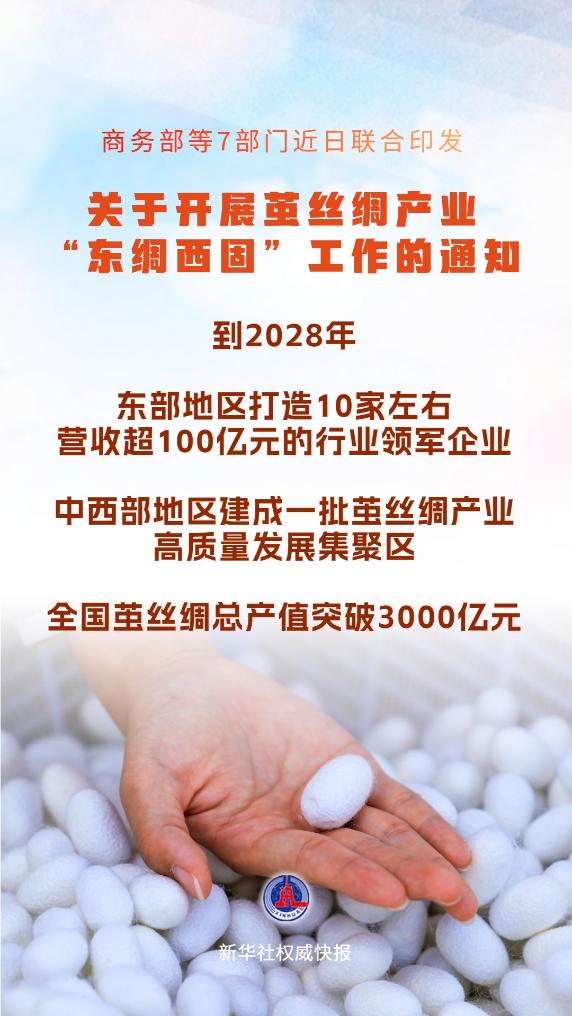
Core Insights - The Ministry of Commerce and six other departments have jointly issued a notice on the "East Silk, West Solid" initiative for the silk industry, published on November 17 [1] - The initiative aims to coordinate the silk resources and industrial foundations of the eastern, central, and western regions, adapting to the needs of the silk industry's gradual transfer [1] Group 1 - The notice emphasizes the development of new productive forces tailored to local conditions and the solid advancement of a modern silk industry system [1] - The goal is to create a new competitive advantage in the silk industry, forming a development pattern characterized by "eastern innovation leadership, central and western production support, and complementary cooperation between the east and west" [1] Group 2 - By 2028, the eastern region aims to establish around 10 leading enterprises with revenues exceeding 10 billion yuan, cultivate over 20 well-known brands with independent intellectual property and international marketing networks, and ensure that high-end silk product exports account for over 50% of the region [1] - The central and western regions are expected to develop high-quality silk industry clusters, nurturing more than 10 leading enterprises with revenues exceeding 500 million yuan, and achieving a 75% share of quality cocoons, silk, and satin production in the region [1] - The initiative also targets breakthroughs in 10 key technologies, including intelligent silk reeling, machine cocoon selection, and green dyeing, with a national silk industry output value exceeding 300 billion yuan [1]
商务部等7部门:开展茧丝绸产业“东绸西固”工作
Zheng Quan Shi Bao Wang· 2025-11-17 08:03
Core Viewpoint - The Ministry of Commerce and seven other departments have issued a notice to promote the "East Silk, West Solid" initiative for the silk industry, aiming for significant growth and development by 2028 [1] Group 1: Eastern Region Goals - By 2028, the eastern region aims to establish around 10 leading enterprises with revenues exceeding 10 billion yuan [1] - The initiative plans to cultivate over 20 well-known domestic and international brands with independent intellectual property rights and international marketing networks [1] - High-end silk product exports are expected to account for over 50% of the total in this region [1] Group 2: Central and Western Region Goals - The central and western regions are set to develop several high-quality development clusters for the silk industry, with a target of nurturing more than 10 leading enterprises with revenues exceeding 500 million yuan [1] - The production of high-quality cocoons, silk, and silk products in these regions is projected to reach 75% of the total output [1] Group 3: Technological Advancements and Overall Industry Growth - The initiative aims to break through 10 key technologies, including intelligent silk reeling, machine cocoon selection, and green dyeing [1] - The total output value of the national silk industry is expected to exceed 300 billion yuan [1]
新华社权威快报丨7部门发文开展茧丝绸产业“东绸西固”工作
Xin Hua Wang· 2025-11-17 08:00
Core Viewpoint - The Ministry of Commerce and six other departments have jointly issued a notice to promote the "East Silk, West Solid" initiative for the silk industry, aiming to enhance the modern industrial system and create new competitive advantages in the international market [4] Summary by Relevant Sections - **Resource Allocation and Development Strategy** - The initiative emphasizes the need to coordinate the silk resources and industrial foundations of the eastern, central, and western regions, adapting to the demand for the gradual transfer of the silk industry [4] - It aims to develop new productive forces tailored to local conditions and solidify the construction of a modern silk industry system [4] - **Goals and Targets by 2028** - By 2028, the eastern region is expected to establish around 10 leading enterprises with revenues exceeding 10 billion yuan, cultivate over 20 well-known domestic and international brands with independent intellectual property rights and marketing networks, and ensure that high-end silk product exports account for over 50% of the region's total [4] - The central and western regions aim to build several high-quality development clusters for the silk industry, nurturing more than 10 leading enterprises with revenues exceeding 500 million yuan, and achieving a production share of over 75% for high-quality cocoons, silk, and satin [4] - **Technological Advancements and Economic Impact** - The initiative targets breakthroughs in 10 key technologies, including intelligent silk reeling, machine cocoon selection, and green dyeing [4] - The overall output value of the national silk industry is projected to exceed 300 billion yuan [4]

一枚蚕茧里的山海情
Xin Hua Ri Bao· 2025-10-22 07:02
Core Insights - The successful testing results of silkworm cocoon production in Yining, Xinjiang, indicate the potential for developing a silk industry in the Ili River Valley, which could become a new "Silk Town" [1] - The collaboration between Nantong's leading silk enterprises and local businesses in Xinjiang aims to leverage advanced silkworm farming techniques to boost local employment and economic development [2][5] Group 1: Project Development - The establishment of the Tian Shan Baby Biotechnology Company was facilitated by the Nantong aid team, combining resources and expertise from various stakeholders [2] - The project faced challenges such as extreme winter temperatures affecting mulberry tree survival, necessitating the introduction of hybrid mulberry varieties with better cold resistance [2][3] - A new mulberry plantation covering 3,000 acres was successfully established after extensive site evaluations to ensure minimal agricultural interference [3] Group 2: Economic Impact - The first batch of silkworms was successfully introduced, with plans to distribute mature silkworms to local farmers for cocoon production, thereby enhancing local income opportunities [4][5] - The projected earnings from silkworm farming are significant, with fresh cocoon prices reaching 60,000 yuan per ton, a 20% increase from the previous year, and local farmers potentially earning over 40,000 yuan annually [5] - The Nantong aid team plans to invest further in resources and training for local farmers, aiming to create a comprehensive silk industry chain that includes research, production, and tourism [5]
一江连两广,携手奔康庄——粤桂协作撬动区域融合发展新动能
Xin Hua Wang· 2025-09-08 02:05
Core Viewpoint - The collaboration between Guangdong and Guangxi (粤桂协作) is enhancing regional economic development through industrial cooperation, talent exchange, and consumer support, ultimately promoting common prosperity and sustainable growth in the region [1][3][4]. Industrial Development - The establishment of the Shenzhen-based deep manufacturing industrial park in Baise, Guangxi, is expected to achieve an annual output value of over 1 billion yuan, with a total projected output of 1.5 billion yuan for the park [2][4]. - Guangxi is set to build 50 projects focused on extending and strengthening industrial chains, with 49 unique industrial categories being developed [3]. - The collaboration has led to the creation of 787 new enterprises and 125 industrial parks, generating an industrial agglomeration effect with an estimated output value of 600 billion yuan [4][5]. Employment and Labor Services - The collaboration has facilitated the creation of 3,500 job opportunities in the Shenzhen Longgang-Baise Jingxi cooperation industrial park, with significant employment support for local residents [6][7]. - Over 42,000 rural laborers have been stabilized in employment through various initiatives, including the establishment of 126 labor markets and 59 employment bases [9]. - The "Sunshine Quick Hire" labor market has successfully connected over 20,000 individuals with job opportunities, enhancing employment services in the region [8][9]. Talent Exchange and Support - The "group-style" assistance model has brought in 219 retired experts to support local healthcare and education sectors in Baise, enhancing the quality of services [10][11]. - Since 2024, over 1,300 professional technical talents have been dispatched from Guangdong to Guangxi, contributing to local capacity building [12]. Consumer Support and Agricultural Development - The collaboration has facilitated the sale of over 36 billion yuan worth of agricultural products and handicrafts from Guangxi to Guangdong, enhancing market access for local farmers [15]. - The introduction of new agricultural products, such as mango ice cream, has significantly increased the processing capabilities in Guangxi, contributing to an estimated total industrial output of 210 billion yuan [14][15]. - The promotion of local brands and products through events has helped raise awareness and demand for Guangxi's agricultural offerings in larger markets [13][14]. Tourism and Cultural Integration - The integration of tourism with local cultural elements has led to a 23.38% increase in domestic tourist visits to Daxin County, generating significant revenue [16]. - The collaboration has fostered the development of cross-border tourism products, enhancing the region's attractiveness to visitors [16].
【行业深度】一文洞察2025年中国茧丝绸行业发展前景及投资趋势研究报告
Sou Hu Cai Jing· 2025-08-05 01:58
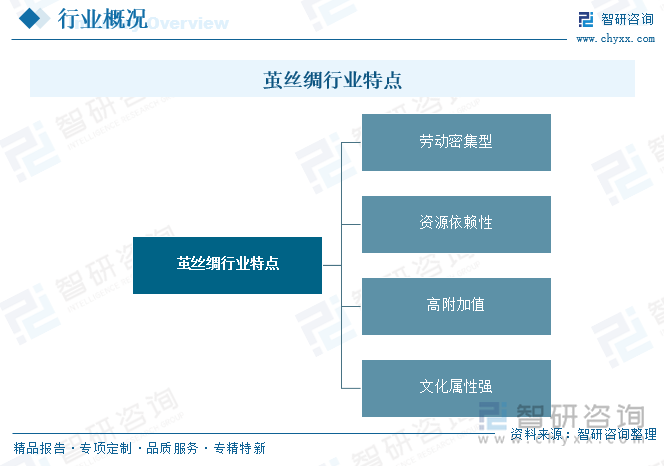
Core Viewpoint - The silk industry in China, with a history of over 5000 years, has rapidly developed and is now the world's largest producer of silk, playing a significant role in economic development, cultural confidence, and international cooperation as part of the Belt and Road Initiative [2] Group 1: Industry Overview - The silk industry is characterized by its labor-intensive nature, resource dependency, high added value, and strong cultural attributes, making it a unique Chinese industry [3][7] - The industry includes various segments such as silk processing, silk weaving, and silk dyeing, with the silk weaving segment generating the highest revenue [2][3] Group 2: Revenue and Growth - In 2024, the revenue of large-scale silk enterprises in China is projected to reach 76.585 billion yuan, an increase of 11.829 billion yuan from 2023 [2] - The silk weaving and silk processing sectors are expected to see a revenue growth of 2.6% and 11.36% respectively, while the silk dyeing segment is projected to decline by 1.4% [2] Group 3: Raw Material Production - In 2023, China's silkworm cocoon production was 806,700 tons, with a forecast of approximately 780,000 tons for 2024 [7] - The average purchase price for silkworm cocoons in 2023 was 55.46 yuan per kilogram, with variations in spring cocoon prices across different regions in 2024 [7] Group 4: Related Companies - Listed companies in the silk industry include Jiaxin Silk (002404.SZ), Taihu Snow (838262.BJ), and Wanlili (301066.SZ), among others [3]
趋势研判!2025年中国茧丝绸行业整体运行形势分析:技术创新与产业升级带来机遇,茧丝绸业仍是一个极具潜力的产业,有着广阔发展前景[图]
Chan Ye Xin Xi Wang· 2025-07-29 01:31
Core Viewpoint - China is the world's largest producer of silk, with a rich history of over 5000 years in sericulture and silk production, and the industry plays a significant role in economic development, cultural confidence, and international cooperation [1][9]. Industry Characteristics and Categories - The silk industry encompasses a complete industrial chain from sericulture to silk processing and product sales, characterized by labor intensity, resource dependence, high added value, and strong cultural attributes [2][6]. - Silk products can be categorized into raw silk, silk fabrics, finished silk products, and by-products [4]. Current Development Status - In 2023, China's silkworm cocoon production was 806,700 tons, projected to decrease to approximately 780,000 tons in 2024. The average purchase price for silkworm cocoons in 2023 was 55.46 yuan/kg [6][8]. - The revenue of large-scale silk enterprises in China is expected to reach 76.585 billion yuan in 2024, an increase of 11.829 billion yuan from 2023 [9][11]. - The silk processing industry is divided into three main categories: silk reeling, silk weaving, and silk dyeing, with the silk weaving sector generating the highest revenue [9][12]. Production and Revenue - The production of silk and blended fabrics is projected to reach 269 million meters in 2024, a 6.2% increase from 2023 [11]. - The revenue growth rates for different segments in 2024 are as follows: silk weaving and processing at 2.6%, silk reeling at 11.36%, and silk dyeing at a decline of 1.4% [9][12]. Industry Chain - The silk industry has developed a complete supply chain, including raw material supply, silk manufacturing, and product distribution, with key upstream activities involving mulberry cultivation and silkworm breeding [13]. Competitive Landscape - The silk industry is characterized by a rich cultural heritage, with major companies like Jiaxin Silk, Kai Xiya, and others leading the market. The market concentration is relatively low, with a CR7 of 11% [15][18]. Development Trends - The silk industry is transitioning from traditional manufacturing to high value-added, intelligent, and green production methods, maintaining a competitive edge in the international market [20].