ETF

Search documents
“资金洞察”系列报告(三):居民跑步入市了吗?
Western Securities· 2025-08-14 04:35
Group 1 - High-net-worth investors are actively entering the market, with significant inflows from private equity, leveraged funds, and speculative trading [1][11][14] - Private equity has seen a notable increase in institutional account openings, while individual account growth remains limited [14] - Leveraged funds have averaged daily inflows of 5.5 billion since July, with the current financing balance exceeding 2 trillion, a record high since 2015 [14][16] - Speculative trading has become active, with net inflows ranking just below the levels seen in 2015 [14][16] Group 2 - Resident funds have not significantly entered the market through public funds, with limited expansion in actively managed equity fund issuance and net subscriptions [2][18] - The issuance of actively managed equity funds remains at historical lows since the market shift in September 2022 [18] - Passive index funds are experiencing outflows, contrasting with the previous market conditions where funds flowed into equity ETFs [19][21] Group 3 - Retail investor participation is low, with current engagement levels not matching those of previous bull markets [3][27] - Retail fund inflows are limited, significantly weaker than the previous market conditions in September 2022 and February 2023 [27] - Recent data indicates a marginal decline in the balance of bank-to-securities transfers, suggesting that retail investors have not significantly entered the market [27][28] Group 4 - There is a growing trend of residents seeking higher returns through bank wealth management products due to excess savings and declining deposit rates [4][12][33] - The one-year fixed deposit rate has fallen below 1%, and the yield on popular wealth management products is only 1.05%, prompting a shift towards wealth management and fixed-income funds [4][33][34] - The combination of abundant funds and a scarcity of attractive assets is expected to accelerate the flow of resident funds into wealth management products, indirectly entering the equity market [4][12][34] Group 5 - Recent data shows a net outflow of 8.591 billion from foreign investments, particularly in financial, non-essential consumer goods, and industrial sectors [37][38] - Speculative trading saw a net inflow of 4.831 billion, primarily into the pharmaceutical, electronics, and machinery sectors [43][46] - Leveraged funds recorded a net inflow of 31.563 billion, focusing on electronics, machinery, and pharmaceuticals [48][53]
Is Franklin U.S. Large Cap Multifactor Index ETF (FLQL) a Strong ETF Right Now?
ZACKS· 2025-08-13 11:21
Core Insights - The Franklin U.S. Large Cap Multifactor Index ETF (FLQL) offers broad exposure to the Style Box - Large Cap Blend category and debuted on April 26, 2017 [1] - The fund is designed to outperform traditional market cap weighted indexes by utilizing a multi-factor selection process [6] Fund Overview - Sponsored by Franklin Templeton Investments, FLQL has amassed over $1.61 billion in assets, making it one of the larger ETFs in its category [5] - The ETF seeks to match the performance of the LibertyQ US Large Cap Equity Index, which aims for lower risk and higher risk-adjusted performance compared to the Russell 1000 Index [6] Cost Structure - FLQL has an annual operating expense ratio of 0.15%, making it one of the cheaper options in the market [7] - The fund has a 12-month trailing dividend yield of 1.13% [7] Sector Exposure and Holdings - The ETF's largest allocation is in the Information Technology sector, comprising approximately 35% of the portfolio [8] - Nvidia Corp (NVDA) is the top holding at about 6.42% of total assets, followed by Microsoft Corp (MSFT) and Apple Inc (AAPL) [9] - The top 10 holdings account for around 34.29% of total assets under management [9] Performance Metrics - As of August 13, 2025, FLQL has returned approximately 13.39% year-to-date and 23.47% over the past year [11] - The fund has a beta of 0.94 and a standard deviation of 16.24% over the trailing three-year period, indicating effective diversification of company-specific risk [11] Alternatives - Other ETFs in the same space include SPDR S&P 500 ETF (SPY) and Vanguard S&P 500 ETF (VOO), with assets of $657.19 billion and $722.37 billion respectively [12] - SPY has an expense ratio of 0.09% while VOO charges 0.03% [12]





Should You Invest in the Invesco Dorsey Wright Technology Momentum ETF (PTF)?
ZACKS· 2025-08-13 11:21
Core Insights - The Invesco Dorsey Wright Technology Momentum ETF (PTF) is a passively managed ETF launched on October 12, 2006, designed for long-term investors seeking broad exposure to the Technology - Broad segment of the equity market [1][10] - PTF has amassed assets over $368.03 million and aims to match the performance of the DWA Technology Technical Leaders Index [3][4] - The ETF has an annual operating expense of 0.6% and a 12-month trailing dividend yield of 0.22% [5] Sector and Holdings - PTF primarily invests in the Information Technology sector, which constitutes about 85.2% of its portfolio, with Telecom and Financials following [6] - The top three holdings include Cadence Design Systems Inc (5.09%), Palantir Technologies Inc, and Broadcom Inc, with the top 10 holdings accounting for approximately 37.8% of total assets [7] Performance Metrics - Year-to-date, PTF has lost about 4.55% but is up roughly 21.96% over the last 12 months as of August 13, 2025 [8] - The ETF has a beta of 1.43 and a standard deviation of 31.5% for the trailing three-year period, indicating high risk [8] Alternatives - Other ETFs in the technology space include the Technology Select Sector SPDR ETF (XLK) with $85.64 billion in assets and an expense ratio of 0.08%, and the Vanguard Information Technology ETF (VGT) with $100.82 billion in assets and an expense ratio of 0.09% [11]

Is Franklin U.S. Low Volatility High Dividend Index ETF (LVHD) a Strong ETF Right Now?
ZACKS· 2025-08-13 11:21
Core Insights - The Franklin U.S. Low Volatility High Dividend Index ETF (LVHD) is designed to provide broad exposure to the Style Box - Large Cap Value category, launched on December 28, 2015 [1] Fund Overview - LVHD is sponsored by Franklin Templeton Investments and has assets exceeding $584.78 million, positioning it as an average-sized ETF in its category [5] - The fund aims to match the performance of the QS Low Volatility High Dividend Index, focusing on profitable U.S. companies with high dividend yields and lower price and earnings volatility [5] Cost Structure - The annual operating expenses for LVHD are 0.27%, which is competitive within its peer group [6] - The ETF has a 12-month trailing dividend yield of 3.34% [6] Sector Allocation and Holdings - The ETF has a significant allocation in the Utilities sector, comprising approximately 24.9% of the portfolio, followed by Consumer Staples and Real Estate [7] - Cisco Systems Inc (CSCO) represents about 2.65% of the fund's total assets, with the top 10 holdings accounting for roughly 25.11% of total assets [8] Performance Metrics - As of August 13, 2025, LVHD has increased by about 7.67% year-to-date and approximately 10.71% over the past year [10] - The fund has traded between $37.37 and $41.26 in the last 52 weeks, with a beta of 0.66 and a standard deviation of 13.37% over the trailing three-year period [10] Alternatives - Other ETFs in the same space include Schwab U.S. Dividend Equity ETF (SCHD) and Vanguard Value ETF (VTV), with SCHD having $70.45 billion in assets and VTV at $140.9 billion [12] - SCHD has a lower expense ratio of 0.06%, while VTV charges 0.04%, making them potentially attractive alternatives for investors [12]

Should SPDR S&P MidCap 400 ETF (MDY) Be on Your Investing Radar?
ZACKS· 2025-08-13 11:21
Core Insights - The SPDR S&P MidCap 400 ETF (MDY) is a significant player in the Mid Cap Blend segment of the US equity market, with assets exceeding $23.09 billion, making it one of the larger ETFs in this category [1] Group 1: Mid Cap Blend Overview - Mid cap companies, with market capitalizations between $2 billion and $10 billion, provide a balance of stability and growth potential, offering less risk and higher growth opportunities compared to small and large companies [2] - Blend ETFs hold a mix of growth and value stocks, exhibiting characteristics of both types of equities [2] Group 2: Costs and Performance - The annual operating expense ratio for MDY is 0.23%, which is competitive within its peer group, and it has a 12-month trailing dividend yield of 1.18% [3] - MDY aims to match the performance of the S&P MidCap 400 Index, having gained approximately 2.72% year-to-date and about 10.49% over the past year, with a trading range of $468.22 to $620.12 in the last 52 weeks [6] Group 3: Sector Exposure and Holdings - The ETF has a significant allocation to the Industrials sector, comprising about 23.7% of the portfolio, followed by Financials and Consumer Discretionary [4] - The top 10 holdings represent around 7.15% of total assets, with Interactive Brokers Group Inc. and Emcor Group Inc. among the notable names [5] Group 4: Risk and Alternatives - MDY has a beta of 1.05 and a standard deviation of 19.55% over the trailing three-year period, categorizing it as a medium-risk investment [7] - Alternatives to MDY include the Vanguard Mid-Cap ETF (VO) and the iShares Core S&P Mid-Cap ETF (IJH), which have larger asset bases and lower expense ratios of 0.04% and 0.05%, respectively [9]

Should JPMorgan BetaBuilders U.S. Mid Cap Equity ETF (BBMC) Be on Your Investing Radar?
ZACKS· 2025-08-13 11:21
Core Insights - The JPMorgan BetaBuilders U.S. Mid Cap Equity ETF (BBMC) is a passively managed ETF launched on April 14, 2020, with assets exceeding $1.89 billion, targeting the Mid Cap Blend segment of the US equity market [1][2] Mid Cap Blend Overview - Mid cap companies have market capitalizations between $2 billion and $10 billion, offering higher growth prospects than large cap companies while being less volatile than small cap companies, making them a stable investment option [2] Cost Structure - The ETF has an annual operating expense ratio of 0.07%, positioning it as one of the lower-cost options in the market, with a 12-month trailing dividend yield of 1.27% [3] Sector Exposure and Holdings - The ETF's largest allocation is to the Industrials sector at approximately 21.5%, followed by Financials and Consumer Discretionary [4] - The top holding is Jpmorgan Us Govt Mmkt Fun at about 1.21% of total assets, with the top 10 holdings comprising around 6.01% of total assets under management [5] Performance Metrics - BBMC aims to match the performance of the Morningstar US Mid Cap Target Market Exposure Extended Index, having gained about 5.4% year-to-date and approximately 17.63% over the past year as of August 13, 2025 [6] - The ETF has a beta of 1.10 and a standard deviation of 20.05% over the trailing three-year period, indicating effective diversification with around 565 holdings [7] Alternatives in the Market - Other ETFs in the Mid Cap Blend space include the Vanguard Mid-Cap ETF (VO) with $86.13 billion in assets and an expense ratio of 0.04%, and the iShares Core S&P Mid-Cap ETF (IJH) with $97.30 billion in assets and an expense ratio of 0.05% [9] Investment Trends - There is a growing trend among retail and institutional investors towards passively managed ETFs due to their low costs, transparency, flexibility, and tax efficiency, making them suitable for long-term investment strategies [10]
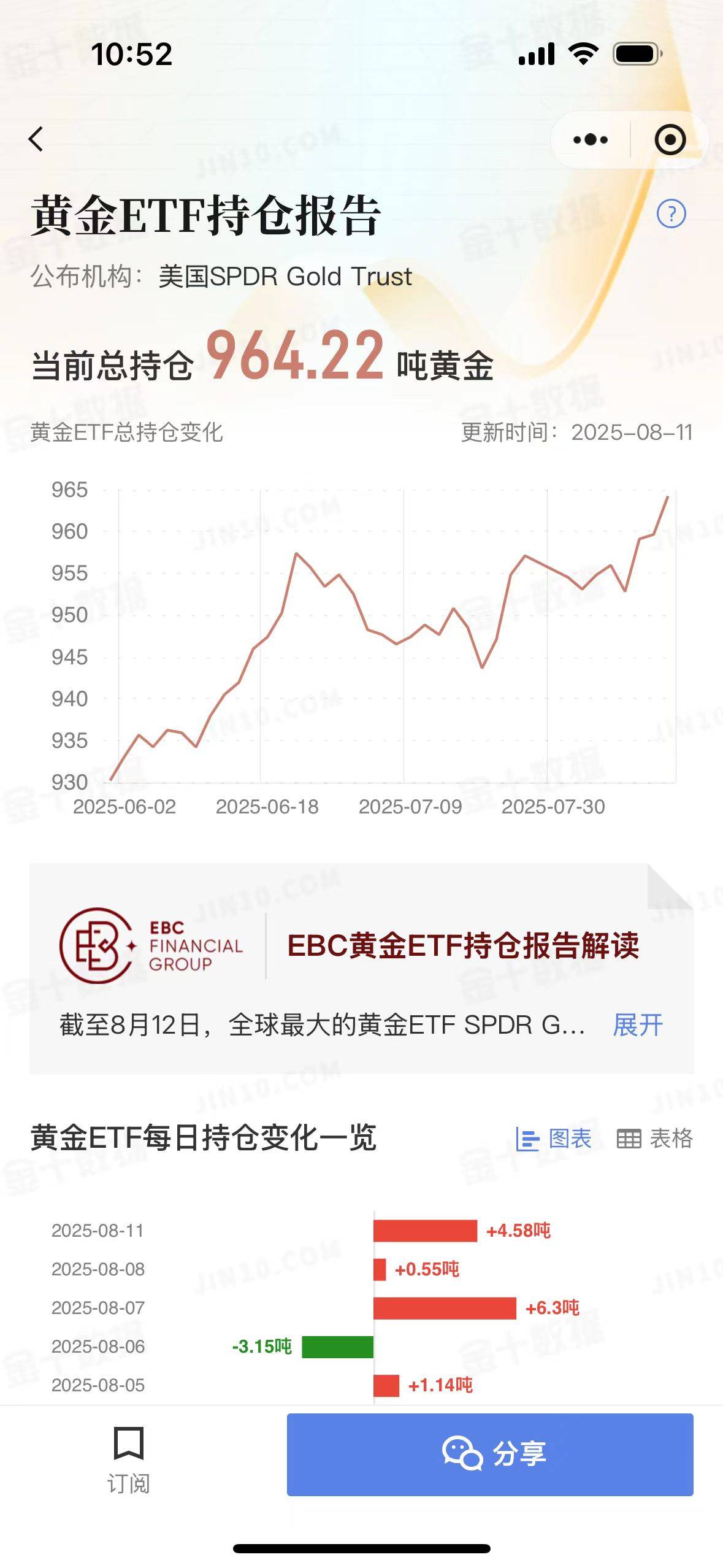
黄金ETF持仓量报告解读(2025-8-13)多因素影响 金价走势如何
Sou Hu Cai Jing· 2025-08-13 07:12
Core Viewpoint - The SPDR Gold Trust's holdings remain stable at 964.22 tons of gold as of August 12, 2025, amidst fluctuating gold prices influenced by U.S. inflation data [5]. Group 1: Gold ETF Holdings - As of August 12, 2025, the SPDR Gold Trust holds 964.22 tons of gold, unchanged from the previous trading day [5]. - The report indicates that the gold ETF's total holdings have not experienced any significant changes recently [5]. Group 2: Gold Price Movements - On August 12, 2025, spot gold prices fluctuated within a range of approximately $30, peaking at $3,358.29 per ounce and dipping to $3,330.81 per ounce, closing at $3,348.07 per ounce, reflecting a slight increase of $5.48 or 0.16% [5]. - Following a significant drop in the previous trading day, gold prices stabilized around $3,350 per ounce during Asian and European market hours [5]. Group 3: U.S. Inflation Data Impact - The U.S. Consumer Price Index (CPI) for July showed a year-over-year increase below expectations, with core CPI rising by 3.1%, marking the highest level since February [5]. - The core CPI's month-over-month increase of 0.3% is the largest since January, leading to increased speculation about a potential interest rate cut by the Federal Reserve in September [5][6]. - Analysts caution that the higher-than-expected core CPI may complicate the Fed's decision-making regarding rate cuts, with further insights expected from the upcoming Jackson Hole symposium [5][6]. Group 4: Market Sentiment and Technical Analysis - Market sentiment is leaning towards a consensus for a September rate cut, but upcoming CPI and non-farm payroll reports will be closely monitored [6]. - Technical analysis indicates a lack of clear direction for gold prices, with the 14-day RSI hovering around 50, suggesting potential downward movement [6]. - If gold prices decline further, short-term targets include the 100-day simple moving average around $3,297, with subsequent support levels at $3,268 and $3,250 [6].
Is First Trust Capital Strength ETF (FTCS) a Strong ETF Right Now?
ZACKS· 2025-08-12 11:21
Core Insights - The First Trust Capital Strength ETF (FTCS) offers investors exposure to the Style Box - Large Cap Blend category and has amassed over $8.42 billion in assets, making it one of the largest ETFs in this segment [1][5]. Investment Strategy - Smart beta ETFs, like FTCS, are designed to outperform traditional market capitalization weighted indexes by selecting stocks based on specific fundamental characteristics [2][3]. - FTCS tracks the Capital Strength Index, which is an equal-dollar weighted index focusing on well-capitalized companies with strong financial metrics [6]. Cost and Performance - FTCS has an annual operating expense of 0.52% and a 12-month trailing dividend yield of 1.21%, which is competitive within its peer group [7]. - The ETF has shown a performance increase of approximately 5.18% year-to-date and 8.12% over the past year, with a trading range between $81.60 and $94.03 in the last 52 weeks [11]. Sector Exposure and Holdings - The ETF's largest sector allocation is in Industrials at 23.6%, followed by Financials and Consumer Staples [8]. - Microsoft Corporation (MSFT) is the largest individual holding at 2.54% of total assets, with the top 10 holdings comprising about 22.99% of total assets under management [9]. Risk Profile - FTCS has a beta of 0.79 and a standard deviation of 12.87% over the trailing three-year period, indicating a medium risk profile with effective diversification across 51 holdings [11].

Should John Hancock Multifactor Small Cap ETF (JHSC) Be on Your Investing Radar?
ZACKS· 2025-08-12 11:21
Core Viewpoint - The John Hancock Multifactor Small Cap ETF (JHSC) offers broad exposure to the Small Cap Blend segment of the US equity market, with assets exceeding $564.78 million since its launch on November 8, 2017 [1] Group 1: Investment Potential - Small cap companies, defined as those with market capitalizations below $2 billion, present high potential but also come with increased risk [2] - Blend ETFs typically include a mix of growth and value stocks, providing diversified exposure [2] Group 2: Cost Structure - The annual operating expenses for JHSC are 0.42%, which is competitive with most peer products [3] - The ETF has a 12-month trailing dividend yield of 1.07% [3] Group 3: Sector Exposure and Holdings - The ETF has a significant allocation of approximately 22.8% to the Industrials sector, followed by Financials and Consumer Discretionary [4] - Nextracker Inc Cl A (NXT) constitutes about 0.55% of total assets, with the top 10 holdings making up around 5.11% of total assets under management [5] Group 4: Performance Metrics - JHSC aims to match the performance of the JOHN HANCOCK DIMENSIONAL SMALL CAP INDEX, which includes companies smaller than the 750th largest U.S. company, excluding the smallest 4% [6] - The ETF has experienced a loss of about 0.41% year-to-date and a gain of approximately 6.51% over the past year, with a trading range between $32.47 and $43.65 in the last 52 weeks [7] Group 5: Alternatives - JHSC holds a Zacks ETF Rank of 3 (Hold), indicating it is a viable option for investors seeking exposure to the Small Cap Blend market [8] - Other comparable ETFs include the Vanguard Small-Cap ETF (VB) with $63.04 billion in assets and an expense ratio of 0.05%, and the iShares Core S&P Small-Cap ETF (IJR) with $80.38 billion in assets and an expense ratio of 0.06% [9] Group 6: General Insights - Passively managed ETFs like JHSC are increasingly favored by retail and institutional investors due to their low costs, transparency, flexibility, and tax efficiency, making them suitable for long-term investment strategies [10]

Should Invesco NASDAQ 100 ETF (QQQM) Be on Your Investing Radar?
ZACKS· 2025-08-12 11:21
Core Viewpoint - The Invesco NASDAQ 100 ETF (QQQM) is a passively managed fund designed to provide broad exposure to the Large Cap Growth segment of the US equity market, with significant assets under management and low expense ratios [1][4]. Group 1: Fund Overview - QQQM was launched on October 13, 2020, and has accumulated over $56.89 billion in assets, making it one of the largest ETFs in its category [1]. - The fund is sponsored by Invesco and aims to match the performance of the NASDAQ-100 Index, which includes 100 of the largest non-financial companies listed on Nasdaq [7]. Group 2: Investment Characteristics - Large cap companies, defined as those with market capitalizations above $10 billion, are generally more stable and less volatile than mid and small cap companies [2]. - Growth stocks, which QQQM primarily invests in, exhibit faster growth rates and higher valuations compared to the broader market, although they tend to be more volatile [3]. Group 3: Cost Structure - The annual operating expense ratio for QQQM is 0.15%, positioning it as one of the least expensive ETFs in the market [4]. - The ETF has a 12-month trailing dividend yield of 0.53% [4]. Group 4: Sector Exposure and Holdings - The ETF has a significant allocation to the Information Technology sector, comprising approximately 53.3% of the portfolio, followed by Telecom and Consumer Discretionary sectors [5]. - Nvidia Corp (NVDA) is the largest holding at about 9.15% of total assets, with the top 10 holdings accounting for approximately 50.54% of total assets under management [6]. Group 5: Performance Metrics - As of August 12, 2025, QQQM has increased by about 12.36% year-to-date and 27.91% over the past year, with a trading range between $171.40 and $236.52 in the last 52 weeks [7]. - The ETF has a beta of 1.15 and a standard deviation of 21.74% over the trailing three-year period, indicating a moderate level of risk [8]. Group 6: Competitive Landscape - QQQM holds a Zacks ETF Rank of 1 (Strong Buy), indicating strong expected performance based on various factors [9]. - Other comparable ETFs include the Vanguard Growth ETF (VUG) and Invesco QQQ (QQQ), with VUG having $184.51 billion in assets and an expense ratio of 0.04%, while QQQ has $363.71 billion in assets and charges 0.2% [10]. Group 7: Investment Appeal - Passively managed ETFs like QQQM are favored by both institutional and retail investors due to their low costs, transparency, flexibility, and tax efficiency [11].