
水利建设

Search documents
甘肃“十四五”水利建设交出硬核答卷:预计完成投资逾千亿元,筑牢水安全保障网
Zhong Guo Fa Zhan Wang· 2025-11-07 09:56
Core Insights - Gansu Province has achieved significant progress in water conservancy construction during the "14th Five-Year Plan" period, with total water investment exceeding 80 billion yuan, 1.5 times that of the "13th Five-Year Plan" period [1] - The province is expected to complete water investment of 100 billion yuan during the "14th Five-Year Plan," a 33% increase from the 75.2 billion yuan in the "13th Five-Year Plan" [1] Group 1: Major Water Projects - The completion of the second phase of the Yintao water supply project has provided over 1 billion cubic meters of water, solving water supply issues for over 6 million people in four cities and eight counties [2] - A series of major projects, including the ecological migration and poverty alleviation water supply project, have added 500 million cubic meters of new water supply capacity, optimizing the water resource allocation [2] Group 2: Rural Water Supply Improvements - Gansu has built 1,459 water storage facilities and improved 623 rural water source and pipeline projects, increasing rural tap water coverage from 90% to 95% [3] - Over 19 million rural residents now have access to safer and more stable drinking water, with urban emergency water supply coverage significantly improved [3] Group 3: Agricultural Water Management - The province has implemented modernization projects for 12 large and 40 medium-sized irrigation districts, improving irrigation areas by over 5 million acres [4] - The effective utilization rate of irrigation water has increased to 0.591, providing reliable water support for continuous grain harvests [4] Group 4: Disaster Prevention and Ecological Restoration - Gansu has enhanced its flood and drought disaster prevention capabilities, with the main river levee compliance rate reaching 75% and 124 dangerous reservoirs reinforced [5] - The province has successfully managed severe flood and drought situations, demonstrating the effectiveness of its water engineering system [5] - Ecological restoration efforts have led to the treatment of over 5,039 square kilometers of soil erosion, with a water and soil conservation rate exceeding 61% [6]
成全国5个拥有三级水网先导区的省区之一
Guang Xi Ri Bao· 2025-10-29 04:21
Core Insights - During the "14th Five-Year Plan" period, Guangxi has prioritized water network construction as a key support for building a beautiful Guangxi, integrating various water networks and achieving recognition as a national pilot area for water networks [1][2] Group 1: Water Network Development - Guangxi has established a leadership group for water network planning and construction, focusing on the collaborative development of five water networks: flood control and drainage, urban and rural water supply, agricultural irrigation, ecological water, and smart water networks [1] - Key projects such as the Pinglu Canal and the Guangxi Water Resource Allocation Project are accelerating, contributing to the construction of the main framework of the water network [2] Group 2: Water Security and Disaster Prevention - The region has improved its flood and drought disaster prevention capabilities, achieving a 74.9% compliance rate for river embankments and successfully managing severe droughts and typhoons this year [2] - The completion of the Datiangxia Water Conservancy Hub has enhanced water resource management and disaster response [2] Group 3: Water Supply and Agricultural Security - Since the beginning of the "14th Five-Year Plan," Guangxi has increased its water supply capacity by 9.5 billion cubic meters, with rural tap water coverage rising to 91.4% [3] - The region has also improved irrigation efficiency, with a significant reduction in water usage per unit of industrial GDP, down 48.4% compared to the end of the "13th Five-Year Plan" [3] Group 4: Ecological Protection and Economic Growth - Guangxi has addressed 2,432 issues related to river and lake management, with a focus on improving water quality and reducing soil erosion [4] - Water conservancy investment has increased annually, with projections for 2025 to exceed 50 billion yuan, reflecting a shift towards diversified financing models [4] - Smart water management technologies are being developed to enhance efficiency in monitoring and managing water resources [4]
“十四五”我国水利建设实现跨越式发展
Yang Shi Wang· 2025-10-22 12:43
Core Insights - During the "14th Five-Year Plan" period, China has achieved significant advancements in water conservancy, establishing the world's largest and most comprehensive water infrastructure system that benefits the most people [1] Group 1: Water Resource Management - As of September 2025, all target tasks for the revival of 88 major rivers have been completed, with 79 rivers fully connected and 9 lakes maintaining effective ecological water levels [3] - The Haihe River Basin has restored flow to 30 previously stagnant rivers and revived 102 dry springs, fundamentally reversing the situation of "dry rivers and polluted waters" [3] Group 2: Investment and Infrastructure Development - Water conservancy construction has seen a leap in investment, surpassing 1 trillion yuan for the first time, with historical records broken for three consecutive years [5] - The water supply capacity of water conservancy projects has reached 900 billion cubic meters, accelerating the formation of a water resource allocation pattern of "south-north transfer and east-west mutual assistance" [5] Group 3: Reservoir and Irrigation Expansion - A total of 95,000 reservoirs have been built, with a total capacity exceeding 1 trillion cubic meters, making China the leader in reservoir types, numbers, and high dams globally [7] - The irrigated area of arable land has increased to 109 million acres, with the effective utilization coefficient of irrigation water rising from 0.565 to 0.58, supporting a projected grain output of over 1.4 trillion jin in 2024 [9] Group 4: Rural Water Supply and Economic Impact - China has established the world's largest rural centralized water supply system, with the national rural tap water coverage expected to reach 96% by the end of the "14th Five-Year Plan" [9] - Despite an average annual economic growth rate of 5.5%, the total water consumption in the country has achieved zero growth, effectively supporting high-quality economic and social development [11]


我省推介超千亿元水利建设项目
Liao Ning Ri Bao· 2025-10-14 00:58
Core Insights - The article highlights the promotion of 102 water conservancy projects in Northeast China, with a total investment of 107 billion yuan, aimed at enhancing water resource management and supporting sustainable economic development [1] Group 1: Investment and Project Overview - A total of 1,067 billion yuan is expected to be invested in water conservancy projects by the end of the "14th Five-Year Plan," which is 2.2 times that of the "13th Five-Year Plan" [1] - The plan includes the construction of 6 large and medium-sized reservoirs, with significant investments in the Yongping and Shengjin reservoirs, which have designed capacities of 194 million cubic meters and 124 million cubic meters, respectively, totaling an investment of 11.664 billion yuan [1] - The Liaodong Peninsula water resource allocation project, a key initiative, involves an investment of over 20 billion yuan and has passed feasibility studies [1] Group 2: Irrigation and Flood Control Projects - During the "14th Five-Year Plan," 34 new and renovated large and medium-sized irrigation projects have been implemented, with a total investment of 4.4 billion yuan, alongside 17 flood control projects with an investment of 1.1 billion yuan [2] - The promotion includes 18 projects such as the Hunpuh and Panshan irrigation area renovations, with an estimated total investment of 21.2 billion yuan [2] - The province aims to implement 1,608 water conservancy projects during the "15th Five-Year Plan," with a total investment of 166.9 billion yuan, which is 1.4 times that of the "14th Five-Year Plan" [2]
四川省水利厅召开水利项目百日攻坚现场动员会
Shui Li Bu Wang Zhan· 2025-09-30 11:03
Core Insights - The Sichuan water conservancy projects are being accelerated to ensure high-quality construction and provide robust water security for the province's economic and social development [1][2][3] - The provincial government aims to complete over 700 billion yuan in water conservancy investments this year, with a focus on integrating traditional and new projects, ensuring construction quality, and maintaining safety [2][3] Investment and Economic Impact - From January to August, Sichuan completed water conservancy investments of 500 billion yuan, representing a 16% year-on-year increase [1] - Water conservancy projects have created approximately 113,000 jobs and contributed over 900 billion yuan to the provincial GDP [1] Strategic Goals and Measures - The provincial water conservancy system is focused on achieving annual investment goals and enhancing project execution, quality control, and safety management [3] - Emphasis is placed on a comprehensive quality management approach and the establishment of a project pipeline that includes planning, construction, and completion phases [3]
5年累计投入各类资金约1200亿!山东财政强力支撑水利建设
Qi Lu Wan Bao· 2025-09-30 09:06
Core Viewpoint - The Shandong provincial government is accelerating high-quality development in water conservancy during the 14th Five-Year Plan period, focusing on financial support, innovative management models, and performance evaluation to enhance water infrastructure and safety [4][5][6]. Financial Support - The provincial finance department has increased investment in water conservancy, with a total of approximately 120 billion yuan allocated over the past five years to support water infrastructure projects [4]. - The government is leveraging various funding sources, including public budgets, central government investments, and special bonds, while actively seeking central funding support [4]. Innovative Management Models - The province is innovating financing mechanisms for water conservancy projects, such as involving insurance companies in the operation and maintenance of water projects, with the government subsidizing up to 60% of insurance premiums for pilot projects [4]. - Social capital is being encouraged to participate in key water projects, with interest subsidies provided for eligible loans, enhancing water security capabilities [4]. Performance Management - The province emphasizes performance management in the allocation of water conservancy funds, implementing a comprehensive evaluation system that includes pre-assessment, monitoring during execution, and post-evaluation [5]. - Since the implementation of performance evaluations for central water development funds in 2017, Shandong has received excellent ratings from the Ministry of Finance and the Ministry of Water Resources on five occasions [5]. Future Plans - The provincial finance department plans to continue optimizing institutional mechanisms and increasing funding efforts to support the advancement of Shandong's modern water network [6].
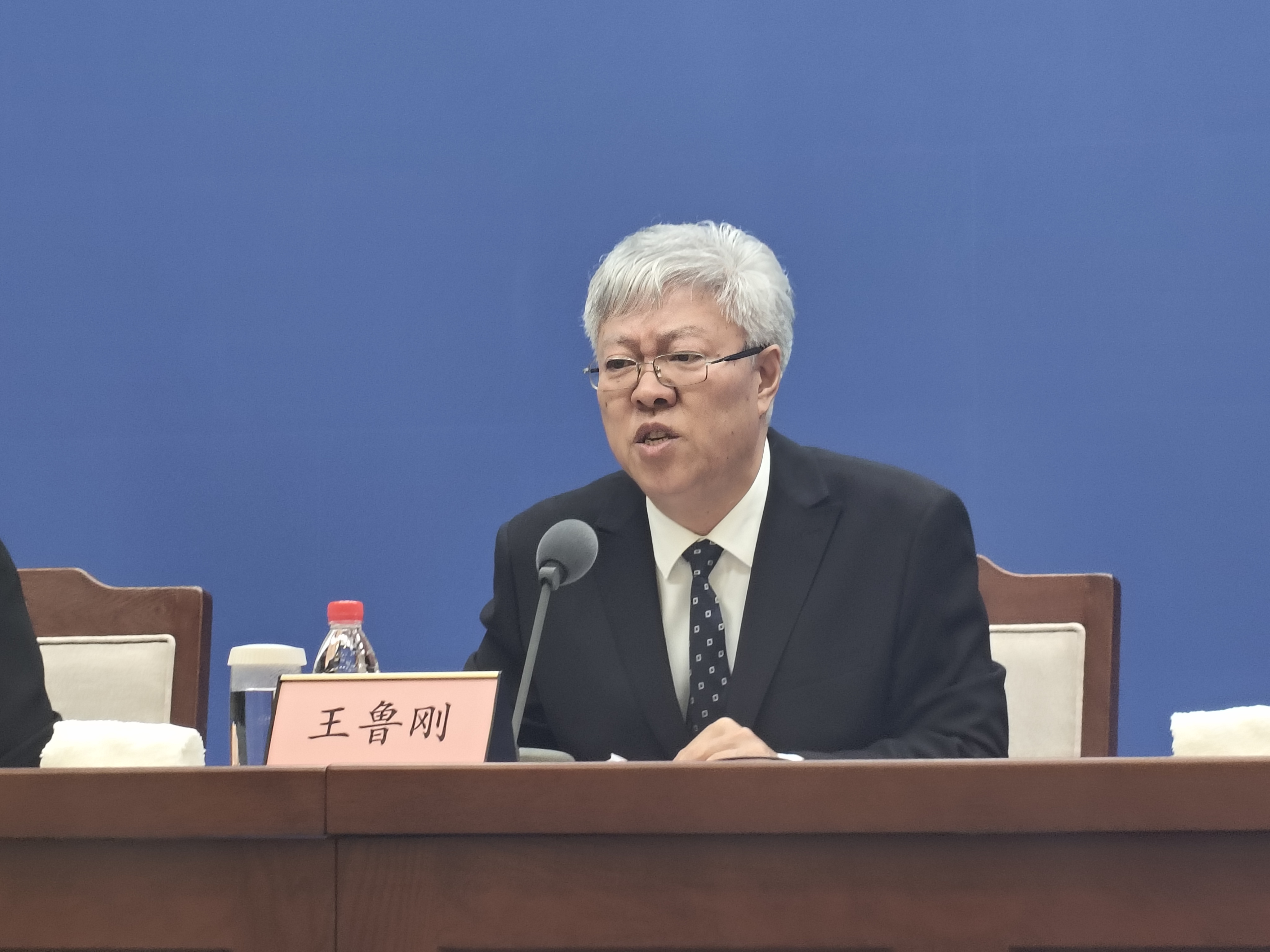
“十四五”中国水利建设完成投资预计超5.4万亿元
Zhong Guo Xin Wen Wang· 2025-09-29 19:31
Core Insights - China's water conservancy investment reached over 1 trillion RMB in 2022, marking a historical milestone and is expected to reach 1.3529 trillion RMB in 2024, with total investment during the 14th Five-Year Plan projected to exceed 5.4 trillion RMB, 1.6 times that of the 13th Five-Year Plan [1][2] Group 1: Water Infrastructure Development - Since the beginning of the 14th Five-Year Plan, 172 major water conservancy projects have commenced, optimizing the layout, structure, function, and system integration of water infrastructure [1] - By the end of 2024, China will have built 95,000 reservoirs, 200 large and medium-sized water diversion projects, 6,924 large and medium-sized irrigation areas, and 318,000 kilometers of embankments, forming the world's largest and most comprehensive water conservancy infrastructure system [1] Group 2: Disaster Prevention and Ecological Improvement - Water and drought disaster prevention has improved, with reservoir flood control capacity at 185.6 billion cubic meters, protecting 660 million people through embankments, and a national flood retention area of 109 billion cubic meters [2] - The proportion of flood disaster losses to GDP has decreased from 0.28% during the 13th Five-Year Plan to 0.18% during the 14th Five-Year Plan [2] - The ecological flow compliance rate for key rivers and lakes reached 98.6%, with 140,000 issues of "disorderly occupation, mining, dumping, and construction" addressed, leading to significant changes in river and lake environments [2]
青春华章|一组数据看“十四五”水利建设“成绩单”
Ren Min Wang· 2025-09-29 13:57
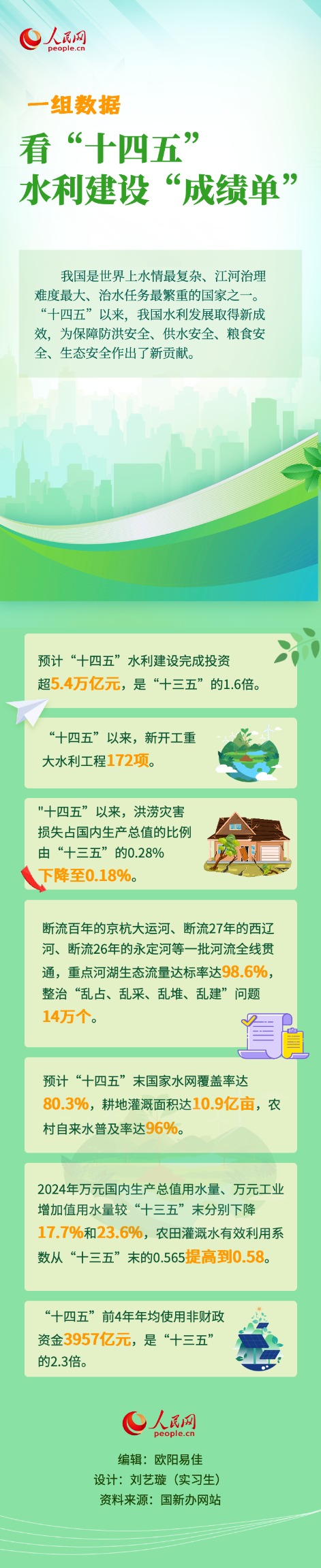
Core Insights - The "14th Five-Year Plan" has led to significant advancements in water conservancy construction in China, with an expected investment exceeding 5.4 trillion yuan, which is 1.6 times that of the "13th Five-Year Plan" [1][2] Group 1: Investment and Projects - A total of 172 major water conservancy projects have commenced since the start of the "14th Five-Year Plan" [2] - The average annual use of non-fiscal funds has reached 395.7 billion yuan, which is 2.3 times that of the "13th Five-Year Plan" [2] Group 2: Disaster Management and Ecological Impact - The proportion of economic losses from flood disasters has decreased from 0.28% during the "13th Five-Year Plan" to 0.18% in the current period [2] - Key rivers such as the Grand Canal and the Xiliao River have been fully restored, achieving an ecological flow compliance rate of 98.6% [2] Group 3: Water Resource Efficiency - By the end of the "14th Five-Year Plan," the national water network coverage is expected to reach 80.3%, with irrigated farmland area at 1.09 billion mu and rural tap water coverage at 96% [2] - Water usage per unit of GDP and industrial added value is projected to decrease by 17.7% and 23.6%, respectively, compared to the end of the "13th Five-Year Plan" [2] - The effective utilization coefficient of irrigation water in farmland has improved from 0.565 to 0.58 [2]
水利部:预计“十四五”时期水利建设完成投资超5.4万亿元
Zheng Quan Ri Bao Wang· 2025-09-29 13:07
Core Insights - Since the start of the 14th Five-Year Plan, China has significantly advanced its water conservancy infrastructure, with investments exceeding 1 trillion yuan for the first time in 2022 and projected to reach 1.3529 trillion yuan in 2024, totaling over 5.4 trillion yuan during the entire period, which is 1.6 times that of the 13th Five-Year Plan [1][2] Investment and Financing - The central government has prioritized water conservancy as a key area for infrastructure investment, implementing various supportive policies, including the issuance of 1 trillion yuan in government bonds in 2023, with water conservancy as a focus area [1] - Average annual non-fiscal funding for water conservancy during the first four years of the 14th Five-Year Plan reached 395.7 billion yuan, which is 2.3 times that of the 13th Five-Year Plan [2] - Social capital participation has been encouraged, with average annual investment from social capital reaching 104 billion yuan, 1.8 times that of the previous plan [2] Infrastructure Development - By the end of 2024, China is expected to have built 95,000 reservoirs, 200 large and medium-sized water diversion projects, 6,924 large and medium-sized irrigation areas, and 318,000 kilometers of embankments, creating the world's largest and most comprehensive water conservancy infrastructure system [2] Safety and Modernization - The water conservancy department emphasizes dam safety, aiming to construct safe, ecological, and intelligent dams, with 12 intelligent dam pilot projects initiated [3] - A modern reservoir management matrix has been established, with 11,814 reservoirs participating, enhancing safety monitoring capabilities significantly [3] Water Resource Management - Despite economic growth, China's total water consumption has remained stable, attributed to efficient water resource management and strict regulations [4] - Water usage per unit of GDP and industrial output has decreased by 17.7% and 23.6% respectively compared to the end of the 13th Five-Year Plan, while the effective utilization coefficient of irrigation water has improved from 0.565 to 0.58 [4]
预计“十四五”水利建设完成投资超5.4万亿元我国水利发展取得新成效
Zhong Yang Ji Wei Guo Jia Jian Wei Wang Zhan· 2025-09-29 08:59
Core Insights - Since the "14th Five-Year Plan," China's water conservancy development has achieved new results, contributing to flood safety, water supply security, food security, and ecological safety, with an expected investment exceeding 5.4 trillion yuan, 1.6 times that of the "13th Five-Year Plan" [1] Investment and Infrastructure - By the end of 2024, China will have built 95,000 reservoirs, 200 major water diversion projects, 6,924 large and medium-sized irrigation areas, and 318,000 kilometers of embankments, forming the world's largest and most comprehensive water conservancy infrastructure system [1] Disaster Prevention and Management - The flood and drought disaster prevention system has improved, with flood control reservoir capacity at 185.6 billion cubic meters, protecting 660 million people, and national flood retention capacity at 109 billion cubic meters [2] - The proportion of flood disaster losses to GDP decreased from 0.28% during the "13th Five-Year Plan" to 0.18% during the "14th Five-Year Plan" [2] Water Resource Utilization - Water resource conservation and utilization capabilities have been enhanced, with an expected national water network coverage rate of 80.3% and irrigation area reaching 109 million acres by the end of the "14th Five-Year Plan" [3] - The total water consumption has achieved zero growth, with water usage per unit of GDP and industrial added value decreasing by 17.7% and 23.6%, respectively, compared to the end of the "13th Five-Year Plan" [3] Digital Transformation - The water conservancy sector is advancing digital twin construction, enhancing flood prevention, water resource management, and allocation through a comprehensive monitoring and sensing system [4] - The establishment of a high-fidelity digital flow simulation model system supports decision-making for flood and drought disaster prevention and unified management of water projects [4] Future Planning - The water conservancy department aims to scientifically plan the "15th Five-Year Plan" to promote high-quality water conservancy development and ensure water security in China [5]