
航空航天和其他运输设备制造业

Search documents
必得科技(605298.SH):预计2025年净利润同比增加41.55%到67.29%
Ge Long Hui A P P· 2026-01-29 09:25
Core Viewpoint - Bidetech (605298.SH) expects a significant increase in net profit for the year 2025, indicating strong growth potential in its business operations [1] Financial Performance - The company anticipates a net profit attributable to shareholders of between 55 million to 65 million yuan for 2025, representing a year-on-year increase of 41.55% to 67.29% [1] - The expected net profit after deducting non-recurring gains and losses is projected to be between 53.7 million to 63.7 million yuan, with a year-on-year growth of 40.81% to 67.03% [1] Business Operations - The increase in net profit is attributed to the growth in the high-speed rail supporting business and an optimization of the product structure [1]

中铁高新工业股份有限公司2025年主要经营数据暨第四季度重大合同签约/中标公告
Xin Lang Cai Jing· 2026-01-28 18:54
证券代码:600528 证券简称:中铁工业 编号:临2026-001 二、2025年第四季度重大合同签约/中标情况 单位:万元 币种:人民币 ■ (二)按地区分布统计 单位:万元 币种:人民币 ■ 中铁高新工业股份有限公司2025年主要经营数据暨第四季度重大合同签约/中标公告 本公司董事会及全体董事保证本公告内容不存在任何虚假记载、误导性陈述或重大遗漏,并对其内容的 真实性、准确性和完整性承担法律责任。 一、2025年新签合同额情况 (一)按业务类型统计 单位:万元 币种:人民币 ■ 上述合同金额合计人民币253,186万元,约占本公司2024年营业收入的8.73%。 特此公告。 中铁高新工业股份有限公司董事会 二〇二六年一月二十九日 ...

中车时代电气取得水压传感器故障检测专利
Jin Rong Jie· 2026-01-27 13:24
国家知识产权局信息显示,株洲中车时代电气股份有限公司取得一项名为"水压传感器的故障检测方 法、装置、存储介质和牵引系统"的专利,授权公告号CN116429319B,申请日期为2022年1月。 天眼查资料显示,株洲中车时代电气股份有限公司,成立于2005年,位于株洲市,是一家以从事铁路、 船舶、航空航天和其他运输设备制造业为主的企业。企业注册资本135794.8412万人民币。通过天眼查 大数据分析,株洲中车时代电气股份有限公司共对外投资了38家企业,参与招投标项目5000次,专利信 息3720条,此外企业还拥有行政许可151个。 作者:情报员 声明:市场有风险,投资需谨慎。本文为AI基于第三方数据生成,仅供参考,不构成个人投资建议。 本文源自:市场资讯 ...

2025年全国铁路、船舶、航空航天和其他运输设备制造业出口货值为5122.7亿元,累计增长24.2%
Chan Ye Xin Xi Wang· 2026-01-26 03:41
Core Viewpoint - The report highlights significant growth in the export value of China's railway, shipping, aerospace, and other transportation equipment manufacturing industries, indicating a robust market trend from 2019 to 2025 [1][2]. Industry Summary - By December 2025, the total export value of the railway, shipping, aerospace, and other transportation equipment manufacturing industries is projected to reach 544.7 billion yuan, reflecting a year-on-year growth of 24.7% [1]. - Cumulatively, the export value for the entire year of 2025 is expected to be 5,122.7 billion yuan, with a year-on-year increase of 24.2% [1]. Company Summary - Listed companies in the transportation equipment sector include Shanxi Road and Bridge (000755), Dongguan Holdings (000828), Modern Investment (000900), among others, indicating a diverse range of players in the market [1].


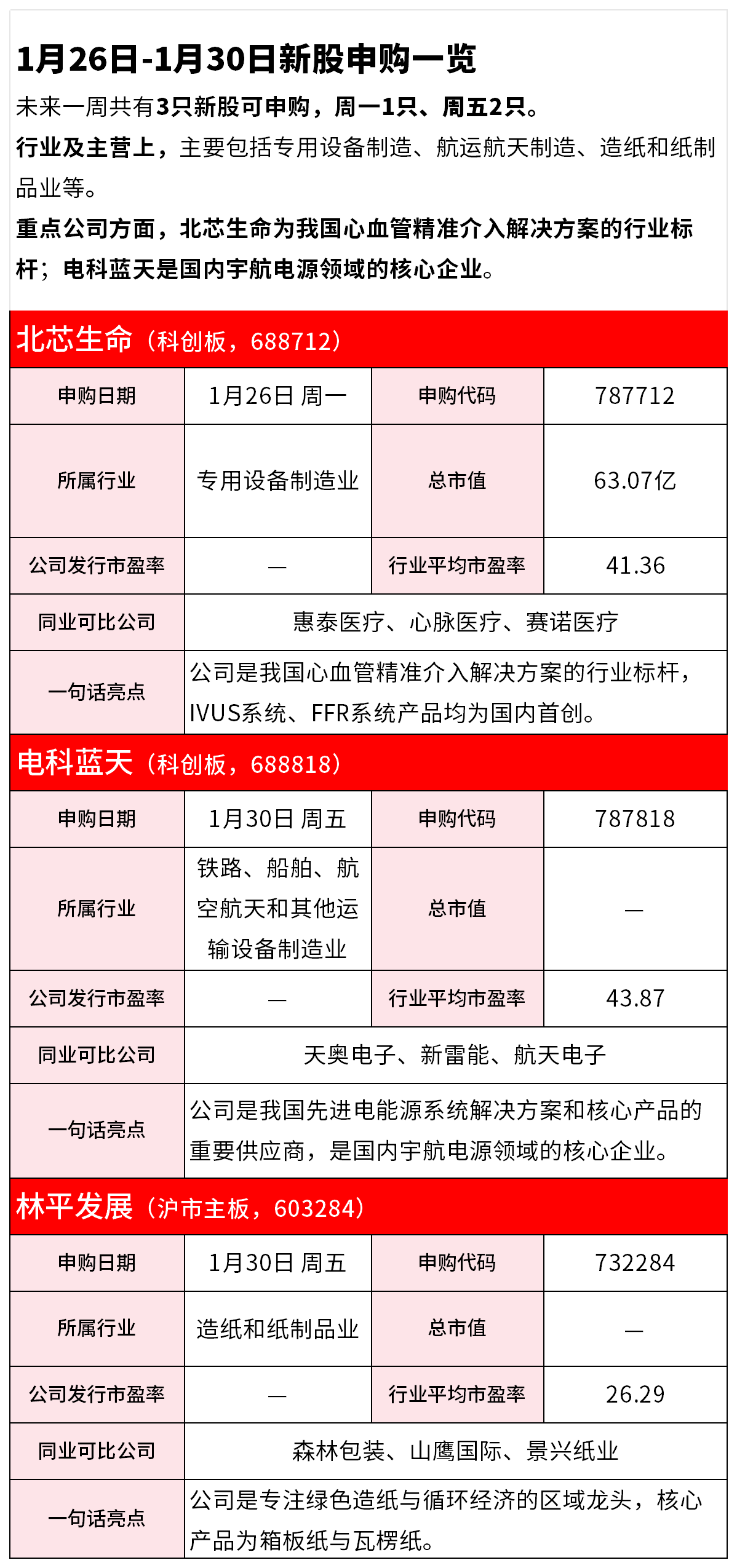
【IPO雷达】1月26日-1月30日新股申购一览
Xuan Gu Bao· 2026-01-25 22:50
Group 1 - Three new stocks are available for subscription in the upcoming week, with one on January 26 and two on January 30 [1] - The industries involved include specialized equipment manufacturing, aerospace manufacturing, and paper products [1] Group 2 - Beixin Life (688712) is a benchmark in cardiovascular precision intervention solutions in China, with a total market value of 6.307 billion [2] - The company has an issuance price-to-earnings ratio, while the industry average is 41.36 [2] - Beixin Life's IVUS and FFR systems are the first of their kind in China [2] Group 3 - Electric Science Blue Sky (688818) is a core enterprise in the domestic aerospace power supply sector, with an issuance price-to-earnings ratio and an industry average of 43.87 [3] - The company is a key supplier of advanced electric energy system solutions and core products [3] Group 4 - Linping Development (603284) focuses on green paper making and circular economy, with a total market value in the paper and paper products industry [3] - The company specializes in boxboard and corrugated paper, positioning itself as a regional leader [3] - The issuance price-to-earnings ratio is compared to an industry average of 26.29 [3]
我国旅客列车室内二氧化碳浓度标准限值为2500ppm ,对旅客健康无影响
Xin Hua She· 2026-01-25 03:33
Group 1 - The reported CO2 concentration in high-speed train carriages exceeds the standard limit of 1000ppm, but this information is based on a standard not applicable to passenger trains [1] - The CO2 concentration control standards for passenger trains in China are defined by TB/T 3493-2017, with a normal operational limit of 2500ppm, while European standards set the limit at 5000ppm [1] - The standards for passenger trains are based on the unique characteristics of mobile transport equipment, considering factors like internal pressure fluctuations and overall comfort indicators [1] Group 2 - The train sets are fully airtight, with air exchange entirely managed by the air conditioning ventilation system, providing a fresh air volume of over 15m³/h per person and achieving 6 to 12 air changes per hour [2] - During normal operation outside tunnels, CO2 concentration typically does not exceed 1500ppm; however, in tunnels, pressure protection measures may temporarily increase CO2 levels without affecting passenger health [2] - The pressure protection system is designed to prevent external air exchange during tunnel passages to mitigate ear discomfort caused by pressure fluctuations [2]
电科蓝天(688818):注册制新股纵览:我国宇航电源领军者
Shenwan Hongyuan Securities· 2026-01-24 15:04
Investment Rating - The report assigns an AHP score of 2.94 and 3.10 to the company, placing it in the 48.6% and 51.3% percentiles of the AHP model, indicating a position in the upper and lower segments of the upstream market [9][10]. Core Insights - The company is a leading provider of aerospace power systems in China, benefiting from a comprehensive vertical integration from core materials to power systems, with a significant focus on aerospace, special power, and new energy applications [4][10]. - The company has a dominant position in the aerospace power market, with over 50% market share and a strong presence in commercial aerospace, having supplied power systems for 47.8% of commercial satellites in 2024 [4][16]. - The company is also a key supplier in the special power sector, focusing on military products and Automated Guided Vehicles (AGVs), with a growing presence in the consumer battery market [4][20]. Summary by Sections AHP Score and Expected Allocation Ratio - The AHP score for the company is calculated to be 2.94, indicating a competitive position in the market, with expected allocation ratios for different investor classes set at 0.0286% and 0.0212% under neutral conditions [9][10]. Company Fundamentals and Highlights - The company operates across three main segments: aerospace power, special power, and new energy applications, with a significant increase in aerospace power revenue, reaching 74% in the first half of 2025 [10][11]. - The company has developed critical technologies, including high-efficiency gallium arsenide solar cells and long-life lithium-ion batteries, with a total of 367 patents granted [15]. - The company has established itself as a primary supplier for major national projects, having supported over 700 spacecraft, including Shenzhou and Tianwen missions [16][18]. Financial Metrics Comparison - The company's revenue and net profit growth rates from 2022 to 2025 are projected to be 11.37% and 27.48%, respectively, which are above the average of comparable companies [28]. - The company’s gross margin has fluctuated between 20% and 25%, with a notable decline in 2025 due to increased revenue from lower-margin commercial aerospace projects [32][33]. - The company’s asset-liability ratio has improved, dropping below 50% in the first half of 2025, indicating a stronger financial structure [38]. Fundraising Projects and Development Vision - The company plans to raise funds for the first phase of its aerospace power system industrialization project, which aims to enhance production capacity and support national aerospace strategies [45][46].
铁路专家:我国旅客列车二氧化碳浓度标准限值为不超过2500ppm
Xin Hua She· 2026-01-24 13:32
Core Viewpoint - The discussion regarding the carbon dioxide concentration in high-speed train carriages exceeding 1000ppm is addressed, clarifying that the standards for passenger trains differ from those for civil buildings [1] Group 1: Standards and Regulations - The carbon dioxide concentration control standard for passenger trains in China is based on TB/T 3493-2017, which sets the limit at 2500ppm under normal operating conditions, while European standards allow up to 5000ppm [1] - The reported passenger measurements reference GB 50736-2012, which is not applicable to passenger trains, as each country's standards are based on the unique characteristics of mobile transport equipment [1] Group 2: Air Quality Management in Trains - China's passenger trains, including high-speed trains, are designed to meet ventilation needs, ensuring continuous supply of fresh air and removal of waste gases, with parameters like air cleanliness and temperature uniformity meeting national railway standards [2] - High-speed trains utilize a ventilation system that includes pressure protection, with an average fresh air supply of over 15m³/h per person and air exchange rates of 6 to 12 times per hour [2] - During operation in non-tunnel sections, carbon dioxide levels typically do not exceed 1500ppm; however, in tunnels, pressure protection measures may temporarily increase CO2 levels due to the closure of external air passages [2]

高铁车厢二氧化碳超标?专家澄清
中国能源报· 2026-01-24 13:06
Core Viewpoint - The indoor carbon dioxide concentration standard for passenger trains in China is set at 2500ppm, which is considered safe for passenger health. Recent claims of CO2 levels exceeding 1000ppm in high-speed trains have been addressed by experts, clarifying that the standards for rail vehicles differ from those for civil buildings [1][2]. Group 1 - The standard for indoor CO2 concentration in passenger trains is based on the TB/T 3493-2017 standard, which allows levels up to 2500ppm, while European standards permit up to 5000ppm [1]. - The reported CO2 levels were compared to the GB 50736-2012 standard for civil buildings, which is not applicable to passenger trains. The standards for train CO2 levels are established based on the unique characteristics of mobile transport equipment [1][2]. Group 2 - The train's air-tight design ensures that air exchange is managed entirely by the air conditioning system, providing a fresh air volume of over 15m³/h and achieving air exchange rates of 6 to 12 times per hour [2]. - During normal operation outside of tunnels, CO2 levels typically remain below 1500ppm. However, when passing through tunnels, the pressure protection system may temporarily increase CO2 levels due to the closure of external air exchange, but this is not harmful to passengers [2].

“一坐高铁就犯困”,铁路专家回应网传“高铁二氧化碳超标”
Xin Lang Cai Jing· 2026-01-24 11:22
Core Viewpoint - The reported CO2 concentration levels in high-speed train carriages have sparked public concern, but experts clarify that the standards for CO2 levels in trains differ significantly from those in buildings, and the levels observed do not pose health risks to passengers [1][2]. Group 1: CO2 Concentration Standards - The CO2 concentration control standard for passenger trains in China is set at a maximum of 2500 ppm according to TB/T 3493-2017, while European standards allow up to 5000 ppm [1]. - The viral video referenced CO2 levels based on GB 50736-2012, which applies to buildings and not to passenger trains [1]. Group 2: Air Quality Management in Trains - High-speed trains are designed with a fully sealed car body, and air exchange is managed entirely by the air conditioning system, providing over 15 m³/h of fresh air per person [1]. - The air exchange rate in these trains is between 6 to 12 times per hour, and they are equipped with a pressure protection system to manage air quality [1]. - During normal operation outside tunnels, CO2 levels typically do not exceed 1500 ppm, but can rise temporarily above 2000 ppm when passing through tunnels due to pressure protection measures [2].