Smartphones

Search documents
知名投行:首款折叠屏iPhone将于明年登场
财联社· 2025-07-30 02:14
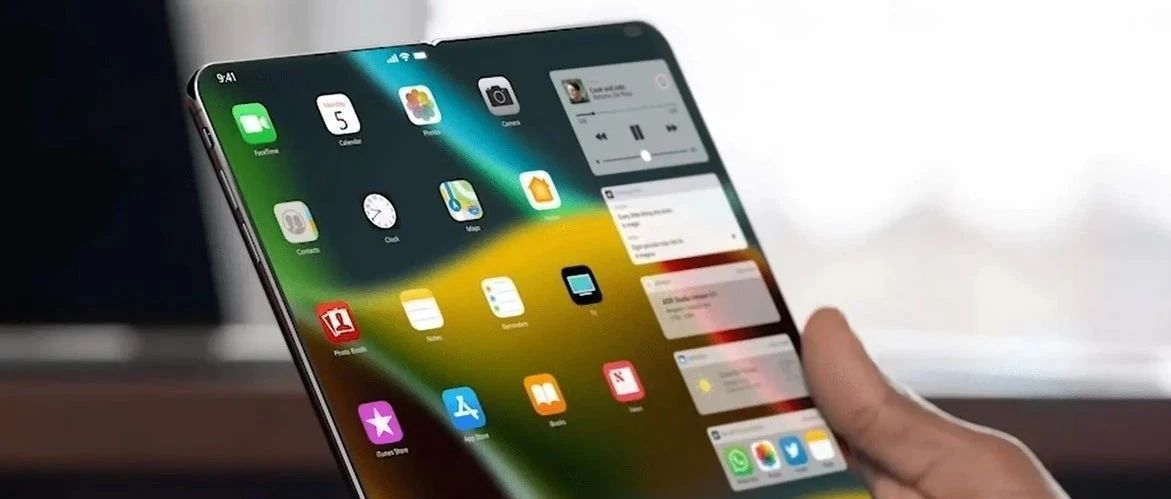
Core Viewpoint - Apple is expected to launch its first foldable iPhone next year, potentially generating up to $65 billion in sales revenue [1][3]. Group 1: Product Launch and Market Impact - The first foldable iPhone is anticipated to be part of the iPhone 18 series, set to be released in September 2026, with a price point of $1,999 [1]. - Analysts suggest that the design of Apple's foldable phone may resemble Samsung's Galaxy Z Fold series, indicating a shift in Apple's product strategy [2]. - The introduction of the foldable iPhone is seen as a significant design change since the original iPhone was launched in 2007, marking a potential revitalization of consumer interest [2]. Group 2: Market Dynamics and Competitive Landscape - The foldable phone market is expected to grow significantly, although it will remain a niche segment within the high-end smartphone market [3]. - Apple's stock has seen a decline of over 15% this year, attributed to various risk factors, including trade tensions under the Trump administration [3]. - The competitive landscape is intensifying, with Samsung planning to release three foldable phones by the end of this year, highlighting the urgency for Apple to innovate [1][2]. Group 3: Design and Innovation Challenges - The upcoming iPhone 17 series is expected to have limited upgrades, leading investors to focus on the next year's product launches [2]. - Apple's historical success in mainstreaming product categories like smartwatches and tablets suggests that the company could similarly influence the foldable phone market [3]. - The departure of former chief designer Jony Ive to join OpenAI for a project aimed at creating a device to rival the iPhone adds another layer of competitive pressure [4].


Apple shutters store in China for first time ever as struggles mount in second-largest market
New York Post· 2025-07-29 15:15
Core Insights - Apple is closing its first store in China, located in Dalian's Parkland Mall, due to struggles in the Chinese smartphone market [1][2] - The closure is part of a broader trend of declining consumer spending in China, affecting various retailers including luxury brands [2] - Apple has reported a significant decline in sales in China, with a total revenue of $66.95 billion last year, down nearly 10% from its peak [5] Group 1: Store Closure and Market Conditions - The closure of the Dalian store marks Apple's first shutdown in China since 2008 [1] - The Parkland Mall has seen several retailers exit, prompting Apple's decision to close its store [2] - The Chinese government has initiated stimulus programs to boost spending on smartphones and electric vehicles [3] Group 2: Sales Performance and Competition - Apple has experienced a sales decline in China for six consecutive quarters, with a 25% drop in the final quarter of the last year [3][5][6] - The company's market share in China fell to 15.5% last year, down from 17.9% the previous year, due to increased competition from local brands like Huawei, Xiaomi, and Vivo [8] - Despite the closure, Apple plans to open a new store in Shenzhen and maintain its other store in Dalian, expecting to end the year with 58 stores in China [8][9]
印度智能手机总产量较去年同期飙升240%
news flash· 2025-07-29 05:20
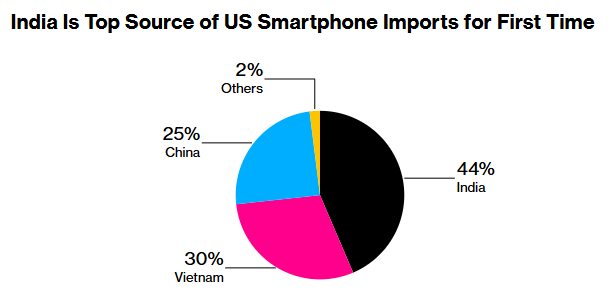
Group 1 - The core point of the article highlights a significant increase in India's smartphone production, which surged by 240% year-over-year [1] - In the second quarter, smartphones assembled in India accounted for 44% of the total U.S. smartphone imports, a substantial rise from 13% in the same period last year [1] - The increase in smartphone shipments from India is primarily driven by Apple's accelerated production plans in the country, aiming to boost iPhone production to about one-quarter of total output in the coming years [1] Group 2 - Despite the growth in production, Apple's overall iPhone shipments declined by 11% year-over-year to 13.3 million units in the second quarter, reversing the previous quarter's growth of 25% [1]
X @外汇交易员
外汇交易员· 2025-07-29 04:39
Market Share & Production Shift - India became the largest smartphone supplier to the US in Q2, accounting for 44% of the market share [1] - Vietnam ranked second with 30% market share [1] - China ranked third in smartphone supply to the US [1] Factors Driving the Shift - Apple significantly increased its production capacity in India [1] - Smartphone manufacturers stockpiled due to tariff concerns [1] Production Efficiency - Indian factories have approximately 10% lower yield rates compared to mainland China and Vietnam due to factors like worker efficiency, technology maturity, and supply chain completeness [1] - The overall situation in India is still within Apple's control [1]
印度首次成为美国手机最大制造国 组装市场份额飙至44%
智通财经网· 2025-07-29 03:41
Group 1 - India has overtaken China as the largest source of smartphone sales to the US, accounting for 44% of the market as of June [1] - The share of smartphones assembled in China has significantly decreased from 61% in Q2 2024 to 25% in Q2 2025 [1] - Apple has increased its production efforts in India, contributing to a 240% year-on-year growth in devices manufactured in India [4] Group 2 - Apple's iPhone shipments to the US have declined by 11%, indicating a distortion in its usual supply chain patterns due to excessive inventory accumulation earlier this year [4] - Despite suppliers increasing inventory, market growth was only 1%, suggesting weak demand amid challenging economic conditions [4] - Apple and other manufacturers are shifting production from China to India and Vietnam to mitigate risks associated with tariffs and geopolitical tensions [4]
「三级头」又加了「八倍镜」:今年旗舰机大逃杀,iPhone 还能吃鸡吗?
3 6 Ke· 2025-07-28 23:51
Core Insights - Apple is focusing on enhancing the long-focus capabilities of its iPhone series, particularly with the upcoming iPhone 17 Pro potentially featuring an 8x continuous optical zoom lens [1][3] - The iPhone 17 Pro may also introduce a first-party professional camera app in iOS 26, along with a new physical button for camera control [1][4] - The imaging system remains a key differentiator between Apple's flagship and non-flagship models, with significant upgrades expected in the camera specifications [3] Group 1: Camera Features - The iPhone 17 Pro is expected to have all three cameras upgraded to 48MP sensors, emphasizing Apple's commitment to superior imaging capabilities [3] - The introduction of a long-focus lens in the Pixel 10 series highlights a competitive shift in the market, as Apple will be the only major brand not offering a long-focus lens in its standard model priced at $799 [8][10] - The absence of a long-focus lens in the standard iPhone 17 raises questions about its classification as a high-end smartphone, especially in comparison to competitors that include long-focus options in their standard models [10][12] Group 2: Market Dynamics - The smartphone market has been characterized by a "two superpowers and one strong" structure, with Apple, Samsung, and Google dominating the mid-to-high-end segments [6][8] - The competitive landscape is shifting as domestic brands in China have already integrated long-focus lenses into their standard models, putting pressure on Apple to adapt [12][15] - The long-focus lens is becoming a critical feature for differentiation in a market where product homogeneity is prevalent, making it essential for flagship models [17]

The Most Important Thing for Apple Stock (AAPL) Investors to Watch in 2025
The Motley Fool· 2025-07-28 04:43
Core Viewpoint - Apple is facing significant challenges in the Chinese smartphone market, which is critical for its revenue, and needs to find solutions to either regain market share or develop new revenue streams [1][4][18] Market Performance - Apple's market capitalization stands at $3.2 trillion, but the stock has declined by 14% in 2025, underperforming compared to the broader market [2] - The stock has shown a slight recovery with a 6% increase in the last month, but concerns remain about its declining market share in China [4] Market Share in China - Apple's market share in China has decreased from 21% in Q4 2023 to 15% in Q1 2025, while competitors Huawei and Xiaomi hold 19% each [7] - Sales in Greater China dropped by 2% year-over-year in Q2 2025, contrasting with growth in other regions [8] Revenue Breakdown - Total sales for Apple in Q2 2025 were $95.3 billion, a 5% increase from $90.7 billion in Q2 2024 [8] - The Services segment generated $26.64 billion in Q2 2025, up 11.6% from $23.86 billion in Q2 2024, highlighting its importance as a revenue source [12] Product Performance - iPhone sales reached $48.84 billion in Q2 2025, a 6.2% increase from the previous year, but the overall growth has stagnated since 2023 [13][9] - The lack of significant technological advancements in recent iPhone models has led to consumers holding onto their devices longer, impacting sales [14][15] Trade and Production Challenges - Apple is affected by the ongoing trade tensions between the U.S. and China, with potential tariffs threatening profit margins [16][17] - The company is in the process of relocating some production to Vietnam and India, but this transition is lengthy and does not fully mitigate tariff risks [16] Future Outlook - Investors should monitor the upcoming fiscal third-quarter earnings report on July 31, particularly focusing on sales trends in Greater China and their impact on overall revenue [18]
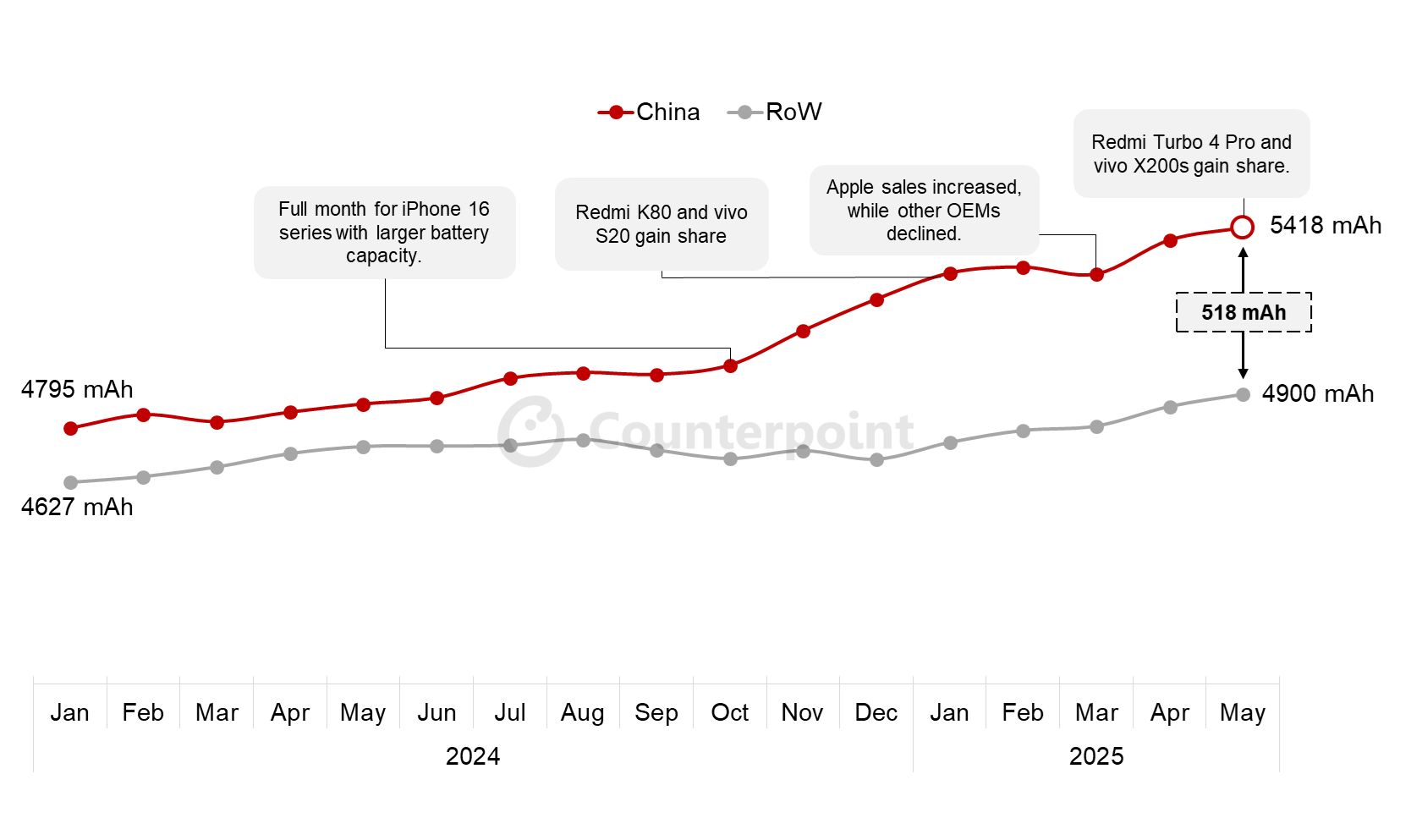
Counterpoint 报告 5 月中国手机平均电池容量 5418mAh:同比增长 11%,比其它市场高 518mAh
Xin Lang Cai Jing· 2025-07-26 14:46
Group 1 - The average battery capacity of smartphones in China is projected to reach 5418mAh by May 2025, representing an 11% year-on-year increase, significantly higher than the global average increase of 3% [1][5] - The introduction of silicon-carbon (SiC) batteries has contributed to the widening gap in battery capacity, with Chinese smartphones leading by over 500mAh compared to other markets [1][5] - The adoption of SiC batteries is expected to accelerate with the launch of popular models such as Honor X60 Pro, REDMI K80, and vivo S19 in the second half of 2024, addressing consumer pain points related to increased screen usage and higher power applications [5] Group 2 - The market share of smartphones with battery capacities of 6000mAh and above in China has surged to 35% by May 2025, up from just 9% a year earlier, indicating a significant shift in consumer preferences [5]
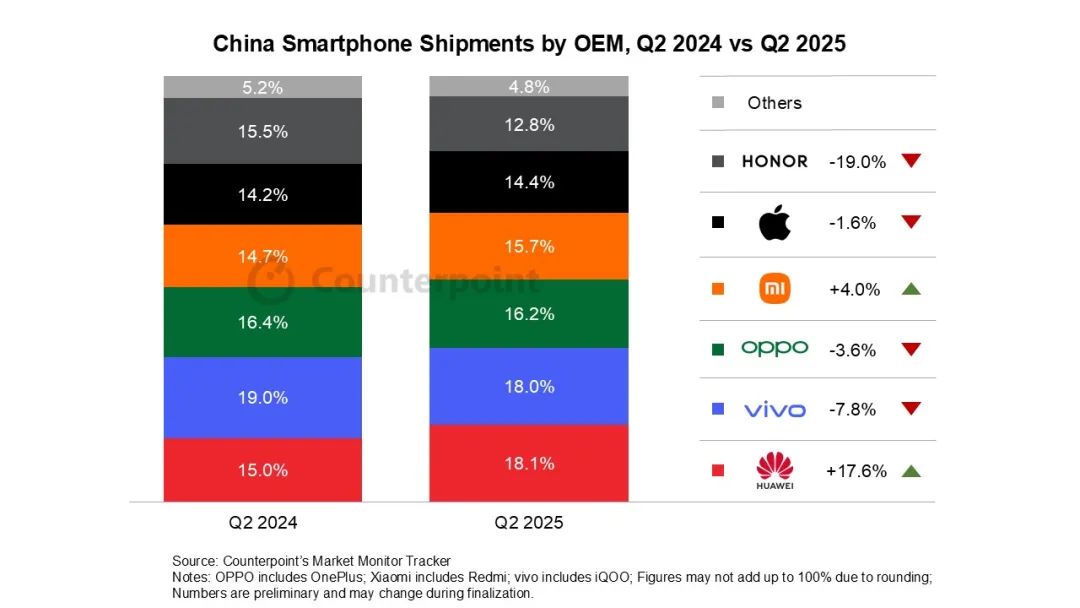
Counterpoint Research:2025年Q2中国智能手机出货量同比下降2%
智通财经网· 2025-07-24 01:23
Core Insights - In Q2 2025, China's smartphone shipments declined by 2.4% year-on-year, attributed to seasonal factors and demand front-loading due to subsidies [1] - Huawei maintained its leading position for the second consecutive quarter, increasing its market share from 15% to 18.1% year-on-year, driven by strong sales of the mid-range nova 14 series and significant price reductions on high-end models [1] - Vivo ranked second in shipments, supported by its strong offline channel network and the successful performance of its Y series in lower-tier cities, along with a surge in demand for the newly launched S30 series during back-to-school promotions [4] - OPPO successfully launched the Reno 14 series before the 618 shopping festival, continuing the strong sales momentum of the Reno 13 series, while its sub-brand OnePlus achieved notable growth by focusing on the gaming experience [4] - Xiaomi recorded the second-fastest growth rate in Q2 2025 with a market share of 15.7%, maintaining growth through price reductions on popular models like Redmi K80 and Xiaomi 15, despite not launching new mid-range products during promotions [5] - Apple performed strongly during the 618 shopping festival due to unprecedented price cuts on the iPhone 16 series, particularly the Pro models, although this may pressure sales of the iPhone 17 base model in the second half of the year [5] - Honor is responding to intense market competition by expanding its product lineup, with the mid-range HONOR 400 series launched at the end of May showing promising initial results [5] Industry Outlook - The demand for smartphones in China remains weak, aligning with previous expectations from Counterpoint, although promotions and subsidies have provided some support for stable sales [6] - Counterpoint anticipates a year-on-year growth in the Chinese market for 2025, albeit at a slower pace, with summer promotions and the early release of flagship products in Q3 expected to boost sales and lay a solid foundation for Q4 performance [6] - The industry will continue to monitor the evolving global market landscape, particularly regarding tariff policies, rising component costs, and changes in consumer demand [6]

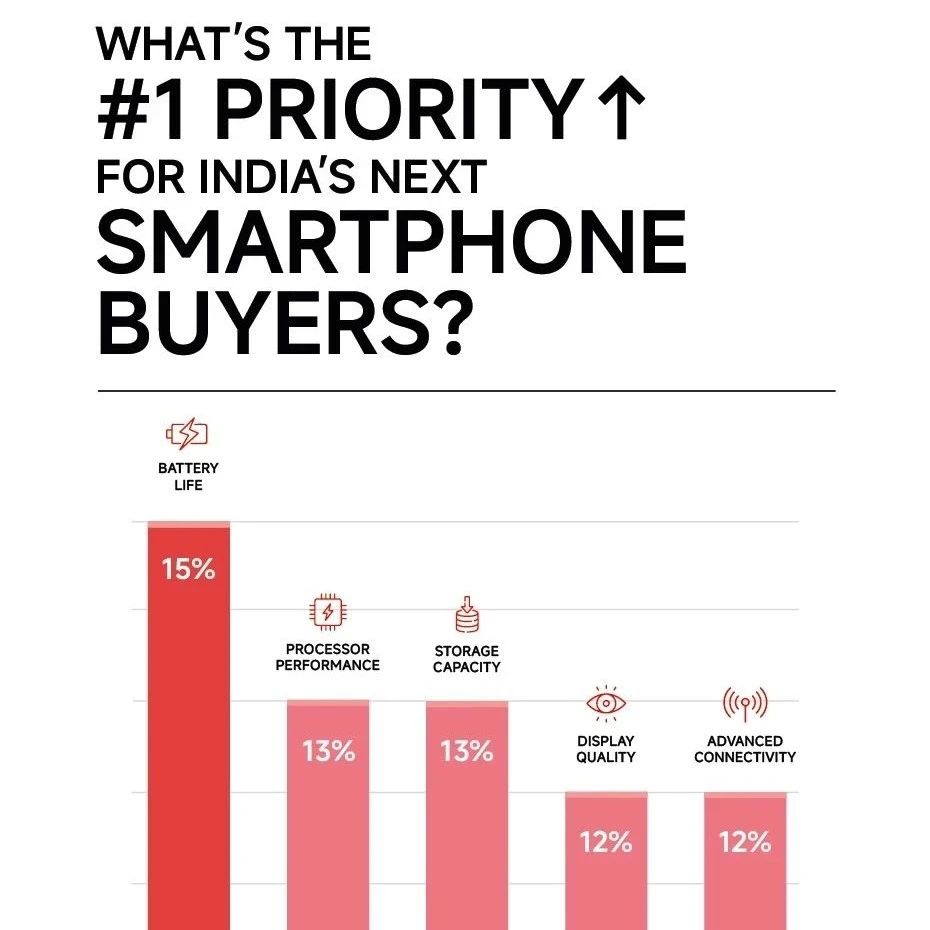
调研:电池性能成为印度经济型智能手机配置优先考虑的重点
Counterpoint Research· 2025-07-23 09:15
Core Insights - The article emphasizes the importance of battery life as a key consideration for consumers purchasing smartphones in the budget segment (under ₹20,000 or approximately $230) in India, despite the overall priority still being on SoC processors [2][3]. Group 1: Consumer Preferences - A recent survey by Counterpoint Research indicates that battery life is the most critical factor for 15% of consumers planning to buy smartphones under ₹20,000 [2][6]. - The top three factors influencing smartphone purchase decisions are processor performance, battery life, and storage capacity [2][3]. - The average battery capacity of smartphones in India has reached 5212 mAh, reflecting the growing consumer reliance on smartphones for various daily tasks [3][8]. Group 2: Market Trends - The increasing dependence on smartphones for social media, digital payments, photography, and other tasks has raised consumer expectations for performance, battery life, and usability [8]. - Consumers are becoming aware that larger battery capacities often lead to heavier devices, prompting a preference for lightweight designs that do not compromise on battery life [8]. - In the budget smartphone market, battery life has transitioned from being a supplementary feature to a decisive factor in purchase decisions [8]. Group 3: Company Overview - Counterpoint Research is a global market research firm focused on the technology ecosystem, providing insights and data across various sectors including smartphones, semiconductors, and consumer electronics [9]. - The company serves a diverse clientele, from smartphone OEMs to chip manufacturers and large tech firms, with a team of experienced analysts offering comprehensive market data and strategic consulting [9].