Beverages

Search documents
春晚,白酒春节营销的巅峰之战|观酒周报
2 1 Shi Ji Jing Ji Bao Dao· 2026-02-09 06:50
Group 1 - The upcoming Spring Festival is a crucial marketing period for the liquor industry, with a long holiday expected to boost consumption opportunities [1] - The CCTV Spring Festival Gala has announced four major liquor sponsors: Wuliangye, Yanghe, Gujinggong, and Langjiu, with each having a significant presence in the event [1][2] - There are expectations of additional liquor brands participating in the Spring Festival Gala, despite a perceived reduction in sponsorship compared to previous years [1] Group 2 - In recent years, the Spring Festival Gala has typically featured a core group of four liquor sponsors, with additional brands appearing in various capacities [2][3] - The number of liquor brands participating in the Spring Festival Gala has varied, with a peak of nine brands in 2024, indicating a trend of increasing brand involvement [4] - Some liquor companies are shifting their focus to local television programs to strengthen brand presence in their key markets, while still maintaining participation in major events like the CCTV Spring Festival Gala [5] Group 3 - Various liquor brands are exploring partnerships with social media platforms to enhance engagement and marketing reach during the Spring Festival [8] - Companies like Xijiu are entering into direct sales partnerships with platforms like Meituan to facilitate quicker delivery and boost sales [9] Group 4 - New product launches are occurring, such as the introduction of a low-alcohol liquor by Shui Jing Fang, which has seen significant pre-sale success [10] - The UMEET blueberry sparkling wine from Moutai has achieved impressive sales figures on its launch day, indicating strong market interest [11] - Luzhou Laojiao aims to enhance its market position and is targeting a top-three industry ranking, reflecting competitive ambitions within the sector [12] Group 5 - Chongqing Beer reported growth in revenue, profit, and sales volume for 2025, indicating a recovery and positive trend in the beer market [14]
Is Coca-Cola’s Unmatched Pricing Power Finally Fizzling?
Yahoo Finance· 2026-02-09 05:01
Core Insights - Coca-Cola has historically maintained strong pricing power, raising prices while retaining customers, but there are concerns that consumers may be reaching their limit [1][3] - The average price of soda has doubled from 2020 to 2025, significantly outpacing national inflation, with Coca-Cola's operating margins increasing from 24% to 32% during the same period [2] - Recent trends indicate that lower-income consumers are shifting to cheaper alternatives, leading to flattened or negative volume growth in major markets [3] Pricing and Market Dynamics - The soda industry has benefited from price increases, with Coca-Cola's share price reaching record highs around $79 [2] - In response to market pressures, PepsiCo announced a 15% price cut on various items, while Coca-Cola is focusing on premiumization and health-oriented products to offset declining flagship sales [5] Consumer Sentiment - Consumer sentiment remains resilient, with optimism at a six-month high, suggesting that while spending continues, there are signs of price sensitivity among consumers [3]

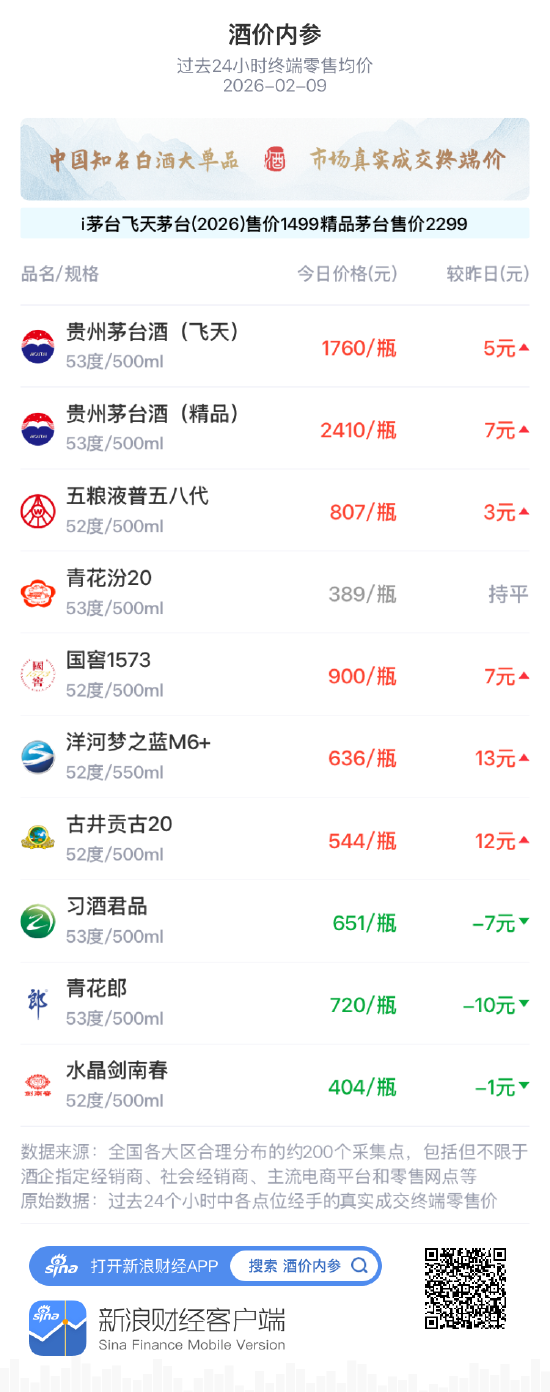
酒价内参2月9日价格发布,飞天茅台上涨5元实现五连阳
Xin Lang Cai Jing· 2026-02-09 01:26
Core Insights - The Chinese white liquor market continues to see an upward trend in retail prices, with the average price of the top ten products reaching 9,221 yuan on February 9, marking a 29 yuan increase from the previous day and the highest since December 27, 2025 [1][6] Price Movements - Among the top ten products, six saw price increases, three experienced declines, and one remained stable, indicating a strong overall upward momentum in prices [1][6] - Leading the price increases, Yanghe Dream Blue M6+ rose by 13 yuan per bottle, followed by Gujing Gong 20 with a 12 yuan increase, and both Guojiao 1573 and premium Moutai increased by 7 yuan per bottle [1][6] - Moutai's Flying Moutai saw a 5 yuan increase, achieving a one-month high, supported by strong market demand ahead of the Spring Festival [1][6] Market Dynamics - The white liquor market is experiencing significant differentiation, with high-end products performing well while mid-range products face slight declines [2][7] - A recent survey indicated a 10%-20% decline in overall sales across the white liquor market, with regional variations; for instance, Shandong and Anhui saw declines of about 20% [2][7] - Despite the overall downturn, over 30% of distributors reported stable or growing performance, particularly for premium brands like Flying Moutai, which saw some distributors' sales increase by over 40% year-on-year [2][7] Pricing Trends - The price dynamics show a clear bifurcation: high-end products priced above 800 yuan are driven by gifting and banquet demands, while the 100-200 yuan range benefits from business and daily consumption needs [2][7] - Conversely, the 300-600 yuan mid-range segment is under pressure, experiencing over a 20% decline in sales due to economic conditions and market competition [2][7]





Stock market today: Dow, S&P 500, Nasdaq futures slip as Dow looks to keep rallying above 50,000
Yahoo Finance· 2026-02-09 00:14
Market Overview - US stock futures declined slightly as investors prepared for a week filled with economic data and corporate earnings, following a record close for the Dow above 50,000 [1] - The Dow surged over 1,200 points, or 2.5%, marking its first close above 50,000, while the S&P 500 and Nasdaq Composite both rose around 2% [2] Economic Data - The delayed January employment report is set to be released on Wednesday, with expectations tempered after ADP reported only 22,000 private-sector job additions last month, a significant drop from 140,000 year-over-year [4] - January's consumer price index will also be released on Friday, following a delay due to a government shutdown [5] Corporate Earnings - Key earnings reports this week include Coca-Cola, McDonald's, Cisco, and ON Semiconductor, which will influence expectations for the Federal Reserve's interest rate decisions [5] Currency and Commodities - The dollar index has decreased by 10% since President Trump took office, despite the nomination of Kevin Warsh, viewed as a policy hawk [6] - Gold prices rose above $5,000 an ounce as dip-buyers returned after a volatile week for precious metals [3][7] Company News - QuantumScape's stock increased by 14% following the launch of its "Eagle Line," a pilot factory aimed at mass-producing battery parts [8] - The Nikkei 225 surged 4.7% after the governing party of Japanese Prime Minister Sanae Takaichi secured a supermajority in elections, indicating a potential for market-friendly policies [9] - Markets across Asia also saw gains, with South Korea's Kospi rising 4.3% as technology stocks in the US rebounded [10]
Inflation, Earnings and Other Key Things to Watch this Week
Yahoo Finance· 2026-02-08 18:00
Economic Data Insights - The January employment report on Wednesday at 8:30am will analyze nonfarm payrolls, unemployment rate, and average hourly earnings to assess labor market conditions and their impact on Fed policy [1][3] - The mid-week timing of the employment report creates unique dynamics, compressing the time for market adjustments before Friday's CPI release [3] Retail Sales and Consumer Spending - December retail sales data on Tuesday at 8:30am will provide insights into holiday shopping performance and consumer spending trends as 2026 begins [2][4] - The report will help determine if strong labor markets are translating into sustained consumer spending or if households are retrenching due to inflation pressures [4] Technology Sector Analysis - Earnings from Cisco (CSCO) on Wednesday and Arista Networks (ANET) on Thursday will provide insights into enterprise networking demand and data center investment amid questions about AI spending sustainability [5] - Cisco's results will focus on corporate IT budgets and cybersecurity product adoption, while Arista's earnings will assess trends in hyperscaler capital expenditures [5] Digital Platforms and Financial Technology - Earnings from Robinhood (HOOD) on Tuesday will provide insights into retail trading activity and cryptocurrency transaction volumes [6] - Results from Shopify (SHOP) and AppLovin (APP) will test the health of e-commerce platforms and mobile gaming advertising, respectively [7] Inflation and Market Reactions - The January CPI report on Friday at 8:30am will be critical for assessing inflation trends, particularly in energy prices, housing costs, and services inflation [8] - The timing of the CPI report following the employment data could lead to significant market volatility, especially in rate-sensitive sectors [8]
Wall Street Brunch: Delayed Data Deluge
Seeking Alpha· 2026-02-08 17:28
Earnings Reports - Coca-Cola, McDonald's, and Cisco are among the 78 S&P 500 companies reporting earnings this week, with Coca-Cola expected to maintain steady growth and protect margins despite a challenging macro environment [4] - Other notable companies reporting include AstraZeneca, Gilead, Ford, T-Mobile US, Applied Materials, and British American Tobacco [10] Market Trends - The Dow Jones Industrial Average surpassed 50,000 for the first time last week, indicating a significant milestone in market performance [4] - The Nasdaq-100 index showed signs of a technical recovery, with momentum potentially shifting back toward bullish trends [11] Economic Indicators - A trifecta of jobs data indicated labor market weakness, with claims and layoffs increasing while job openings decreased; however, nonfarm payrolls are expected to rise by approximately 70,000, keeping the unemployment rate steady at 4.4% [2] - The Consumer Price Index (CPI) is forecasted to show a 0.3% monthly gain, with annual rates about 0.5% above the Federal Reserve's 2% target [3] Corporate Actions - Hims & Hers Health has decided to stop offering a compounded version of Novo Nordisk's Wegovy pill for weight loss following pressure from the FDA [6][7] - Will Lewis, CEO of The Washington Post, stepped down after the company reduced its workforce by about one-third, aiming for a sustainable future for the publication [8]



Dow 50,000 sets table for inflation data, delayed January jobs report: What to watch this week
Yahoo Finance· 2026-02-08 12:38
Market Overview - The Dow Jones Industrial closed above 50,000 for the first time, while the S&P 500 and Nasdaq Composite indexes experienced a 2% daily rally, recovering some losses from earlier in the week [1] - Despite the rally, the Nasdaq recorded its fourth consecutive losing week, dropping nearly 3%, primarily due to investor concerns over AI-related disruptions in software [2] - The S&P 500 has also declined in three out of the last four weeks, while the Dow and S&P 500 are up for the year; however, the Nasdaq has forfeited its year-to-date gains [2] Upcoming Economic Data - The delayed January jobs report is expected to be released on Wednesday, with economists forecasting the creation of 70,000 nonfarm payroll jobs and an unemployment rate steady at 4.4% [3] - Key inflation data will be released on Friday, with the Consumer Price Index (CPI) expected to show a 0.3% increase over the previous month and a 2.5% rise over the past year [3] Labor Market Insights - The jobs report was delayed due to a government shutdown, and recent data indicates a shaky labor market, with ADP reporting only 22,000 jobs added in January, about half of economists' expectations [4] - The Job Openings and Labor Turnover Survey (JOLTS) revealed that job openings in December fell to their lowest level since the pandemic began in 2020, while layoff announcements in January reached the highest level for that month since 2009 [5] - Despite low layoffs and a slight decline in unemployment, the strength in the labor market appears to be fading quickly, according to Indeed's senior economist [6] Corporate Earnings Reports - Notable companies scheduled to report earnings in the upcoming week include Coca-Cola, McDonald's, Cisco, and ON Semiconductor [6] Market Sentiment - The stock market faced significant challenges, reaching both price and sentiment lows, with a noted negative sentiment among investors despite the rally on Friday [7]
What to Expect in Markets This Week: Delayed January Jobs Report, Inflation and Retail Sales Data, Earnings From Cisco, Coca-Cola, McDonald's, Ford
Investopedia· 2026-02-08 10:50
Economic Data and Earnings Reports - Key economic releases this week include delayed January jobs data, consumer inflation, and retail sales reports due to a recent government shutdown [1][3][4] - The January jobs report is expected to show fewer job additions than anticipated, despite a decrease in the unemployment rate [3] - The January CPI inflation report is anticipated to reveal steady inflation, with core inflation lower than expectations, influencing Federal Reserve rate decisions [4] Company Earnings - Cisco is set to report earnings, which may provide insights into AI infrastructure demand, with the CEO highlighting significant opportunities in this sector [5] - Consumer stocks such as Coca-Cola and McDonald's are also reporting; Coca-Cola has recently exceeded profit expectations, while McDonald's may reveal trends among affluent customers [6] - Other notable earnings reports include those from Ford, Honda, Ferrari, AstraZeneca, Moderna, and Vertex Pharmaceuticals, which will provide insights into auto sales and pharmaceutical demand [7]



What to Expect in Markets This Week: January Jobs Report, Inflation and Retail Sales Data; Earnings From Cisco, Coca-Cola, McDonald’s
Yahoo Finance· 2026-02-08 10:00
Economic Data Releases - January jobs data is set to be released on Wednesday, following a delay due to a government shutdown, with expectations of fewer jobs added in December despite a lower unemployment rate [3] - The January CPI inflation report is due on Friday, indicating steady inflation in December, with core inflation lower than expected, influencing Federal Reserve rate decisions [4] - December retail sales report will be released on Tuesday, assessing consumer spending during the holiday season [4] Company Earnings Reports - Cisco is expected to report earnings on Wednesday, which may provide insights into AI infrastructure demand, with the CEO highlighting significant opportunities in this area [5] - Coca-Cola has recently reported better-than-expected profits, with shares at all-time highs, while McDonald's earnings report may reveal trends among wealthier customers [6] - Reports from Ford, Honda, and Ferrari will provide insights into auto sales levels, while financial updates from Marriott and Airbnb will reflect travel demand [7] - Pharmaceutical firms such as AstraZeneca, Moderna, and Vertex Pharmaceuticals are also reporting this week, which will be closely monitored by investors [7]
i茅台出手,飞天茅台一周猛涨120元
21世纪经济报道· 2026-02-08 06:46
Core Viewpoint - The article discusses the recent fluctuations in the market price of Moutai's "Flying Moutai" and the operational updates from the iMoutai app, highlighting the impact of user experience and market dynamics on the company's performance [1][5]. Group 1: iMoutai App Updates - The iMoutai app will undergo maintenance from February 8, 2026, 14:00 to February 9, 07:00 to improve user experience and system stability due to high traffic [1]. - Users reported difficulties in loading the iMoutai app, affecting their ability to purchase products [1]. Group 2: Market Price Fluctuations - The market price of Flying Moutai has seen significant volatility, with a sudden increase of 150 yuan per bottle followed by a decrease of 160 yuan over the weekend [1]. - As of February 8, 2026, the price for a full box of Flying Moutai (53 degrees/500ml) is reported at 1710 yuan, an increase of 120 yuan since February 2 [2]. - The price for loose Flying Moutai (53 degrees/500ml) is reported at 1630 yuan, up by 60 yuan since February 2 [2]. Group 3: Company Stock Performance - Following the recent price recovery of Flying Moutai, the stock price of Kweichow Moutai has increased by over 14% since January 29, 2026, reaching above 1500 yuan [3]. - As of February 6, 2026, Kweichow Moutai's total market capitalization is 1.8972 trillion yuan, ranking fourth in the A-share market [3]. Group 4: Price and Channel Adjustments - Analysts suggest that the recovery in Flying Moutai prices is a key factor driving Kweichow Moutai's strong performance, attributed to adjustments in both the distribution channels and pricing strategies [5].