
财政管理

Search documents
部分资金被挪用 超10万亿转移支付资金如何强监管?
Di Yi Cai Jing· 2025-10-19 22:38
Core Insights - The Chinese government has been utilizing over 10 trillion yuan in transfer payments to address fiscal imbalances among regions and promote coordinated regional development [1] - Recent audit reports from 28 provinces have highlighted issues with the timely allocation, compliance, and rational distribution of transfer payments, indicating a need for improved regulatory oversight [1][2] Transfer Payment Issues - The overall scale of intergovernmental transfer payments in China is increasing, with central government transfers to localities projected at approximately 100.4 billion yuan for 2024 and 103.4 billion yuan for 2025 [2] - Many local governments are struggling with fiscal imbalances, leading to increased competition for transfer payments, which necessitates a more scientific and rational distribution of these funds [2] - Specific audit findings include: - Gansu's report noted a lack of management regulations for 26 projects and ineffective utilization of project reserves [2] - Hebei's report highlighted delays in revising funding management methods and unreasonable fund allocations affecting 10.74 billion yuan [2][3] Inefficiencies in Fund Allocation - Audit reports from various provinces revealed issues such as: - Shandong's report indicated that funds for smart city initiatives were distributed too broadly, with some eligible enterprises receiving only minimal support [3] - Anhui's report pointed out overlapping objectives among different special transfer payments, leading to inefficiencies [3] - Hunan's audit found that fixed distribution methods did not adequately address the needs of counties with significant fiscal gaps [3] Delays and Idle Funds - Delays in the allocation of transfer payments have been a recurring issue, with reports indicating that some funds were not distributed within the required timeframes, impacting budget execution and fund utilization [4][5] - For instance, Guangdong's audit revealed that 161.61 billion yuan in transfer payments exceeded the allocation deadline, with some delays lasting up to 334 days [4] - Idle funds due to slow project progress were also reported, with Hainan noting 8.04 billion yuan in unspent ecological protection funds [5] Regulatory Improvements - The Chinese government is working to enhance the transfer payment system and strengthen oversight to improve fund utilization efficiency [6] - Recommendations include optimizing the distribution methods for transfer payments, establishing evaluation mechanisms for regional balance, and ensuring timely fund disbursement [7][8] - Local audits have suggested reforms such as clarifying the functions of various transfer payments and implementing dynamic adjustment mechanisms to prevent fund wastage [8]
河南省财政厅原一级巡视员高战荣接受审查调查
Zhong Guo Xin Wen Wang· 2025-10-15 08:36
Core Viewpoint - Gao Zhanrong, former member of the Party Leadership Group and Deputy Director of the Henan Provincial Department of Finance, is under investigation for serious violations of discipline and law [1] Group 1 - Gao Zhanrong is currently undergoing disciplinary review and supervision investigation by the Henan Provincial Commission for Discipline Inspection and Supervision [1]
河南省财政厅原一级巡视员高战荣被查
Xin Jing Bao· 2025-10-15 08:23
Core Points - Gao Zhanrong, former member of the Party Leadership Group and Deputy Director of the Henan Provincial Department of Finance, is under investigation for serious violations of discipline and law [1] Summary by Category - **Investigation Details** - Gao Zhanrong is currently undergoing disciplinary review and supervision investigation by the Henan Provincial Commission for Discipline Inspection and Supervision [1]
我省启动财政电子票据跨省报销试点
Xin Hua Ri Bao· 2025-09-21 21:01
Core Points - Jiangsu Province has launched a pilot program for cross-provincial reimbursement of electronic invoices, marking the full initiation of the project [1] - The program aims to provide efficient cross-regional invoice reimbursement services for businesses and citizens, supporting the development of a digital government [1] Group 1 - The pilot program is based on the Ministry of Finance's requirements and utilizes a unified public payment platform for electronic invoices [1] - A digital account system has been established to facilitate secure and efficient cross-provincial sharing of electronic invoices [1] - The digital account offers services such as invoice collection, status inquiry, authenticity verification, reimbursement locking, and feedback, addressing issues related to reimbursement for medical expenses and commercial insurance [1] Group 2 - Digital accounts are categorized into personal and corporate types, with personal accounts allowing individuals to activate across multiple provinces and collect invoices from various locations [2] - Corporate accounts are designed for independent legal entities, featuring additional modules for reimbursement locking and information feedback to meet financial management needs [2] - The system will enter a formal application phase in November after a promotion phase in September and October [2]
广元市朝天区财政局加强债券资金全生命周期管理
Sou Hu Cai Jing· 2025-09-18 12:38
Group 1 - The core viewpoint is that the Chaotian District Finance Bureau of Guangyuan City has successfully issued special bonds amounting to 290 million yuan, which will significantly boost the economic and social development of the district [2] - The focus is on the entire process of special bond project planning, application, and fund allocation, ensuring that projects are matched with funding based on their maturity [6] - The management of special bonds emphasizes quality improvement and efficiency optimization, ensuring accurate and timely data entry into the management system for project progress and fund usage [10] Group 2 - A comprehensive lifecycle management mechanism for special bonds has been established to prevent debt risks, including a tracking system for fund usage progress [12] - An innovative three-level verification mechanism has been implemented to ensure compliance in fund payments, involving self-checks by project units, reviews by industry authorities, and joint audits by finance [12] - Performance evaluation is integrated throughout the project lifecycle to ensure that special bond funds are effectively allocated, utilized, and managed [12]


财政部:1-8月证券交易印花税1187亿元 同比增长81.7%
智通财经网· 2025-09-17 08:14
Core Insights - The national general public budget revenue for January to August reached 148198 billion yuan, showing a year-on-year growth of 0.3% [1][3] - Tax revenue amounted to 121085 billion yuan, with a slight increase of 0.02% year-on-year, while non-tax revenue was 27113 billion yuan, growing by 1.5% [1][3] - Central government revenue decreased by 1.7% to 64268 billion yuan, while local government revenue increased by 1.8% to 83930 billion yuan [1][3] Revenue Breakdown - Domestic value-added tax generated 47389 billion yuan, up 3.2% year-on-year [4] - Domestic consumption tax totaled 11523 billion yuan, increasing by 2% [5] - Corporate income tax reached 31477 billion yuan, with a growth of 0.3% [6] - Personal income tax was 10547 billion yuan, reflecting an increase of 8.9% [7] - Import VAT and consumption tax amounted to 11770 billion yuan, down 6.7%, while customs duties were 1527 billion yuan, decreasing by 6.5% [8] - Export tax rebates were 15766 billion yuan, up 9% [9] - Stamp duty revenue was 2844 billion yuan, with a significant increase of 27.4%, and securities transaction stamp duty reached 1187 billion yuan, growing by 81.7% [12] Expenditure Overview - Total public budget expenditure for January to August was 179324 billion yuan, reflecting a year-on-year increase of 3.1% [21] - Central government expenditure was 26570 billion yuan, up 8%, while local government expenditure was 152754 billion yuan, increasing by 2.3% [21] - Major expenditure categories included education (27078 billion yuan, +5.6%), social security and employment (30723 billion yuan, +10%), and health (13717 billion yuan, +5.1%) [22] Government Fund Budget - Government fund budget revenue for January to August was 26449 billion yuan, down 1.4% [23] - Central government fund revenue was 2933 billion yuan, up 0.6%, while local government fund revenue was 23516 billion yuan, down 1.6% [23] - Government fund budget expenditure reached 62602 billion yuan, a significant increase of 30% [24]
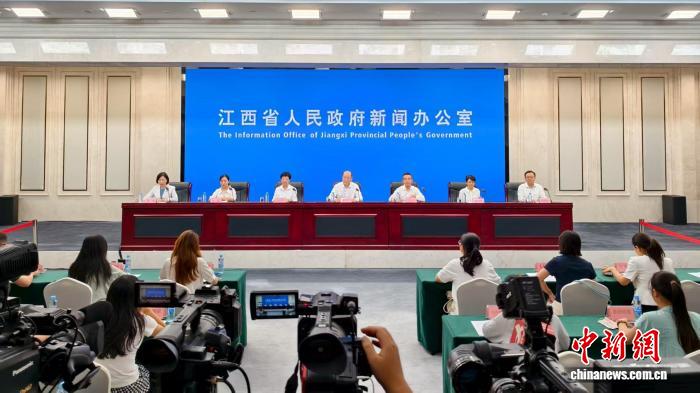
“十四五”时期,江西财政“蛋糕”越做越大
Sou Hu Cai Jing· 2025-09-16 10:30
Core Insights - The Jiangxi provincial government reported significant growth in fiscal strength during the "14th Five-Year Plan" period, with general public budget revenue expected to reach 1.5 trillion yuan over five years [1] - Total technology expenditure in Jiangxi reached 112.49 billion yuan, with a focus on high-level innovation platforms and key core technology breakthroughs [1] - Social welfare spending amounted to 2.7 trillion yuan, maintaining an 80% expenditure ratio, with over 50% allocated to employment, education, social security, and healthcare [1] Fiscal Performance - General public budget revenue increased from 281.2 billion yuan in 2021 to 306.7 billion yuan in 2024, with an average annual growth rate of 5.2%, surpassing the national average [1] - Per capita general public budget expenditure rose from 14,533 yuan at the end of the "13th Five-Year Plan" to 17,068 yuan [1] Social Investment - The focus on social policies resulted in substantial investments in public welfare, with a significant portion of the budget dedicated to improving living standards [1] - The standards for basic pension, basic medical care, social assistance, and preferential treatment have been gradually increased [1] Fiscal Sustainability Measures - Jiangxi is implementing concentrated rectification and special inspections in key areas such as township finance, rural revitalization, and government procurement to ensure sustainable fiscal operations [2] - The government is enhancing the rigidity of financial discipline through the promotion of an electronic travel authorization system [2]
五年来江西一般公共预算支出累计达3.4万亿元
Zhong Guo Xin Wen Wang· 2025-09-16 09:30
Core Points - Over the past five years, Jiangxi Province has accumulated a total general public budget expenditure of 3.4 trillion yuan, ranking 13th nationally in annual expenditure [1][2] - Jiangxi's general public budget revenue is projected to grow from 281.2 billion yuan in 2021 to 306.7 billion yuan in 2024, with an average annual growth rate of 5.2%, surpassing the national average [2] - The province has allocated over 1.5 trillion yuan in transfer payments to cities and counties, with an annual growth rate of 10.8%, and county-level revenue consistently exceeding the national average by 7 percentage points [2] Financial Strength and Support - Jiangxi's financial strength has been bolstered through resource integration and fiscal source expansion, providing solid support for high-quality development [2] - The province has established a high-quality development transfer payment incentive mechanism, allocating 1.25 billion yuan to encourage cities and counties to cultivate new productive forces and expand tax sources [2] Investment in Technology and Infrastructure - In the past five years, Jiangxi has invested a total of 112.49 billion yuan in technology, with the proportion of technology expenditure in the general public budget ranking 9th nationally in 2024 [3] - The province has streamlined research funding management and expanded pilot programs for budget flexibility, granting researchers greater autonomy over funding and technical direction [3] - Jiangxi has allocated 14.76 billion yuan for consumer upgrades and improved commercial environments, along with 85.02 billion yuan for infrastructure funding and 699.28 billion yuan in special bonds to address infrastructure gaps [3]
武汉应用AI赋能锻造“财政尖兵”
Chang Jiang Ri Bao· 2025-09-02 00:28
Core Insights - Wuhan's Finance Bureau is focusing on enhancing the quality of its workforce to support the city's economic and social development through a series of reforms and initiatives [1][3] Group 1: AI Empowerment and Digital Transformation - The integration of AI technology is a key highlight of the workforce enhancement initiative, aiming to modernize fiscal governance and management processes [1] - A smart analysis platform for fiscal policy has been established to enable automatic policy interpretation and dynamic data monitoring, creating a comprehensive management loop throughout the policy lifecycle [1] - AI evaluation methods are being introduced in budget performance management to optimize fund allocation models, ensuring precise alignment of fiscal resources with development needs [1] Group 2: Comprehensive Training and Development - The Finance Bureau has implemented a system of "21 hard measures + 32 quantitative indicators" to enhance the overall quality of its workforce, including targeted learning trips to major cities [2] - Collaborative training programs with Shanghai Jiao Tong University have been initiated, along with a series of lectures aimed at improving staff capabilities, reaching over 2000 participants in the first half of the year [2] - A mentorship program has been established to pair 80 experienced staff with younger employees, facilitating knowledge transfer and professional growth [2] Group 3: Strategic Focus and Future Plans - The Finance Bureau will continue to focus on serving the broader goals of development and public welfare, aiming to build a strong and capable fiscal team [3] - The initiative aims to provide ongoing talent support for high-quality fiscal development in the new era, contributing to the transformation of Wuhan into a strategic hub in central China [3]
云南财政监管提质为企减负
Sou Hu Cai Jing· 2025-08-28 01:12
Group 1 - The core viewpoint of the articles is that Yunnan Province's Finance Department is optimizing administrative inspections related to enterprises, aiming to reduce burdens on businesses while enhancing regulatory quality [1][2] - Yunnan Finance is shifting from a "regulatory enforcement" approach to a "service-oriented supervision" model, implementing a "comprehensive inspection once, all at once" strategy to minimize redundant checks and streamline processes [1] - The department is conducting quality checks on 40 accounting firms and 16 asset appraisal institutions, reducing on-site inspections by promoting centralized inspections through intermediary organizations [1] Group 2 - To improve the precision of problem detection, Yunnan Finance is utilizing unified regulatory platforms for the accounting and asset appraisal industries, employing an "Internet + regulation" approach to address the issues of excessive inspections and regulatory gaps [2] - The department is categorizing and classifying inspections based on risk levels and actual conditions, issuing over 200 reports for 56 inspected enterprises, thereby enhancing the effectiveness and targeting of enforcement actions [2] - Yunnan Finance is committed to institutional development, standardizing inspection behaviors, and implementing a checklist management system to ensure that inspections are conducted lawfully and uniformly [2]