
证券交易所

Search documents
专访陈翊庭:海外“长钱”踊跃加码中国资产
Shang Hai Zheng Quan Bao· 2025-09-08 01:23
Core Viewpoint - The Hong Kong stock market is experiencing a resurgence in interest from long-term foreign investors, shifting from a previous stance of avoidance to one of necessity for investment in Chinese assets [1][5]. Group 1: Market Activity - The Hong Kong Stock Exchange (HKEX) hosted the 2025 Future Technology Summit, indicating a vibrant atmosphere with full attendance and investor engagement [1]. - Daily trading volume in the Hong Kong stock market has significantly increased, with an average of 2.4 trillion HKD in the first half of the year, nearly doubling from the previous year [4]. - In September, three out of the first five trading days saw trading volumes exceed 3 trillion HKD [4]. Group 2: Foreign Investment Trends - There is a notable increase in foreign participation in the Hong Kong IPO market, with total new stock financing reaching 134.5 billion HKD in the first eight months of the year, a nearly sixfold increase compared to the same period in 2024 [4]. - The participation of foreign long-term funds in IPOs has risen, with some technology IPOs seeing 70-80% of subscriptions coming from overseas funds [4][5]. - The perception of Chinese assets has shifted from "cannot invest" to "cannot miss out," reflecting a growing consensus among global investors [5]. Group 3: Future Outlook - The HKEX aims to enhance its platform and product offerings to retain and attract more capital, ensuring sustainable growth in the market [6]. - The exchange is committed to being the first choice for mainland companies seeking to go public and is open to various sectors as long as they meet investor interest [6]. - There is a focus on providing liquidity and risk management tools for foreign investors, with plans to expand offerings in fixed income, foreign exchange, and commodities [7].



专访港交所行政总裁陈翊庭:海外“长钱”踊跃加码中国资产
Xin Lang Cai Jing· 2025-09-08 01:05
Group 1 - The Hong Kong Stock Exchange (HKEX) is experiencing a resurgence in interest from long-term foreign investors, shifting from a previous stance of "cannot invest" to "cannot miss out" on Chinese assets [2][5][6] - The average daily trading volume of Hong Kong stocks has reached 240 billion HKD in the first half of the year, nearly doubling compared to the previous year, with significant trading activity even during traditionally slow months [3][4] - The total amount raised through IPOs in Hong Kong for the first eight months of the year reached 134.5 billion HKD, a nearly sixfold increase compared to the same period in 2024, with foreign participation in IPOs becoming increasingly prominent [3][5] Group 2 - HKEX aims to enhance its platform and product offerings to attract and retain global capital, emphasizing inclusivity in its listing policies to support companies with financing needs [6][7] - The exchange is encouraging existing listed companies to pursue refinancing opportunities, with over 350 billion HKD raised through refinancing in the first eight months of the year, surpassing IPO financing amounts [7] - HKEX is also exploring the introduction of more diverse financial products to meet the liquidity and risk management needs of long-term foreign investors, particularly in fixed income, foreign exchange, and commodities [7]
上证报记者专访港交所行政总裁陈翊庭:海外“长钱”踊跃加码中国资产 丰富“货架”擦亮国际金融中心金字招牌
Shang Hai Zheng Quan Bao· 2025-09-07 18:30
Core Insights - The Hong Kong Stock Exchange (HKEX) is experiencing a resurgence in interest from long-term overseas investors, shifting from a previous stance of "cannot invest" to "cannot miss investing" in Chinese assets [1][5][6] - The average daily trading volume in the Hong Kong stock market has nearly doubled compared to last year, reaching 240 billion HKD in the first half of the year [2][3] - The IPO market in Hong Kong has seen significant growth, with total new stock financing reaching 134.5 billion HKD in the first eight months of the year, a nearly sixfold increase compared to the same period in 2024 [3][5] Investment Trends - Overseas funds are increasingly participating in Hong Kong's IPO market, with foreign long-term funds accounting for a substantial portion of subscriptions for technology IPOs [3][5] - The perception of Chinese assets among global investors has shifted from passive to active engagement, with many now actively researching the fundamentals of Chinese companies [4][5] Market Dynamics - The trading volume from southbound funds is only about 20% of the total daily trading volume, indicating that a significant portion of trading activity is driven by global investors [3] - The HKEX is focusing on enhancing its platform and product offerings to retain and attract more capital, aiming to support companies with financing needs [6][7] Future Outlook - The HKEX plans to continue improving its inclusivity for various sectors, including biotechnology, advanced manufacturing, and new consumption, to attract more listings [6][7] - The exchange is also looking to expand its product offerings beyond equities to include fixed income, foreign exchange, and commodities, addressing the needs of long-term investors for liquidity and risk management tools [7]
香港交易所集团行政总裁陈翊庭: 港股市场IPO热度仍将持续中国资产已变成“不能不投资”
Zheng Quan Shi Bao· 2025-09-07 18:29
Core Viewpoint - The Hong Kong stock market is experiencing a significant revival, with IPO activity returning to the forefront globally, driven by increased foreign investment in Chinese assets as they transition from being deemed "uninvestable" to "essential" [1][2][3]. Group 1: IPO Market Dynamics - The Hong Kong IPO market has seen a remarkable resurgence, with the total financing amount reaching HKD 137.5 billion by the end of August, marking a nearly sixfold increase compared to the same period in 2024 [4]. - Over 200 companies are currently in the pipeline for listing, with a significant portion being technology firms, indicating a robust supply of potential IPOs [3]. - The A+H listing model has been particularly successful, accounting for 70% of the total financing in the first half of the year [4]. Group 2: Foreign Investment Interest - There is a notable increase in foreign interest in Chinese assets, with many foreign investors actively seeking opportunities in the Hong Kong market [2][3]. - A significant portion of the subscriptions for new listings, especially in high-tech sectors, is coming from foreign investors, with some listings seeing up to 70% participation from overseas funds [3]. - The shift in perception among global investors regarding Chinese assets is evident, as they are now more inclined to consider them as viable investment options [3]. Group 3: Market Structure and Future Outlook - The Hong Kong Stock Exchange (HKEX) is committed to enhancing its market structure to better accommodate diverse investor needs and ensure a competitive edge [6]. - There is a recognition of the need to diversify product offerings beyond equities, particularly in fixed income and commodities, to compete effectively with other global markets [7][8]. - The integration of REITs into the Stock Connect program is in advanced preparation, which will further enrich the trading options available to investors [7].
香港交易所集团行政总裁陈翊庭: 港股市场IPO热度仍将持续 中国资产已变成“不能不投资”
Zheng Quan Shi Bao· 2025-09-07 18:24
Group 1 - The Hong Kong stock market has shown significant recovery since September last year, with IPO activity returning to the top globally in the first half of this year, and daily trading volume doubling [1] - The interest from foreign investors in Chinese assets has increased, shifting from "not investable" to "must invest" [2][3] - There are currently over 200 companies queued for IPOs, with a significant portion being technology firms, indicating a healthy supply of potential listings [3] Group 2 - The total financing amount for new stock issuance in Hong Kong reached HKD 137.5 billion by the end of August, a nearly sixfold increase compared to the same period in 2024 [4] - The trend of "A first, then H" listings has emerged due to companies' expansion needs and the demand for overseas financing platforms [5] - The Hong Kong Stock Exchange (HKEX) has a unique advantage in accommodating both large and small companies, enhancing its market inclusivity [6] Group 3 - Despite the strong performance of the Hong Kong market, there are still areas for improvement, particularly in the bond and commodity markets [7] - HKEX aims to diversify its product offerings beyond equities to remain competitive and meet the needs of foreign investors [7][8] - The inclusion of REITs in the Stock Connect program is being prepared, which will further enrich the trading options available [7]
深交所就可持续发展报告编制指南征求意见
Yang Guang Wang· 2025-09-07 07:34
Core Viewpoint - Shenzhen Stock Exchange (SZSE) is revising the guidelines for compiling sustainable development reports, seeking public feedback to enhance the sustainability disclosure framework for listed companies [1][2]. Group 1: Revision of Guidelines - The SZSE is revising the "Self-Regulatory Guidelines for Listed Companies on Sustainable Development Reporting" to improve the sustainability information disclosure rules [1]. - The revised guidelines will include new chapters on pollutant emissions, energy utilization, and water resource utilization, detailing common risks and opportunities associated with these topics [2]. Group 2: Disclosure Requirements - The guidelines will provide general calculation processes and methods for disclosing data, including examples of common pollutants and formulas for calculating energy consumption and water usage [2]. - Specific disclosure points will be clarified, including pollutant emission information, reduction information, total energy consumption, and total water usage [2]. Group 3: Future Plans - The SZSE plans to continuously enrich the guidelines and improve the sustainable development regulatory framework, aiming to support a stable and low-carbon market ecosystem [3].
港交所行政总裁陈翊庭:港股IPO申请超200宗 近半为科技企业
Shang Hai Zheng Quan Bao· 2025-09-05 20:21
Group 1 - The core viewpoint is that the Hong Kong stock market has seen a significant increase in new stock issuance this year, with total financing reaching HKD 134.5 billion by the end of August, nearly six times higher than the same period in 2024, surpassing the global new stock financing growth rate [1] - The "A+H" listing model has performed exceptionally well, with related enterprises accounting for 70% of total financing in the first half of the year, indicating strong momentum between the A-share and Hong Kong markets [1] - Nearly 40% of the total refinancing this year has come from technology companies, reflecting global investors' long-term optimism towards the tech sector [1] Group 2 - The Hong Kong Stock Exchange launched the "Tech Company Fast Track" in May to provide one-stop listing consultation services for 18C special technology companies and 18A biotech companies, aimed at improving communication efficiency and transparency [1][2] - As of the end of August, there are 24 biotech companies and 12 special technology companies currently processing listing applications, showcasing the market's strong appeal and inclusiveness for innovative enterprises [2] - The Hong Kong Stock Exchange is processing over 200 listing applications, with nearly half being technology companies, indicating sustained interest from international long-term funds in China's tech innovation [4]
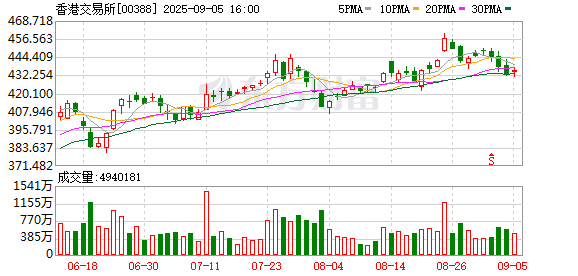
纳斯达克抬高上市门槛,港交所机会来了?
Sou Hu Cai Jing· 2025-09-05 11:44
Core Points - Nasdaq has introduced new regulations targeting IPOs and listing maintenance conditions, raising the bar for new companies, accelerating delisting for non-compliant firms, and specifically clarifying fundraising requirements for Chinese companies [2][3] Group 1: New Regulations Overview - The new rules include higher listing thresholds, with public float market value for companies meeting "profitability standards" set at a minimum of $15 million [5] - Companies with market values below $5 million will face accelerated delisting if issues arise [5] - Chinese companies must now meet a minimum fundraising requirement of $25 million for IPOs, explicitly defined as "public offering fundraising" [5][6] Group 2: Impact on Chinese Companies - Currently, there are 411 Chinese companies listed in the U.S., with 338 on Nasdaq, representing over 80% [7] - Approximately 36 Chinese companies have market values below $5 million, and around 46 have values between $5 million and $10 million, indicating potential delisting risks for low-value stocks [7] - The new fundraising threshold will significantly increase the barriers for future Chinese IPOs in the U.S., as only three out of 21 Chinese companies that went public this year met the $25 million requirement [7] Group 3: Implications for Hong Kong Stock Exchange - The new Nasdaq regulations may lead to a shift of Chinese companies seeking to list on the Hong Kong Stock Exchange (HKEX) as an alternative [8] - HKEX has been optimizing its listing mechanisms, offering more flexible fundraising requirements compared to Nasdaq [8] - The increasing acceptance of Chinese companies by HKEX investors, along with the opening of the Stock Connect mechanism, enhances the attractiveness of HKEX for Chinese firms [9] Group 4: Challenges and Considerations - The influx of companies to HKEX may lead to concerns over the quality of listings, as some firms may have unstable earnings or unclear business models [9][10] - HKEX must maintain rigorous listing standards to avoid the risk of "sick companies" entering the market, which could harm its reputation [10] - Investors should focus on the fundamentals of newly listed Chinese companies in HKEX, analyzing their revenue structure and profitability prospects to avoid speculative investments [10]

上交所、深交所、北交所,刚刚发布!
Zhong Guo Ji Jin Bao· 2025-09-05 10:51
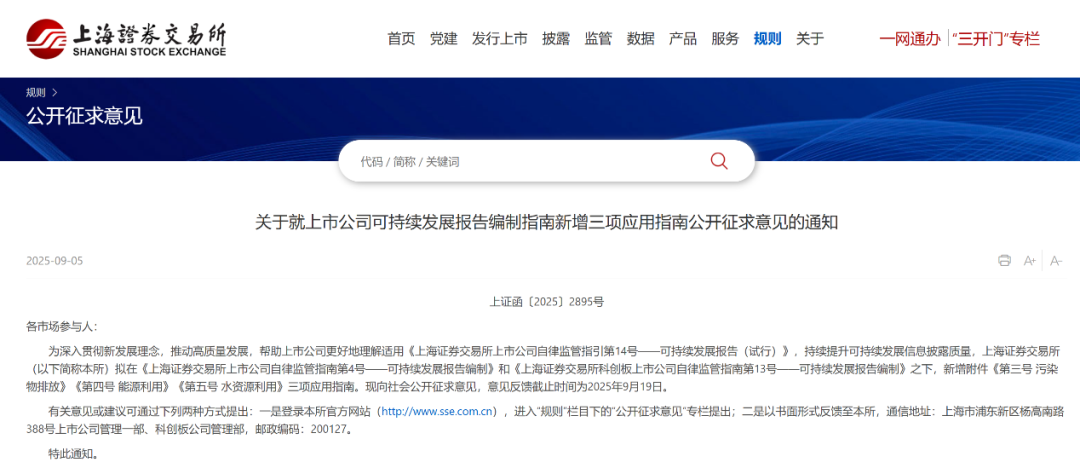
Core Viewpoint - The three major stock exchanges in China have taken significant steps towards enhancing sustainable development information disclosure by revising the "Sustainable Development Report Preparation Guidelines" and inviting public feedback until September 19, 2025 [1][3]. Group 1: Purpose and Goals - The revision aims to guide listed companies in actively practicing sustainable development principles and to further standardize the disclosure of sustainable development information [3]. - The updated guidelines are expected to provide clearer and more actionable instructions for companies, particularly aiding small and medium-sized enterprises in adapting to ESG disclosure requirements [4][5]. Group 2: New Guidelines and Framework - Three new application guidelines have been introduced: "Pollutant Emissions," "Energy Utilization," and "Water Resource Utilization," which complement the previously released overall framework and climate change guidelines [4]. - The revisions follow principles such as reinforcing conceptual guidance, clarifying disclosure points, providing reference examples without imposing additional mandatory disclosures, and ensuring continuous improvement [5]. Group 3: Current Practices and Trends - A-share listed companies have shown significant progress in sustainable development information disclosure, with over 1,300 companies in the Shanghai market alone publishing separate sustainability reports in 2024, representing 57% of the total [6]. - In the Shenzhen market, 1,164 companies proactively published sustainability reports for 2024, accounting for over 40% of the total [6]. - The ESG investment ecosystem is expanding, with over 162 index products based on the China Securities ESG evaluation, collectively exceeding 260 billion yuan in scale, indicating a steady flow of long-term capital towards companies committed to sustainable development [7]. Group 4: Future Developments - The China Securities Regulatory Commission plans to guide the three exchanges in launching more detailed guidelines on various topics, gradually establishing a more complete, transparent, and practical sustainable development information disclosure rule system [8].
港交所陈翊庭:港交所正处理超200宗上市申请近半数为科技企业
Xin Lang Cai Jing· 2025-09-05 10:09
Group 1 - The Hong Kong stock market continues to show strong momentum, with over 200 companies currently processing listing applications, nearly half of which are from technology firms [1] - As of the end of August this year, there are 24 biotech companies under the 18A listing application process, along with 12 specialized technology companies that have submitted applications under the 18C chapter [1] - These companies span various cutting-edge fields, including visual intelligence, metaverse and digital content platforms, smart driving, and robotics, highlighting the strong appeal and inclusiveness of the Hong Kong market for innovative enterprises [1]