
ESG信息披露

Search documents
上市公司高质量发展特征鲜明
Jin Rong Shi Bao· 2026-02-27 00:57
Core Insights - In 2025, A-share listed companies achieved a new level of high-quality development driven by policy guidance, focusing on governance transparency, innovation efficiency, and normalized returns [1] Governance and Innovation Enhancement - The improvement in governance became a significant driver for high-quality development, with a shift from "passive compliance" to "active value creation" in internal control and ESG practices [2] - By 2025, 99.89% of listed companies disclosed internal control deficiencies, a substantial increase reflecting enhanced regulatory enforcement and corporate compliance awareness [2] - ESG report disclosure reached 99% among A-share companies, with state-owned enterprises achieving 100% coverage, indicating a transition towards proactive integration of ESG into long-term strategies [2] Market Structure Optimization - The dual mechanism of delisting and the expansion of specialized and innovative enterprises led to significant market optimization, with a 44% year-on-year decrease in delisting rates [3] - The number of specialized and innovative enterprises rose to 2,100, directing resources towards high-innovation companies, thereby enhancing overall market vitality [3] - Average R&D intensity for specialized and innovative enterprises reached 8%, significantly higher than non-specialized counterparts, showcasing a clear focus on innovation in sectors like semiconductors and new energy [3] Shareholder Return Mechanism Maturation - In 2025, the willingness and ability of listed companies to return value to investors reached new heights, with total cash dividends amounting to 2.08 trillion yuan and share buybacks totaling 142.84 billion yuan, resulting in a combined return of 2.22 trillion yuan [4] - The trend of normalized and diversified dividends was evident, with companies like Rihua Co. increasing their dividend payout ratio by 19.66 percentage points to 57.71% [4] - The purpose of buybacks became more diverse, with 42% aimed at "market value management" and 38% for "employee stock ownership plans," indicating a mature approach to shareholder returns [4] Market Ecosystem Development - Analysts noted that leading companies are stabilizing investor expectations through substantial returns, reflecting both robust operational performance and a maturing market ecosystem focused on shareholder returns [5] - Trends in dividends included increased frequency, improved quality and transparency, driven by regulatory measures and market dynamics, fostering a virtuous cycle of "dividends—valuation increase—further dividends" [6] - Strong policy support and spontaneous market behavior are creating a new ecosystem characterized by better structure, governance, innovation, and returns [6]


国新证券:ESG信息披露全面升级 专项应用指南精准补
Xin Lang Cai Jing· 2026-02-18 03:56
Core Insights - The China Securities Regulatory Commission (CSRC) has guided the Shanghai, Shenzhen, and Beijing stock exchanges to release disclosure guidelines on three environmental topics: "pollutant emissions," "energy utilization," and "water resource utilization," further improving ESG information disclosure rules for listed companies [2] Group 1: ESG Disclosure Guidelines - The release of the guidelines addresses key disclosure pain points for high energy-consuming and high-emission industries, specifying calculation methods, data sources, and disclosure formats for specific indicators [3] - The year 2025 is identified as a critical transition year for ESG information disclosure in China's A-share market, moving from voluntary to mandatory disclosure [3] - The new ESG disclosure regulations achieve three core breakthroughs: expanding the mandatory disclosure scope, systematizing disclosure content, and aligning international standards with local innovations [3] Group 2: Industry-Specific Strategies - Different industries require differentiated strategies for ESG disclosure due to variations in business characteristics, environmental impact, and social relevance [4] - High energy-consuming industries focus on carbon management and detailed disclosures on pollutants and energy use, while manufacturing emphasizes supply chain data management [4] - Emerging industries like renewable energy and AI must integrate innovation with sustainability, focusing on technology research and data ethics, respectively [4] Group 3: Future Implications - The expansion of mandatory disclosure and continuous improvement of standards will optimize the ESG ecosystem in the A-share market [4] - ESG information disclosure will become a crucial tool for companies to enhance core competitiveness, reduce financing costs, and connect with international capital markets [4] - This shift will support China's dual carbon goals and high-quality development by directing capital market resources towards sustainable development [4]
预计向市场让利11亿元 上交所2026年将持续推进降费
Zhong Guo Jing Ying Bao· 2026-02-12 15:05
Core Viewpoint - The Shanghai Stock Exchange (SSE) has released a project list for 2026 aimed at enhancing the quality of the capital market through specific actionable measures, focusing on inclusivity, adaptability, and digital transformation [1] Group 1: Key Measures - The project list includes ten actionable items across five main areas: listing review, frontline regulation, product innovation, market services, investor protection, and information technology [1] - One key measure is to optimize information disclosure channels to improve accessibility, including expanding online browsing capabilities for all business guidelines and creating a dedicated section for real estate ABS securities information [1] - Another measure focuses on enhancing regulatory service quality and improving corporate governance by refining ESG disclosure standards and expanding mobile voting services for shareholder meetings [1] Group 2: Market Engagement and Services - The SSE aims to deepen comprehensive service offerings to enhance participant satisfaction by organizing various industry salons and upgrading the stock options section on its website [2] - The SSE plans to enrich index investment options to better meet diverse investment needs, including the development of a more comprehensive "fixed income+" multi-asset index system and promoting index and ETF products [1][2] Group 3: Cost Reduction and Market Benefits - The SSE is committed to reducing market operation costs, with an estimated benefit of approximately 1.113 billion yuan to the market by 2026 [3] - The SSE emphasizes a people-centered approach, aiming to address market concerns through practical measures and has received positive feedback for its ongoing efforts to serve the market [3]
上交所发布2026年办实事清单,预计让利11.13亿元
2 1 Shi Ji Jing Ji Bao Dao· 2026-02-12 13:37
Core Viewpoint - The Shanghai Stock Exchange (SSE) has officially released a project list for 2026, which includes ten initiatives across five major areas aimed at enhancing market services, regulatory efficiency, and investor protection while promoting transparency and innovation in the capital market [1]. Group 1: Information Disclosure and Investor Services - The SSE will optimize information disclosure channels to improve accessibility, including expanding online browsing capabilities for all business guidelines and creating a dedicated section for real estate ABS securities information [3]. - The SSE aims to enhance the quality of regulatory services and improve corporate governance by refining ESG disclosure standards and expanding mobile voting services for shareholder meetings [3]. Group 2: Investment Products and Market Participation - The SSE plans to diversify investment options by enriching the "fixed income+" multi-asset index and ETF product system to better meet the varied investment needs of residents and long-term capital [3]. - The SSE will enhance comprehensive service offerings by organizing industry salons and extending the operating hours of the China Securities Museum to improve engagement with market participants [4]. Group 3: Cost Reduction and Market Efficiency - The SSE is committed to reducing market operating costs, with plans to waive certain fees, including listing fees for Shanghai-listed companies and transaction fees for non-convertible bonds, resulting in an estimated benefit of approximately 1.113 billion yuan to the market in 2026 [4].
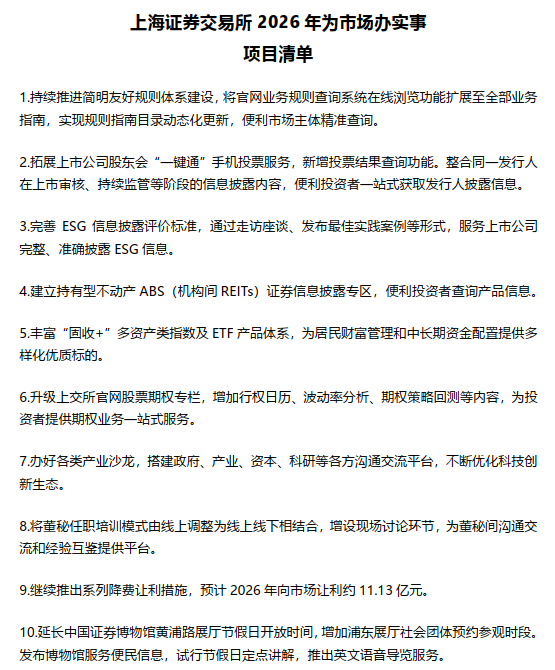
上交所发布2026年为市场办实事项目清单 预计全年向市场让利约11.13亿元
Xin Lang Cai Jing· 2026-02-12 12:20
Group 1 - The core message of the article is the release of the Shanghai Stock Exchange's (SSE) "2026 Market Service Project List," which aims to enhance various aspects of market operations and services [1] Group 2 - The project list includes ten initiatives across five main areas: listing review, frontline regulation, product innovation, market services, and investor protection [1] - One initiative focuses on optimizing information disclosure channels to improve accessibility, including expanding online browsing functions for all business guidelines and creating a dedicated section for real estate ABS securities information [2] - Another initiative aims to enhance regulatory service quality and improve corporate governance by refining ESG disclosure standards and expanding mobile voting services for shareholder meetings [2] - The SSE plans to enrich index investment options to better meet diverse investment needs, including the enhancement of the "fixed income+" multi-asset index system and promoting index and ETF products [2] - The SSE will deepen comprehensive service offerings to enhance market participants' experience, including organizing industry salons and upgrading the stock options section on its website [2] - A significant initiative is the continued effort to reduce costs and provide benefits to the market, with an expected total of approximately 1.113 billion yuan in benefits to the market by 2026 [2]
三大环境“底牌”必须亮 ESG披露新规扭转企业“纸上谈兵”
Zhong Guo Zheng Quan Bao· 2026-02-08 22:11
Core Viewpoint - The new mandatory ESG information disclosure guidelines for A-share listed companies in China, effective from 2026, aim to enhance the quality and comparability of environmental data, addressing long-standing issues in environmental information disclosure [1][2]. Group 1: New Guidelines and Their Impact - The revised guidelines introduce three new environmental disclosure topics: pollutant emissions, energy utilization, and water resource utilization, providing a unified method for ESG reporting [2]. - Companies are expected to align their 2025 ESG disclosures with the new guidelines, aiming for full compliance with the Shenzhen Stock Exchange's requirements [1][5]. - The guidelines address the fragmentation and lack of standardization in environmental disclosures, which have historically hindered data comparability and quality [2][4]. Group 2: Industry Response and Implementation - Companies like Zijin Mining and Dufu Technology are developing systematic data collection processes to comply with the new guidelines, integrating ESG data into their daily management [5][10]. - The guidelines emphasize the need for companies to analyze the financial impacts of environmental issues on their operations, including effects on profit and cash flow [6][7]. - The guidelines allow for adjustments based on the complexity of a company's operations and data availability, promoting a more tailored approach to ESG reporting [3][8]. Group 3: Risk Management and Opportunities - The new guidelines provide a framework for companies to identify and manage environmental risks, linking ESG disclosures with internal management practices [8][9]. - Companies are recognizing green opportunities, such as recycling and energy recovery, which can enhance both environmental performance and economic benefits [9][10]. - The guidelines encourage companies to proactively manage environmental challenges, moving from compliance to strategic management [8].


三大环境“底牌”必须亮ESG披露新规扭转企业“纸上谈兵”
Zhong Guo Zheng Quan Bao· 2026-02-08 20:22
Core Viewpoint - The new mandatory ESG information disclosure guidelines for A-share listed companies in China, effective from 2026, aim to enhance the quality and comparability of environmental data, addressing long-standing issues of fragmented and qualitative disclosures [1][2]. Group 1: New Guidelines Overview - The revised guidelines introduce three new environmental disclosure topics: pollutant emissions, energy utilization, and water resource utilization, providing a unified method for ESG reporting [2]. - The guidelines aim to resolve the historical challenges of inconsistent data standards and improve the credibility of environmental disclosures by establishing clear definitions and calculation methods [2][3]. Group 2: Industry Response and Implementation - Several listed companies are preparing to align their 2025 ESG disclosures with the new guidelines, with a goal of full compliance by the end of March [1]. - Companies like Zijin Mining and Dufu Technology are developing systematic data collection processes to ensure accurate reporting, utilizing technology for real-time monitoring and data management [4][5]. Group 3: Financial Impact Analysis - The new guidelines emphasize the need for companies to analyze and disclose the financial impacts of environmental issues on their financial statements, including potential effects on cash flow and operational costs [5]. - Companies are encouraged to assess how environmental factors, such as extreme weather and resource scarcity, could affect their financial performance [5][6]. Group 4: Risk Management and Strategic Opportunities - The guidelines provide a framework for companies to identify and manage environmental risks, integrating ESG disclosures into their overall management strategies [6]. - Companies are recognizing green opportunities, such as recycling and energy efficiency projects, which can enhance both environmental performance and economic benefits [6][7]. Group 5: Challenges and Recommendations - Companies face challenges in aligning domestic regulations with international standards, particularly in data reporting and calculation methods [7]. - There is a call for regulatory bodies to offer training and support to help companies navigate the complexities of the new guidelines and improve their ESG reporting practices [7].
A股必看新规 交易所新增污染物、水、能源三项ESG指南
Huan Qiu Wang· 2026-02-06 01:13
Core Viewpoint - The newly released guidelines for ESG disclosure by Chinese stock exchanges provide a structured framework for companies to report on pollution emissions, energy use, and water resources, aiming to enhance transparency and comparability in ESG practices [1][3][9]. Group 1: Guidelines and Framework - The revised guidelines, effective immediately, detail specific requirements for pollution emissions, energy utilization, and water resource management, serving as a "textbook" for companies preparing for ESG disclosures [1][3]. - The guidelines are structured into three chapters focusing on risk assessment, data calculation methods, and disclosure points, addressing the needs of the market [3][4]. - The guidelines emphasize the analysis and disclosure of financial impacts related to ESG issues, highlighting their significance on financial statements [4][11]. Group 2: Challenges and Data Governance - Companies face challenges in ESG practices, including weak data foundations, missing historical data, and inconsistent cross-departmental statistics, making data governance a critical task [2][7]. - The lack of robust internal data management systems hampers high-quality ESG disclosures, necessitating the establishment of systematic data governance frameworks [7][8]. - Companies report difficulties in data collection and accounting, particularly for cross-regional and multi-scenario data, which complicates risk quantification and financial impact assessment [8]. Group 3: Market Trends and Investor Focus - An increasing number of companies, regardless of their ESG disclosure requirements, are prioritizing ESG management in their strategic planning due to anticipated regulatory tightening [5][6]. - The international perspective on China's ESG disclosure system is gaining attention, as it aims to align with global investment analysis frameworks, enhancing the comparability of information for international investors [9][10]. - The implementation of overseas regulations, such as the EU's carbon border adjustment mechanism, is driving companies to improve their ESG management to meet external demands [10]. Group 4: Financial Relevance and Investment Trends - The three ESG topics of pollution emissions, energy use, and water resources are critical areas of focus for global financial institutions in sustainable investment decisions [10][11]. - MSCI data indicates that nearly half of the companies in the MSCI China Index are linked to these key ESG issues, underscoring their financial relevance in investment strategies [11].
A股可持续发展信披新指南发布
Jin Rong Shi Bao· 2026-02-04 02:27
Core Viewpoint - The construction of the sustainable development information disclosure system for listed companies in China is advancing steadily along a pragmatic path of "subject framework first, key issues breakthrough" [1] Group 1: Updates on Guidelines - On January 30, under the guidance of the China Securities Regulatory Commission, the Shanghai, Shenzhen, and Beijing stock exchanges revised and released the "Guidelines for the Preparation of Sustainable Development Reports by Listed Companies," adding three application guidelines related to pollutant emissions, energy utilization, and water resource utilization [1] - The update of the guidelines marks a new stage of refined and standardized implementation of sustainable development information disclosure for listed companies in China [1][2] - The updated guidelines are expected to provide a more systematic operational framework for sustainable development information disclosure, which is significant for the standardization of sustainable development in China [1] Group 2: Feedback and Optimization - In September 2025, the exchanges publicly solicited opinions on the three application guidelines, with market participants generally recognizing their guiding role and providing detailed optimization suggestions [2] - The exchanges adopted several suggestions, including adding examples of pollutant-related risks and financial impacts, and refining the calculation methods for energy consumption and water usage [2] - The overall framework and core requirements of the officially released guidelines remain stable and continuous compared to the draft, with adjustments focusing on content refinement [2] Group 3: Implementation Support - The guidelines provide detailed explanations of common risks and opportunities related to environmental issues, helping listed companies address core pain points in ESG disclosure [4] - They include common risk assessments, workflows, and methods for calculating disclosure data, thus lowering the difficulty for companies in implementing the guidelines [4][5] - Specific disclosure requirements are clarified for pollutant emissions, energy utilization, and water resource utilization, guiding companies in systematic risk identification and management [5] Group 4: ESG Disclosure Landscape - China has been continuously enhancing policies in the ESG field, forming a sustainable development rule system that combines encouragement, guidance, and mandatory requirements [6] - As of September 2025, over 2,500 A-share listed companies published sustainable development reports, with a disclosure rate of nearly 35%, reflecting a significant increase compared to previous years [6] - In 2026, A-share listed companies will be required to disclose sustainable development reports for the first time, marking a shift towards mandatory ESG reporting [6][7] Group 5: Future Directions - The release of the three application guidelines is expected to strengthen regulatory compliance while considering industry inclusiveness, aiding companies in preparing for the first mandatory disclosure period [7] - Companies are encouraged to view sustainable development efforts as tools for enhancing risk resilience and exploring green growth opportunities, rather than merely fulfilling external compliance requirements [7]
上市公司可持续发展报告编制指南升级
Zheng Quan Ri Bao· 2026-01-30 16:10
Core Viewpoint - The China Securities Regulatory Commission (CSRC) has guided the revision of the sustainable development report preparation guidelines for listed companies, introducing three new application guidelines focused on pollutant emissions, energy utilization, and water resource utilization, with mandatory disclosure set to begin in 2026 [1][4]. Group 1: New Guidelines and Their Purpose - The newly added guidelines aim to enhance the coverage of important issues in sustainable information disclosure, providing more comprehensive and detailed guidance for listed companies [1][2]. - The guidelines do not impose additional mandatory disclosure obligations but encourage companies to gradually improve their awareness of environmental protection and resource conservation responsibilities [2][3]. Group 2: Key Focus Areas of the Guidelines - The revised guidelines focus on three main aspects: identifying risks and opportunities related to environmental issues, standardizing accounting methods, and clarifying disclosure content [2][5]. - Specific risks and opportunities include environmental compliance risks in production operations and market opportunities from green technology applications [2][3]. - The guidelines provide calculation processes and methods for disclosure data, enhancing comparability and reliability of data related to pollutant emissions, energy consumption, and water resource usage [2][5]. Group 3: Implementation Timeline and Requirements - The new guidelines will be officially implemented on May 1, 2024, with mandatory disclosure required for companies included in specific indices, which must submit their first sustainable development report by April 30, 2026 [4][6]. - The CSRC has also revised the management measures for information disclosure and governance standards for listed companies, emphasizing the importance of sustainable development reporting [4][5]. Group 4: Industry Impact and Future Outlook - The guidelines are expected to significantly improve the quality of sustainable information disclosure and ratings, supporting high-quality development in the capital market [1][6]. - The comprehensive coverage of risk assessment, workflow, and common disclosure data calculation methods will assist companies in preparing for the first mandatory disclosure period, laying a solid foundation for sustainable development during the 14th Five-Year Plan period [6].