
中国资产

Search documents
国泰海通·策略前瞻丨调整是机会,布局中国资产
国泰海通证券研究· 2026-03-29 15:17
Core Viewpoints - Stability is the fundamental characteristic of China's economy and stock market, and the transformation and industrial development in China can break the current narrative of "stagflation" [2] - After market adjustments, the Chinese stock market is showing important bottoms and inflection points, with a positive outlook on finance, technology manufacturing, and domestic demand [4] Market Analysis - The Chinese stock market is currently experiencing significant volatility due to complex geopolitical situations and high oil prices, but it is believed that important bottoms and inflection points are emerging [4] - China's energy consumption has a low oil and gas proportion of less than 30%, which is below the global average, enhancing resilience against risks [4] - The relatively stable security situation, economic society, complete supply chain system, and positive industrial progress in China are rare even in a global context [4] - Communication with overseas long-term capital indicates that foreign investors are reassessing China's rise and industrial advantages, presenting an opportunity for active investment [4] Stability and Risk Assessment - China's energy structure, with oil and gas accounting for less than 30%, significantly reduces risk exposure compared to global averages [5] - The complete industrial system in China has shown strong resilience during past global crises, maintaining and even increasing export shares [5] - The focus of China's economic policy in 2026 will be on domestic demand, with expansionary fiscal policies aimed at stabilizing investment and supporting consumption [5] - The improvement of China's unique market stabilization mechanisms enhances the stock market's ability to withstand risks, attracting global capital [5] Economic Transformation and Industry Progress - China's economic transformation and active industrial progress are key to breaking the current stagflation risk narrative and are foundational for a "long bull," "slow bull," and "transformation bull" market [6] - The acceleration of capital expenditure in new economy sectors and the global demand for energy transition will be crucial for China's growth logic in 2026 [6] - The urgency of global energy transition due to rising geopolitical tensions and high oil prices strengthens China's competitive advantages in green industries and technology manufacturing [6] Industry Comparisons - The financial sector remains a preferred choice, with high dividend yields providing investment value, recommending banks, electricity, and highways [7] - Technology manufacturing and energy transition sectors are expected to benefit from China's competitive advantages, recommending electric equipment, new energy, and engineering machinery [7] - Domestic demand is anticipated to stabilize due to policy support and inflation recovery, recommending construction materials, real estate, hotels, and consumer goods [7] Future Earnings Outlook - The recovery trend of the Chinese economy is expected to accelerate in 2026, with industrial profits showing significant improvement, particularly in upstream raw materials and AI hardware manufacturing [22] - The financial sector is seen as a stabilizing force in the current geopolitical uncertainty, with attractive dividend levels and a potential increase in long-term capital allocation [24] - The supply chain security and energy transition are expected to drive investment opportunities in new energy infrastructure and advanced energy equipment [35][36]



中信证券朱烨辛:中国资产的全球吸引力持续上升
Xin Lang Cai Jing· 2026-03-20 03:26
Group 1 - The core viewpoint emphasizes the strong strategic resonance between Chinese enterprises going global and the internationalization of the Renminbi, which opens up vast imagination space for the systematic revaluation of Chinese assets [1] - The external environment is increasingly impacted by international economic and trade conflicts, geopolitical tensions, and a volatile financial environment, which collectively weaken the resilience and growth potential of the global economy [1] - China's economy is positioned as a stable anchor and main engine for global economic growth, with a projected GDP growth target of 4.5%-5% for 2026, reflecting a focus on economic quality and structural adjustments [1] Group 2 - The implementation of a more proactive fiscal policy and moderately loose monetary policy is expected to release strong signals for stable growth and reform, with a fiscal deficit target set at around 4% and plans to issue long-term special bonds totaling 1.3 trillion yuan [2] - The macroeconomic policy will emphasize collaboration between fiscal and financial measures, directing funds towards consumption, employment stability, and technological advancement [2] - The transformation of old and new growth drivers is anticipated to lead to a qualitative leap, reshaping the pricing logic of core Chinese assets through the construction of a modern industrial system and the globalization of Chinese enterprises [2] Group 3 - The capital market ecosystem is improving, enhancing the attractiveness of Chinese assets, with a focus on stabilizing the market and developing a long-term investment environment [3] - Regulatory measures are being strengthened to combat financial fraud and insider trading, alongside the enforcement of mandatory delisting rules, which purify the market environment [3] - The multi-tiered capital market system is becoming more inclusive, with reforms in the ChiNext board and optimized refinancing mechanisms to support new industries and technological innovation [3]

伊朗冲突扰动下,如何看待中国资产表现?
淡水泉投资· 2026-03-19 09:29
Core Viewpoint - The article discusses the impact of the escalating geopolitical tensions in the Middle East, particularly the Iran conflict, on global capital markets and the resilience of Chinese assets amidst these uncertainties. Group 1: Market Reactions to Geopolitical Tensions - The capital market has experienced "two rounds of shocks" due to the Iran conflict, with the first round characterized by risk aversion and liquidity shocks following the initial outbreak of the conflict [2] - The second round involves inflation shocks driven by rising oil prices, as the Strait of Hormuz, a key energy transport hub, accounts for approximately 20% of global oil trade, leading to supply tightness and heightened inflation concerns [4] Group 2: Resilience of Chinese Assets - Chinese assets have shown stronger resilience compared to other markets like Japan and South Korea, supported by internal market dynamics [6] - China's energy reserve advantage provides a "safety cushion," with strategic oil reserves projected to reach 1.204 billion barrels by the end of 2025, sufficient to meet over 200 days of consumption needs even in extreme supply disruptions [8] - Policy and liquidity support enhance market resilience, with expectations of a positive turnaround in PPI and corporate earnings due to ongoing anti-involution policies and a favorable liquidity environment [11] Group 3: Shifts in Investment Focus - As the geopolitical conflict continues, the market's focus is expected to gradually shift from geopolitical issues to fundamental drivers, with earnings growth certainty becoming a primary source of returns [17] - The structural growth trends in China's advantageous industries, particularly in technology and advanced manufacturing, have stabilized A-share earnings, with positive macroeconomic data emerging in early 2025 [21] - The uncertainty in energy supply due to geopolitical tensions may reshape valuation logic in related industries, potentially giving rise to new industry trends [21]

中信证券朱烨辛:中国资产吸引力持续提升,A股迎增量配置转折期
Xin Jing Bao· 2026-03-19 05:52
Group 1 - The capital market ecosystem in China is significantly improving, enhancing the attractiveness of Chinese assets [1] - Regulatory measures are being strengthened to protect investor returns, including strict actions against financial fraud and insider trading, as well as the enforcement of mandatory delisting systems [1] - The multi-tiered capital market system is becoming more inclusive, with reforms in the ChiNext board and optimized refinancing mechanisms to support new industries and technological innovation [1] Group 2 - In 2026, China will continue to implement a more proactive fiscal policy and moderately loose monetary policy, signaling strong support for growth and reform [2] - The transition from old to new growth drivers is experiencing a qualitative leap, with the construction of a modern industrial system reshaping the pricing logic of core Chinese assets [2] - The internationalization of the RMB and the globalization of Chinese enterprises are creating a powerful strategic resonance, opening vast possibilities for the systematic revaluation of Chinese assets [2]
解读一下今天下午的重磅发布会
表舅是养基大户· 2026-03-06 13:31
Group 1 - The core viewpoint is that "Chinese assets" are increasingly attractive to international investors due to the diversification of asset allocation needs and the focus on China's long-term industrial planning [5][7] - The "Six Networks" initiative, which includes water, electricity, computing power, new communication, urban underground pipelines, and logistics networks, is a new concept that emphasizes the importance of the computing power network and electricity network for long-term investment [8][9] - The establishment of a national-level merger fund is expected to facilitate the exit channels for venture capital investments, potentially leveraging over 1 trillion yuan in various funds [12][13] Group 2 - The service consumption market is robust, with a projected annual growth rate of 10.4% in service retail from 2022 to 2025, indicating significant opportunities in service consumption sectors [14] - The People's Bank of China aims to maintain low financing costs and has emphasized the importance of regulating financing intermediary fees to ensure that enterprises benefit from low-interest rates [15][16] - Structural monetary policy tools will focus on supporting domestic demand, technological innovation, and small and medium-sized enterprises, highlighting a shift towards more precise monetary policy [17] Group 3 - The proportion of cross-border trade settled in RMB has reached 30%, indicating a significant increase in the internationalization of the RMB and a diversification of trade destinations [18][20] - The concentration of leading companies in the A-share market reflects the increasing importance of listed companies in the overall economy, suggesting a trend towards investing in high-quality stocks [21][22] - The integration of capital markets with technological innovation is crucial for fostering new industries and enhancing the quality of capital market development [23][24] Group 4 - The expansion of personal consumption loan subsidies to over 500 institutions aims to enhance consumer access to loans, reflecting a shift towards "investing in people" [27][28] - The premium on school district housing is expected to decline as the population of school-age children peaks, leading to changes in supply and demand dynamics in the education sector [29][30] - The resilience of exports is highlighted by the diversification of trade relationships, with over 51.9% of trade now involving countries participating in the Belt and Road Initiative [32][33] Group 5 - The optimization of refinancing measures is anticipated to be a significant focus this year, providing opportunities for investment banking activities [34] - The reduction of debt risks associated with financing platforms and high-risk small financial institutions indicates a trend towards consolidation in the financial sector [35] - A lower volatility in the A-share market is expected, supported by structural monetary policy tools and enhanced market stability measures [36]

吴清:中国资产吸引力明显提高
21世纪经济报道· 2026-03-06 08:32
Group 1 - The core viewpoint of the article emphasizes the increasing demand for diversified asset allocation among international investors, highlighting the growing attractiveness of Chinese assets [1] - The China Securities Regulatory Commission (CSRC) aims to enhance the market, product, service, and institutional aspects of cross-border investment and financing, promoting a new level of bilateral openness [1] - As of the current date, the total market capitalization of A-shares exceeds 110 trillion yuan [2]

吴清:目前A股总市值超过110万亿元
财联社· 2026-03-06 08:04
Core Viewpoint - The A-share market is experiencing significant growth, with a total market value exceeding 110 trillion yuan and over 5,400 listed companies generating revenue surpassing half of the GDP, indicating a strong momentum towards new and high-quality development [1] Group 1: Market Stability and Mechanisms - During the "14th Five-Year Plan" period, there will be improvements in the construction of a stable market mechanism with enhanced cross-cycle and counter-cyclical adjustment measures to strengthen the market's inherent stability [2] - The role of the stock market as a barometer is becoming more pronounced, with improvements in market scale, structure, and quality, as well as enhanced resilience and risk resistance [4] Group 2: Corporate Governance and Investment Value - There will be a focus on improving the investability of listed companies by enhancing governance levels, promoting dividend repurchases, and actively engaging in mergers and acquisitions to foster resource allocation efficiency and cultivate world-class enterprises [3] Group 3: Capital Market Reforms - The capital market will undergo comprehensive reforms to improve foundational systems, promote diverse equity financing, and expand exit channels for private equity and venture capital funds [5] - There will be a strong emphasis on combating financial fraud, market manipulation, and insider trading, while continuously improving the protection of investors' legal rights [6] Group 4: International Investment Appeal - The attractiveness of Chinese assets is significantly increasing, driven by the growing demand for diversified asset allocation among international investors, with efforts to create a market-oriented, law-based, and international business environment [7]

中信证券:伊朗局势的关键信号与潜在走向
智通财经网· 2026-03-01 09:32
Core Viewpoint - The situation in Iran has escalated into a military conflict as of February 28, with significant implications for global markets, potentially resembling a larger version of the "Twelve-Day War" of June 2025, depending on key signals such as U.S. military movements, changes in Iranian politics, and the extent of conflict spillover [1][2][3]. Group 1: Event Overview - On February 28, Israel and the U.S. announced military actions against Iran, marking the onset of military conflict after unsuccessful nuclear negotiations [2]. - The U.S. has conducted three rounds of indirect negotiations with Iran since 2026, focusing on nuclear issues, weapon arrangements, and sanctions, but no substantial breakthroughs have been achieved [2]. Group 2: Key Signals for Market Impact - Signal 1: The scale of U.S. military mobilization will determine the duration of the conflict. Current U.S. military deployments around Iran are comparable to those during the 1998 "Desert Fox" operation, which involved limited airstrikes without ground combat [3]. - Signal 2: The stability of Iran's internal politics will influence the extent of conflict escalation. Recent statements regarding the health of Iran's Supreme Leader could lead to significant political changes [3][4]. - Signal 3: Iran's retaliatory actions against key oil facilities and shipping routes will impact market volatility. Reports indicate that oil tanker transport through the Strait of Hormuz has been halted due to safety concerns amid escalating tensions [4]. Group 3: Historical Context and Market Patterns - Historical analysis of eight major conflicts in the Middle East since 1970 shows that gold is a more effective safe-haven asset compared to the U.S. dollar during wartime [5]. - Oil prices are influenced by supply and demand dynamics, with historical crises indicating that significant price increases (over 50%) could trigger economic recessions in the U.S. [6]. - U.S. stock market reactions vary based on military involvement; if the U.S. does not engage directly, market sentiment typically stabilizes within a week, whereas direct involvement prolongs recovery [6].
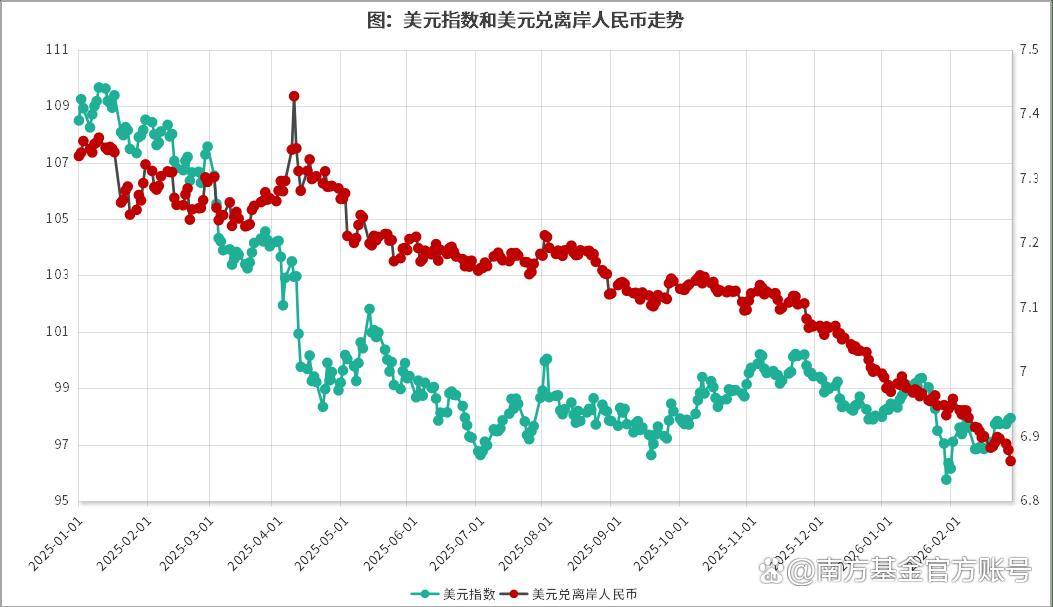
南方基金:人民币持续升值,中国资产值得高看一手?
Sou Hu Cai Jing· 2026-02-27 03:38
Group 1 - The recent appreciation of the RMB is driven by both internal and external factors, including a weakening dollar and strong trade surplus [2][3] - The U.S. dollar is under pressure due to a potential 75 basis point rate cut by the Federal Reserve and ongoing investigations into its chairman, impacting the dollar's credibility [2] - China's trade surplus exceeded $1.076 trillion in 2025, with a significant increase in corporate currency settlement around the Lunar New Year, contributing to the RMB's strength [3] Group 2 - The appreciation of the RMB is expected to positively influence the A-share market, with a focus on sectors like real estate and advanced manufacturing benefiting from improved market sentiment [4] - Industries with high dollar-denominated debt, such as motorcycles and photovoltaic equipment, will experience reduced debt burdens and enhanced profitability due to currency gains [5] - Sectors reliant on imported materials, like electronic chemicals and steel, will see improved profit margins as the RMB's purchasing power increases [6] Group 3 - The RMB's appreciation reflects the resilience of the Chinese economy, strong foreign trade capabilities, and restored market confidence [7] - Structural opportunities are emphasized, suggesting a focus on technology growth, price expectations, cost improvements, and foreign investment preferences rather than speculative trading [9]
市场分析:资源电池行业领涨,A股震荡上行
Zhongyuan Securities· 2026-02-25 09:29
Investment Rating - The industry investment rating is "outperforming the market," indicating an expected increase of over 10% in the industry index relative to the CSI 300 index over the next six months [15]. Core Insights - The A-share market showed a strong upward trend with a slight fluctuation, particularly in sectors such as non-ferrous metals, energy metals, batteries, and aerospace, while sectors like film and television, tourism retail, advertising, and digital media lagged behind [2][3]. - The average price-to-earnings (P/E) ratios for the Shanghai Composite Index and the ChiNext Index are 16.93 times and 53.12 times, respectively, which are above the median levels of the past three years, suggesting a favorable environment for medium to long-term investments [3][14]. - The total trading volume on the two exchanges reached 24,812 billion, which is above the median trading volume of the past three years, indicating robust market activity [3][14]. - There is a notable inflow of overseas mutual funds into A-shares, reaching a multi-month high, which enhances the attractiveness of Chinese assets for global allocation [3][14]. - The market is expected to maintain a slight upward trend, with a likelihood of wide fluctuations and structural differentiation in index performance [3][14]. Summary by Sections A-share Market Overview - On February 25, the A-share market opened high and experienced slight upward fluctuations, with the Shanghai Composite Index facing resistance around 4,167 points [7]. - The Shanghai Composite Index closed at 4,147.23 points, up 0.72%, while the Shenzhen Component Index closed at 14,475.87 points, up 1.29% [8]. - Over 70% of stocks in the two markets rose, with significant gains in small metals, energy metals, steel, real estate services, and aerospace sectors [7][9]. Future Market Outlook and Investment Recommendations - The report suggests that investors should closely monitor macroeconomic data, changes in overseas liquidity, and policy developments [3][14]. - Short-term investment opportunities are recommended in sectors such as non-ferrous metals, electronic components, batteries, and aerospace [3][14].
