
信托

Search documents
中国信托业协会“媒体走进信托公司”第四期活动在上海信托成功举办
Zheng Quan Ri Bao Zhi Sheng· 2025-11-03 11:38
Core Viewpoint - The event "Media Entering Trust Companies" aims to showcase the role of trust in China's financial system and its contributions to the real economy and people's lives, emphasizing the importance of trust companies like Shanghai Trust in the development of the financial sector [1][2]. Group 1: Historical Context and Development - The modern trust industry in China originated in the first half of the 20th century, evolving from mixed operations with banks and insurance, and has become an integral part of the asset management development history over the past century [2]. - Since the reform and opening up, trust companies, represented by Shanghai Trust, have significantly contributed to raising construction funds, promoting the development of Pudong, large infrastructure projects, attracting foreign investment, and establishing local financial state-owned enterprises [2]. Group 2: Current Trends and Transformations - Since 2018, the trust industry has accelerated its return to core business, focusing on asset services, asset management, and public welfare charity, taking on greater responsibilities for national and public welfare [2]. - Shanghai Trust is committed to long-termism, providing trust services across various sectors and households, and has made breakthroughs in wealth management, capital market products, long-term technology equity investments, and charitable trusts [2]. Group 3: Communication and Collaboration - The media event aims to foster a comprehensive and objective understanding of the trust industry's development over the past 40 years and its evolving roles at different stages [3]. - The event emphasizes the need for trust companies to clarify their positioning, leverage the unique advantages of trust in wealth management, and innovate various trust tools to actively serve social governance [3]. Group 4: Discussions and Insights - Media representatives engaged in discussions with Shanghai Trust executives on various topics, including the functional positioning of trusts in the new environment, the popularization of pension finance, the differentiation between charitable trusts and public funds, and the challenges in real estate trusts [3].
2025年绿色发展案例发布会在北京副中心举行
Huan Qiu Wang· 2025-11-03 10:48
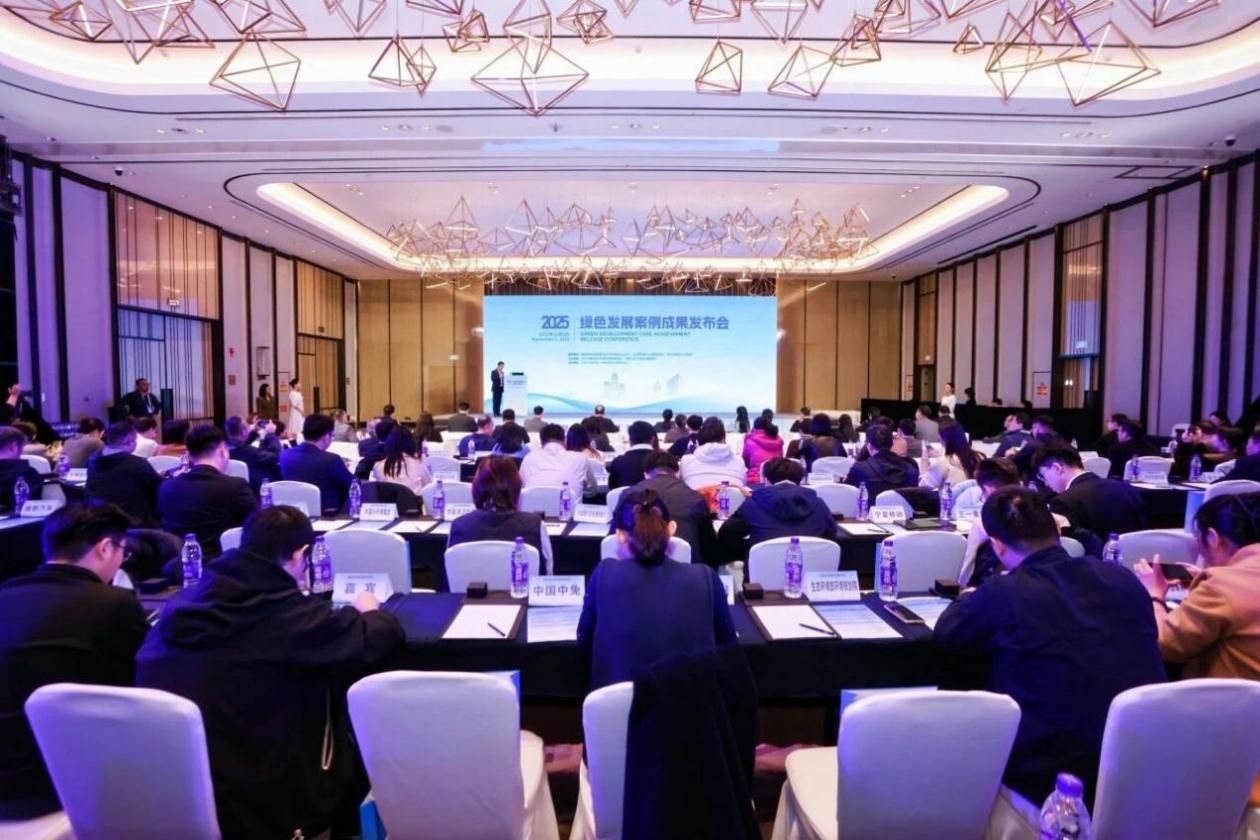
【环球网财经综合报道】2025年绿色发展案例成果发布会近日在北京城市副中心运河商务区成功举办。活动正式发布了覆盖能源、生态治理、社区建设等多 个领域的60余项绿色发展先进经验与案例,为全国企业绿色转型树立了标杆、提供了宝贵经验。 本次发布会由北京市通州区运河商务区管理委员会与中国人民大学财政金融学院联合主办,北京ESG研究院承办。自今年8月案例征集活动启动以来,在国 家发展和改革委员会价格成本和认证中心的指导下,共收到来自全国14个省市的120余个申报案例,充分彰显了副中心在绿色发展方面的示范引领作用与广 泛影响力。 通州区政协副主席、区投资促进服务中心主任吴涛在致辞中表示,北京城市副中心肩负建设国家绿色发展示范区使命,紧抓政策机遇,优化产业生态,践行 可持续发展理念,前瞻布局探索新范式。下一步,北京城市副中心将继续围绕绿色低碳生产、绿色健康生活、绿美乐活生态、绿色发展制度创新等方面提质 增效,并期待以此次发布会为契机,吸引企业、深化合作,为全球可持续发展贡献"通州方案"与"通州智慧"。 与会嘉宾一致认为,绿色发展是企业转型升级的必然选择,也是实现经济社会可持续发展的重要途径。(文馨) 国家发展和改革委员会价 ...

《资产管理信托管理办法》征求意见出炉
Jing Ji Guan Cha Bao· 2025-11-03 09:40
Core Viewpoint - The "Asset Management Trust Management Measures (Draft for Comments)" was released by the National Financial Supervision Administration, aiming to strengthen regulatory requirements for asset management trusts and delineate new red lines for various business practices [1][2]. Group 1: Background and Purpose - The current regulations for trust companies have been in place since 2007 and require adjustments to align with industry practices. The new measures are a response to previous regulations established in 2018 and 2023, aiming to enhance supervision and risk prevention in the trust industry [3]. - The draft aims to solidify the regulatory framework for the healthy development of asset management trusts [3]. Group 2: Structure and Content of the Measures - The draft consists of five chapters and 85 articles, covering general principles, product establishment, operational management, supervision, and definitions [4]. - It defines asset management trusts as private asset management products based on trust law, emphasizing the need for active management and adherence to market principles [5]. Group 3: Sales Requirements - Trust companies must clearly disclose risks to investors and cannot guarantee returns or obscure actual risk conditions. There are strict requirements for risk disclosure and sales management [7]. - Trust companies are required to assess the risk tolerance of individual investors and match them with appropriate products [7]. Group 4: Investment Management Requirements - Trust companies must manage trust assets legally and transparently, adhering to specified investment scopes and managing different asset categories distinctly [8]. - There are limits on the proportion of single asset investments within trust products [8]. Group 5: Risk Management and Information Disclosure - A comprehensive risk management system must be established, covering various types of risks, including operational, credit, market, and liquidity risks [9]. - Information disclosure requirements are detailed, ensuring transparency in trust asset management [9]. Group 6: Regulation of Key Business Areas - The draft prohibits channel business and fund pool operations, mandating that trust companies take active management responsibility for their products [10]. - It also sets strict guidelines for related party transactions, requiring accurate identification and regulation of such transactions [10]. Group 7: Rectification of Existing Trust Business - Trust companies are required to review existing asset management trust businesses against the new measures, develop rectification plans, and ensure orderly reduction of non-compliant business scales [11].
信托业的新标准与新挑战
Jin Rong Shi Bao· 2025-11-03 04:21
Core Viewpoint - The release of the "Asset Management Trust Management Measures" draft aims to regulate the asset management trust business of trust companies, marking a significant development in the asset management industry and reflecting the central financial work meeting's spirit [1] Group 1: Regulatory Framework - The draft establishes clear operational standards and regulatory requirements for trust companies, positively impacting the development of asset management trust business [2] - It emphasizes a non-retail high-end private placement positioning for qualified investors, with stricter qualification requirements for different risk levels of trust products [2] - The draft aligns with the three-category classification of trusts, highlighting the service-oriented nature of asset management trusts and introducing additional service norms [2] Group 2: Industry Transformation - The draft drives trust companies to transition from "financing platforms" to "true asset management institutions," focusing on professional investment management capabilities [3] - It promotes the "net value and standardization" of product forms, encouraging a shift from non-standardized debt assets to standardized assets like stocks and bonds [3] - The draft delineates clear boundaries for business innovation, urging trust companies to innovate within a framework of strict risk management and information disclosure [3] Group 3: Unique Characteristics - The draft integrates the unique characteristics of trusts with universal applicability, aligning asset management trust operations with securities fund management standards [4] - It establishes a clear connection between asset management trusts and service trusts, recognizing both as "institutional investors" [5] - The draft imposes strict regulations on non-standard assets, guiding trust companies towards high-quality alternative investment products [5] Group 4: Implementation Challenges - The draft represents a significant opportunity for the trust industry but faces challenges in practical implementation, such as the difficulty in accurately assessing investor risk tolerance [6] - Valuation of non-standard assets poses challenges due to a lack of active trading markets and subjective valuation models [6] - Balancing information disclosure is complex, as overly detailed disclosures may breach commercial confidentiality while insufficient disclosures fail to meet regulatory requirements [6]
11万亿资产管理信托新增红线
Di Yi Cai Jing· 2025-11-03 02:45
Core Viewpoint - The recent release of the "Asset Management Trust Management Measures (Draft for Comments)" marks a significant regulatory update in the trust industry, following the major revision of the "Trust Company Management Measures" after 18 years. This new regulation aims to enhance the supervision of asset management trusts and address various compliance issues within the industry [1][2]. Regulatory Background - The current regulations have been in place since 2007 and require updates to align with the evolving practices in the trust industry. The introduction of the asset management new regulations in 2018 and the three-category regulations in 2023 set the stage for this new draft [2]. - The new draft consists of five chapters and 85 articles, focusing on product positioning, sales management, and investment management, thereby reinforcing regulatory requirements [1][2]. Asset Management Trust Positioning - The draft defines asset management trusts as private asset management products based on trust law, emphasizing three main characteristics: serving the maximum legal interests of investors, maintaining a private placement status, and adhering to strict investor standards [3]. Industry Trends - The trust industry is transitioning from traditional non-standard financing to a more diversified model that balances asset service trusts and asset management trusts. As of June to December 2023, over 30,000 trust products were established, with a total scale of approximately 4.33 trillion yuan, where asset service trusts accounted for about 57% and asset management trusts for about 43% [4]. Enhanced Management Requirements - The new regulations emphasize comprehensive management of trust products and introduce several critical restrictions, including tighter investor concentration requirements and the need for transparency in identifying actual investors [7][9]. - Specific limits are set on the amount a single investor can contribute to a trust product, with a maximum of 50% of the trust's total size for individual investors and 80% for institutional investors [7]. Sales and Investment Restrictions - The draft outlines six key prohibitions regarding the use of trust product assets, including restrictions on direct investments in bank credit assets and providing services that circumvent regulatory requirements [10]. - It also mandates that trust companies must clearly identify related parties and regulate related transactions, ensuring compliance with the new sales management requirements [11]. Compliance and Rectification - Trust companies are required to review their existing asset management trust businesses and develop rectification plans to align with the new regulations. The progress of these rectifications will be monitored as part of the classification supervision [12].
11万亿资产管理信托新增红线
第一财经· 2025-11-03 02:42
Core Viewpoint - The article discusses the recent release of the "Asset Management Trust Management Measures (Draft for Comments)" which aims to enhance the regulatory framework for the trust industry in China, following previous regulations and reforms in the asset management sector [3][5]. Summary by Sections Background of the New Regulations - The current regulations have been in place for 18 years and require updates to align with industry practices. The new draft is a response to the evolving landscape of asset management, particularly after the introduction of the asset management new regulations in 2018 and the three-category regulations in 2023 [5][6]. Positioning of Asset Management Trusts - The draft positions asset management trusts as private asset management products based on trust law, emphasizing three main characteristics: serving the maximum legal interests of investors, being privately placed to qualified investors with a cap of 200 participants, and adhering to strict investor standards [6][7]. Industry Transition - The trust industry is transitioning from traditional non-standard financing to a more diversified model that balances asset service trusts and asset management trusts. In 2023, over 30,000 trust products were established, with a total scale of approximately 4.33 trillion yuan, where asset service trusts accounted for about 57% and asset management trusts for 43% [7]. Enhanced Management and Regulatory Requirements - The new regulations emphasize comprehensive management of trust products and introduce multiple red lines across key areas. For instance, the concentration of investors is restricted, with limits on the amount a single investor can contribute to a trust product [9][10]. Investor Concentration and Reporting - The draft specifies that a single investor's contribution cannot exceed 50% of the trust's total scale, while institutional investors and their affiliates are limited to 80%. Additionally, there are requirements for transparency regarding the actual investors and funding sources [10][11]. Performance Fees and Investment Limits - The regulations set a cap on performance fees, which cannot exceed 60% of the investment returns above the benchmark specified in the trust documents. Furthermore, investments in the same asset are limited to 25% of the trust's total scale, with certain exemptions [12]. Sales and Prohibited Activities - The draft outlines strict sales requirements, prohibiting channel and fund pool businesses. Trust companies must clearly disclose risks to investors and cannot guarantee returns or obscure actual risk conditions [13][14]. Rectification of Existing Trust Business - Trust companies are required to review and rectify existing asset management trust businesses in accordance with the new regulations, with progress monitored by the financial regulatory authority [15].

国网英大涨2.02%,成交额2.03亿元,主力资金净流入689.86万元
Xin Lang Cai Jing· 2025-11-03 02:07
Core Viewpoint - The stock of State Grid Yingda has shown significant growth in recent months, with a notable increase in both share price and trading volume, indicating strong investor interest and potential for further appreciation [1][2]. Company Overview - State Grid Yingda, established on November 14, 1997, and listed on October 10, 2003, is located in the China (Shanghai) Free Trade Zone. The company specializes in electrical and new materials equipment, power operation services, low-carbon energy-saving engineering services, and various financial services including securities, trusts, and futures [2]. - The company's revenue composition is as follows: electrical and new materials equipment (84.25%), power operation services (11.30%), low-carbon energy-saving engineering services (3.64%), carbon asset business (0.43%), and other (0.38%) [2]. Financial Performance - For the period from January to September 2025, State Grid Yingda reported a revenue of 7.87 billion yuan, reflecting a year-on-year growth of 2.30%. The net profit attributable to shareholders was 2.23 billion yuan, marking a substantial increase of 53.73% [2]. - The company has distributed a total of 3.78 billion yuan in dividends since its A-share listing, with 1.45 billion yuan distributed over the past three years [3]. Stock Performance - Year-to-date, State Grid Yingda's stock price has increased by 21.47%, with a 14.04% rise over the last five trading days, a 13.84% increase over the last 20 days, and a 24.67% increase over the last 60 days [2]. - As of November 3, the stock was trading at 6.58 yuan per share, with a market capitalization of 37.63 billion yuan [1]. Shareholder Information - As of September 30, 2025, the number of shareholders for State Grid Yingda was 60,600, a decrease of 2.01% from the previous period. The average number of circulating shares per shareholder increased by 2.05% to 94,382 shares [2]. - Among the top ten circulating shareholders, Hong Kong Central Clearing Limited holds 53.99 million shares, an increase of 9.79 million shares from the previous period, while Southern CSI 500 ETF holds 24.89 million shares, a decrease of 514,400 shares [3].

金融监管总局就《资产管理信托管理办法 (征求意见稿)》公开征求意见
Jin Rong Shi Bao· 2025-11-03 01:27
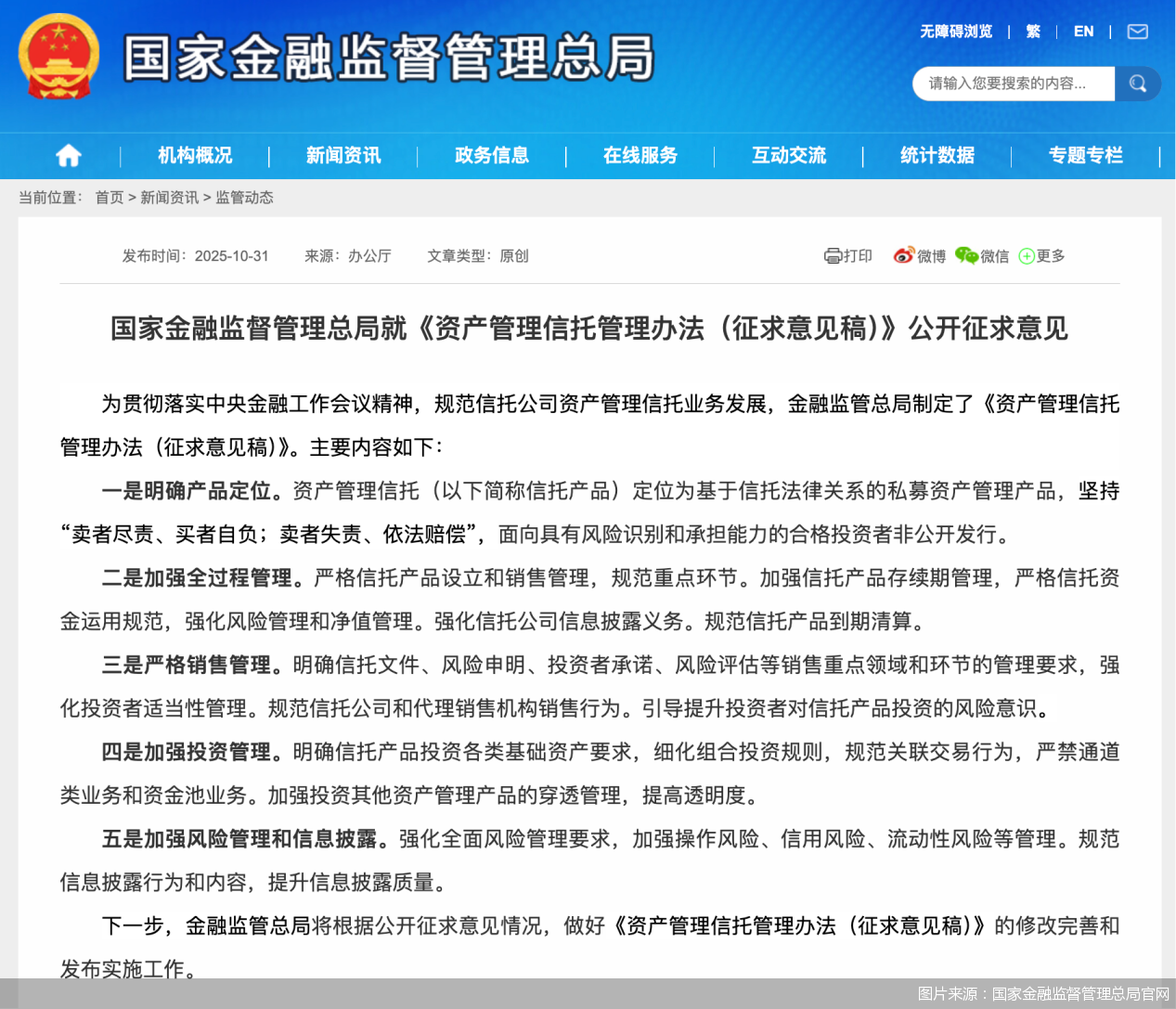
Core Viewpoint - The Financial Regulatory Bureau has drafted the "Asset Management Trust Management Measures (Draft for Comments)" to standardize the development of asset management trust businesses in accordance with the central financial work conference spirit [1][2] Group 1: Product Positioning - Asset management trusts are defined as private asset management products based on trust legal relationships, aimed at qualified investors with risk identification and bearing capabilities [1] - The principle of responsibility is established: "the seller is responsible, the buyer bears the risk; if the seller is negligent, compensation is required" [1] Group 2: Management and Regulation - Comprehensive management throughout the product lifecycle is emphasized, including strict regulations on product establishment, sales management, and ongoing management [1] - Trust companies are required to enhance risk management and net value management, as well as to fulfill information disclosure obligations [1] Group 3: Sales Management - Clear management requirements are set for trust documents, risk declarations, investor commitments, and risk assessments [1] - The regulation aims to enhance investor awareness of the risks associated with trust product investments [1] Group 4: Investment Management - Specific requirements for the types of underlying assets in trust products are outlined, along with detailed rules for portfolio investments [1] - Prohibition of channel business and fund pool operations is established, along with enhanced transparency in managing investments in other asset management products [1] Group 5: Risk Management and Information Disclosure - Strengthened comprehensive risk management requirements are introduced, focusing on operational, credit, and liquidity risks [2] - The quality of information disclosure is to be improved, with regulations on disclosure behavior and content [2]
32万亿信托业迎新规!三条“红线”开启资管信托真私募时代
Bei Jing Shang Bao· 2025-11-02 13:28
Core Viewpoint - The introduction of the new regulatory framework for asset management trusts marks a significant shift in the trust industry, emphasizing a transition from a financing intermediary to a true asset management institution, enhancing compliance and operational standards [1][11][12]. Group 1: Regulatory Framework - The National Financial Regulatory Administration has released a draft for the "Asset Management Trust Management Measures," which is open for public feedback until December 1, 2025 [1]. - The new measures require trust companies to strengthen comprehensive management and clearly define regulations for key business areas such as channel services, fund pools, and related transactions [5][6]. - The measures establish three key "red lines" for asset management trusts: adherence to the essence of asset management, maintaining a private placement position, and setting a minimum net asset requirement of 3 million yuan for investors [1][10]. Group 2: Operational Management - The draft consists of five chapters and eighty-five articles, detailing the establishment, modification, and termination of asset management trust products, as well as standards for qualified investors and risk assessment [5]. - Trust companies are mandated to enhance the management of asset management trust products throughout their lifecycle, including strict regulations on product establishment, sales, and risk management [5][8]. - The measures prohibit trust companies from promising investors against capital loss or minimum returns, and from engaging in certain high-risk financing activities [7][10]. Group 3: Investor Standards - Asset management trusts are defined as private asset management products based on trust law, with strict investor qualifications and a cap of 200 investors per product [9][10]. - Qualified individual investors must meet specific criteria, such as having a family financial net worth of at least 3 million yuan or an average annual income of 400,000 yuan over the past three years [10]. - The tightening of investor standards is seen as a crucial step in transforming the trust industry, focusing on high-net-worth clients and reducing disputes [10][11]. Group 4: Industry Impact - The new measures are expected to accelerate the elimination of weaker players in the industry, pushing trust companies to invest in research, risk control, and financial technology to build core competitiveness [8][11]. - The regulatory changes are anticipated to lead to a significant transformation in the trust industry, moving from traditional financing roles to investment and service-oriented functions [11][12]. - The overall trust asset management scale is projected to exceed 30 trillion yuan, with asset management trusts becoming a dominant force in driving industry growth [13].
11万亿资产管理信托新增红线,通道、资金池业务再迎禁令
Di Yi Cai Jing· 2025-11-02 12:41
Core Viewpoint - The recent release of the "Asset Management Trust Management Measures (Draft for Comments)" marks a significant regulatory update in the trust industry, following the major revision of the "Trust Company Management Measures" after 18 years, aiming to enhance the supervision of asset management trusts and address various regulatory gaps in the sector [1][2]. Regulatory Background - The current regulations have been in place since 2007 and require adjustments to align with the evolving practices in the trust industry [2]. - The introduction of the new draft is a response to previous regulations, including the 2018 Asset Management New Regulations and the 2023 Three Classification New Regulations, which clarified the boundaries of different types of trusts [2]. Positioning of Asset Management Trusts - The draft positions asset management trusts as private asset management products based on trust law, emphasizing three main characteristics: serving the maximum legal interests of investors, being privately placed to qualified investors with a cap of 200 participants, and adhering to strict investor standards [3]. Industry Transition - The trust industry is transitioning from traditional non-standard financing to a more diversified and professional model, balancing asset service trusts and asset management trusts [4]. Enhanced Management Requirements - The new regulations emphasize comprehensive management of trust products and introduce multiple red lines across key operational areas [5]. Investor Concentration and Transparency - New rules tighten investor concentration requirements, limiting individual investments to 50% of the trust's actual scale and institutional investments to 80% [6]. - The draft mandates transparency in identifying actual investors and funding sources, particularly when other asset management products invest in trust products [6]. Investment Thresholds and Performance Fees - The draft sets minimum investment thresholds for different types of trust products, with specific amounts for fixed income, mixed, equity, and non-standard asset products [7]. - It also establishes a cap on performance fees, which should align with the product's duration and characteristics, not exceeding 60% of the defined investment returns [7]. Asset Concentration Limits - The regulations impose limits on the concentration of investments in single assets, capping it at 25% of the trust's actual scale, with certain exemptions for specific asset types [8]. Sales and Operational Restrictions - The draft outlines strict sales requirements, prohibiting channel and fund pool businesses, and emphasizes the need for clear risk disclosures to investors [9][10]. - Trust companies must manage their sales processes rigorously, ensuring compliance with the new regulations and maintaining accountability in their operations [10]. Rectification of Existing Trust Business - Trust companies are required to review and rectify existing asset management trust businesses in accordance with the new regulations, with progress monitored by the financial regulatory authority [11].