航空装备

Search documents
江苏迈信林航空科技股份有限公司关于召开2025年第三季度业绩说明会的公告
Shang Hai Zheng Quan Bao· 2025-11-12 18:40
Core Viewpoint - Jiangsu Maixinlin Aviation Technology Co., Ltd. is holding a performance briefing on November 21, 2025, to discuss its Q3 2025 results and address investor inquiries [2][3][4]. Group 1: Performance Briefing Details - The performance briefing will take place on November 21, 2025, from 14:00 to 15:00 at the Shanghai Stock Exchange Roadshow Center [2][4]. - Investors can submit questions from November 14 to November 20, 2025, through the Roadshow Center website or via the company's email [2][5]. - The briefing aims to provide a comprehensive understanding of the company's Q3 2025 operational results and financial status [2][3]. Group 2: Fundraising and Project Completion - The company has completed its fundraising projects, including the "Intelligent Manufacturing Industrialization Project for Core Aviation Components," "Defense Equipment R&D Center Project," and "Supplementing Working Capital" [6][12]. - The total amount raised from the public offering was approximately RMB 252.26 million, with a net amount of RMB 200.14 million after deducting issuance costs [6][12]. - The company will transfer all remaining funds from the fundraising account to its general account for permanent working capital supplementation and will proceed to close the fundraising account [12][13].

中航重机:公司正加强存货管理及应收账款回款,同时推进新订单承接,全年目标将力争实现
Zheng Quan Ri Bao Wang· 2025-11-12 14:14
Core Viewpoint - The company reported a sequential decline in revenue for the third quarter, primarily due to adjustments in the delivery schedule of certain models and a temporary contraction in industry demand [1] Group 1: Financial Performance - The company's third-quarter revenue decreased compared to the previous quarter [1] - The decline in revenue is attributed to the adjustment in delivery schedules and a phase of reduced industry demand [1] Group 2: Strategic Actions - The company is enhancing inventory management and accounts receivable collection [1] - The company is actively pursuing new order acquisitions to meet its annual targets [1]

中航重机:在航空锻铸领域保持技术领先,商用航空与民品业务占比有效提升
Zheng Quan Ri Bao Wang· 2025-11-12 14:11
Core Viewpoint - The performance differences among peers in the industry are attributed to variations in business structure and market positioning [1] Group 1: Company Performance - AVIC Heavy Machinery maintains a technological lead in the aerospace forging and casting sector [1] - The proportion of commercial aviation and civilian product business has effectively increased [1]
中航成飞大宗交易成交1887.48万元
Zheng Quan Shi Bao Wang· 2025-11-12 10:40
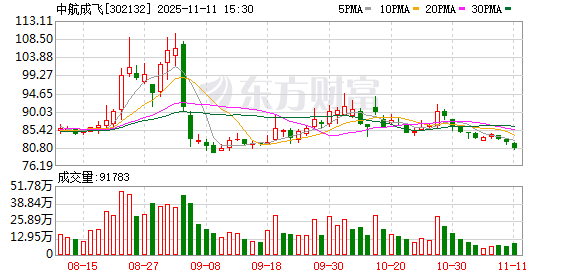
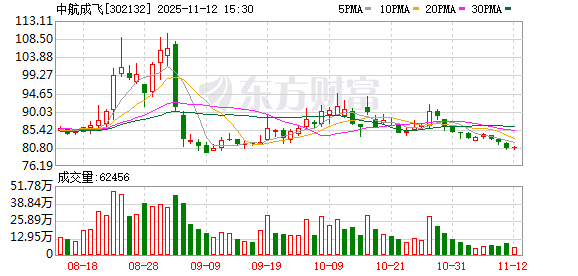
Group 1 - The core transaction on November 12 involved a block trade of 214,000 shares of AVIC Chengfei, with a transaction value of 18.8748 million yuan, at a price of 88.20 yuan, representing a premium of 9.04% over the closing price of the day [2][3] - The buyer was Ping An Securities Co., Ltd. Beijing Beitucheng West Road Securities Business Department, while the seller was Ping An Securities Co., Ltd. Shanghai Lingang New Area Branch [2][3] - Over the past three months, AVIC Chengfei has recorded three block trades, with a total transaction value of 63.4539 million yuan [2] Group 2 - The closing price of AVIC Chengfei on the day of the transaction was 80.89 yuan, reflecting a 0.40% increase, with a turnover rate of 1.07% and a total trading volume of 504 million yuan [2] - The net outflow of main funds for the day was 44.0805 million yuan, and the stock has seen a cumulative decline of 2.95% over the past five days, with a total net outflow of 339 million yuan [2] - The latest margin financing balance for AVIC Chengfei is 1.418 billion yuan, which has decreased by 107 million yuan over the past five days, representing a decline of 7.00% [3]


中航沈飞(600760):单季业绩同比有所改善,静待需求链条理顺
Changjiang Securities· 2025-11-12 09:20
Investment Rating - The investment rating for the company is "Buy" and is maintained [9]. Core Insights - The company reported a year-on-year improvement in quarterly performance, with Q3 revenue reaching 5.978 billion yuan, a 62.77% increase compared to the same period last year. However, cumulative revenue for the first three quarters of 2025 was 20.607 billion yuan, a decrease of 18.54% year-on-year. The net profit attributable to the parent company for Q3 was 0.225 billion yuan, reflecting a 12.89% increase year-on-year, while the cumulative net profit for the first three quarters decreased by 25.1% [6][2]. Summary by Sections Financial Performance - In Q3, the company achieved an operating income of 5.978 billion yuan, primarily driven by increased sales. The gross margin was affected by changes in product mix and the early-stage profitability of new products, leading to a decrease in both year-on-year and quarter-on-quarter margins. The company's net profit margin declined due to increased management expenses and asset/credit impairment losses [2][6]. Production and Capacity Expansion - The company is committed to expanding production to meet future demand and is actively preparing for short-term delivery. The balance of construction in progress increased compared to the beginning of the year, mainly due to ongoing construction of the new factory in Shenbei New District to support large-scale production of new models [2][6]. Future Profitability Projections - The company forecasts net profits attributable to the parent company for 2025, 2026, and 2027 to be 3.451 billion, 3.860 billion, and 5.092 billion yuan, respectively, with year-on-year growth rates of 1.67%, 11.87%, and 31.91%. The corresponding price-to-earnings ratios are projected to be 48, 43, and 32 times [2][6].

航空装备板块11月12日跌1.28%,三角防务领跌,主力资金净流出14.35亿元
Zheng Xing Xing Ye Ri Bao· 2025-11-12 08:49
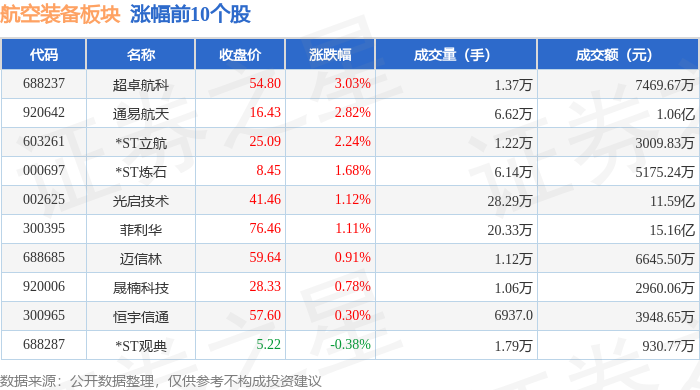
Market Overview - The aviation equipment sector experienced a decline of 1.28% on November 12, with Triangular Defense leading the drop [1] - The Shanghai Composite Index closed at 4000.14, down 0.07%, while the Shenzhen Component Index closed at 13240.62, down 0.36% [1] Stock Performance - Notable gainers in the aviation equipment sector included: - Super Aerospace Technology (688237) with a closing price of 54.80, up 3.03% [1] - Tongyi Aerospace (920642) at 16.43, up 2.82% [1] - ST Lihang (603261) at 25.09, up 2.24% [1] - Major decliners included: - Triangular Defense (300775) at 29.23, down 7.09% [2] - Aero Engine Corporation of China (600391) at 27.30, down 4.75% [2] - Western Superconducting (688122) at 70.45, down 4.59% [2] Capital Flow - The aviation equipment sector saw a net outflow of 1.435 billion yuan from institutional investors, while retail investors contributed a net inflow of 1.118 billion yuan [2] - The detailed capital flow for specific stocks indicated: - Maxinlin (688685) had a net inflow of over 9.9407 million yuan from institutional investors [3] - ST Lihang (603261) recorded a net inflow of 2.5151 million yuan from institutional investors [3] - Triangular Defense (300775) faced a significant outflow of 212.34 million yuan from institutional investors [3]

航宇科技与中天动力签署战略合作协议
Zheng Quan Shi Bao Wang· 2025-11-12 05:56
Core Viewpoint - Aerospace Technology has signed a strategic cooperation agreement with Sichuan Aerospace Zhongtian Power Equipment Co., Ltd. to establish a deep strategic partnership in the field of aerospace precision forgings [1] Group 1 - Aerospace Technology and Sichuan Aerospace Zhongtian Power Equipment will collaborate in the aerospace precision forgings sector [1]

中航重机跌2.02%,成交额1.94亿元,主力资金净流出850.37万元
Xin Lang Cai Jing· 2025-11-12 04:01
Core Viewpoint - 中航重机's stock price has experienced a decline of 18.86% year-to-date, with recent fluctuations indicating a slight recovery in the short term [1][2] Financial Performance - For the period from January to September 2025, 中航重机 reported revenue of 7.776 billion yuan, reflecting a year-on-year growth of 3.35% [2] - The company's net profit attributable to shareholders was 616 million yuan, showing a significant decrease of 39.21% compared to the previous year [2] Stock Market Activity - As of November 12, 中航重机's stock price was 16.51 yuan per share, with a market capitalization of 25.814 billion yuan [1] - The stock has seen a trading volume of 194 million yuan on the same day, with a turnover rate of 0.75% [1] - The stock has experienced a net outflow of 8.5037 million yuan in principal funds, with large orders showing a mixed buying and selling activity [1] Shareholder Information - As of September 30, 2025, 中航重机 had 98,200 shareholders, a decrease of 6.02% from the previous period [2] - The average number of circulating shares per shareholder increased by 12.33% to 15,816 shares [2] Dividend Distribution - 中航重机 has distributed a total of 1.462 billion yuan in dividends since its A-share listing, with 833 million yuan distributed over the past three years [3] Institutional Holdings - As of September 30, 2025, 富国中证军工龙头ETF and 国投瑞银国家安全混合A have increased their holdings in 中航重机, while 香港中央结算有限公司 has exited the top ten shareholders list [3]
航发控制:拟使用不超7.10亿元闲置募集资金进行现金管理
2 1 Shi Ji Jing Ji Bao Dao· 2025-11-12 00:37
Core Viewpoint - The company plans to utilize up to RMB 710 million of temporarily idle raised funds for cash management, investing in principal-protected cash management products such as time deposits [1] Group 1 - The board of directors will hold the 31st meeting of the 9th session on November 11, 2025, to review the cash management proposal [1] - The approved cash management amount is valid for 12 months from the date of board approval, allowing for rolling use within the limit [1] - The company assures that this decision will not affect the progress of the investment projects funded by the raised capital or the normal production and operation of the company [1]

中航成飞:截至2025年11月10日股东总数72706户
Zheng Quan Ri Bao· 2025-11-11 10:48
Group 1 - The core point of the article is that AVIC Chengfei announced on November 11 that as of November 10, 2025, the total number of shareholders is 72,706 [2]