债券发行

Search documents
财政部在卢森堡发行40亿欧元主权债券
Sou Hu Cai Jing· 2025-11-19 09:16
Core Viewpoint - The Ministry of Finance of the People's Republic of China successfully issued €4 billion in sovereign bonds in Luxembourg, marking the first issuance of euro-denominated sovereign bonds by China in this market, which received strong demand from international investors [1] Group 1: Issuance Details - The issuance included €2 billion in 4-year bonds with an interest rate of 2.401% and €2 billion in 7-year bonds with an interest rate of 2.702% [1] - The total subscription amount reached €100.1 billion, which is 25 times the issuance amount, with the 7-year bonds having a subscription multiple of 26.5 times [1] Group 2: Investor Profile - The investor base was diverse, with geographical distribution as follows: 51% from Europe, 35% from Asia, 8% from the Middle East, and 6% from offshore investors in the United States [1] - The types of investors included sovereign entities (26%), fund management (39%), banks and insurance companies (32%), and dealers (3%) [1] Group 3: Custody and Listing - All issued bonds will be held in the Central Moneymarkets Unit (CMU) of the Hong Kong Monetary Authority and will subsequently be listed on the Hong Kong Stock Exchange and the Luxembourg Stock Exchange [1]
交易商协会严打各类财务信披违规
Jin Rong Shi Bao· 2025-11-19 01:38
Core Viewpoint - The China Interbank Market Dealers Association has issued self-discipline penalties for financial reporting violations, highlighting the importance of accurate financial information disclosure for debt financing tool issuers [1] Group 1: Violations and Penalties - Two companies, Xinjiang Guanghui Industrial Investment Group and Guanghui Automotive Service Group, were penalized for failing to disclose financial reports on time, including annual and quarterly reports [2] - Both companies received warnings and were required to undertake comprehensive rectifications [2] - Guanghui Automotive, once the largest automotive dealer in China, has faced significant financial challenges, including a reported loss of 674 million yuan in the first half of 2024 and over 2.1 billion yuan in bond defaults since 2025 [2] Group 2: Revenue Recognition Issues - There has been a rise in the practice of inflating revenue through commodity trading, with some companies misclassifying their roles in trade transactions to artificially boost revenue figures [3] - Certain issuers have continued to use gross revenue recognition methods despite prior audits recommending a switch to net revenue recognition, leading to significant discrepancies in reported income [4] Group 3: Financial Reporting Authenticity - Common issues include failure to terminate asset recognition for land that has been sold and not disclosing related party transactions accurately, which can mislead investors about a company's financial health [5][6] - The concealment of related party transactions can distort financial data and raise concerns about potential financial misconduct, impacting investor trust and market stability [6] Group 4: Role of Intermediaries - The association emphasized the need for underwriters and accounting firms to fulfill their responsibilities in due diligence and auditing to maintain market integrity [7]
只有中国!美债狂揽1182亿,华尔街沉默,美联储头疼了
Sou Hu Cai Jing· 2025-11-17 17:10
Core Insights - China's rise in finance is drawing global attention, highlighted by the successful issuance of $4 billion sovereign dollar bonds in Hong Kong, with a staggering subscription amount of $118.2 billion, resulting in a subscription ratio of 30 times, and 33 times for the five-year bonds [1][3] Group 1: Market Dynamics - The issuance of Chinese bonds is reshaping the global financial landscape, challenging the dominance of the U.S. dollar bond market [3] - The interest rates on the issued bonds are nearly on par with U.S. Treasury rates, with three-year bonds at 3.646% and five-year bonds at 3.787% [3] - Despite a two-notch credit rating gap between China (A1) and the U.S. (AA1), the bonds attracted significant interest from global investors, indicating a shift in market perception [3][4] Group 2: Investor Participation - Institutional investors played a crucial role in the bond subscription, with sovereign funds accounting for 42%, banks and insurance companies 24%, and funds and asset management companies 32% [3] - Asian investors contributed 53% of the subscription amount, followed by European investors at 25%, and Middle Eastern and American investors at 22% [3] Group 3: Economic Fundamentals - Investors are focusing on China's strong economic fundamentals, including over $3 trillion in foreign exchange reserves, a growing trade surplus, and a stable policy environment [6] - The issuance of these bonds provides a near-equivalent yield to U.S. Treasuries, serving as a strategic option for diversifying investment risks [6] Group 4: Implications for Global Finance - The successful bond issuance signals that emerging markets can establish their own dollar credit benchmarks, setting an example for other nations [6][7] - The event reflects a potential shift in global asset allocation, allowing investors more diverse options to mitigate risks [7] - China's financial openness and the trust shown by global capital mark a significant change in the global economic landscape [7][8]

俄罗斯即将发行首笔人民币债券,每笔面值一万元,你会购买吗
Sou Hu Cai Jing· 2025-11-14 09:14
俄罗斯如今大力发行人民币债券,说明其确实在经济上承受了一定的压力,尤其是战争和制裁的双重影响。毕竟,当前俄罗斯正面临战争,战争是一项消耗 大量资金的"工程"。通过民间借贷的方式,可以缓解俄罗斯政府面临的经济压力。因此,从这个角度来看,投资者实际上是在间接支持俄罗斯的军事行动。 我个人认为,俄罗斯愿意拿国家信誉作为担保,这本身就意味着债券的安全性还是可以信赖的。只要俄罗斯在俄乌冲突中没有遭遇战败,基本上就不会出现 违约的风险。实际上,俄罗斯通过这种方式将民间资金与国家利益紧密地联系在一起。 根据今日俄罗斯RT的报道,俄罗斯财政部宣布,计划在莫斯科交易所发行首批人民币计价的联邦贷款债券。根据信息,债券的技术性发行时间定为12月8 日,而认购的截止日期则为12月2日。投资者可以购买两批债券,每批的面值为1万元人民币,期限设定在3到7年之间,票息支付周期为182天。根据媒体的 报道,实际上俄罗斯早在十年前就有意发行人民币债券,但一直到今天,这一计划才得以实现。那问题来了,作为一名投资者,你是否愿意购买俄罗斯的债 券呢? 从本质上讲,这种债券的核心依靠的是国家的信誉。如果你相信俄罗斯的国家信誉,那么购买这些债券就不失为 ...
【厦财动态】我市顺利完成全年地方政府债券发行工作
Sou Hu Cai Jing· 2025-11-14 06:13
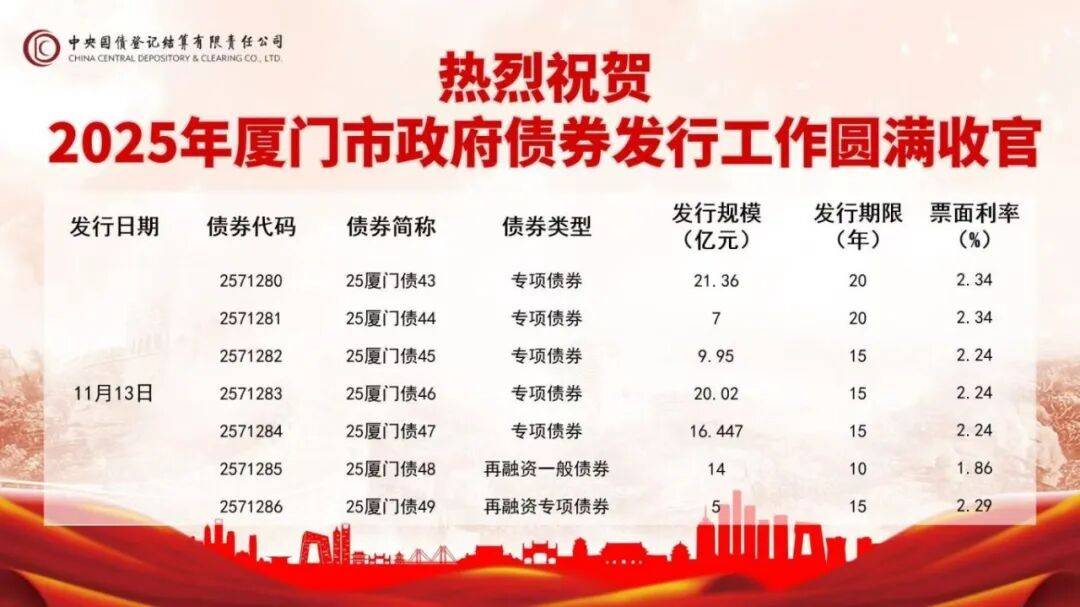
Core Points - The city successfully issued the sixth batch of government bonds for 2025, totaling 9.3777 billion yuan, which includes 7.4777 billion yuan in new special bonds and 1.9 billion yuan in refinancing bonds [1][4] Group 1: Bond Issuance Details - The bond issuance included various types of bonds with different terms and interest rates, such as: - Special bonds with a total of 21.36 billion yuan for 20 years at a rate of 2.34% - Special bonds totaling 7 billion yuan for 20 years at a rate of 2.34% - Special bonds of 9.95 billion yuan for 15 years at a rate of 2.24% - Special bonds of 20.02 billion yuan for 15 years at a rate of 2.24% - Special bonds of 16.447 billion yuan for 15 years at a rate of 2.24% - General refinancing bonds of 1.4 billion yuan for 10 years at a rate of 1.86% - Special refinancing bonds of 500 million yuan for 15 years at a rate of 2.29% [3] - The bonds received a AAA credit rating, with a competitive bidding process resulting in a subscription multiple of 15.52 times [3] Group 2: Overall Bond Issuance Performance - The successful issuance of this batch of bonds marks the completion of the city's government bond issuance task for the year, with a total of 60.77682 billion yuan issued throughout the year, including 48.8 billion yuan in new bonds and 11.97682 billion yuan in refinancing bonds [4] - The city’s finance bureau plans to enhance bond fund management and expedite the spending of bond funds to support infrastructure development and investment growth [4]
川普没想到中国发行四十亿美元债券,竟引来一千一百八十二亿全球资金疯抢,美联储急刹车
Sou Hu Cai Jing· 2025-11-13 16:55
Core Insights - The issuance of $4 billion sovereign bonds by China in Hong Kong on November 5, 2025, attracted a staggering subscription amount of $118.2 billion, achieving a record subscription multiple of 30 times, significantly surpassing the 2.5 to 2.7 times for U.S. Treasury bonds during the same period [1][3][5] - China's bond yields for three-year and five-year bonds were 3.646% and 3.787%, respectively, which were competitive with U.S. Treasury yields, indicating a shift in global investor confidence towards Chinese sovereign credit [1][3] - The issuance reflects a broader trend where global capital is increasingly viewing China as a safe haven, especially in light of the U.S. national debt exceeding $38 trillion and political uncertainties affecting investor confidence in U.S. Treasuries [1][5][12] Investment Demand and Structure - Sovereign investors accounted for 42% of the total subscriptions, with significant participation from central banks and sovereign wealth funds, indicating strong institutional confidence in China's long-term creditworthiness [3][5] - Geographically, 53% of the subscriptions came from Asia, 25% from Europe, and 16% from the Middle East, with 6% from U.S. investors, showcasing a diverse international interest in Chinese bonds [3][5] Strategic Implications - The issuance is part of a broader strategy by China to create an alternative dollar circulation system, challenging the traditional U.S.-dominated financial framework and potentially disrupting the existing global financial order [3][7][10] - By issuing bonds in Hong Kong, China not only reinforces Hong Kong's status as an international financial center but also facilitates cross-border financing and settlement, enhancing the global liquidity of the renminbi [9][10] Market Dynamics - The successful bond issuance sends a clear signal about the resilience of China's financial system, suggesting that it cannot be easily excluded from the global financial landscape [12] - The ongoing trend of "de-dollarization," with the dollar's share in global reserves dropping to 58.9%, indicates a shift towards a more multipolar currency system, with countries increasingly diversifying their reserves into assets like gold, euros, and renminbi [10][12]

【立方债市通】地方国资扎堆卖房/河南AAA主体拟发债5亿/河南首单旗舰店渠道柜台债交易落地
Sou Hu Cai Jing· 2025-11-13 16:44
Key Points - Local state-owned assets are increasingly being sold off, with experts indicating that selling properties is a direct manifestation of asset capitalization, which enhances local government financial strength [1] - The People's Bank of China conducted a 1.9 trillion yuan 7-day reverse repurchase operation, resulting in a net injection of 972 billion yuan [3] - In the first ten months of 2025, net financing from government bonds reached 1.195 trillion yuan, an increase of 372 billion yuan year-on-year [4] - The first flagship store channel counter bond transaction in Henan province has been successfully executed, with a total trading amount of 27.11 billion yuan [6] - Henan Railway Construction Investment Group plans to issue 500 million yuan of medium-term notes with a subscription range of 1.5% to 2.5% [9] - Zhengzhou High-tech Industry Investment Group has received approval for a 300 million yuan non-public issuance of technology innovation corporate bonds [9] - The Ningxia Transportation Investment Group has undergone a restructuring, with a new registered capital of 22 billion yuan and total assets of 118 billion yuan [12] - The first asset-backed securities (ABS) in the photovoltaic industry, amounting to 3.045 billion yuan, have been approved, marking a significant breakthrough in the securitization of renewable energy and real estate [11] - The research team from Zhongzheng Pengyuan has identified new urban renewal financing models, emphasizing the need for government-led investment and the involvement of social capital [20][21]

五中介负14.5%连带责任,首例应用损失核定模型债券虚假陈述案宣判
Sou Hu Cai Jing· 2025-11-13 13:12
Core Viewpoint - The Shanghai Financial Court has made a landmark ruling in the case of Shanghai Huaxin International Group Co., Ltd. regarding false statements in bond issuance, marking a significant development in the judicial practice of bond false statement liability disputes in China [2][3]. Group 1: Case Details - The court determined that the losses caused by false statements amounted to 128 million yuan, with five intermediary institutions bearing a total joint liability of 14.5% for the bond underwriting, resulting in a total compensation of 18.54 million yuan [2][4]. - The case involved the issuance of bonds by Shanghai Huaxin, which was once a star enterprise in the capital market, but faced financial fraud allegations in 2018, leading to a significant drop in bond prices and eventual bankruptcy [4][5]. - The plaintiff, a rural commercial bank, claimed that the bond issuance documents contained significant omissions and misrepresentations, seeking full joint compensation for economic losses totaling over 232 million yuan [5][6]. Group 2: Judicial Innovations - This case is notable for being the first to introduce third-party professional institutions to explore the "bond value comparison method" for loss calculation, which deducts losses caused by non-false statement factors [3][8]. - The court's decision to involve a third-party institution for loss assessment is seen as an important innovation in judicial practice, particularly given the complexities involved in determining losses from bond false statements [8][10]. - The Shanghai Financial Court's ruling emphasized the need for stricter internal control mechanisms among underwriters, accountants, and rating agencies, aiming to enhance their professional standards in bond issuance and financial verification [6][10]. Group 3: Implications for the Industry - The ruling sends a clear signal to strengthen the responsibilities of market gatekeepers, indicating that intermediary institutions must exercise due diligence in their roles [5][6]. - The court's approach to assigning liability in a tiered manner encourages a more nuanced understanding of the responsibilities of different intermediary institutions, which could help mitigate excessive impacts on the industry from blanket joint liability [6][11]. - The case highlights the necessity for transparency in the loss calculation process and suggests the establishment of a registry for financial judicial appraisal institutions to enhance the credibility of conclusions in similar cases [11].

特朗普没想到中国敢这么干,发行美债狂揽1182亿,美联储急刹车
Sou Hu Cai Jing· 2025-11-13 10:22
Group 1 - The core point of the article is that China's Ministry of Finance successfully issued USD sovereign bonds in Hong Kong, raising a total of $4 billion, with an unprecedented subscription amount of $118.2 billion, marking a record in the history of USD sovereign bond issuance [1][4][11] - The subscription rate for China's bonds significantly exceeded that of U.S. bonds, indicating strong international investor confidence in China [3][6] - The issuance of these bonds serves multiple purposes, including improving the yield curve of USD sovereign bonds and balancing China's sovereign debt structure, which currently has a low proportion of foreign debt [9][11] Group 2 - The issuance is also aimed at demonstrating global investor confidence in China's economy, as evidenced by the willingness of investors to accept a bond yield of 3.646%, only slightly higher than that of U.S. bonds [11][13] - The successful bond issuance reflects China's economic stability and healthy environment, countering recent credit ratings from Wall Street agencies that rated China lower than the U.S. [15] - The deeper strategic intent behind issuing these bonds includes providing financial support to smaller countries burdened by debt, thereby enhancing China's economic cooperation with these nations and promoting the Belt and Road Initiative [23][25] Group 3 - The funds raised from the bond issuance can be used to help these smaller countries repay their debts to the U.S., reducing their vulnerability to U.S. financial institutions [20][22] - Additionally, the repayment of these loans could potentially be made in RMB, indirectly promoting the internationalization of the Chinese currency [25] - The article suggests that the successful bond issuance will lead to increased global capital inflow into China, enhancing the influence of the RMB and potentially reducing the dominance of the USD in international markets [25][27]

特朗普没料到中国敢这么干,发行美债增持1182亿,美联储急刹车
Sou Hu Cai Jing· 2025-11-13 08:24
Core Insights - The issuance of $4 billion in Chinese sovereign bonds attracted a staggering $118.2 billion in subscriptions, achieving a subscription rate 30 times higher than the amount issued, indicating a strong global interest in Chinese dollar bonds compared to U.S. Treasury bonds [4][6]. Group 1: Bond Issuance Details - The Chinese bonds had competitive interest rates, with a 3-year rate of 3.646% and a 5-year rate of 3.787%, which are nearly on par with U.S. Treasury rates [3][4]. - The distribution of investors showed that 53% of the subscription funds came from Asia, 25% from Europe, 16% from the Middle East, and 6% from U.S. investors, highlighting a diverse global interest [3][4]. Group 2: Financial Context - The U.S. national debt has surpassed $38 trillion, with annual interest payments exceeding $1.1 trillion, raising concerns about fiscal sustainability [6]. - China, with over $3 trillion in foreign exchange reserves, is not issuing dollar bonds due to a cash shortage but rather as a strategic financial maneuver [6][10]. Group 3: Market Implications - The issuance sets a new interest rate benchmark for Chinese enterprises seeking to raise funds in international markets, providing a reference point for future dollar bond issuances [8]. - The funds raised will support infrastructure projects along the Belt and Road Initiative, creating a cycle where international capital flows into China and then is reinvested globally [8][10]. Group 4: Global Financial Dynamics - This issuance allows China to redefine the concept of "safe assets" in the international financial system, challenging existing credit ratings by demonstrating strong market demand [6][10]. - By becoming an active dollar allocator rather than a passive holder, China is reshaping global capital flows and potentially paving the way for the internationalization of the renminbi [10][14]. Group 5: Hong Kong's Role - The choice to issue bonds in Hong Kong reinforces its status as an international financial center, with China having issued a total of $25 billion in sovereign bonds there since 2017 [12]. - The high subscription rates for Chinese bonds compared to U.S. Treasuries suggest that international investors view Chinese sovereign credit ratings as comparable to those of the U.S. [12][14].