
政府债券发行

Search documents
证券交易印花税增长1.1倍!前两个月财政运行平稳开局
证券时报· 2026-03-19 11:34
Core Viewpoint - The fiscal revenue and expenditure data for January and February 2026 indicate a stable start to the fiscal year, with slight growth in revenue and accelerated expenditure [2][9]. Revenue Summary - In the first two months of 2026, the national general public budget revenue reached 4.42 trillion yuan, a year-on-year increase of 0.7% [1]. - Tax revenue increased by 0.1%, while non-tax revenue grew by 3.4% [3]. - The domestic value-added tax rose by 4.7%, while domestic consumption tax, corporate income tax, and individual income tax saw declines of 6.2%, 3.9%, and 6.9% respectively [3]. - The growth in value-added tax is attributed to the growth in industrial services and a narrowing decline in industrial producer prices [6]. - The increase in import value-added tax and consumption tax was 12.9%, and the export value-added tax and consumption tax increased by 9.7% [6]. - Securities transaction stamp duty revenue reached 49.9 billion yuan, reflecting a year-on-year increase of 110%, indicating active trading in the stock market [6]. Expenditure Summary - National general public budget expenditure increased by 3.6% in the first two months of 2026 [9]. - Key expenditure areas such as social security and employment, health care, housing security, and urban-rural community spending saw year-on-year increases of 8.6%, 17.3%, 9%, 7.7%, and 5.4% respectively [10]. - The proportion of spending on medical, education, social security and employment, and housing security has been increasing in the general public budget [10]. - Government bond issuance has accelerated, with a year-on-year increase of 12.2% for national bonds and 8.5% for local government bonds [10].


央行今日开展6000亿元中期借贷便利操作
Sou Hu Cai Jing· 2026-02-25 01:15
Group 1 - The People's Bank of China (PBOC) conducted a 600 billion yuan Medium-term Lending Facility (MLF) operation to maintain liquidity in the banking system, with a one-year term [1] - This operation results in a net injection of 300 billion yuan for the month, marking the 12th consecutive month of increased MLF issuance [1] - The continued net injection of liquidity indicates a supportive monetary policy stance, which is expected to encourage banks to increase credit issuance and stabilize market expectations [1] Group 2 - The PBOC plans to issue 50 billion yuan in central bank bills in Hong Kong, with 30 billion yuan for the first issue and 20 billion yuan for the second issue [2] - The issuance aims to enrich the high-credit-quality RMB financial products in Hong Kong and improve the RMB yield curve [2]
2月MLF续作加量3000亿,短期内降准的可能性较小
Sou Hu Cai Jing· 2026-02-24 12:34
Core Viewpoint - The People's Bank of China (PBOC) announced a 600 billion MLF operation to maintain liquidity in the banking system, indicating a continued supportive monetary policy stance amid potential tightening pressures [1][2]. Group 1: MLF Operations - On February 25, 2026, the PBOC will conduct a 600 billion MLF operation with a one-year term, marking the 12th consecutive month of increased MLF issuance [1]. - The MLF rollover in February is 300 billion, which is less than the previous month's 700 billion, indicating a smaller increase in liquidity [1]. Group 2: Liquidity and Economic Stability - The net liquidity injection in February reached 900 billion, continuing a trend of net injections for 10 months, although slightly lower than the previous month's 1 trillion [1]. - The increase in MLF and other liquidity measures aims to support major projects and stabilize macroeconomic operations, especially with the early issuance of local government bonds [1][2]. Group 3: Monetary Policy Implications - The significant increase in mid-term liquidity injections suggests a reduced likelihood of a reserve requirement ratio (RRR) cut in the short term, indicating a period of observation following the introduction of structural policies in January [2]. - The PBOC's actions are intended to counter potential liquidity tightening effects while ensuring stable funding for government bond issuance and maintaining credit support from banks [2].
2025年安徽省地方政府债券发行情况
Sou Hu Cai Jing· 2026-01-12 18:37
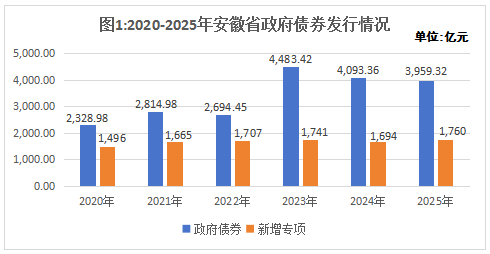
Core Viewpoint - In 2025, Anhui Province issued a total of 105 government bonds across 11 batches, amounting to 395.932 billion yuan, ranking 10th nationwide. The average issuance interest rate for government bonds was 1.98%, a decrease of 27 basis points year-on-year, indicating a further reduction in financing costs [1]. Group 1: Bond Issuance Structure - The total issuance of new bonds was 189.978 billion yuan, with special bonds reaching a historical high of 176 billion yuan, accounting for 44% of the total issuance. General bonds amounted to 13.978 billion yuan, representing 4% of the total. Refinance bonds totaled 205.954 billion yuan, making up 52% of the total issuance [2]. - From a regional perspective, Hefei City led in the issuance of new special bonds with a scale of 42.471 billion yuan, while Huangshan City and Tongling City had smaller issuances of 4.473 billion yuan and 3.421 billion yuan, respectively [4]. - The funds from new special bonds supported 1,615 projects, primarily in municipal and industrial park infrastructure (31.948 billion yuan), land reserves (28.278 billion yuan), transportation infrastructure (19.226 billion yuan), social undertakings (18.603 billion yuan), and affordable housing projects (17.22 billion yuan), collectively accounting for 65% of the total [6]. Group 2: Bond Issuance Duration - In 2025, the majority of government bonds issued in Anhui Province had a duration of 7 years or more, comprising 97% of the total issuance. The average issuance duration was 12.76 years, a decrease of 0.22 years from the previous year. The average duration for general bonds was 9.18 years, while special bonds had an average duration of 13.61 years, with newly issued special bonds averaging 14.43 years [8]. Group 3: Bond Issuance Interest Rates - The issuance interest rates for government bonds in Anhui Province reached historical lows in 2025, with 10-year bond rates entering the "1%" era. However, the rates exhibited significant volatility throughout the year rather than a consistent downward trend [11]. Group 4: Issuance Market Conditions - The issuance rhythm in 2025 was characterized by an early start, rapid progress, and an early conclusion, making Anhui one of the first provinces to complete its annual issuance tasks. The second and third quarters saw concentrated issuance, effectively ensuring timely funding support for project construction [16]. - The issuance venues were well-arranged, with 241.51 billion yuan issued through the Central Government Securities Depository and Clearing Co., 90.366 billion yuan through the Shanghai Stock Exchange, 53.563 billion yuan through the Shenzhen Stock Exchange, and 10.493 billion yuan through the Beijing Stock Exchange [16]. - The average subscription multiple for government bond issuance was 28.43 times, with the first and ninth batches exceeding 32 times, reflecting investor confidence in the province's economic development, fiscal strength, and government credit. The subscription structure showed that bank financial institutions accounted for 86.93%, while brokerage firms made up 13.07%, with bank subscriptions increasing by 17.8 percentage points compared to the previous year [16].
央行将开展1.1万亿元买断式逆回购操作
Zheng Quan Shi Bao· 2026-01-07 22:28
Group 1 - The People's Bank of China (PBOC) announced a reverse repurchase operation of 1.1 trillion yuan with a term of 3 months, indicating a continuation of liquidity support in the banking system [1] - In January, a total of 1.7 trillion yuan in reverse repos will mature, and there is an expectation for an increase in the 6-month reverse repo operations to maintain liquidity [1] - Analysts suggest that the PBOC's actions are aimed at stabilizing the funding environment in response to potential liquidity tightening due to government bond issuances [1] Group 2 - The Ministry of Finance has completed the first batch of 2026 discount treasury bond auctions, with local governments also beginning to issue special bonds, indicating a significant increase in government bond issuance at the start of the year [2] - Experts predict that the scale of government bonds will further increase in 2026, necessitating the PBOC to implement measures to maintain stable liquidity in the banking system [2] - There is an estimated liquidity gap of approximately 1.3 trillion yuan in January, prompting the PBOC to potentially use reverse repos and other monetary policy tools to ensure reasonable liquidity levels [2]
Opening of new 2-year Danish Government Bond on 21 January 2026
Globenewswire· 2026-01-07 16:00
Core Viewpoint - The Kingdom of Denmark will issue a new DGB 2.00 per cent 2028 bond on 21 January 2026, replacing the DGB 0.50 per cent 2027 bond as the key on-the-run issue [1] Group 1: Bond Issuance Details - The new bond will have an annual coupon payment on 15 November and will mature on 15 November 2028 [1] - The total nominal value of the bond sale will not exceed DKK 6 billion [2] - The auction will be conducted via MTS Denmark's auction system with primary dealers as counterparties, contingent on stable market conditions [2] Group 2: Auction Process - Bids can be submitted from 8:00 a.m. to 10:15 a.m. CET on the opening day, with a cut-off price fixed shortly after [3] - Bids at the cut-off price or above will be accommodated at that price, with a pro-rata allocation for bids at the cut-off price if necessary [3] Group 3: Securities Lending - The DGB 2.00 per cent 2028 bond will be included in the central government's securities lending facility starting from 21 January 2026 [4]
央行将开展1.1万亿元买断式逆回购操作!
证券时报· 2026-01-07 15:39
Group 1 - The People's Bank of China (PBOC) announced a 1.1 trillion yuan reverse repurchase operation with a term of 3 months, indicating a continuation of liquidity support in the market [1] - In January, a total of 1.7 trillion yuan in reverse repos will mature, and the market expects further operations to maintain liquidity stability [1][2] - The central bank is likely to use reverse repos and Medium-term Lending Facility (MLF) to manage liquidity amid government bond issuance and tax payments [2][3] Group 2 - The Ministry of Finance has completed the first batch of 2026 government bond issuance, indicating an increase in government bond scale for the year [2] - Experts predict that the government will maintain necessary fiscal deficits and expand fiscal spending, leading to a higher issuance of government bonds in 2026 [2] - The central bank's actions are aimed at ensuring a stable funding environment to accommodate the increased supply of government bonds [2]

前11个月广义财政支出超收入近10万亿
Di Yi Cai Jing Zi Xun· 2025-12-26 02:31
Core Viewpoint - The article discusses the performance of China's broad fiscal revenue and expenditure in the first 11 months of the year, highlighting a slight decline in revenue but an increase in expenditure, reflecting a proactive fiscal policy aimed at stabilizing economic growth and expanding domestic demand [2][5]. Fiscal Revenue - In the first 11 months, broad fiscal revenue reached 24,079 billion yuan, showing a year-on-year decline of approximately 0.2% [2]. - The general public budget revenue increased by 0.8% compared to the same period last year, slightly better than the initial forecast of 0.1% [5]. - The decline in government fund revenue was 4.9%, significantly lower than the expected growth of 0.7%, primarily due to a 10.7% drop in local government land use rights transfer income [6]. Fiscal Expenditure - Broad fiscal expenditure amounted to 34,066 billion yuan, with a year-on-year increase of about 4.5%, aligning closely with the economic growth rate of around 5% [2][7]. - The expenditure growth rate was lower than the initial official forecast, which anticipated a 9.3% increase for the year [7]. - To maintain fiscal expenditure levels, the central government allowed local governments to issue an additional 500 billion yuan in bonds in the fourth quarter to support local financial capacity and major project construction [7]. Government Debt - Net financing from government bonds reached 1.315 trillion yuan in the first 11 months, an increase of 361 billion yuan year-on-year [8]. Fiscal Policy Focus - The fiscal expenditure structure has been optimized, with increased focus on social welfare and public services, such as a 1 billion yuan childcare subsidy [9]. - Experts predict that the fiscal deficit rate for 2026 may be set around 4%, with an expected increase in government debt issuance to support fiscal spending [9].

LPR连续7个月不变,明年怎么安排?
Jing Ji Wang· 2025-12-26 02:04
Core Viewpoint - The Loan Prime Rate (LPR) has remained unchanged for seven consecutive months, reflecting a stable macroeconomic environment and reduced reliance on short-term stimulus policies [3][4]. Group 1: Economic Environment - The current macroeconomic environment shows strong growth resilience, with exports performing better than expected and new productivity sectors developing rapidly, indicating that the need for aggressive counter-cyclical adjustments has diminished [3]. - The central economic work conference has emphasized the flexible and efficient use of various policy tools, suggesting that monetary policy will actively support growth targets [4][8]. Group 2: Future LPR Adjustments - Although the LPR has been stable, there is still potential for future adjustments, particularly in the first quarter of 2026, as the central bank may implement new rounds of reserve requirement ratio (RRR) cuts or interest rate reductions [4][6]. - The timing for potential LPR cuts is likely around the Chinese New Year, a critical period for policy measures aimed at stabilizing expectations and promoting consumption [6]. Group 3: Rationale for Potential LPR Cuts - Four key reasons support the possibility of LPR cuts: 1. Clear national policy direction provides operational space for interest rate reductions [8]. 2. The need to maintain a healthy yield curve due to significant government bond issuance this year [8]. 3. The LPR pricing mechanism has room for transmission, as liquidity has been injected into the banking system, lowering funding costs [8]. 4. Balancing market supply and demand with risk pricing is essential, as adjustments must consider both promoting lower financing costs and maintaining financial system stability [8]. Group 4: Benefits of LPR Cuts - A reduction in LPR would lower costs for homebuyers, boosting confidence in the housing market and stabilizing expectations [9][12]. - It would also decrease financing costs for the real economy, particularly benefiting small and medium-sized enterprises and sectors related to new productivity [12]. - Overall, LPR cuts could help stabilize and boost the macroeconomy by increasing disposable income and enhancing consumption willingness, thereby driving total demand [12].

“十四五”我省管好用好债券资金 护航发展保民生
Sou Hu Cai Jing· 2025-12-22 12:41
Group 1 - The core viewpoint emphasizes the establishment of a comprehensive government debt management system that effectively utilizes bond funds to stabilize investment, promote development, and benefit people's livelihoods, with a total issuance of 9,582 billion yuan in new local government bonds supporting approximately 3,800 public welfare projects across various sectors [1] Group 2 - The institutional framework for debt financing has been strengthened, with a new method for distributing local debt limits introduced in 2023, focusing on precise fund allocation and post-issuance management [2] - A pilot program for self-audit and self-issue of special bond projects is set for 2025, aiming to enhance project feasibility and financing balance while ensuring timely project funding [2] Group 3 - The proactive approach to bond issuance has led to a reduction in financing costs, with 435 government bonds issued during the "14th Five-Year Plan" period, achieving an average interest rate of 2.67%, resulting in an estimated savings of 3,569.09 billion yuan in financing costs for various levels of government [3] Group 4 - The overall risk of local debt has been effectively controlled through organized leadership and targeted measures, resulting in a significant alleviation of debt risks [4] Group 5 - A comprehensive monitoring mechanism for local debt has been established to track bond fund expenditures, enhancing risk analysis and management effectiveness [5] - Strengthened financial supervision and accountability measures are in place to ensure compliance with fiscal discipline and address any irregularities in debt management [5]