生命科学

Search documents
青岛海尔生物医疗股份有限公司 关于股东增持股份达到5%的权益 变动提示性公告
Zhong Guo Zheng Quan Bao - Zhong Zheng Wang· 2025-10-16 04:10
Core Viewpoint - The announcement details that Qingdao Jiushi Investment Management Co., Ltd. has increased its stake in Haier Biomedical to 5% without triggering a mandatory takeover bid [2][3]. Group 1: Shareholding Changes - Jiushi Youxuan No. 1 Private Securities Investment Fund acquired 15,897,909 shares of Haier Biomedical from August 14, 2024, to October 14, 2025, representing 5% of the total share capital [4][10]. - The increase in shareholding does not change the company's controlling shareholder or actual controller [3][5]. Group 2: Investment Rationale - The investment is based on confidence in the future development of the life sciences industry and recognition of Haier Biomedical's governance, industry position, business capabilities, operational results, and risk management [10]. - Jiushi Youxuan No. 1 has no current plans to increase or decrease its stake in the next 12 months [11]. Group 3: Compliance and Reporting - The report complies with relevant laws and regulations, including the Securities Law and the Management Measures for the Acquisition of Listed Companies [7][12]. - The report confirms that the information disclosed is accurate and complete, with no misleading statements or omissions [12].

海尔生物突遭私募举牌!久实投资具有国资背景
Zhong Guo Ji Jin Bao· 2025-10-15 23:55
Core Viewpoint - Haier Biomedical has been targeted for a stake acquisition by Jiushi Investment, reaching a 5% shareholding threshold, indicating confidence in the company's future development and potential for collaborative growth [1][4][2]. Group 1: Investment Details - Jiushi Investment's Jiushi Preferred No. 1 Fund acquired 15,897,900 shares of Haier Biomedical, representing 5% of the total share capital [4]. - The investment was made through secondary market transactions and was funded by Jiushi Investment's own capital [4]. - Jiushi Investment has no immediate plans to increase or decrease its stake in Haier Biomedical within the next 12 months [4]. Group 2: Company Background - Haier Biomedical is a subsidiary of Haier Group's health ecosystem brand, established in October 2005 and listed on the Shanghai Stock Exchange's Sci-Tech Innovation Board in October 2019 [7]. - The company has faced a continuous decline in stock price over the past four years, with significant drops of 29.83%, 35.46%, 12%, and 6.38% in the years 2022, 2023, 2024, and 2025 respectively [10]. Group 3: Financial Performance - In the first half of 2025, Haier Biomedical reported revenue of 1.196 billion yuan, a decrease of 2.27% year-on-year, and a net profit of 143 million yuan, down 39.09% year-on-year [8]. - The company attributes the profit decline to external factors, new capacity ramp-up, and strategic investments, but anticipates improvement as industry conditions recover [8]. - The overseas business showed strong growth, with revenue of 427 million yuan, a year-on-year increase of 30.17%, achieving the highest quarterly revenue and growth rate since 2023 in the second quarter [9].

瞄准“最前沿”,弄潮儿向涛头立(评论员观察)
Ren Min Wang· 2025-10-15 22:21
Core Insights - China is increasingly becoming a source of significant original and disruptive technological achievements, marking a profound change during the "14th Five-Year Plan" period [1][4] - The country has made substantial advancements in various cutting-edge fields, transitioning from "catching up" to "keeping pace" and "leading" in technology [1][4] Group 1: Technological Advancements - Chinese researchers have achieved groundbreaking results in quantum technology, life sciences, and brain-machine interfaces, showcasing the country's growing original innovation capabilities [1][3] - The efficiency of electric vehicle batteries has improved over four times in the past five years, highlighting significant advancements in foundational research [3] Group 2: Innovation Ecosystem - A robust innovation ecosystem is essential for optimizing the allocation of innovative resources and facilitating efficient collaboration among innovation entities [4] - The continuous increase in funding for basic research and the combination of free exploration with goal-oriented approaches have contributed to the emergence of original achievements during the "14th Five-Year Plan" [3][4] Group 3: Policy and Market Dynamics - The interplay between top-level design, policy-driven initiatives, and spontaneous market innovation has positioned China at the forefront of artificial intelligence [2] - The reform of the technology evaluation system and the promotion of collaborative innovation are recognized as key factors in fostering a conducive environment for technological breakthroughs [4]
海尔生物被久实优选1号私募证券投资基金举牌
Zhong Guo Ji Jin Bao· 2025-10-15 16:19
【导读】海尔生物被久实优选1号私募证券投资基金举牌 中国基金报记者 吴君 10月15日晚间,海尔生物发布公告称,在本次增持以后,青岛久实投资管理有限公司(以下简称久实投 资)旗下久实优选1号私募证券投资基金(以下简称久实优选1号)拥有权益的股份数量及占公司总股本 的比例为5%,达到举牌线。 值得注意的是,海尔生物股价已经连续调整4年左右。国资背景的久实投资此时出手举牌,公司表示意 在未来发展中实现协同共赢。 久实投资举牌海尔生物 海尔生物最新发布公告称,2025年10月15日,公司收到久实投资(代表"久实优选1号")发来的《简式 权益变动报告书》,基于对公司未来发展前景的信心和对公司长期投资价值的认可,久实优选1号于 2024年8月14日至2025年10月14日通过二级市场集中竞价和大宗交易方式增持公司股份1589.79万股,占 公司总股本的5.00%。 | 基金名称 | 基金备案编号 | 久实优选1号私募证券投资基金 SJD567 | | | | | | --- | --- | --- | --- | --- | --- | --- | | 信息披露 义务人基 | | | | | | | | 基金管理人名称 ...

一A股,突遭私募举牌!
Zhong Guo Ji Jin Bao· 2025-10-15 16:16
Core Viewpoint - Haier Biomedical has been targeted by Qindao Jiushi Investment Management Co., Ltd. through its private equity fund, Jiushi Preferred No. 1, which has acquired a 5% stake in the company, marking a significant investment after four years of stock price decline [2][4][12]. Group 1: Investment Details - Jiushi Preferred No. 1 acquired 15,897,909 shares of Haier Biomedical, representing 5% of the total share capital, through secondary market transactions from August 14, 2024, to October 14, 2025 [4][6]. - The investment was made using self-owned funds, and there are no immediate plans to increase or decrease the stake in the next 12 months [6][8]. Group 2: Company Background - Haier Biomedical is a subsidiary of Haier Group's health ecosystem brand, Yingkang Yisheng, established in October 2005 and listed on the Shanghai Stock Exchange's Sci-Tech Innovation Board in October 2019 [13]. - The company has faced a continuous decline in stock price over the past four years, with significant drops of 29.83%, 35.46%, 12%, and 6.38% in 2022, 2023, 2024, and 2025 respectively [12][14]. Group 3: Financial Performance - In the first half of 2025, Haier Biomedical reported revenue of 1.196 billion yuan, a year-on-year decrease of 2.27%, and a net profit attributable to shareholders of 143 million yuan, down 39.09% year-on-year [14]. - The company noted that its new industries are growing well, contributing to 47% of total revenue, with significant growth in overseas business, which saw a 30.17% increase year-on-year [14].
一A股,突遭私募举牌!
中国基金报· 2025-10-15 16:09
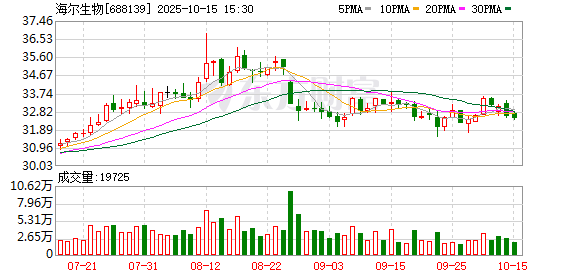
【导读】海尔生物被久实优选1号私募证券投资基金举牌 中国基金报记者 吴君 10月15日晚间,海尔生物发布公告称,在本次增持以后,青岛久实投资管理有限公司(以下 简称久实投资)旗下久实优选1号私募证券投资基金(以下简称久实优选1号)拥有权益的股 份数量及占公司总股本的比例为5%,达到举牌线。 值得注意的是,海尔生物股价已经连续调整4年左右。国资背景的久实投资此时出手举牌,公 司表示意在未来发展中实现协同共赢。 久实投资举牌海尔生物 海尔生物最新发布公告称,2025年10月15日,公司收到久实投资(代表"久实优选1号")发 来的《简式权益变动报告书》,基于对公司未来发展前景的信心和对公司长期投资价值的认 可,久实优选1号于2024年8月14日至2025年10月14日通过二级市场集中竞价和大宗交易方 式增持公司股份1589.79万股,占公司总股本的5.00%。 | | 基金名称 基金备案编号 | 久实优选 1 号私募证券投资基金 SJD567 | | | | | --- | --- | --- | --- | --- | --- | | 信息披露 义务人基 本信息 | | | | | | | | 基金管理人名称 | ...

Danaher Stock: Monopoly Margins, Discounted Price
Forbes· 2025-10-15 14:25
Core Insights - Danaher (NYSE:DHR) stock is highlighted for its monopoly-like high margins available at a discounted price [1] Company Overview - Danaher provides a range of professional, medical, industrial, and commercial products across Life Sciences, Diagnostics, and Environmental solutions, including lab automation, diagnostic systems, genomics, and microscopy technologies [4] Financial Performance - Revenue growth for Danaher was 1.9% over the last twelve months (LTM) and -2.6% over the last three-year average, with expectations for growth driven by innovation in life sciences and diagnostics, as well as expansion in high-growth healthcare and biotechnology segments [6] - Recent profitability metrics include an operating cash flow margin of 25.7% and an operating margin of 18.4% LTM [6] - Long-term profitability metrics show approximately 29.9% operating cash flow margin and 21.6% operating margin over the last three-year average [6] - The stock is currently available at a price-to-sales (P/S) multiple of 6.2, representing a 29% discount compared to one year ago [6] Market Position - The market typically values companies with strong pricing power and high margins, which fosters consistent and predictable profits and cash flows, thereby reducing risk and allowing for capital reinvestment [3]


Orion, Nio, Alibaba Group And Other Big Stocks Moving Lower In Tuesday's Pre-Market Session
Benzinga· 2025-10-14 12:05
Core Insights - U.S. stock futures are lower, with Dow futures dropping over 350 points [1] - Orion SA reported preliminary third-quarter results, expecting adjusted EBITDA of approximately $55 million for Q3 and a full-year projection of $220-$235 million, leading to an 18.6% drop in shares to $5.56 in pre-market trading [1] Company Movements - ENDRA Life Sciences Inc saw a 19.4% decline to $6.54 after a previous 25% increase due to $4.9 million in funding commitments [4] - Canaan Inc experienced an 11.8% drop to $1.34 after a 39% rise, with a maintained Buy rating and a $4 price target from Rosenblatt analyst Kevin Cassidy [4] - DBV Technologies SA fell 11.8% to $14.48 after a 10% gain on the previous day [4] - Nanobiotix SA tumbled 10.2% to $27.23 following a 28% increase [4] - Draganfly Inc dipped 9.4% to $12.47 after filing for a mixed shelf of up to $200 million [4] - Bitdeer Technologies Group fell 9% to $18.61 after a 15% gain [4] - Diginex Ltd declined 9% to $23.40 [4] - HIVE Digital Technologies dipped 8.1% to $6.21, with a maintained Buy rating and a $10 price target from Canaccord Genuity analyst Joseph Vafi [4] - Oatly Group AB fell 7.8% to $13.29 after a 5% gain [4] - Bit Digital Inc declined 7.7% to $3.69 after a 6% increase [4] - Upexi Inc fell 7.7% to $5.98 [4] - Sharplink Gaming Inc declined 7.1% to $14.98 after a 5% increase [4] - Nio Inc fell 5% to $6.82, with US-listed Chinese stocks trading lower due to new port fees [4] - Alibaba Group Holding Ltd declined 4% to $160.20, also affected by new port fees [4]


2025最具潜力企业出炉,六大领域或成未来经济“增长极”
Guo Ji Jin Rong Bao· 2025-10-10 07:18
当前,具身智能已走向规模化应用,成为激活新质生产力、破解社会痛点的关键引擎。 近日,安永复旦共同举办的"2025最具潜力企业"评选结果正式揭晓,26家企业荣膺"最具潜力企业 奖",8家企业获颁"最具潜力种子企业奖"。 本届评选以"无限可能・智能具身拓未来"为核心主题,聚焦具身智能技术的产业化落地与价值释 放,获奖企业覆盖具身智能、人工智能、生命科学、移动出行、芯片、增强现实六大核心领域,其中14 家企业来自具身智能赛道,成为本次评选的最大亮点,彰显出中国在实体智能领域的强劲创新活力。 在人口老龄化背景下,AI养老护理机器人可实现自主巡护、健康监测,缓解居家养老人力缺口; 制造业升级浪潮中,能适应小批量、多品类生产需求的复合型协作机器人正推动"中国制造"向"中国智 造"转型;低空经济成为新增长极,未来将重塑城市短途交通。具身智能正在重新构建制造、医疗、城 市、生活等多重场景的运作方式。它不仅是自动化的升级,更是智能体与环境共融的生态革命,为实体 经济与数字未来的无缝衔接奠定了坚实基础。 "创新是企业成长潜力的核心源泉,而资本赋能则是实现高增长的关键支撑。"安永大中华区业务主 管合伙人毕舜杰表示,作为人工智能与现 ...
“并购之王”丹纳赫是如何“养成”的?
首席商业评论· 2025-10-08 02:28
Core Insights - Danaher Corporation has successfully completed nearly 400 acquisitions over 40 years, spending approximately $90 billion, resulting in a market capitalization of about $200 billion and creating around $250 billion in shareholder value [2][4]. Acquisition Strategy - Danaher has a high frequency of acquisitions, averaging over 10 per year, with a peak of 19 in one year, and has never had a year without acquisitions [4]. - The company boasts a high success rate in acquisitions, with most large transactions being notably successful [4]. - Danaher operates across various industries, evolving from low-end manufacturing to advanced life sciences and diagnostics [4]. Evolution of Acquisition Style - In the 1980s, Danaher focused on high leverage and significant asset restructuring, later shifting to a strategy of seeking innovative and low-cost products [6]. - Under CEO Kalp, a core team was established, leading to a more scientific and structured acquisition process, integrating the Danaher Business System (DBS) into acquisition management [7][8]. Recent Trends - Post-2016, Danaher has focused on divesting non-core businesses and concentrating on life sciences and diagnostics, with over 95% of acquisition funds directed towards these sectors [11][12]. - The average number of acquisitions per year has decreased to 7.4, but the size of individual transactions has increased significantly, with an average deal size of $910 million [12]. - Danaher has also begun investing in early-stage technologies, establishing a venture capital arm to identify disruptive innovations [14]. Platform Strategy - Danaher employs a platform strategy, starting with a cornerstone asset to build a strategic business platform, followed by acquisitions of independent companies to enter adjacent markets [16]. - The water quality platform exemplifies this strategy, with significant acquisitions leading to substantial revenue growth and profitability [21][20]. Financial Performance - The water quality platform generated approximately $5 billion in revenue by 2022, with a return on invested capital (ROIC) exceeding 20% [21]. - The testing and measurement platform, which included notable acquisitions like Fluke and Tektronix, achieved significant financial success, contributing to Danaher's overall growth [23]. Sector-Specific Insights - The life sciences platform has become a focal point for Danaher, with substantial investments and acquisitions aimed at enhancing capabilities in this area [42]. - The in vitro diagnostics platform has also shown remarkable growth, with revenues reaching $9.6 billion and a profit margin of 27.4% [38][41].