
信托

Search documents
家庭金融服务体系重塑行业新标杆 国投泰康信托:做可信赖的受托人
Zhong Guo Zheng Quan Bao· 2025-09-27 01:12
百年未有之大变局中,在践行金融工作"政治性""人民性"的要求下,信托公司乃至整个行业都在结合自 身的资源禀赋,积极找寻通往未来的新钥匙。 "金融服务应该从过去主要关注个人金融服务转而更多关注家庭金融服务。"国投泰康信托董事长傅强认 为,家庭是社会的细胞,个人和家庭都面临着投资经营失败、婚变、疾病、失智失能等诸多风险,需要 社会服务体系提供支持与帮助,而信托则是公认的家庭财富管理的最佳制度安排,能够为家庭财富的传 承和安全保驾护航。 在我国人口结构深度调整、家庭财富管理需求升级的背景下,叠加信托行业回归本源的政策导向,信托 业正加速从传统业务模式向服务民生的高质量发展路径转型。在此行业变革关键期,国投泰康信托以敏 锐的市场洞察与前瞻布局,将家庭金融服务作为转型核心抓手,通过制度创新、场景融合与生态构建, 不仅实现了自身业务结构的优化升级,更凭借"1+3+1家庭金融服务体系"等突破性实践,破解了多类民 生服务痛点,成功树立起信托行业服务家庭、普惠民生的新标杆,为行业转型提供了可复制、可推广的 实践样本。 发力家庭金融服务 破解民生服务痛点 曾几何时,拥有全能牌照优势的信托公司,依托房地产和政信等"非标"业务就能躺 ...

家庭金融服务体系重塑行业新标杆国投泰康信托:做可信赖的受托人
Zhong Guo Zheng Quan Bao· 2025-09-26 20:48
百年未有之大变局中,在践行金融工作"政治性""人民性"的要求下,信托公司乃至整个行业都在结合自 身的资源禀赋,积极找寻通往未来的新钥匙。 "金融服务应该从过去主要关注个人金融服务转而更多关注家庭金融服务。"国投泰康信托董事长傅强认 为,家庭是社会的细胞,个人和家庭都面临着投资经营失败、婚变、疾病、失智失能等诸多风险,需要 社会服务体系提供支持与帮助,而信托则是公认的家庭财富管理的最佳制度安排,能够为家庭财富的传 承和安全保驾护航。 在我国人口结构深度调整、家庭财富管理需求升级的背景下,叠加信托行业回归本源的政策导向,信托 业正加速从传统业务模式向服务民生的高质量发展路径转型。在此行业变革关键期,国投泰康信托以敏 锐的市场洞察与前瞻布局,将家庭金融服务作为转型核心抓手,通过制度创新、场景融合与生态构建, 不仅实现了自身业务结构的优化升级,更凭借"1+3+1家庭金融服务体系"等突破性实践,破解了多类民 生服务痛点,成功树立起信托行业服务家庭、普惠民生的新标杆,为行业转型提供了可复制、可推广的 实践样本。 ● 李玉敏 石诗语 发力家庭金融服务 破解民生服务痛点 曾几何时,拥有全能牌照优势的信托公司,依托房地产和政信 ...
李正斌拟任中铁信托总经理
2 1 Shi Ji Jing Ji Bao Dao· 2025-09-26 10:10
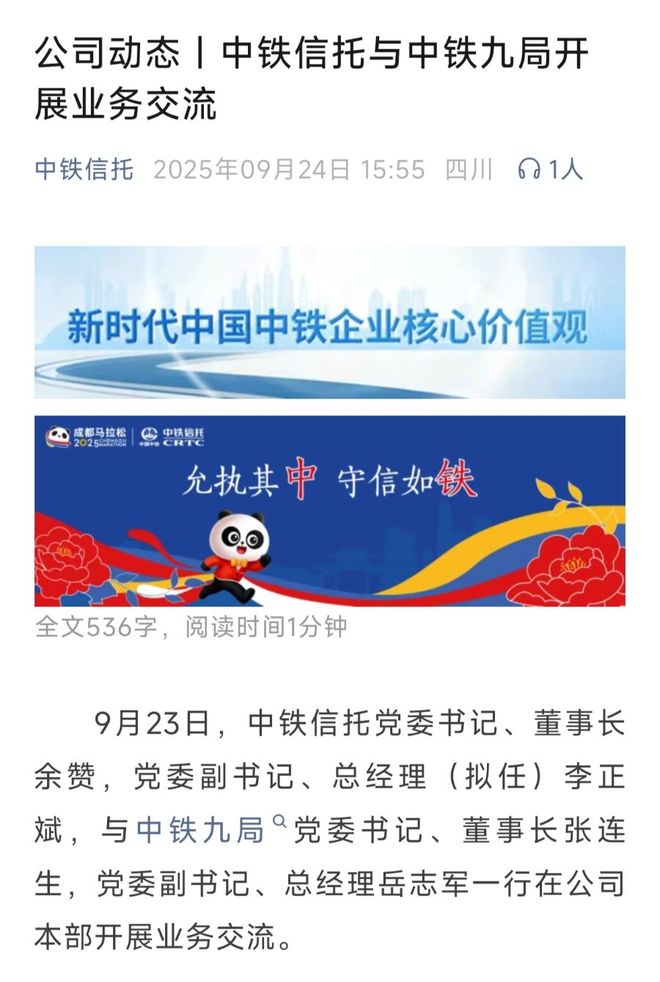
南方财经全媒体记者 林汉垚 正式担任中铁信托副总经理不足一年,李正斌被拟任中铁信托总经理。 近日,中铁信托官微消息显示,已拟任李正斌为其公司总经理。 据该公司官微,9月23日,中铁信托党委书记、董事长余赞,党委副书记、总经理(拟任)李正斌,与 中铁九局党委书记、董事长张连生,党委副书记、总经理岳志军一行在公司本部开展业务交流。 据了解,在拟任总经理前,李正斌于2024年9月23日正式获批担任中铁信托副总经理。 中铁信托控股股东中国中铁股份有限公司(A+H)是特大型央企集团,是全球最大建筑工程承包商之一, 业务范围涵盖了几乎所有基本建设领域。 简历显示,李正斌历任中铁二局机筑处会计员、助理会计师、会计师、财务部副部长,重庆垫忠高速公 路有限公司财务总监,中铁信托财务中心副总经理、总经理,中铁信托总会计师,中铁信托党委委员、 工会主席、职工董事等职。 另外,据证券时报报道,中铁信托前任总经理陈赤已于今年4月转任中铁城投、中铁开投专职外部董 事。 履历显示,陈赤历任西南财经大学政治经济学教研室副主任,四川省信托投资公司峨眉山办事处总经理 助理,衡平信托有限责任公司总经理助理。中铁信托副总经理、董事会秘书、总经理等职 ...
信托、理财、保险资管机构管理资产近100万亿;不动产信托登记扩围;中信信托被冒名|周报
Zheng Quan Shi Bao· 2025-09-26 09:17
Group 1 - The total assets managed by trust, wealth management, and insurance asset management institutions have reached nearly 100 trillion yuan, doubling since the end of the 13th Five-Year Plan [1] - The banking and insurance sectors have total assets exceeding 500 trillion yuan, with an average annual growth rate of 9% over the past five years, solidifying their positions as the largest credit and second-largest insurance markets globally [1] - Tianjin has launched a pilot program for real estate trust property registration, with the first project involving a commercial property valued at 3 million yuan [1] Group 2 - Zhongtie Trust announced the appointment of Li Zhengbin as the proposed general manager, indicating a leadership change within the company [1] - Zhongyuan Trust has received approval for a capital increase to 5 billion yuan, with an additional investment of approximately 724 million yuan from Henan Investment Group [1] - Huaxin Trust reported a signing rate of 95.5% for the transfer of trust beneficiary rights to Anding Company, with the signing window set to close on September 25, 2025 [1] Group 3 - Citic Trust has been involved in a case of identity misrepresentation regarding its participation in the shareholder registration of Xiamen Shiga Mountain Sea Technology Company [2] - Jianyuan Trust has made a new equity investment through the establishment of a private equity fund with a capital contribution of 3.44 billion yuan [2] - Everbright Trust is planning to transfer development rights for a city renewal project in Shenzhen's Guangming District [2]

从北上广到天津:不动产信托登记试点扩容 制度创新加速
Jing Ji Guan Cha Bao· 2025-09-26 04:11
Core Insights - The article discusses the expansion of real estate trust property registration trials in China, with Tianjin becoming the fifth city to join this initiative, following Beijing, Shanghai, Guangzhou, and Xiamen [1][2] Group 1: Policy and Implementation - Tianjin's local financial management bureau, along with several national and local authorities, issued a notification to officially start the real estate trust property registration trial [1] - The notification includes innovative institutional designs aimed at ensuring the registration process is standardized, accurate, and complete, thereby protecting the legal rights of trust parties [1] - The trial aims to promote the implementation of service industry expansion policies and create replicable experiences in real estate trust property registration [1] Group 2: Innovation and Integration - Tianjin's trial uniquely integrates the advantages of the Tianjin Free Trade Zone with the real estate trust property registration system, creating a new framework that includes dual scenarios for holding and purchasing, innovative asset revitalization applications, dual processes for transfer in and out, and multi-departmental collaboration [1] - This innovative system is designed to better serve the real economy and meet public needs [1] Group 3: Timeline and Progress - The article notes that other cities have also initiated real estate trust registration trials, with Beijing starting in late 2024, followed by Shanghai, Guangzhou, and Xiamen in 2025 [2] - The addition of Tianjin brings the total number of cities participating in the trial to five [2]
服务链条延伸 不动产信托财产登记试点再扩容
Zheng Quan Ri Bao· 2025-09-25 23:52
Core Viewpoint - The pilot program for real estate trust property registration has expanded to five cities, including Tianjin, following Beijing, Shanghai, Guangzhou, and Xiamen, indicating a significant move towards enhancing the real estate trust framework in China [1][2]. Group 1: Expansion of Pilot Cities - The pilot program for real estate trust property registration is accelerating, with Tianjin joining the initiative, bringing the total number of participating cities to five [2]. - The pilot program began in Beijing at the end of 2024, with successful registrations occurring in various districts by different trust companies [2]. - The new notification from Tianjin introduces innovative mechanisms, such as allowing trustees to purchase real estate, thus catering to diverse client needs and enhancing asset management capabilities [2]. Group 2: Addressing Pension Issues - The expansion of the pilot cities highlights the potential of real estate trusts in addressing pension challenges, particularly in the context of an aging population [3][4]. - The registration process has been clarified, which helps resolve ownership issues related to real estate as trust property, thereby facilitating the transfer of assets into trusts [3]. - Real estate trusts can activate existing assets to provide funding for elderly care, while the asset isolation feature of trusts protects the financial interests of older adults [3]. Group 3: Service Chain Extension - The increasing demand for elder care services due to population aging has prompted trust companies to explore innovative service models [4]. - Real estate trusts can lower pension costs and improve asset utilization and returns, contributing to the development of the elder care industry and optimizing wealth management [4]. - Several trust companies are actively promoting real estate trust services, particularly in the elder financial sector, aiming to create a comprehensive ecosystem involving various financial and elder care institutions [5].
不动产信托财产登记试点再扩容
Zheng Quan Ri Bao· 2025-09-25 23:25
Core Viewpoint - The pilot program for real estate trust property registration has expanded to five cities, including Tianjin, indicating a significant move towards utilizing real estate trusts as a tool for addressing aging population issues and enhancing wealth management [1][2]. Group 1: Expansion of Pilot Program - The pilot program for real estate trust property registration has accelerated, with Tianjin joining Beijing, Shanghai, Guangzhou, and Xiamen [2]. - The new regulations introduced in Tianjin allow for innovative methods of real estate trust registration, including the option for trustees to purchase real estate, thus catering to diverse client needs [2][3]. - The pilot program aims to enhance the flexibility of real estate trusts by broadening the range of beneficiaries [2]. Group 2: Addressing Aging Population Needs - Real estate trusts are seen as a viable solution for addressing the financial needs of the aging population by unlocking existing assets and providing a source of retirement funding [3][4]. - The property transfer and trust registration model aims to clarify ownership rights, thereby protecting the interests of beneficiaries [3]. - The integration of real estate trusts into the retirement planning landscape is expected to improve asset utilization and reduce costs compared to traditional retirement methods [4]. Group 3: Industry Innovations and Services - Several trust companies are actively promoting real estate trust services, particularly in the context of retirement finance [5]. - Companies like Shanghai Trust and Aijian Trust are innovating their business models to include comprehensive services that connect real estate trusts with quality retirement institutions [5]. - Aijian Trust is focusing on a "house-for-pension" model that maintains elderly individuals' control over their properties while providing integrated financial and retirement services [5].
不动产信托财产登记试点再扩容 继北京、上海、广州、厦门先后开展不动产信托财产登记试点后 天津也加入了试点行列
Zheng Quan Ri Bao· 2025-09-25 17:47
Core Viewpoint - The pilot program for real estate trust property registration has expanded to five cities, including Tianjin, which joins Beijing, Shanghai, Guangzhou, and Xiamen, indicating a significant acceleration in the implementation of real estate trusts as a tool for asset management and elder care [1][2]. Group 1: Expansion of Pilot Cities - The pilot program for real estate trust property registration has been accelerated, with Tianjin becoming the fifth city to join after Beijing, Shanghai, Guangzhou, and Xiamen [2]. - The new regulations introduced in Tianjin include innovative mechanisms such as allowing trustees to purchase real estate, catering to diverse client needs and enhancing asset management capabilities [2][3]. Group 2: Addressing Elderly Care Issues - Real estate trusts are increasingly recognized for their potential to address elderly care challenges by unlocking existing assets to provide financial support for retirement [3][4]. - The registration process for real estate trusts has been clarified in pilot cities, facilitating the transfer of property into trusts and ensuring the protection of beneficiaries' rights [3]. Group 3: Service Chain Extension - The growing demand for elderly care services amid an aging population has prompted trust companies to explore innovative service models, enhancing asset utilization and efficiency [4][5]. - Companies like Aijian Trust are developing integrated solutions that combine real estate trusts with various elder care services, aiming to create a comprehensive support system for the elderly [5].
不动产信托财产登记试点再扩容 继北京、上海、广州、厦门先后开展不动产信托财产登记试点后,天津也加入了试点行列
Zheng Quan Ri Bao· 2025-09-25 17:14
Core Viewpoint - The pilot program for real estate trust property registration has expanded to five cities, including Tianjin, indicating a significant move towards enhancing the application of real estate trusts, particularly in addressing pension needs amid an aging population [1][2][3]. Group 1: Expansion of Pilot Cities - The pilot program has accelerated, with Tianjin joining Beijing, Shanghai, Guangzhou, and Xiamen, increasing the total number of pilot cities to five [2]. - The new notification from Tianjin introduces innovative mechanisms, such as allowing trustees to purchase real estate, which caters to diverse client needs and enhances asset management capabilities [2][3]. Group 2: Addressing Pension Issues - Real estate trusts are gaining attention for their potential to address pension challenges, as they can activate existing assets to provide funding for elderly care [3][4]. - The registration process has been clarified in pilot cities, which helps in resolving ownership issues and ensures the protection of beneficiaries' rights [3][4]. Group 3: Service Chain Extension - The growing demand for elderly care services has prompted trust companies to explore innovative service models, which can lower costs and improve asset utilization [4][5]. - Companies like Aijian Trust are developing integrated solutions that combine real estate trusts with various elderly care services, aiming to enhance the quality of life for seniors [5].