
建筑材料

Search documents
砀山翔禾建筑材料有限公司成立 注册资本100万人民币
Sou Hu Cai Jing· 2025-09-13 01:58
Core Insights - A new company, Zhangshan Xianghe Building Materials Co., Ltd., has been established with a registered capital of 1 million RMB [1] - The legal representative of the company is Zou Dafan [1] Business Scope - The company is involved in various licensed projects including construction labor subcontracting and construction engineering [1] - General business activities include labor services (excluding labor dispatch), sales of building decoration materials, processing of building stones, and sales of construction materials [1] - The company also engages in the rental of construction machinery and equipment, earthwork engineering, sales of building blocks, lightweight building materials, waterproofing materials, metal fittings for construction, steel products, ceramic products, and cement products [1] - Additional services include building cleaning and landscaping engineering [1]
无锡谯慧建筑材料有限公司成立 注册资本5万人民币
Sou Hu Cai Jing· 2025-09-13 01:24
Core Insights - A new company, Wuxi Qiaohui Building Materials Co., Ltd., has been established with a registered capital of 50,000 RMB [1] Company Overview - The legal representative of the company is Sun Chao [1] - The company’s business scope includes the sale of various building materials, such as construction materials, decorative materials, lightweight building materials, and concrete products [1] - Additional activities include the sale of waterproof materials, insulation materials, metal products, and sales agency services [1] Industry Activities - The company is also involved in the leasing of construction machinery and equipment, as well as providing technical services, development, consulting, and technology transfer [1] - The operations are conducted under the premise of legal compliance, as the company is authorized to carry out business activities based on its business license [1]
泰州鑫瀚建筑材料有限公司成立 注册资本200万人民币
Sou Hu Cai Jing· 2025-09-13 01:24
Group 1 - A new company, Taizhou Xinhang Building Materials Co., Ltd., has been established with a registered capital of 2 million RMB [1] - The legal representative of the company is Chen Zhengyan [1] - The business scope includes sales of various building materials, including general building materials, decorative materials, lightweight materials, and ecological environment materials [1] Group 2 - The company is also involved in the sales of non-metallic minerals and products, as well as logistics services such as unloading and domestic cargo transportation agency [1] - The company operates under the principle of conducting business activities independently with its business license, except for projects that require approval [1]
宿迁市灵珀机电设备有限公司成立 注册资本5万人民币
Sou Hu Cai Jing· 2025-09-12 23:28
Core Viewpoint - A new company, Suqian Lingpo Electromechanical Equipment Co., Ltd., has been established with a registered capital of 50,000 RMB, focusing on a wide range of sales and services in the mechanical and construction sectors [1] Company Overview - The legal representative of the company is Ni Ningbo [1] - The registered capital of the company is 50,000 RMB [1] Business Scope - The company engages in the sale of various products including mechanical equipment, building materials, molds, plastic products, metal structures, daily necessities, and hardware [1] - Additional services include information consulting (excluding licensed consulting services), cement products sales, coatings sales (excluding hazardous chemicals), furniture manufacturing, and window sales [1] - The company also offers services in equipment repair, labor services (excluding labor dispatch), and cleaning services for buildings [1] - The sales range extends to agricultural machinery, electronic products, rubber products, and lighting fixtures, among others [1]
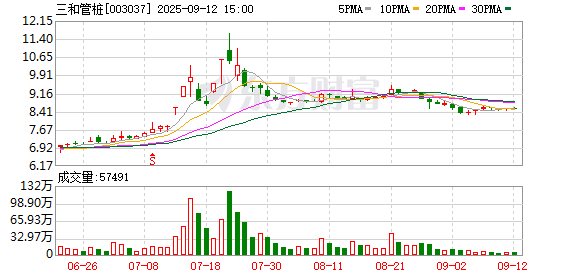
三和管桩最新筹码趋于集中
Zheng Quan Shi Bao Wang· 2025-09-12 13:09
Core Points - The company Sanhe Pile disclosed that as of September 10, the number of shareholders was 36,315, a decrease of 2,245 from the previous period (August 31), representing a decline of 5.82% [2] - The closing price of Sanhe Pile was 8.49 yuan, down 0.59%, with a cumulative decline of 2.53% since the concentration of shares began, showing 5 days of increases and 5 days of decreases [2] - The company's semi-annual report indicated that for the first half of the year, it achieved operating revenue of 3.039 billion yuan, a year-on-year increase of 11.31%, and a net profit of 66.444 million yuan, a year-on-year increase of 3,433.46%, with basic earnings per share of 0.1114 yuan and a weighted average return on equity of 2.39% [2]


山东中行以高质量跨境金融服务助推高水平对外开放
Zhong Guo Jin Rong Xin Xi Wang· 2025-09-12 12:35
Core Viewpoint - The China Bank Shandong Branch is enhancing its financial support for foreign trade enterprises in alignment with the national "stabilizing foreign trade" strategy, focusing on innovative cross-border financial services to facilitate international business operations [1] Group 1: Financial Support and Services - The Shandong Bank is actively providing financial support to foreign trade enterprises, implementing precise measures and innovative solutions to enhance cross-border financial services [1] - A pharmaceutical export company in Dongying successfully utilized the "Wide Range Treasure" options strategy to hedge against USD depreciation risks, processing 44 transactions worth $620 million in 2024, mitigating over 6 million yuan in exchange losses [2] - The efficiency of fund turnover for the pharmaceutical company improved by 40% due to streamlined cross-border payment processes facilitated by the Shandong Bank [2] Group 2: Cross-Border Financial Services - The Mingtou Group, specializing in construction materials, anticipates a 10% increase in export volume this year, attributing this growth to the support from China Bank's cross-border services [3] - The Mingtou Group has processed over 3,000 cross-border receipts totaling more than $6.4 million in the first half of the year, benefiting from expedited payment services [3] - The bank's risk management capabilities, including a professional letter of credit review process, have helped Mingtou Group mitigate potential risks while expanding its customer base [4] Group 3: Innovations in Foreign Exchange Services - The Yantai Bank has integrated its market procurement trade platform "Yicaitong" with the cross-border remittance system, allowing for 24/7 automatic account crediting, significantly improving fund arrival efficiency [6] - Since the launch of the "Yicaitong" service, Yantai Bank has processed 1,138 transactions worth $17.8 million, enhancing the operational efficiency of market participants [6] - The bank has implemented a "fee reduction + exchange rate optimization" strategy to alleviate the financial burden on small and micro enterprises, resulting in significant cost savings and increased profitability [7]
泸州古蔺佰旭建筑材料有限公司成立 注册资本10万人民币
Sou Hu Cai Jing· 2025-09-12 08:25
Group 1 - A new company, Luzhou Gulin Baixu Building Materials Co., Ltd., has been established with a registered capital of 100,000 RMB [1] - The legal representative of the company is Wei Youcai [1] - The company's business scope includes construction labor subcontracting, urban construction waste disposal, and building demolition operations (excluding blasting operations) [1] Group 2 - The company is authorized to engage in various general projects such as sales of building materials, masonry sales, lightweight building materials sales, sales of construction steel products, brick and tile sales, sales of coatings (excluding hazardous chemicals), sales of cement products, and sales of asbestos cement products [1] - The company will operate independently based on its business license, except for projects that require approval from relevant authorities [1]
长沙晶岩石材有限公司成立 注册资本80万人民币
Sou Hu Cai Jing· 2025-09-12 04:43
Core Viewpoint - Changsha Jingyan Stone Co., Ltd. has been established with a registered capital of 800,000 RMB, indicating a new player in the construction and building materials industry [1] Company Summary - The legal representative of Changsha Jingyan Stone Co., Ltd. is Liu Jun [1] - The company has a registered capital of 800,000 RMB [1] - The business scope includes construction engineering contracting, building labor subcontracting, and various sales of construction materials and related services [1] Industry Summary - The company is involved in multiple sectors including construction materials sales, building decoration materials sales, and flooring sales [1] - It also offers technical services, development, consulting, and project management services [1] - The company engages in the sale of metal products, furniture accessories, hardware products, optical cables, and anti-corrosion materials [1]
江西鹏腾材料有限公司成立 注册资本100万人民币
Sou Hu Cai Jing· 2025-09-12 02:49
天眼查App显示,近日,江西鹏腾材料有限公司成立,法定代表人为徐涛,注册资本100万人民币,经 营范围为许可项目:建设工程设计,住宅室内装饰装修,公路管理与养护,路基路面养护作业,建筑物 拆除作业(爆破作业除外),城市建筑垃圾处置(清运),建设工程质量检测(依法须经批准的项目, 经相关部门批准后在许可有效期内方可开展经营活动,具体经营项目和许可期限以相关部门批准文件或 许可证件为准)一般项目:建筑材料销售,轻质建筑材料销售,建筑装饰材料销售,建筑用钢筋产品销 售,建筑防水卷材产品销售,隔热和隔音材料销售,建筑工程机械与设备租赁,园林绿化工程施工,工 程管理服务,土石方工程施工,机械设备租赁,建筑砌块销售,装卸搬运,电力电子元器件销售,服装 服饰批发,五金产品批发,软件开发,厨具卫具及日用杂品批发,劳动保护用品销售,安防设备销售, 消防器材销售,风动和电动工具销售,环境保护专用设备销售,办公用品销售,照明器具销售,泵及真 空设备销售,电气设备销售(除依法须经批准的项目外,凭营业执照依法自主开展经营活动)。 ...
盘中利好传来,海南自贸区板块拉升
Di Yi Cai Jing Zi Xun· 2025-09-12 02:41
Core Viewpoint - The Hainan Free Trade Zone sector experienced a significant surge, with Haiqi Group hitting the daily limit, alongside other companies like Haima Automobile and Hainan Highway, following news of potential tax policy adjustments for duty-free goods aimed at enhancing residents' benefits [1] Group 1: Market Reaction - Hainan Free Trade Zone stocks, including Haiqi Group, Haima Automobile, and Hainan Highway, saw substantial gains, indicating strong market optimism regarding upcoming policy changes [1] - The surge in stock prices reflects investor confidence in the potential for increased consumer spending and economic activity within the region [1] Group 2: Policy Developments - National authorities are conducting research on tax policies for duty-free goods to enhance the purchasing power of local residents, which is expected to have a broad impact [1] - A new round of optimization and adjustment of the offshore duty-free policy is underway, aimed at increasing the attractiveness of the policy and promoting the return of overseas consumption [1]


