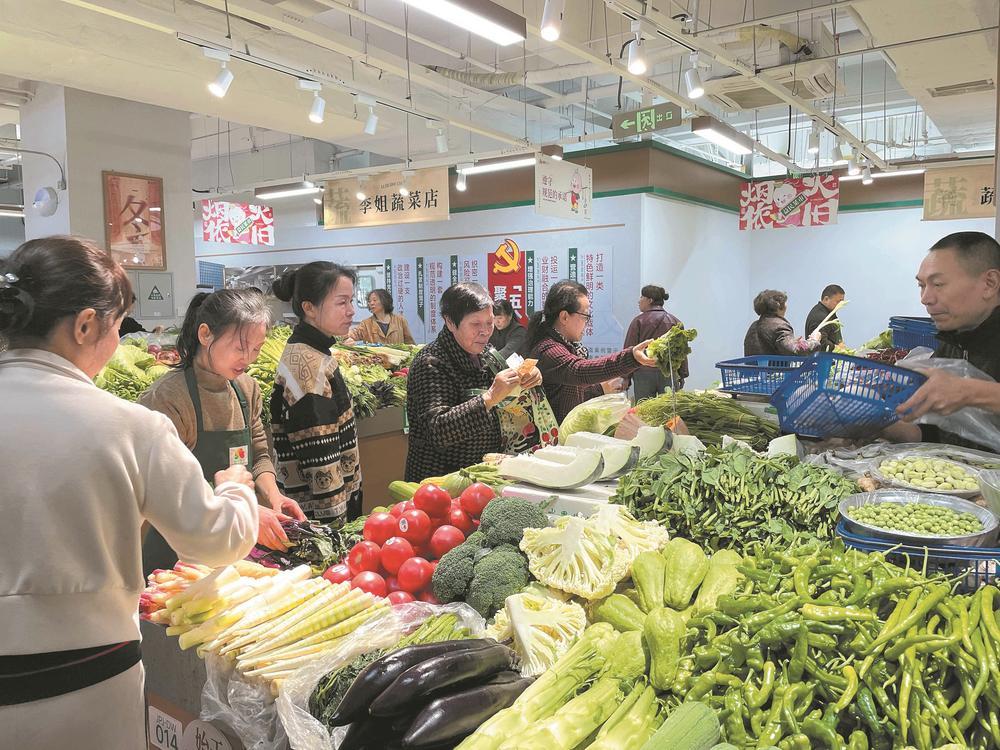
农产品生产与流通

Search documents
国家发展改革委等部门部署民生商品保供稳价 “米袋子”“菜篮子”量足价稳
Zheng Quan Ri Bao Wang· 2026-02-12 01:45
Core Insights - The National Development and Reform Commission (NDRC) has emphasized the importance of ensuring stable supply and prices for essential goods during the upcoming Spring Festival, collaborating with various ministries to implement measures for market stability and support for vulnerable populations [1][2] Group 1: Supply Assurance - The NDRC is focusing on enhancing agricultural production and logistics to ensure sufficient supply of essential goods, particularly vegetables, by improving crop management and increasing stock levels in wholesale markets and supermarkets [1] - A "green channel" policy for the transportation of fresh agricultural products is being implemented to facilitate logistics and address any transportation issues [1] Group 2: Price Stability - The government will release reserves of vegetables and other essential goods to meet consumer demand ahead of the Spring Festival, while also promoting fair pricing through community stores and supermarkets [1] - Market supervision will be strengthened to prevent price gouging and ensure compliance among vendors [1] Group 3: Support for Vulnerable Populations - There will be ongoing monitoring and support for low-income households and individuals facing financial difficulties, including timely disbursement of social assistance funds [2] - A mechanism linking social assistance standards to inflation is being prepared to prevent poverty and ensure adequate support for those in need [2] Group 4: Overall Market Conditions - The production of essential goods is reported to be strong, with grain production exceeding 1.4 trillion jin for two consecutive years, and meat production surpassing 100 million tons [2] - The supply of vegetables is expected to increase due to expanded planting areas and improved logistics, contributing to a stable market environment during the festive season [2]
国家发改委、民政部、交通运输部、农业农村部、商务部、市场监管总局,联合印发通知
Xin Jing Bao· 2026-02-11 08:26
Group 1 - The National Development and Reform Commission (NDRC) is analyzing the supply and price situation of essential goods, focusing on ensuring sufficient supply and stable prices for the upcoming Spring Festival [1][2] - Collaboration among various departments, including the Ministry of Civil Affairs, Ministry of Transport, Ministry of Agriculture and Rural Affairs, Ministry of Commerce, and the State Administration for Market Regulation, is emphasized to enhance the supply chain and price stability [1] - Measures include increasing the production of fast-growing leafy vegetables, ensuring smooth logistics, and implementing a "green channel" policy for fresh agricultural products to facilitate transportation [1] Group 2 - The government is focusing on supporting vulnerable groups, including low-income families and those facing financial difficulties, by monitoring their needs and providing timely assistance [2] - A mechanism linking social assistance standards to price increases is being prepared to prevent poverty and ensure that support is adequate [2] - The overall production of essential goods is strong, with grain production exceeding 1.4 trillion jin for two consecutive years, and meat production surpassing 100 million tons, indicating a solid foundation for market stability during the Spring Festival [2]
沈阳全力保障春节期间“菜篮子”量足价稳
Zhong Guo Xin Wen Wang· 2026-02-07 11:04
Core Viewpoint - Shenyang is strengthening its agricultural supply chain to ensure sufficient, stable, and high-quality food supply during the upcoming Spring Festival, focusing on modern urban agriculture and effective logistics systems [1][2][3]. Group 1: Agricultural Production - Shenyang aims to achieve a vegetable production of 4.337 million tons by 2025, representing a year-on-year increase of 3.7%, marking a historical high [1]. - The city is developing facility agriculture, with an area of 252,000 acres, the largest in Liaoning Province, to enhance local winter vegetable supply [1]. Group 2: Supply Chain and Logistics - A comprehensive distribution network is being established, centered around large wholesale markets, regional markets, and retail terminals, ensuring easy access to agricultural products within a 15-minute living circle [2]. - Cold chain logistics are prioritized to reduce losses during transportation and maintain the quality of fresh products, supporting the supply of off-season vegetables and premium fruits [2]. Group 3: Food Safety and Quality Control - A full-chain quality safety supervision system is in place, enhancing quality control at production stages and increasing inspection frequency during critical periods [2][3]. - A price monitoring network has been established to track prices of essential goods daily, allowing for timely responses to market fluctuations [3][4].
储备充足价格平稳 “菜篮子”有保障
Xin Lang Cai Jing· 2026-01-05 20:49
Core Viewpoint - The agricultural supply in Chengdu is stable and sufficient, ensuring the availability of essential food products for the population during the winter season, despite adverse weather conditions [1][2]. Production Side - Chengdu has a diverse agricultural supply, including vegetables, meat, eggs, dairy, fruits, and fish, with significant production areas dedicated to various crops [1][2]. - The area of vegetable cultivation in Pengzhou is 267,000 acres, with over 20 major varieties expected to be available before the Spring Festival [1]. Market Side - The Chengdu Agricultural Wholesale Market operates efficiently, with a wide variety of agricultural products and stable prices, even during peak demand periods [2][3]. - The city has established a comprehensive distribution network consisting of three large wholesale markets, over 20 regional markets, more than 800 farmer's markets, and over 7,100 retail outlets [3]. Emergency Supply - Chengdu has implemented a plan to cultivate and support production bases that can ensure stable supply during emergencies, such as natural disasters or public events [4][5]. - The city maintains a stock that can meet normal sales for seven days, with over 1,200 vegetable emergency supply bases and over 1,400 meat emergency supply bases in place [5].