加氢站

Search documents
势银数据 | 2025年中国新建成加氢站94座,广东、山东位居全国前列
势银能链· 2026-01-23 04:12
Core Viewpoint - The article discusses the growth and development of hydrogen refueling stations in China, highlighting significant increases in construction and investment, particularly from state-owned enterprises, as part of the country's hydrogen energy infrastructure goals by the end of 2025 [2][5][15]. Group 1: Construction and Growth of Hydrogen Stations - By the end of December 2025, a total of 631 hydrogen stations will be built in China, with 94 new stations completed in 2025, representing a 25.3% increase compared to 2024 [2]. - The construction of liquid hydrogen refueling stations marks a significant breakthrough, with the first commercial integrated liquid hydrogen storage and refueling station in Panzhihua, Sichuan, achieving a daily refueling capacity of 500 kg [2]. - Guangdong and Shandong provinces lead in the number of newly built hydrogen stations, accounting for 26.3% of the total, while cities in demonstration clusters contribute 27.4% of new stations [5]. Group 2: Types and Capabilities of Hydrogen Stations - As of the end of 2025, integrated energy stations (oil-hydrogen, oil-gas-hydrogen) will constitute 38% of all built hydrogen stations, a shift from earlier independent hydrogen stations due to the push from major state-owned enterprises [8]. - The average daily refueling capacity of newly built hydrogen stations in 2025 is expected to remain at 1200 kg, with 500 kg stations being the market mainstream [10]. - The largest hydrogen station globally, located in Xinjiang, will have a design capacity of 10,000 kg per day, capable of serving up to 500 vehicles daily [10]. Group 3: Investment and Market Dynamics - Over 50% of the investment in hydrogen stations in 2025 comes from state-owned enterprises, reflecting the high costs and long payback periods associated with hydrogen station construction [15]. - Major companies like Sinopec and local sales companies account for 13.8% of newly built stations, indicating their significant role in the sector [15]. - The competitive landscape among hydrogen station equipment integrators shows that the top five companies hold a market share of 58.2%, indicating a trend towards consolidation and resource allocation to firms with core competencies [18].


加氢站:燃料电池车先锋军
2025-12-08 00:41
Summary of Hydrogen Station Industry Conference Call Industry Overview - The hydrogen station industry in China primarily adopts an external hydrogen supply model, with construction methods including standalone hydrogen stations and co-built stations. The main pressure level is 35 MPa, while 70 MPa technology is gradually maturing [1][3] - The core infrastructure of hydrogen stations includes compressors, hydrogen storage facilities, and refueling systems, with technology choices impacting operational efficiency and costs [1][4] Key Insights - The global number of hydrogen stations is continuously increasing, with significant growth in China. By the end of 2024, approximately 500 hydrogen stations are expected to be built in China. However, achieving the national target of 1,000 stations by 2025 may be challenging [1][5][7] - The cost of refueling varies significantly based on type and specifications, with large-scale effects being notable. The internal hydrogen production model can save transportation costs, but production costs remain high, necessitating a comprehensive consideration of scale and technological advancements to optimize economics [1][8] Economic Factors - Key factors affecting hydrogen project profitability include: - Hydrogen procurement costs, terminal prices, and the composite rate of hydrogen stations [1][9] - Current hydrogen retail prices are high, with government efforts aiming to reduce prices to below 35 yuan per kilogram by 2025, supported by subsidies [10] Government Support and Policy - Local governments provide financial subsidies and policy support for hydrogen station construction, typically covering 30% to 50% of investment costs. However, the lack of unified industry standards and regulatory frameworks poses challenges [10] - The operational composite rate of hydrogen stations is currently low due to the limited number of fuel cell vehicles, impacting efficiency and profitability [10] Future Development Focus - Future development priorities for hydrogen stations include: - Continuous policy support for infrastructure development - Monitoring the annual construction numbers of hydrogen stations to assess market expansion speed - Observing trends in procurement costs and terminal sales prices, which are closely related to the sales volume and ownership of fuel cell vehicles [11][12]
北交所定期报告20250818:北交所行情高涨,北证50与专精特新指数均创历史新高
Soochow Securities· 2025-08-18 13:27
Group 1: Capital Market News - The US government announced an expansion of the 50% tariff on steel and aluminum imports, including hundreds of derivative products, effective August 18, 2025 [6] - Japanese companies are expected to face a significant impact from US tariff policies, with a projected total operating profit decrease of 3.5 trillion yen for 42 major listed companies in the current fiscal year [7] Group 2: Industry News - The Ministry of Commerce extended the anti-subsidy investigation period for imported dairy products from the EU until February 21, 2026, due to the complexity of the case [8] - Guangdong Province released funding management guidelines for innovation projects in artificial intelligence and robotics, with a maximum support of 50 million yuan per project [9][10] - Beijing is set to implement measures to accelerate the application of photovoltaic technology in infrastructure, focusing on urban areas and rural projects [11] - Chongqing is planning to advance the construction of hydrogen stations and promote renewable energy hydrogen production, with a focus on integrating with existing energy infrastructure [12] Group 3: Market Performance - As of August 18, 2025, the North Exchange 50 Index rose by 6.79%, while the overall A-share market showed positive performance with the ChiNext Index up by 2.84% and the Shanghai Composite Index up by 0.85% [3.1] - The North Exchange had a total of 271 constituent stocks with an average market capitalization of 3.352 billion yuan and a trading volume of 45.464 billion yuan, an increase of 16.888 billion yuan from the previous trading day [3.2] Group 4: Company Announcements - Guohang Ocean announced the completion of registration for its Singapore subsidiary, focusing on dry bulk shipping and related services [22] - Lintai New Materials reported a 67.72% year-on-year increase in revenue for the first half of 2025, reaching 205 million yuan, with a net profit growth of 167.81% [23] - Qingju Technology achieved a revenue of 351 million yuan in the first half of 2025, marking a 2.39% increase year-on-year, with new contracts signed amounting to 658 million yuan, a 29.50% increase [24]
2025加氢站产业进展汇总
势银能链· 2025-05-23 03:26
Core Viewpoint - The growth rate of hydrogen refueling stations in China has slowed down significantly since 2024, contrasting sharply with the high growth rates of previous years. The promotion of hydrogen fuel cell vehicles is gradually unfolding, but large-scale application has not yet formed, directly impacting the utilization rate of hydrogen refueling stations. Currently, the online rate of hydrogen vehicles in demonstration city clusters is around 25%, while the online rate of hydrogen refueling stations is about 40% [2][3]. Summary by Sections Hydrogen Refueling Station Development - Since 2025, there has been a noticeable change in the development momentum of hydrogen refueling stations in China, with frequent progress reported in various aspects such as construction, acceptance, operation, and policy [3]. Hydrogen Vehicle and Refueling Station Statistics - Total hydrogen vehicles: 13,344, with 3,301 online (24.7% online rate) - Total hydrogen refueling stations: 139, with 56 online (40.3% online rate) - Specific city cluster statistics include: - Beijing-Tianjin-Hebei: 4,286 vehicles, 1,071 online (25.0% online rate), 27 stations, 15 online (55.6% online rate) - Shanghai: 4,079 vehicles, 960 online (23.5% online rate), 24 stations, 6 online (25.0% online rate) - Guangdong: 759 vehicles, 104 online (13.7% online rate), 24 stations, 8 online (33.3% online rate) - Hebei: 2,441 vehicles, 670 online (27.4% online rate), 25 stations, 6 online (24.0% online rate) - Zhengzhou: 1,779 vehicles, 498 online (28.0% online rate), 39 stations, 21 online (53.8% online rate) [3]. Progress in Construction and Operation of Hydrogen Refueling Stations - In May, the first hydrogen energy comprehensive energy station in Liupanshui, Guizhou, passed acceptance with a daily hydrogen refueling capacity of 2,000 kg [5]. - The hydrogen refueling station project at the Fuping service area on the Jingkun Expressway received approval for fire safety design, marking its entry into the construction phase [5]. - In April, the Rongcheng New Energy hydrogen refueling station officially commenced operations, supporting clean transportation for upstream and downstream steel products [5]. - The Sinopec Guizhou comprehensive energy station completed a green upgrade and began operations, serving as a key energy hub for the "hydrogen corridor" in the western region [5]. Certification and Qualification Progress - In May, the first phase of the wind-solar hydrogen integrated demonstration project in Jiujiang, Jiangxi, was approved, with a hydrogen production capacity of 400 Nm³/h and a refueling station capacity of 500 kg/d [9]. - The hydrogen refueling station on Pinghai Road in Suzhou became the first in Jiangsu to receive "carbon neutral" certification, having provided clean fuel for over 8,900 hydrogen buses [9]. Contractual Developments - In March, Hubei Guanggu East Holdings signed a contract with Sinopec for the operation of the Dazhong East comprehensive energy station, which will be the largest hydrogen refueling station in Hubei [11]. - Strategic cooperation agreements were signed between various companies to enhance collaboration in hydrogen refueling station construction, hydrogen sales, and logistics applications [11]. Policy Overview for Hydrogen Refueling Stations in 2025 - Various regions have introduced policies to support the construction of hydrogen refueling stations, including allowing construction outside chemical parks, encouraging partnerships between enterprises and research institutions, and providing financial subsidies for new and upgraded stations [13][14].

趋势研判!2025年中国撬装式加氢站行业产业链全景、行业现状、竞争格局及发展趋势分析:氢能补给新时代来临,撬装式加氢站构筑高效氢能网络[图]
Chan Ye Xin Xi Wang· 2025-05-16 01:16
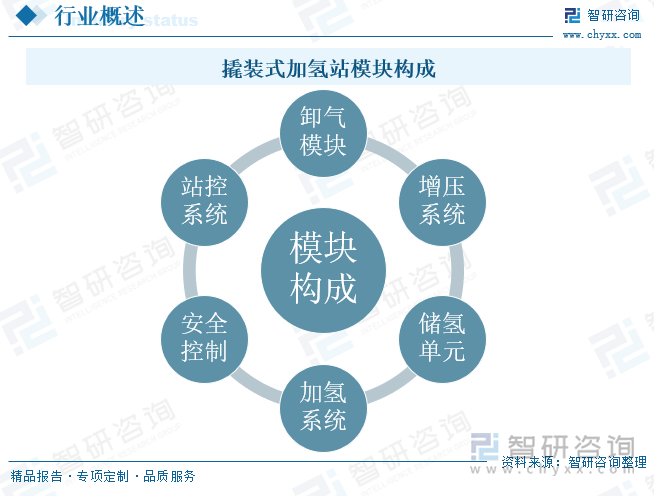
Core Insights - The portable hydrogen refueling station industry in China is currently in the market demonstration and promotion stage, leveraging its advantages of low-cost investment and rapid deployment to penetrate key operational scenarios for heavy fuel cell vehicles, such as port logistics and mining transportation [1][15] - The demand for portable stations is expected to surge as the number of fuel cell vehicles continues to rise, with projections indicating that by 2024, the cumulative number of portable hydrogen stations in China will exceed 190, accounting for 35% of the total hydrogen stations nationwide [1][15] - The "14th Five-Year Plan" for hydrogen energy is set to conclude in 2025, prompting accelerated construction efforts across various regions, with Guangdong province planning to establish 200 hydrogen stations by 2025, of which 40% are expected to be portable stations [1][15] Industry Overview - Portable hydrogen stations integrate multiple functional modules, such as hydrogen production, compression, storage, and refueling, into a movable shell, offering advantages like compact structure, low investment costs, and ease of operation and maintenance [2] - The industry is characterized by a collaborative ecosystem driven by upstream equipment manufacturing and hydrogen supply, midstream construction and operation services, and downstream applications in fuel cell vehicles [9][11] Technical and Economic Advantages - Portable hydrogen stations exhibit significant advantages in terms of technical economics, with a modular design that reduces land use to 1/3 to 1/2 of traditional fixed stations, and initial investment costs that are 30%-50% lower [5][8] - The rapid installation feature allows for a site commissioning period of just 1-2 weeks, greatly enhancing the efficiency of hydrogen infrastructure deployment [5][8] Competitive Landscape - The competitive landscape includes state-owned enterprises, private companies, and innovative firms, with major players like Sinopec and PetroChina leading the market due to their extensive fuel station networks and financial strength [17][20] - The industry is witnessing a shift towards regional development, with eastern regions focusing on commercial applications while central and western regions leverage green hydrogen resources [17][20] Future Trends - The portable hydrogen station industry is transitioning from policy pilot projects to large-scale applications, characterized by a combination of policy-driven initiatives, technological breakthroughs, and innovative business models [22] - Future developments will focus on integrating renewable energy sources, enhancing energy service capabilities, and fostering global collaboration within the industry [22][25]