
卫生陶瓷

Search documents
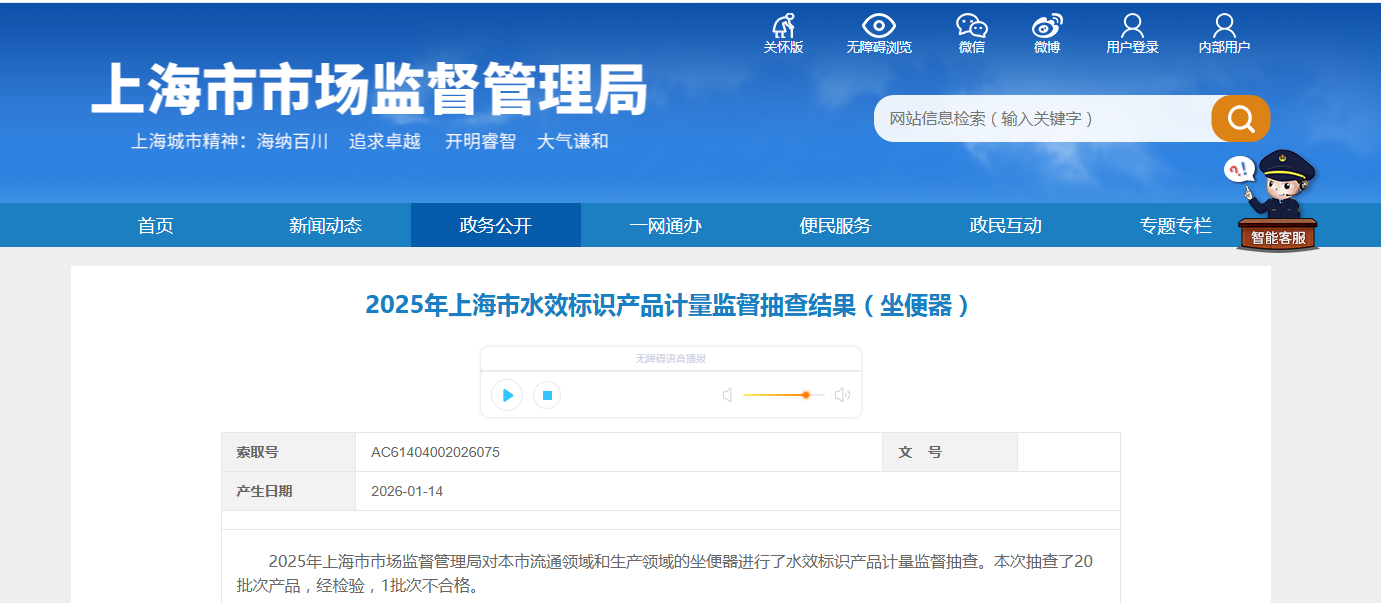
2025年上海市水效标识产品计量监督抽查结果(坐便器)公布
Zhong Guo Zhi Liang Xin Wen Wang· 2026-01-15 07:37
Core Insights - The Shanghai Municipal Market Supervision Administration conducted a water efficiency labeling product measurement supervision inspection for toilets in 2025, revealing that out of 20 batches tested, 1 batch was found to be non-compliant [1]. Group 1: Compliance Results - The inspection was based on the implementation details of the Shanghai energy efficiency and water efficiency labeling product measurement supervision inspection for toilets [1]. - A list of compliant products was provided, including various brands and models, with details on manufacturers and sales channels [1][2]. Group 2: Non-compliance Findings - The non-compliant product identified was a toilet manufactured by Shanghai Letao Kitchen and Bath Co., Ltd., which failed to meet the water flushing volume and water efficiency grade requirements [3]. - The specific model that did not pass the inspection was noted, highlighting the importance of adherence to water efficiency standards in the industry [3].

TOTO社长:中国业务26年度绝对实现盈利
日经中文网· 2026-01-11 00:33
Core Viewpoint - TOTO is shifting its business focus in China from new housing to the renovation market, following the closure of two ceramic factories in Beijing and Shanghai, resulting in the layoff of 1,000 employees [2][4]. Group 1: Business Strategy and Operations - The company has closed two ceramic factories in Beijing and Shanghai, laying off 1,000 employees, which was a difficult decision for the president [2][4]. - A total of 120 employees have been transferred to a new factory in Liaoning, and the company expects to achieve profitability in its China operations by 2026 despite stable sales figures [4]. - TOTO is introducing entry-level products while successfully guiding customers towards higher-end models during business negotiations [5]. Group 2: Environmental Initiatives - TOTO plans to focus on reducing carbon emissions in its main factory in Kitakyushu, Japan, by improving kiln efficiency and implementing a new method of burning a mixture of hydrogen and natural gas [5]. Group 3: Market Position and Collaborations - The company is part of the TDY Alliance with YKKAP and DAIKEN, which is currently discussing customer management strategies while maintaining the operational model of their joint showroom [7]. - TOTO has established a new ceramic factory in the U.S. for the first time in 30 years, focusing on automated production of high-value products tailored for the American market [7][8]. Group 4: Future Production Plans - A decision on local production of TOTO's washlet products in the U.S. will be made by 2030, with current exports coming from Thailand and Malaysia [8].

特朗普“关税大棒”砸向建材家具
Di Yi Cai Jing· 2025-09-26 15:34
Group 1 - The article discusses the recent announcement by President Trump regarding new tariffs on various imported products, including a 50% tariff on kitchen cabinets and a 30% tariff on imported furniture, effective from October 1 [2][3] - The potential impact of these tariffs on Southeast Asia and China's sanitary ceramics, finished furniture, and kitchen cabinet industries is highlighted, with expectations that U.S. consumers will bear most of the cost [3] - Historical data shows that China's finished furniture exports to the U.S. experienced a decline of 7% and 9% in April and May due to tariff factors, but rebounded with a 1.25% increase in June as tensions eased [3] Group 2 - Despite the high tariffs, Chinese sanitary products may still be priced lower than U.S. manufactured goods, as illustrated by a case where a Chinese showerhead priced at $129 would cost $239 if manufactured in the U.S. [4] - In 2024, China's sanitary ceramics exports are projected to reach 110 million units, with a total export value of $15.64 billion, making the U.S. the largest export destination [4] - The U.S. is the largest furniture import market globally, with an import value of $27.14 billion for the 2023-2024 fiscal year, heavily reliant on imports from Vietnam and China [5]

特朗普“关税大棒”砸向建材家具,业内人士称美国消费者将为此买单
Di Yi Cai Jing· 2025-09-26 14:03
Group 1 - The U.S. is highly dependent on imports for finished furniture and ceramic sanitary ware, with significant tariffs imposed on various imported products, including a 50% tariff on kitchen cabinets and a 30% tariff on imported furniture starting October 1 [1][4] - The impact of these tariffs is expected to be shared between exporters and U.S. consumers, with consumers likely bearing a larger portion of the cost [1][2] - In recent months, the export volume of Chinese finished furniture has fluctuated due to tariff impacts, with a 7% and 9% decline in April and May, respectively, but a recovery to a 1.25% increase in June as tensions eased [1] Group 2 - The U.S. remains the largest export destination for China's sanitary ceramics, with an export volume of 28.5 million pieces last year, and a total export value of $15.64 billion projected for 2024 [3] - In the first half of 2025, China's furniture industry is expected to have an export value of $34.92 billion, with the U.S. accounting for $8.04 billion, representing 23% of total exports [3] - The U.S. furniture import market is dominated by Vietnam, followed by China and Canada, with total imports projected at $27.14 billion for the 2023-2024 fiscal year [3][4]
内需逐步恢复建材运行“亮点”频现
Zhong Guo Chan Ye Jing Ji Xin Xi Wang· 2025-06-13 00:36
Group 1: Building Materials Industry Overview - The building materials industry in China is experiencing a significant recovery due to large-scale urban renewal projects, "old-for-new" consumer policies, and ongoing energy structure adjustments [1] - The industry serves various sectors including construction, new energy, new materials, electronics, and automotive [1] - The fiberglass and related products sector is identified as a key emerging industry, with production and economic performance showing strong recovery in early 2023 [1] Group 2: Fiberglass Sector Performance - From January to April 2023, the production of fiberglass, fiberglass cloth, and fiberglass reinforced composites increased by 2.6%, 12.5%, and 17.7% year-on-year, respectively [1] - The price index for fiberglass and composite materials rose by 2.5% year-on-year [1] - The revenue of the fiberglass sector increased by 18.3% year-on-year, while total profits surged by 120.0% [1] Group 3: Mica Products Sector Performance - The mica products industry, particularly in the context of the new energy vehicle sector, has shown continuous growth, driven by the demand for battery outer shells [1] - From January to April 2023, the factory price of mica products increased by 0.9%, with industry revenue rising by 23.8% and total profits increasing by 57.6% [1] Group 4: Insulation Materials Sector Performance - The insulation materials sector has also benefited from urban renewal policies, with production and profitability improving [2] - From January to April 2023, the production of insulation materials increased by 2.0%, while industry revenue grew by 5.6% and total profits rose by 0.8% [2] Group 5: Overall Building Material Consumption Trends - The building material consumption market has reversed the downward trend observed since 2022, with retail sales of construction and decoration materials increasing by 2.3% year-on-year in early 2023 [2] - In April 2023, the retail sales growth reached 9.7% year-on-year [2] - The sanitary ceramics sector reported a revenue increase of 1.7% and a profit growth of 6.8% from January to April 2023 [2]
河北:绿电支撑工业企业转型发展
Xin Hua She· 2025-05-28 13:17
Group 1 - Hebei province is focusing on the development of renewable energy, particularly wind and solar power, to support industrial transformation and upgrade [1][2] - The use of green electricity is becoming a competitive advantage for companies like Huida Sanitary Ware, which plans to consume 25.6 million kWh of green electricity in 2024, saving 3,146.24 tons of standard coal and reducing CO2 emissions by 8,463.39 tons [1] - Steel companies in the region, such as the Shougang Group's Qian'an Steel Company, are increasing their green electricity purchases, with plans to exceed 850 million kWh in 2024 [1][2] Group 2 - The government has set mandatory green electricity consumption targets for key industries like steel, making it a crucial driver for low-carbon transformation [2] - The Lynk & Co factory in Zhangjiakou has achieved 100% green electricity production since its inception and has been recognized as a national-level green factory [2] - Hebei Xinhuantong Transformer Manufacturing Co., a national high-tech enterprise, has been recognized as a national green factory in 2024, emphasizing the importance of green supply chains [2] Group 3 - The rapid integration of large-scale green electricity poses challenges for local power grid stability, necessitating advancements in equipment research and manufacturing [3] - The State Grid Shijiazhuang Power Supply Company has collaborated with Baoding Tianwei Baobian Electric Co. to develop a domestic first single-core phase-shifting transformer to address the impacts of high renewable energy penetration [3] - Industry leaders are urged to increase R&D investments in high-end equipment manufacturing and solutions for renewable energy integration [3]