
发电业

Search documents
先凑够电力再说:东南亚想接盘取代中国产业链,门儿都没有!
Sou Hu Cai Jing· 2026-01-02 07:15
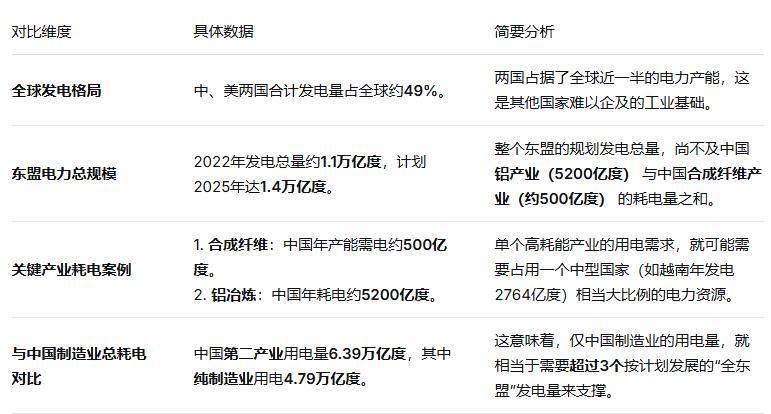
Group 1 - In 2023, China generated approximately 9.2 trillion kilowatt-hours of electricity, accounting for 34% of global electricity generation, while the US generated 4.5 trillion kilowatt-hours, making up 15% [1][8] - Together, China and the US account for nearly half of the world's electricity consumption, with the remaining 18 countries in the top 20 generating only about 49% combined [1][2] - The total electricity generation of ASEAN countries in 2022 was about 1.1 trillion kilowatt-hours, with a planned increase to 1.4 trillion kilowatt-hours by 2025, which is significantly lower than China's consumption in key industries [2][5] Group 2 - China's synthetic fiber industry produced 68.72 million tons in 2023, consuming about 500 billion kilowatt-hours of electricity, while the aluminum industry consumed 520 billion kilowatt-hours, surpassing the total electricity consumption of several major European countries [3][5] - Southeast Asian countries like Vietnam and Indonesia have significantly lower electricity generation, with Vietnam generating 2.764 trillion kilowatt-hours and Indonesia 1.85 trillion kilowatt-hours in 2023, highlighting the disparity in energy capacity [3][10] - The electricity demand for industries such as aluminum and automotive manufacturing in Southeast Asia would require a substantial increase in their current electricity generation capabilities, which is not feasible in the short term [5][11] Group 3 - China's manufacturing sector consumed 4.79 trillion kilowatt-hours in 2023, representing 52% of the country's total electricity generation, indicating the critical need for robust energy infrastructure to support industrial growth [6][11] - The current electricity supply in Southeast Asia is insufficient to support high-energy industries, with countries like Vietnam and Indonesia struggling to meet basic electricity needs [10][11] - The transition of industrial chains from China to Southeast Asia is not merely a logistical challenge but requires decades of investment in energy infrastructure to achieve comparable levels of electricity supply [11][12]

广东“护法”绿色发展:出台全国首个碳资产变现司法保障文件
2 1 Shi Ji Jing Ji Bao Dao· 2025-08-13 10:35
Core Viewpoint - Guangdong Province has introduced systematic judicial guarantees for carbon emission quota pledge financing, marking a significant step in promoting green finance and carbon asset monetization [1][5]. Group 1: Policy and Framework - The joint issuance of the "Opinions" by the Guangdong Provincial High Court, the Provincial Ecological Environment Department, and the People's Bank of China Guangdong Branch provides a structured legal framework for carbon emission quota pledge financing [1][5]. - The "Opinions" include 13 specific regulations addressing issues such as dispute resolution, emission reduction incentives, assessment supervision, and guarantee innovation, effectively overcoming key bottlenecks in the carbon asset financialization process [3][6]. Group 2: Market Impact and Financial Innovation - The introduction of the "Opinions" is expected to boost confidence among emission control enterprises and financial institutions in participating in carbon emission quota pledge financing [3][4]. - The policy encourages financial institutions to explore diversified financing scenarios, including annual pre-allocated quota guarantee financing, carbon sink future revenue rights pledge, and carbon asset securitization products [3][4]. Group 3: Historical Context and Current Developments - Guangdong has been developing carbon emission quota pledge financing for several years, with 34 transactions completed by July 2025, involving 849.97 million tons of pledged carbon emission rights and a total financing amount of 1.14 million yuan [3]. - The first carbon asset securitization pilot case in Guangdong was launched in July 2024, indicating a growing trend in carbon asset financing [4]. Group 4: Legal and Risk Management - The "Opinions" clarify that carbon emission quotas are legitimate pledge objects, establishing legal effectiveness upon registration on provincial trading platforms [6]. - A dual registration model combining the People's Bank of China movable property financing unified registration system and provincial trading platforms is introduced to mitigate asset transfer risks [6][7].