图形计算

Search documents
五一视界 摩尔线程:新一代仿真与GPU完成适配,共筑全栈国产化物理AI底座
Zhong Jin Zai Xian· 2026-02-24 07:06
Core Viewpoint - The new 2026 version of the "Access Review Requirements for Road Motor Vehicle Production Enterprises" mandates simulation verification capabilities, creating significant market opportunities for domestic simulation platforms and accelerating the autonomous driving industry's shift towards "self-controllable" solutions [1]. Group 1: Simulation Platform Development - 51Sim's next-generation autonomous driving simulation platform, SimOne 4.0, has successfully completed systematic adaptation and deep optimization on the MTT S5000 GPU, marking a significant advancement in domestic computing power and end-to-end intelligent driving simulation systems [1]. - The MTT S5000 GPU, designed for large model training and high-performance computing, boasts a maximum AI computing power of 1000 TFLOPS, 80GB of memory, and a memory bandwidth of 1.6TB/s, indicating a shift in the high-end GPU market previously dominated by foreign giants [2]. Group 2: Performance Metrics - The MTT S5000 GPU has demonstrated a performance increase of approximately 1.47 times in key precision metrics such as FP32, FP16, and INT8, and a leading margin of about 1.48 times in FP64 double precision computing [3]. - In real-world testing, the MTT S5000 outperformed international competitors in response speed during the "Prefill" phase, achieving up to a 14% advantage, and maintained robust throughput under high-pressure conditions [4]. Group 3: Ecosystem and Compliance - 51Sim has achieved comprehensive compatibility with mainstream domestic chip architectures, including ARM and x86, ensuring smooth deployment across various platforms, which is crucial for meeting stringent compliance requirements in sensitive industries [6]. - The company has adapted its products to work seamlessly with domestic operating systems, such as Kirin and UOS, enabling clients in sensitive sectors to utilize a fully self-controllable digital twin solution from chip to application [6]. Group 4: Industry Evolution - The collaboration with Moer Technology and the advancements in simulation verification capabilities signify a transformative phase for Chinese enterprises, moving from mere parameter benchmarking to establishing a strategic ecosystem [7]. - The performance of SimOne 4.0 indicates that domestic hardware and software solutions have surpassed the "usable" threshold and entered the "high-precision, high-load" phase, contributing to the formation of a robust, self-controllable physical AI ecosystem [7].


摩尔线程赢图形顶会3DGS挑战赛大奖 自研LiteGS全面开源
Di Yi Cai Jing· 2025-12-17 12:14
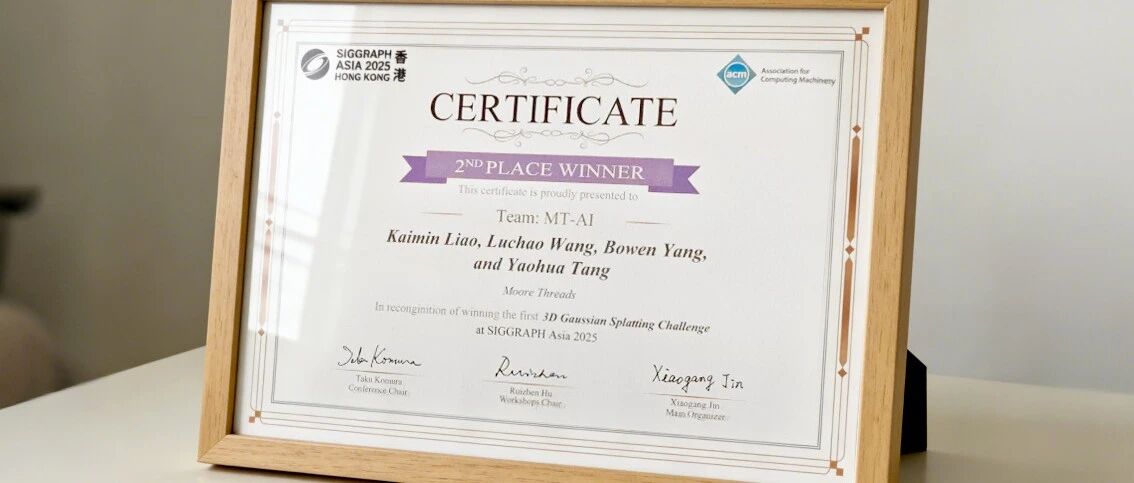
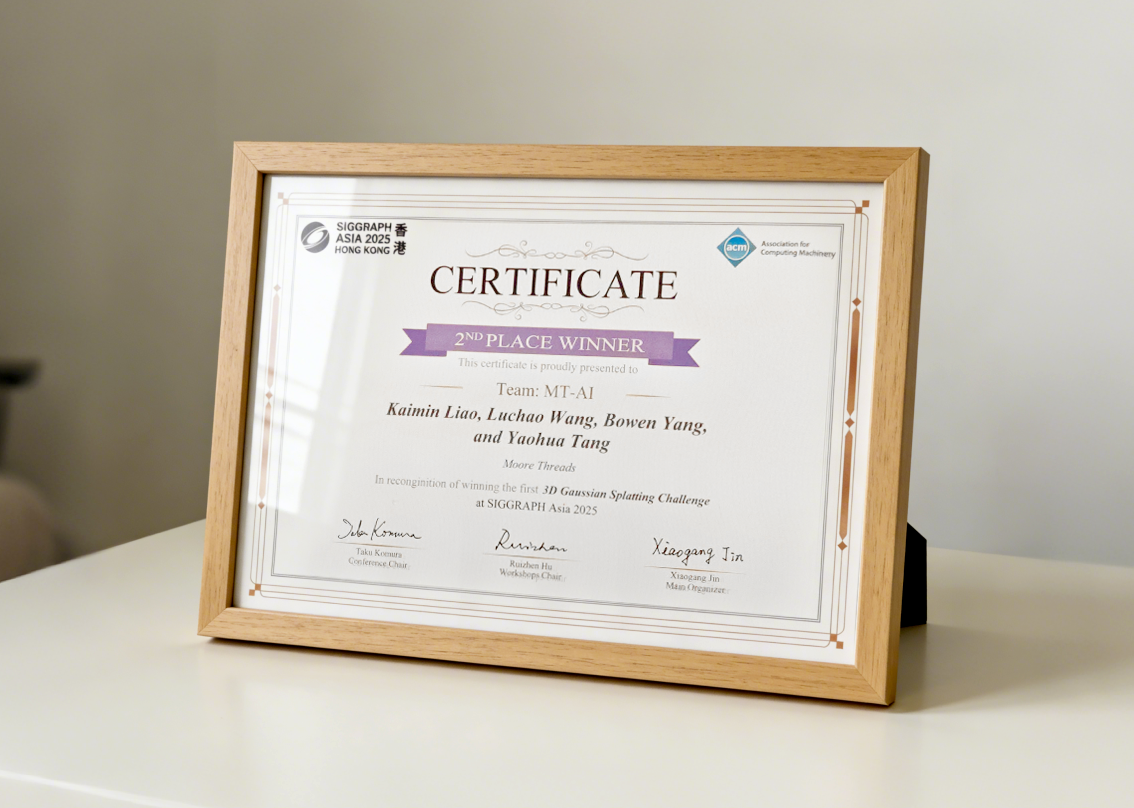
Core Insights - The article highlights the achievement of Moore Threads at the SIGGRAPH Asia 2025 conference, where the company won a silver medal in the 3D Gaussian Splatting Reconstruction Challenge with its proprietary technology LiteGS, showcasing its strength in next-generation graphics rendering technology [1][18]. Group 1: 3D Gaussian Splatting Technology - 3D Gaussian Splatting (3DGS) is a revolutionary 3D scene representation and rendering technology that offers a remarkable balance between image quality, efficiency, and resource usage, significantly outperforming traditional NeRF by enhancing rendering efficiency by hundreds to thousands of times while maintaining realistic rendering quality [3][5]. - The technology has shown strong adaptability and scalability in areas such as ray tracing, real-time rendering for VR/AR, and multi-modal fusion, making it a key focus for both academia and industry [5]. Group 2: Competition Details - The 3DGS Reconstruction Challenge required participants to complete high-quality 3DGS reconstruction within 60 seconds using real terminal video sequences and imperfect camera trajectories, with PSNR and reconstruction speed as evaluation metrics [6]. - The results of the challenge have been made publicly available, allowing for transparency and authority in the rankings [6]. Group 3: Moore Threads' Performance - Moore Threads' AI team, competing under the identifier "MT-AI," achieved an average PSNR of 27.58 and a reconstruction time of 34 seconds, placing them among the top three teams in the competition [7][8]. - The company’s performance reflects its leading capabilities in 3DGS algorithm construction and hardware-software optimization [7]. Group 4: LiteGS Development - Moore Threads has developed the LiteGS library, which optimizes the training process of 3DGS, achieving significant improvements in training efficiency and reconstruction quality through a full-stack optimization approach [9][10]. - LiteGS can achieve up to 10.8 times training acceleration while reducing parameter count by over 50%, demonstrating its practical engineering applicability [15]. Group 5: Open Source and Future Directions - LiteGS has been fully open-sourced on GitHub to promote collaborative development and continuous evolution in 3D reconstruction and rendering technologies [18]. - The company plans to discuss the implications of 3DGS and other graphics intelligence technologies at the upcoming MUSA Developer Conference, emphasizing their role in advancing embodied intelligence and other cutting-edge fields [18].
摩尔线程算法一鸣惊人,图形学顶会夺银!已开源
量子位· 2025-12-17 09:07
Core Viewpoint - Moore Threads won the silver medal at the 3D Gaussian Splatting Reconstruction Challenge (3DGS Challenge) during SIGGRAPH Asia 2025, showcasing its advanced algorithm capabilities and hardware-software optimization in next-generation graphics rendering technology [1][2][13]. Group 1: 3D Gaussian Splatting Technology - 3D Gaussian Splatting (3DGS) is a revolutionary 3D scene representation and rendering technology proposed in 2023, achieving an exceptional balance between image quality, efficiency, and resource usage [4]. - Compared to traditional Neural Radiance Fields (NeRF), 3DGS significantly enhances rendering efficiency by hundreds to thousands of times while maintaining realistic rendering quality, demonstrating strong adaptability in ray tracing, VR/AR real-time rendering, and multi-modal fusion [4][6]. - 3DGS is becoming a key foundational technology in embodied AI training scenarios, providing reliable support for accurate world modeling, enhancing path planning, environmental perception, and complex task execution [7][8]. Group 2: Competition and Performance - The 3DGS Challenge required participants to complete high-quality 3DGS reconstruction within 60 seconds using real terminal video sequences and SLAM point clouds, with PSNR and reconstruction speed as evaluation metrics [9][10]. - Moore Threads achieved an average PSNR of 27.58 and a reconstruction time of 34 seconds, ranking third overall and significantly outperforming many teams [15][16]. Group 3: LiteGS Development - Moore Threads developed the LiteGS foundational library to optimize the training process of 3DGS, achieving a significant reduction in training time and parameter count while maintaining high reconstruction quality [17][20]. - LiteGS can achieve up to 10.8 times training acceleration and reduce parameter count by over 50%, while also exceeding mainstream solutions in PSNR by 0.2–0.4 dB [20][21]. - LiteGS has been fully open-sourced on GitHub to promote collaboration and continuous evolution in 3D reconstruction and rendering technology [23]. Group 4: Strategic Implications - The success at the international graphics competition reflects Moore Threads' ability to grasp global technology trends and lead the future direction of graphics computing technology [23][25]. - The company will host the first MUSA Developer Conference on December 20-21, 2025, to discuss how technologies like 3DGS can shape the future and empower fields such as embodied intelligence [25].

SIGGRAPH Asia 2025:摩尔线程赢图形顶会3DGS挑战赛大奖,自研LiteGS全面开源
机器之心· 2025-12-17 05:28
Core Insights - Moore Threads won the silver medal at the 3D Gaussian Splatting Reconstruction Challenge during SIGGRAPH Asia 2025, showcasing its advanced algorithm capabilities and hardware-software optimization in next-generation graphics rendering technology [1][16]. Group 1: 3D Gaussian Splatting Technology - 3D Gaussian Splatting (3DGS) is a revolutionary 3D scene representation and rendering technology that achieves an exceptional balance between image quality, efficiency, and resource usage, significantly outperforming traditional NeRF methods by enhancing rendering efficiency by hundreds to thousands of times [4][19]. - 3DGS has shown strong adaptability and scalability in areas such as ray tracing, real-time VR/AR rendering, and multi-modal fusion, making it a key technology in the evolving landscape of graphics rendering [4][8]. Group 2: Competition Overview - The 3DGS Reconstruction Challenge required participants to complete high-quality 3DGS reconstruction within 60 seconds using provided real terminal video sequences and SLAM point clouds, emphasizing both reconstruction quality and speed [10][12]. - The evaluation metrics included PSNR (Peak Signal-to-Noise Ratio) and reconstruction speed, ensuring a fair and authoritative ranking of the competing teams [12]. Group 3: Performance Results - Moore Threads' team, identified as "MT-AI," achieved an average PSNR of 27.58 and a reconstruction time of 34 seconds, placing them third overall in the competition [17][20]. - The results highlighted the company's leading capabilities in 3DGS algorithm construction and hardware-software optimization [16][20]. Group 4: LiteGS Development - Moore Threads developed the LiteGS library, which optimizes the entire pipeline from GPU systems to data management and algorithm design, achieving a training acceleration of up to 10.8 times while reducing parameter count by over 50% [20][25]. - LiteGS has been open-sourced on GitHub to promote collaboration and continuous evolution in 3D reconstruction and rendering technologies [27]. Group 5: Strategic Implications - The success at the SIGGRAPH Asia competition reflects Moore Threads' strategic understanding of global technology trends and its ability to lead future graphics computing directions [28]. - The advancements in 3DGS technology highlight the high demands for algorithm and hardware collaboration, positioning Moore Threads as a forward-thinking player in the graphics intelligence computing field [28].