LiteGS

Search documents
马斯克预测某车企:没救了,非“死”不可;“AI才女”罗福莉完成小米首秀;国家医保局发文回应生娃不花钱;玛莎拉蒂APP遭下架...
Sou Hu Cai Jing· 2025-12-21 00:16
Group 1 - The National Healthcare Security Administration aims to implement a policy where childbirth costs are minimized, targeting a "no out-of-pocket" expense for eligible individuals by 2025 [4] - By the end of 2025, all 31 provinces and regions in China will include eligible assisted reproductive projects in health insurance, with seven provinces achieving full coverage of hospitalization costs for childbirth [4] - The administration emphasizes the inclusion of flexible employment workers and migrant workers in maternity insurance coverage [4] Group 2 - The State Administration for Market Regulation warns that platforms requiring merchants to offer "lowest prices online" may constitute monopolistic behavior [5] - New guidelines on antitrust compliance for internet platforms have been issued, highlighting eight new types of monopolistic risks [5] Group 3 - Elon Musk predicts the decline of traditional automotive companies, specifically mentioning Ford's contraction in electric vehicle strategy as a sign of the industry's demise [6] - Musk argues that traditional internal combustion engine vehicles are outdated and that the industry is resistant to necessary changes [6] Group 4 - Xiaomi's new AI model, MiMo-V2-Flash, was launched by AI talent Luo Fuli, showcasing significant performance improvements over previous models [6][7] - The model ranks in the top two of global open-source models and offers low-cost, high-speed capabilities [6][7] Group 5 - Maserati's app was removed from the market due to violations of user rights, as reported by the Shanghai Communications Administration [7] - The app provided features for vehicle safety and remote control but faced scrutiny leading to its removal [7] Group 6 - Sunac China announced a plan to fully resolve $9.6 billion in debt through a restructuring process expected to be completed by December 2025 [10] - The company will issue mandatory convertible bonds to creditors as part of the restructuring [10] Group 7 - The launch of Muxi shares saw a significant increase of 568.83% on its first day, with a peak price of 895 yuan per share, leading to a market capitalization of 3320.43 billion yuan [16] - The company focuses on high-performance GPU development and has applications in multiple AI computing clusters [16][17] Group 8 - Databricks completed over $4 billion in financing, achieving a valuation of $134 billion, with participation from major investment firms [18] - The funding round was led by Insight Partners and included contributions from Fidelity and JPMorgan Asset Management [18]

SIGGRAPH 2025:摩尔线程赢3DGS挑战赛大奖,LiteGS全面开源
具身智能之心· 2025-12-18 00:07
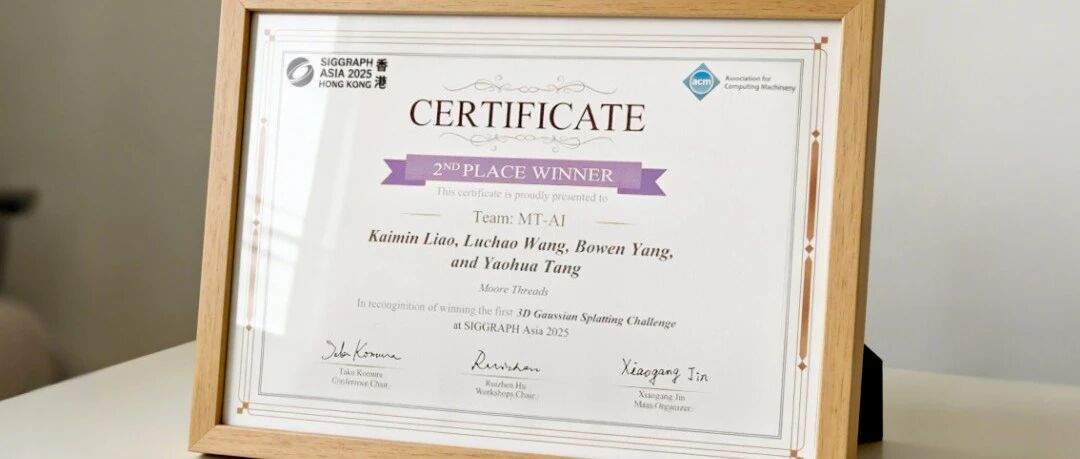
Core Insights - The article highlights the significant achievement of Moore Threads at the SIGGRAPH Asia 2025, where the company won a silver medal in the 3D Gaussian Splatting Reconstruction Challenge, showcasing its advanced algorithm capabilities and hardware-software optimization in next-generation graphics rendering technology [1][17]. Group 1: 3D Gaussian Splatting Technology - 3D Gaussian Splatting (3DGS) is a revolutionary 3D scene representation and rendering technology introduced in 2023, achieving a remarkable balance between image quality, efficiency, and resource usage, with rendering efficiency improved by hundreds to thousands of times compared to traditional NeRF [4][8]. - The technology demonstrates strong adaptability and scalability in areas such as ray tracing, real-time VR/AR rendering, and multimodal fusion, making it a foundational technology for embodied AI, which requires high-quality, low-latency 3D environment modeling [7][8]. Group 2: Competition Details - The 3DGS Reconstruction Challenge required participants to complete high-quality 3DGS reconstruction within 60 seconds using real terminal video sequences and imperfect camera trajectories, emphasizing the challenge of achieving both reconstruction quality and speed [10][12]. - The evaluation metrics included PSNR (Peak Signal-to-Noise Ratio) for reconstruction quality and time taken, ensuring a fair and transparent ranking process [12][14]. Group 3: Moore Threads' Performance - Moore Threads' AI team, competing under the identifier "MT-AI," achieved a commendable balance in reconstruction accuracy and efficiency, securing the second place with an average PSNR of 27.58 and a reconstruction time of 34 seconds [17][21]. - The results from the competition indicated that Moore Threads' performance was competitive, with the top team achieving a PSNR of 28.43 and a reconstruction time of 57 seconds [18]. Group 4: LiteGS Library - Moore Threads developed the LiteGS library, which optimizes the entire pipeline from GPU systems to data management and algorithm design, achieving a PSNR of 27.58 and a reconstruction time of 34 seconds, significantly ahead of many competitors [21][24]. - LiteGS can achieve up to 10.8 times training acceleration while reducing parameter count by over 50%, demonstrating its engineering practicality and technological foresight [25][31]. - The library has been fully open-sourced on GitHub to promote collaborative development and continuous evolution in 3D reconstruction and rendering technology [27].
摩尔线程斩获3DGS重建挑战赛银奖 自研LiteGS全面开源
Zheng Quan Ri Bao Wang· 2025-12-17 10:49
Core Insights - Moore Threads won the silver award at the 3D Gaussian Splatting Reconstruction Challenge during SIGGRAPH Asia 2025 in Hong Kong, showcasing its self-developed technology LiteGS with outstanding algorithm capabilities and hardware-software optimization [1] Group 1: Technology and Innovation - 3D Gaussian Splatting (3DGS) is a revolutionary 3D scene representation and rendering technology that excels in 3D reconstruction and real-time rendering, with potential foundational value in broader AI applications [1] - The training process of 3DGS typically takes tens of minutes to hours, which limits its widespread application due to performance constraints [1] - Moore Threads developed the LiteGS library, achieving full-link collaborative optimization from the underlying GPU system to mid-level data management and high-level algorithm design [1] Group 2: Performance Metrics - LiteGS significantly leads in training efficiency and reconstruction quality, setting a new performance benchmark in the field [2] - LiteGS can achieve up to 10.8 times training acceleration while reducing the parameter count by over 50% when reaching the same quality level as current optimal solutions [2] - With the same parameter count, LiteGS surpasses mainstream solutions by 0.2–0.4 dB in PSNR metrics and reduces training time by 3.8 to 7 times [2] - For lightweight models, LiteGS requires only about 10% of the original 3DGS training time and 20% of the parameter count to achieve equivalent quality, demonstrating exceptional engineering practicality and technological foresight [2] - LiteGS is fully open-sourced on the GitHub platform [2]
SIGGRAPH Asia 2025:摩尔线程赢图形顶会3DGS挑战赛大奖,自研LiteGS全面开源
机器之心· 2025-12-17 05:28
Core Insights - Moore Threads won the silver medal at the 3D Gaussian Splatting Reconstruction Challenge during SIGGRAPH Asia 2025, showcasing its advanced algorithm capabilities and hardware-software optimization in next-generation graphics rendering technology [1][16]. Group 1: 3D Gaussian Splatting Technology - 3D Gaussian Splatting (3DGS) is a revolutionary 3D scene representation and rendering technology that achieves an exceptional balance between image quality, efficiency, and resource usage, significantly outperforming traditional NeRF methods by enhancing rendering efficiency by hundreds to thousands of times [4][19]. - 3DGS has shown strong adaptability and scalability in areas such as ray tracing, real-time VR/AR rendering, and multi-modal fusion, making it a key technology in the evolving landscape of graphics rendering [4][8]. Group 2: Competition Overview - The 3DGS Reconstruction Challenge required participants to complete high-quality 3DGS reconstruction within 60 seconds using provided real terminal video sequences and SLAM point clouds, emphasizing both reconstruction quality and speed [10][12]. - The evaluation metrics included PSNR (Peak Signal-to-Noise Ratio) and reconstruction speed, ensuring a fair and authoritative ranking of the competing teams [12]. Group 3: Performance Results - Moore Threads' team, identified as "MT-AI," achieved an average PSNR of 27.58 and a reconstruction time of 34 seconds, placing them third overall in the competition [17][20]. - The results highlighted the company's leading capabilities in 3DGS algorithm construction and hardware-software optimization [16][20]. Group 4: LiteGS Development - Moore Threads developed the LiteGS library, which optimizes the entire pipeline from GPU systems to data management and algorithm design, achieving a training acceleration of up to 10.8 times while reducing parameter count by over 50% [20][25]. - LiteGS has been open-sourced on GitHub to promote collaboration and continuous evolution in 3D reconstruction and rendering technologies [27]. Group 5: Strategic Implications - The success at the SIGGRAPH Asia competition reflects Moore Threads' strategic understanding of global technology trends and its ability to lead future graphics computing directions [28]. - The advancements in 3DGS technology highlight the high demands for algorithm and hardware collaboration, positioning Moore Threads as a forward-thinking player in the graphics intelligence computing field [28].