
多式联运物流

Search documents
八方速递 | 内蒙古累计审定草品种313个;海南公布第一批文化微地标
Ren Min Ri Bao· 2026-02-25 22:02
Group 1 - Inner Mongolia has approved a total of 313 grass varieties, with 36 new varieties approved for 2025, including 32 cultivated and 4 wild domesticated varieties [1] - The 2025 grass variety approvals focus on ecological restoration and grassland livestock development needs in Inner Mongolia, aiming to enhance the supply capacity of quality local grass and forage varieties [1] Group 2 - The first batch of cultural micro-landmarks in Hainan has been officially announced, including 16 unique cultural spaces such as the Yundong Library and Haikou Clock Tower [2] - The selection of cultural micro-landmarks was based on three dimensions: cultural connotation, social recognition, and sustainable development, involving multiple rounds of expert evaluations and public consultations [2] Group 3 - The Yushu Yak Product Distribution Center in Qinghai has officially opened, marking the full integration of the yak industry from breeding and processing to distribution and sales [3] - The distribution center and production workshop cover over 1,600 square meters and include three production lines for yak meat sauce, yak jerky, and marinated meat, offering over 20 product varieties [3] Group 4 - Anhui has successfully launched its first water-to-water multimodal transport business for export goods, with the "Jianghaitong 188" vessel carrying containers from Wuhu Port to Shanghai without customs declaration for transshipment [4][5] - This multimodal transport simplifies customs processes and enhances logistics efficiency, providing a more economical and convenient channel for Anhui's exports [5] Group 5 - Gansu's Linxia Prefecture has introduced interactive cultural activities across various venues during the Spring Festival, creating new cultural experiences that attract significant participation from citizens and tourists [6] - The Linxia World Geopark Museum has launched immersive experiences incorporating ice and snow themes and interactive science education, while the pottery museum utilizes 3D technology to showcase millennia-old pottery culture [6]
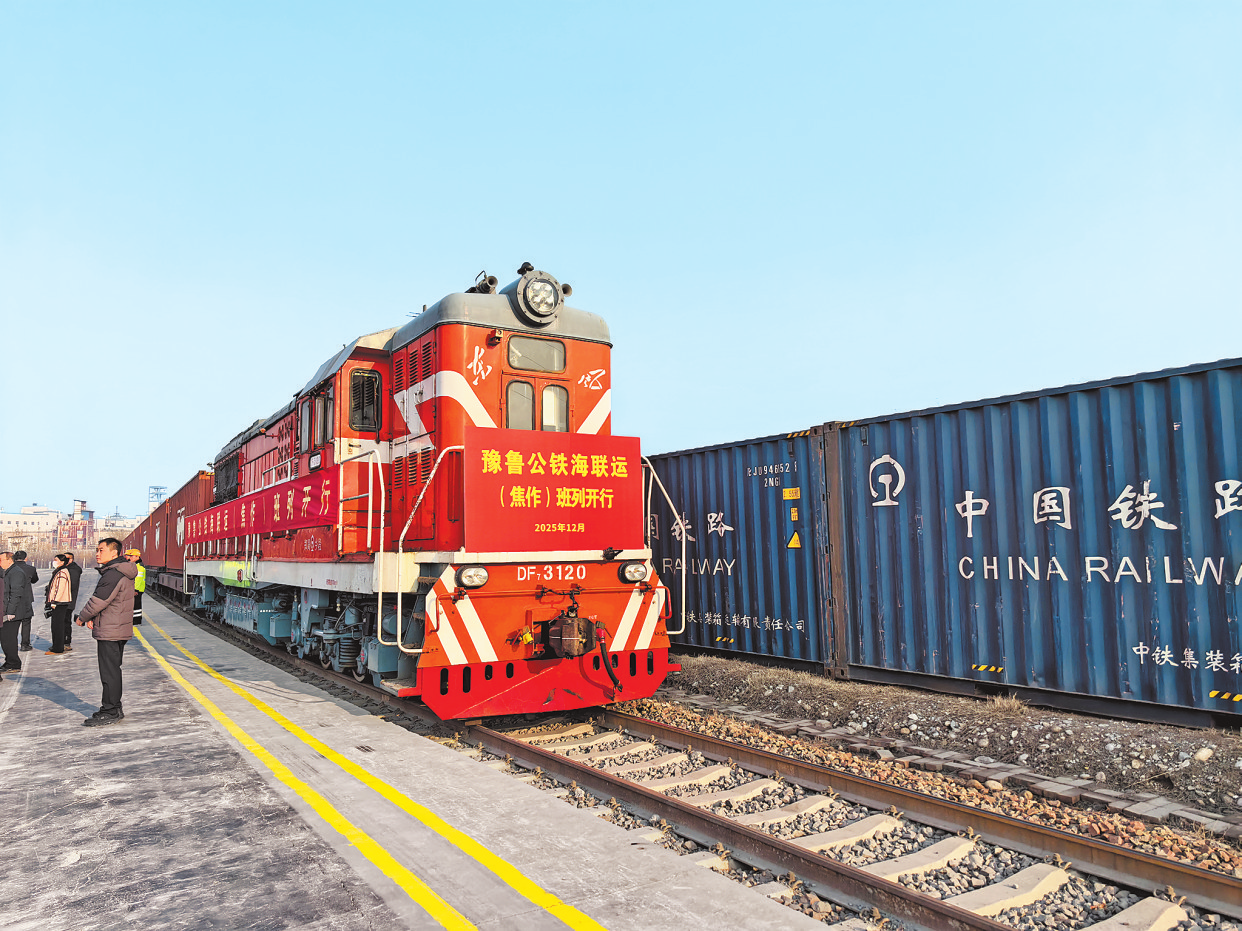
这条黄金通道一路向东出海,链接全球 豫鲁公铁海联运(焦作)班列开行
He Nan Ri Bao· 2025-12-17 23:48
Core Viewpoint - The successful launch of the Yulu Public-Rail-Sea Intermodal Transport (Jiaozuo) train service marks a significant step in enhancing logistics efficiency and reducing costs for local manufacturers, facilitating their access to international markets [3][4]. Group 1: Launch and Operations - The Yulu Public-Rail-Sea Intermodal Transport (Jiaozuo) train service commenced on December 17, carrying goods such as automotive tires and titanium dioxide from Jiaozuo to Qingdao Port for international shipping [3]. - The service allows for direct container transport to the port, reducing costs by 30% and improving safety and reliability for exporters [3]. - The Jiaozuo-Shandong Port rail-sea service has achieved a stable operation of two trains per week with a punctuality rate exceeding 98% [4]. Group 2: Strategic Partnerships - A cooperation agreement was signed among Jiaozuo Municipal Government, China Railway Zhengzhou Group, and Shandong Port Group to advance the construction of the intermodal transport corridor [4]. - The focus is on integrating logistics, trade, finance, and shipping resources to enhance the local industrial sector's access to port services [5]. Group 3: Infrastructure and Development - Jiaozuo is positioned as a key city in the Zhengzhou metropolitan area and has developed a robust infrastructure for multi-modal transport, including six major railway lines [4]. - The Jiaozuo Municipal Government has prioritized the development of intermodal transport corridors as part of its infrastructure improvement initiatives [4]. Group 4: Future Plans and Support - The Shandong Port Group aims to provide comprehensive port services to local enterprises, enhancing their competitiveness in international markets [5]. - The Jiaozuo city government plans to establish a regular coordination mechanism to support the development of the intermodal transport services [6]. - Jiaozuo State-owned Assets Group is set to play a leading role in integrating railway and port resources to streamline logistics operations for local businesses [7].

习近平总书记关切事丨潮涌天山活力新
Xin Hua Wang· 2025-09-21 23:44
Group 1: Development and Opportunities in Xinjiang - Xinjiang's development is crucial for long-term stability, with a focus on high-quality growth and integration into national strategies [2] - The establishment of the China (Xinjiang) Free Trade Zone marks a significant step in enhancing Xinjiang's role in international trade [5] - The Urumqi International Land Port Area has become a key hub for multi-modal transport, significantly improving logistics efficiency [7][8] Group 2: Renewable Energy Growth - Xinjiang has vast renewable energy potential, with solar energy capacity estimated at 420 million kilowatts, the highest in China, and wind energy capacity at 100 million kilowatts, the second highest [9] - By 2024, Xinjiang's renewable energy installed capacity is expected to exceed 100 million kilowatts, accounting for over 50% of the total power capacity [10] - The region is developing a comprehensive renewable energy industry chain, including manufacturing for wind and solar equipment [10] Group 3: Modern Agriculture and Technological Advancements - Xinjiang is advancing modern agriculture through technological innovations, with significant breakthroughs in drought-resistant wheat varieties that yield 508.32 kg per mu, a 17.11% increase over traditional varieties [11] - The region is transitioning to mechanized and intelligent farming practices, enhancing productivity and efficiency [11] - The integration of agriculture with tourism is being promoted, exemplified by the success of the peach industry in the Shihezi area, which has expanded into tourism and value-added products [16]
习近平总书记关切事|潮涌天山活力新
Xin Hua She· 2025-09-21 12:29
New Opportunities - The Urumqi International Land Port Area is evolving from a relatively closed inland region to a frontier of openness, highlighted by the establishment of the China (Xinjiang) Free Trade Zone in November 2023, which is crucial for the Urumqi area [2][4] - The region has launched four new scheduled freight train routes, significantly reducing transit times by over 60% compared to regular services, enhancing operational efficiency [4] - Since 2017, over 300 enterprises have been introduced to the land port area, with cumulative import and export trade exceeding 300 billion yuan, indicating robust economic growth [4][5] New Dynamics - Xinjiang's renewable energy sector is rapidly developing, with solar energy potential estimated at 4.2 billion kilowatts, the highest in the country, and wind energy potential at 1 billion kilowatts, ranking second [6][7] - By 2024, Xinjiang's installed renewable energy capacity is expected to exceed 100 million kilowatts, accounting for over 50% of the total power generation capacity in the region [6] - The region is also focusing on modern agriculture, with significant advancements in crop yields, such as a new wheat variety that achieves a 17.11% increase in yield under water-saving conditions [9] New Concepts - The Urumqi International Land Port Area aims to enhance logistics services and attract more logistics, trade, and export-oriented manufacturing enterprises, supporting high-level openness in Xinjiang [5] - The integration of agriculture, industry, and tourism is being promoted, with initiatives like the "Peach Economy" in the Shihezi area, which combines agricultural production with tourism to boost local income [14]