
政府采购代理

Search documents
代理行业如何规范发展?
Xin Lang Cai Jing· 2026-01-21 16:27
Core Viewpoint - The article emphasizes the importance of fair competition in the agency industry and the need for regulatory measures to eliminate "involution" and promote a healthy competitive environment [2][3][5]. Group 1: Industry Challenges - The agency industry has been experiencing intense competition, leading to a phenomenon known as "involution," characterized by inefficient and unfair competition, resulting in a "lose-lose" situation for many agencies [2][3]. - Agencies are facing pressure from declining service fees and increasing operational standards, which challenge their profitability and employee compensation [2][3]. - Various irregularities have emerged in the industry, such as collusion between evaluators and agencies, manipulation of scoring, and unauthorized fees, undermining fair competition in government procurement [3][4]. Group 2: Regulatory Measures - The Ministry of Finance, along with other regulatory bodies, has initiated a special rectification campaign targeting four types of illegal activities in government procurement, including improper fees and late return of deposits [3][4]. - New regulations have been established to create a supervision and inspection mechanism for agencies, detailing responsibilities, principles, and procedures for checks, which will be categorized based on agency performance and compliance [4][5]. - The implementation of these regulations aims to enhance the accountability of agencies and prevent illegal activities, thereby fostering a more competitive and fair market environment [5][6]. Group 3: Promoting Healthy Competition - The article advocates for a shift from price competition to a focus on innovation, service quality, and professionalism among agencies [6][7]. - Some agencies are exploring technological advancements, such as artificial intelligence, to improve risk management and streamline procurement processes, thereby enhancing their service offerings [6][7]. - Agencies are encouraged to develop their professional capabilities through training and establishing clear job responsibilities, which will help them provide higher quality services to clients [7][8].


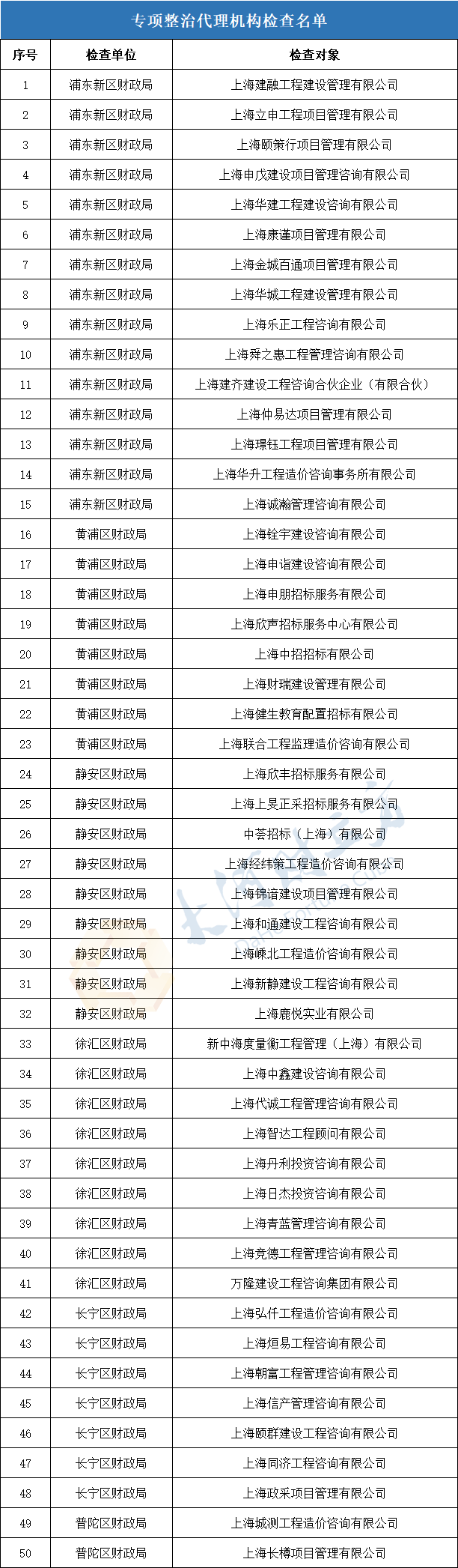
上海开展政府采购领域“四类”违法违规行为专项整治工作,检查对象公布→
Sou Hu Cai Jing· 2025-08-06 08:33
Core Viewpoint - The Shanghai Municipal Finance Bureau and other departments have launched a special rectification campaign targeting four types of illegal activities in government procurement for 2025, aiming to standardize market order and optimize the business environment [1][8]. Group 1: Focus of the Rectification Campaign - The campaign will focus on discriminatory practices favoring local enterprises, unreasonable conditions imposed on suppliers, illegal fees charged by agencies, and fraudulent documents provided by suppliers [1][8]. - Key regulatory matters include the public disclosure of procurement information, adherence to procurement policies, timely contract signing, and proper payment of contract funds [1][8]. Group 2: Organization of the Campaign - The campaign will be organized through collaboration between municipal and district finance departments, public security, and market regulation departments [9]. - The finance department will conduct key inspections of government procurement activities and handle cases of fraud and collusion accordingly [9]. Group 3: Selection of Agencies for Inspection - A total of 149 agencies have been included in the special rectification campaign based on a classification system for inspections [10]. - Agencies will be categorized into five groups for inspection frequency, ensuring comprehensive coverage of those requiring scrutiny [10]. Group 4: Work Schedule - The campaign will be conducted in phases, including self-inspection by agencies, written reviews, on-site inspections, extended investigations, collective reviews, and enforcement actions [11][12][13][14][15][16]. - Each phase has specific deadlines, with the final reports due by December 30, 2025 [17]. Group 5: Requirements for the Campaign - Departments are required to recognize the significance of the campaign, enhance organizational leadership, and ensure effective communication and coordination [18]. - Inspectors must adhere to confidentiality regulations and maintain integrity throughout the inspection process [18].
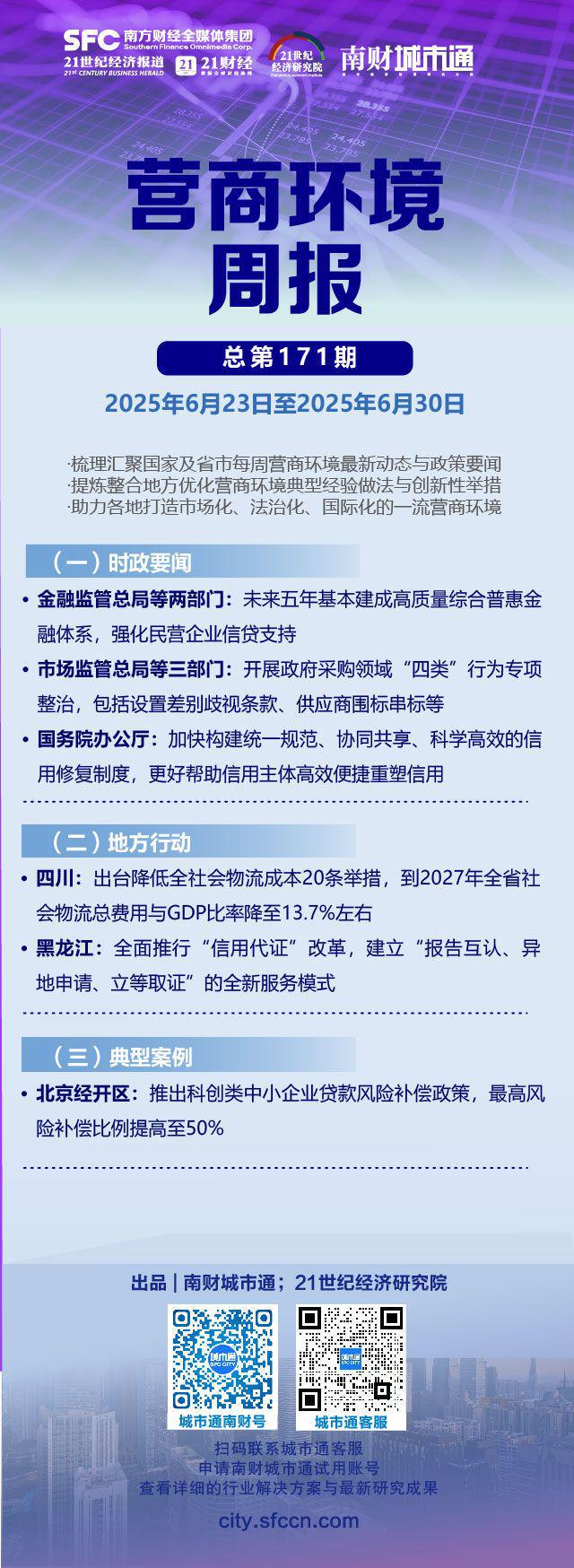
开展政府采购领域“四类”行为专项整治|营商环境周报
2 1 Shi Ji Jing Ji Bao Dao· 2025-07-02 01:58
Group 1: Financial Regulatory Developments - The Financial Regulatory Bureau and the People's Bank of China have jointly released an implementation plan aimed at establishing a high-quality inclusive financial system over the next five years, focusing on enhancing credit support for private enterprises [6][7] - The implementation plan outlines six key areas with 16 measures to optimize the inclusive financial service system, strengthen the inclusive credit system, and improve the inclusive insurance system [6][7] Group 2: Government Procurement Regulations - The Ministry of Finance, Ministry of Public Security, and State Administration for Market Regulation have announced a special rectification initiative targeting four types of illegal activities in government procurement, including discriminatory clauses and collusion among suppliers [8][9] - The rectification work will commence in June 2025 and conclude by the end of January 2026, focusing on ensuring fair procurement practices [8][9] Group 3: Credit Repair System - The State Council has issued an implementation plan to enhance the credit repair system, aiming to create a unified, efficient, and collaborative framework for credit restoration [10][11] - The plan includes ten key tasks, such as establishing a unified credit information disclosure platform and simplifying the credit repair application process [10][11] Group 4: Logistics Cost Reduction in Sichuan - The Sichuan provincial government has introduced a plan to reduce overall logistics costs, targeting a ratio of social logistics costs to GDP of approximately 13.7% by 2027 [13][14] - The plan includes 20 measures across five areas, focusing on improving transportation efficiency and developing modern logistics infrastructure [13][14] Group 5: Credit Report Reform in Heilongjiang - Heilongjiang Province has implemented a "credit report instead of proof of no violations" reform, allowing businesses to use credit reports to replace traditional proof documents, significantly reducing processing time [16][17] - The reform has already issued 2,295 special credit reports, replacing over 42,816 traditional documents since its launch in December 2024 [16][17] Group 6: Loan Risk Compensation for SMEs in Beijing - The Beijing Economic and Technological Development Zone has introduced a loan risk compensation policy for technology innovation SMEs, increasing the maximum compensation ratio to 50% [20][21] - The policy aims to alleviate financing difficulties for innovative SMEs by enhancing the credit confidence of cooperating banks [20][21]
2025年政府采购专项整治启动,大型代理机构全部纳入检查
Sou Hu Cai Jing· 2025-06-23 06:32
Core Viewpoint - The Ministry of Finance, Ministry of Public Security, and State Administration for Market Regulation have launched a special rectification campaign targeting four types of illegal activities in government procurement from June 2023 to January 2024, aiming to standardize the market order and consolidate previous rectification results [1]. Group 1: Focus of the Rectification Campaign - The campaign will address discriminatory clauses set by procurement entities favoring local enterprises, unreasonable conditions imposed on suppliers based on registration location, ownership structure, and other criteria [1]. - It will also target illegal fees charged by agency institutions, false materials provided by suppliers, and collusion among suppliers during the bidding process [1]. Group 2: Inspection Procedures - Central and local financial departments will conduct inspections on agency institutions involved in government procurement, implementing a tiered inspection system [2]. - Agencies will be categorized into three groups for inspection frequency: "annual check," "triennial check," and "newly registered" agencies, with specific criteria for each category [2][3]. - A total of 12 agencies from four provinces will be selected for inspection, and the process will include self-inspection, written review, on-site checks, and penalties if necessary [3].