流程制造

Search documents
中国企业社会化用工趋势分析报告
艾瑞咨询· 2026-01-24 00:06
Core Viewpoint - The trend of socialized employment is expanding, driven by macroeconomic pressures, labor shortages, and the need for flexible workforce solutions across various industries, particularly in manufacturing and retail sectors [1][2][6]. Group 1: Concept and Environment - Socialized employment refers to various forms of employment outside standard labor relations, including outsourcing, labor dispatch, hourly pay, platform-based flexible employment, and shared employment [1][3]. - The macroeconomic environment is characterized by economic fluctuations and a declining working-age population, leading to labor shortages and rising costs for companies [1][6][16]. - The retail sector utilizes a mix of outsourcing, hourly pay, and platform-based flexible employment to adapt to market demand fluctuations, with high employee turnover being a core issue [1][29]. Group 2: Trends and Policy - The scale of socialized employment continues to grow, with supportive policies expected to improve further [2][9]. - Socialized employment is becoming a standard practice for companies, with human resource service providers upgrading to more specialized and digital services [2][9]. - Government policies are encouraging the development of socialized employment models to enhance competitiveness [9]. Group 3: Macro Environment - The digital economy is rapidly growing, projected to reach 63.2 trillion yuan by 2024, accounting for 46.8% of GDP, driving the demand for new employment forms [6]. - The integration of digital technology is reshaping employment relationships, fostering various platform-based flexible employment models [12][40]. Group 4: Industry Penetration - As of 2024, over 240 million people are engaged in flexible employment in China, with socialized employment deeply penetrating various industries [19]. - Business outsourcing has a penetration rate exceeding 50%, while labor dispatch accounts for 20-30%, and platform-based employment is below 20% [19]. Group 5: Micro Environment - External competition and internal management demands are driving companies to adopt socialized employment strategies to remain agile and control labor costs [23]. - Socialized employment effectively balances the need for cost efficiency and individual development, allowing companies to dynamically adjust labor costs based on business fluctuations [26]. Group 6: Sector-Specific Characteristics - In the retail sector, socialized employment is characterized by high employee turnover, with a turnover rate exceeding 30% for frontline positions [37]. - Manufacturing companies are increasingly using socialized employment to manage labor costs and risks, particularly during peak demand periods [44][49]. - Different types of retail enterprises have varying socialized employment needs, with fast-moving consumer goods companies focusing on promotional roles and instant retail emphasizing delivery personnel [35].


中国企业社会化用工趋势分析报告
艾瑞咨询· 2025-12-30 00:07
Core Viewpoint - The trend of socialized employment is expanding, driven by macroeconomic fluctuations, labor shortages, and rising costs, particularly in manufacturing and retail sectors, which are the most receptive to this model [1][2][6]. Group 1: Concept and Environment - Socialized employment refers to various forms of employment outside standard labor relations, including outsourcing, labor dispatch, hourly pay, platform-based flexible employment, and shared employment [1][3]. - The macroeconomic environment is characterized by a decline in the working-age population, leading to dual pressures of labor shortages and rising costs for enterprises [1][16]. - The retail sector utilizes a mix of outsourcing, hourly pay, and platform-based flexible employment to adapt to sales fluctuations and market demands, with high employee turnover being a core pain point [1][29]. Group 2: Trends and Policy - The scale of socialized employment continues to grow, with supportive policies expected to improve further [2][9]. - Socialized employment is becoming a standard for enterprises, with human resource service providers upgrading towards specialization and digitalization [2][9]. - The relationship between individuals and organizations is shifting from dependency to symbiosis, requiring a more diverse skill set from individuals [2]. Group 3: Macro Environment - The digital economy is projected to reach 63.2 trillion yuan by 2024, accounting for 46.8% of GDP, driving high-quality economic development and transforming the employment market [6]. - National policies have been introduced to encourage the development of socialized employment, pushing enterprises to balance efficiency and risk management [9]. Group 4: Industry Penetration - As of 2024, over 240 million flexible employment individuals exist in China, with socialized employment penetrating various industries deeply and qualitatively [19]. - Business outsourcing has a penetration rate exceeding 50%, while labor dispatch accounts for 20%-30%, and platform-based employment is below 20%, indicating a diverse employment landscape [19]. Group 5: Micro Environment - External competition and internal management demands are driving enterprises to adopt socialized employment strategies, allowing for agile organizational structures and flexible cost control [23]. - Socialized employment effectively balances the need for cost efficiency in enterprises with the personal development needs of workers [26]. Group 6: Sector-Specific Characteristics - In the retail sector, socialized employment is characterized by high employee turnover, with rates exceeding 30% for frontline positions, leading to management challenges [37]. - Manufacturing enterprises prefer socialized employment for its flexibility in adjusting workforce size in response to production capacity fluctuations, with outsourcing becoming more common [44][49]. Group 7: Emerging Job Demands - The rise of AI and instant retail is creating new job roles in digital operations and intelligent supply chains, necessitating a workforce skilled in both traditional and emerging technologies [40][54]. - Socialized employment in manufacturing is increasingly requiring cross-disciplinary and composite talents to adapt to technological advancements [54].

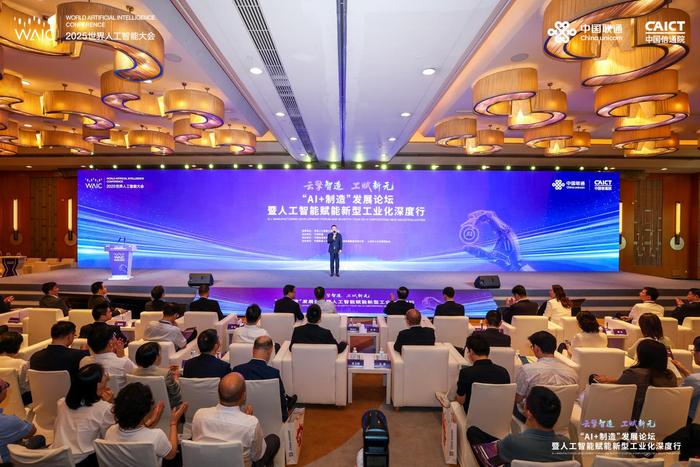
“AI+制造”发展论坛暨人工智能赋能新型工业化深度行成功举办
Guan Cha Zhe Wang· 2025-07-29 04:56
Core Insights - The "AI + Manufacturing" development forum and deep dive event into AI-enabled new industrialization was successfully held during the 2025 World Artificial Intelligence Conference, featuring key figures from government and industry [1][2][11] Group 1: Event Overview - The event was attended by representatives from various countries and over 300 participants from government, industry, academia, and research sectors [1] - Keynote speeches were delivered by prominent figures, including the Chief Scientist of the National Intelligent Control Technology Innovation Center and the Director of the Ministry of Industry and Information Technology's Science and Technology Department [1][11] Group 2: Objectives and Initiatives - The AI-enabled new industrialization initiative aims to enhance the intelligence level of the manufacturing sector through six main tasks, including policy promotion, platform empowerment, and service ecosystem development [2] - The initiative plans to achieve at least 100 supply-demand matches and create no less than 50 benchmark application scenarios to optimize resource supply and support the development of "AI + Manufacturing" in Shanghai [2] Group 3: Technological Developments - China Unicom unveiled its "UniAI·Smart City" strategy and the "Industrial Brain" platform, which includes an industrial data engine and eight industrial scenario intelligent agents [5] - The launch of key platforms such as Industrial Intelligent Cloud and Industrial Corpus Public Service Platform aims to provide integrated services for the manufacturing industry [7] Group 4: Financial Support - Eight major banks announced a joint credit scale of 400 billion yuan to support the "AI + Manufacturing" initiative, offering a diverse range of financial products tailored to different stages of development and enterprise needs [9] Group 5: Expert Insights and Future Vision - Industry experts shared insights on cutting-edge trends and applications in AI-enabled manufacturing, discussing the transformation of production methods and marketing models [11] - The forum set the stage for Shanghai's future in "AI + Manufacturing," emphasizing innovation-driven development and collaboration to accelerate the new industrialization process [16]