电力零售

Search documents
大摩闭门会:从油井到电网:电力、太阳能与特斯拉
2026-02-10 03:24
Summary of Conference Call Industry Overview - The discussion primarily focuses on the energy sector, particularly independent power producers (IPPs), renewable energy, and energy storage solutions. [1][2] Key Points and Arguments Market Dynamics - Recent market volatility has seen certain stocks drop by 15% to 20% without any negative news, attributed to a sharp decline in market risk appetite. [1] - The retail sector is experiencing a seasonal downturn, with January typically strong but February showing weakness, exacerbated by capital gains taxes. [1] Independent Power Producers (IPPs) - The IPP sector is currently viewed positively, with companies like Vista and Talon identified as top picks due to strong valuation support and attractive free cash flow yields. [3] - The demand growth in markets like Texas and PJM is outpacing supply, leading to a tight market environment. [3][4] - Political dynamics and affordability concerns are impacting the market, but the supply-demand imbalance is expected to support future price increases. [4] Transaction Activity - There is an expectation for continued transaction activity among IPPs, particularly as they offer unique advantages such as prime land and long-term contracts. [5][6] On-Site Power Generation - On-site power generation stocks have shown strong performance, with companies like Liberty Energy expanding their power business significantly. [6] - The trend towards self-generation among data centers is expected to continue, providing opportunities for on-site power stocks. [8] Energy Storage - The energy storage market is projected to grow significantly, driven by the demand from data centers and utility-scale projects. [10] - The potential market size for data center energy storage is estimated to be between 225 to 550 GWh. [10] - Companies like Nxtra and AES are highlighted as key players in the energy storage sector. [10] Renewable Energy Projects - Utility-scale renewable energy projects are expected to maintain strong order volumes, with NextEra Energy reporting record orders. [14] - The solar industry is facing potential impacts from new tariffs and regulations, which could affect companies like First Solar. [22][24] Residential Solar Market - The residential solar market is showing signs of recovery, with companies like Enphase potentially reaching a bottom in their performance. [25][26] - The leasing model in residential solar is expected to provide more stable growth compared to companies focused on sales. [26] Bloom Energy - Bloom Energy is anticipated to provide strong revenue guidance for 2026, with expectations for significant order volumes. [28] Additional Important Insights - The discussion touches on the geopolitical implications of energy supply chains, particularly regarding reliance on Chinese imports for battery production. [12] - The potential for Tesla to enter the solar panel market is noted, with implications for competition in the solar industry. [16][23] - The conversation also highlights the importance of regulatory clarity in facilitating transactions in the energy sector. [5] This summary encapsulates the key discussions and insights from the conference call, providing a comprehensive overview of the current state and future outlook of the energy sector.

山东“预警函”发力:让电力零售新规落地生威
Zhong Guo Dian Li Bao· 2025-12-22 02:05
Core Viewpoint - The implementation of the "Shandong Province Electricity Retail Market Price Risk Prevention Implementation Rules" demonstrates the government's commitment to maintaining market order and protecting user rights, signaling that new regulations are not merely symbolic but are actively enforced [1][8]. Group 1: Addressing Information Asymmetry - The electricity retail market has long suffered from severe information asymmetry between electricity suppliers and numerous small users, leading to unfair contracts and high price differentials [2]. - The introduction of a price cap mechanism acts as a "price circuit breaker," scientifically calculated to protect users from excessive electricity costs while also raising awareness of potential risks among users who do not opt for this protection [2][3]. - The government has reduced the learning costs for users by providing decision-making buffers and risk confirmation mechanisms, allowing users to make informed choices without needing to become experts in complex market rules [3]. Group 2: Promoting Fair Competition - The measures taken aim to reward integrity and professionalism in the market while driving out opportunistic and fraudulent practices, thereby enhancing overall market credibility [4]. - By publicly identifying high-risk users and the corresponding electricity suppliers, the initiative increases market transparency and encourages users to avoid suppliers that may mislead them [4]. - This shift in competition will focus more on service quality and risk management rather than exploiting information asymmetry for profit, benefiting honest operators in the long run [4]. Group 3: Economic Stability and Development - Fair and stable electricity pricing is crucial for the operational costs and expectations of various market entities, impacting the overall business environment and economic vitality [5]. - The price cap and warning system help stabilize expectations for businesses, particularly small and medium enterprises, allowing them to focus on innovation and development rather than unpredictable energy costs [7]. - The initiative also aims to purify the market ecosystem by investigating and addressing price violations, thereby maintaining market order and enhancing investor confidence in Shandong [7]. Group 4: Broader Implications - The actions taken in Shandong reflect a proactive approach to governance, balancing market liberalization with effective regulation, and addressing issues that extend beyond the province [8].
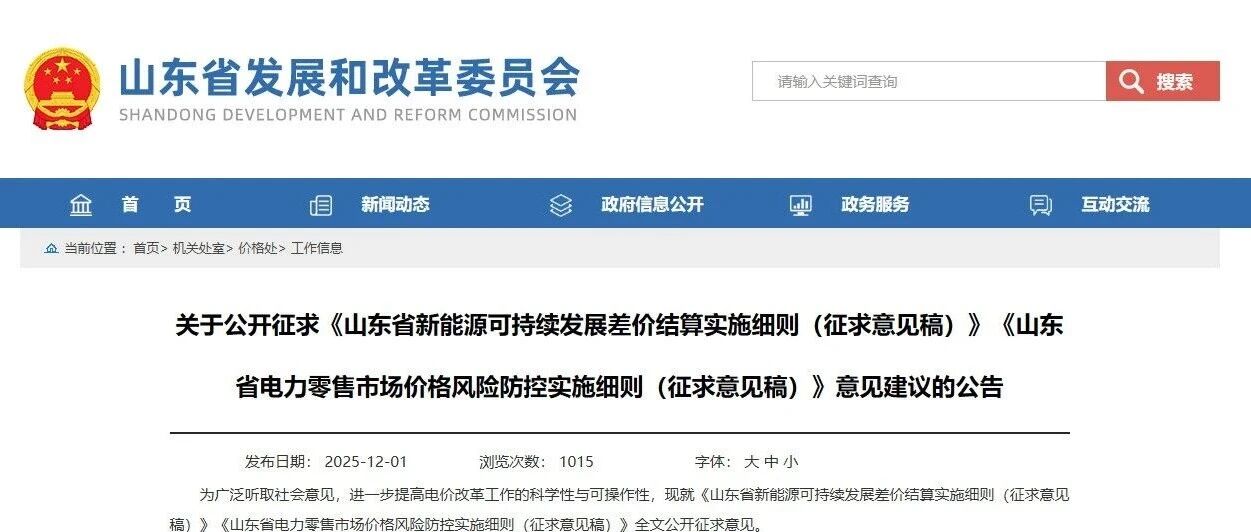
存量机制电量0~100%,电价0.3949元/度!《山东省新能源可持续发展差价结算实施细则(征求意见稿)》发布
中关村储能产业技术联盟· 2025-12-03 05:26
Core Viewpoint - The article discusses the public solicitation of opinions on the draft implementation rules for the sustainable development price settlement of new energy in Shandong Province and the risk prevention measures for the retail electricity market, aiming to enhance the scientific and operational aspects of electricity price reform [2][8]. Group 1: New Energy Sustainable Development Price Settlement - The implementation rules define new energy projects as wind and solar power projects connected to the Shandong power grid, with projects completed by May 31, 2025, classified as existing projects and those starting from June 1, 2025, as incremental projects [2][11]. - The mechanism electricity ratio for existing photovoltaic poverty alleviation projects completed before December 31, 2024, is set at 100% [3][14]. - For existing projects, the mechanism electricity price is based on the provincial coal benchmark price of 0.3949 yuan per kWh, including VAT [5][18]. Group 2: Mechanism Electricity and Price Settlement - The monthly difference settlement fee is calculated using the formula: Monthly difference fee = (mechanism price - settlement reference price) × monthly mechanism electricity [5][20]. - The settlement reference price for wind and solar power is determined based on the weighted average price of similar centralized projects in the Shandong electricity market [20][21]. - The mechanism electricity for incremental projects will not execute the mechanism price if the annual mechanism electricity scale is not met by the end of the year [4][15]. Group 3: Execution Period and Project Changes - The execution period for existing projects is determined by the remaining hours of reasonable utilization over the project's lifecycle or 20 years, whichever is shorter [6][25]. - Existing projects can voluntarily apply to reduce the mechanism electricity ratio, with a minimum reduction of 10% per application [7][31]. - Incremental projects must meet specific conditions to participate in the mechanism price bidding, and any delays in full capacity connection may result in the invalidation of the bidding results [28][34]. Group 4: Retail Market Price Risk Prevention - The retail market allows electricity companies and users to autonomously conduct transactions, determining electricity quantity and price through contracts [39][40]. - A price ceiling option is available for retail users, allowing them to choose whether to implement a price cap in their contracts [42][51]. - The article emphasizes the establishment of a price warning mechanism to monitor and address price anomalies in the retail market [53][54].

四位专家联合撰文:构建信息透明、共享共赢的电力零售市场新生态
Zhong Guo Dian Li Bao· 2025-11-25 01:01
Core Insights - The article emphasizes the need for a profound transformation in China's electricity retail market, shifting from a "price difference arbitrage" model to a "value creation" model to support the new power system construction [2][11]. Group 1: Current State of the Electricity Retail Market - The number of electricity retail companies in China exceeded 4,200 by August 2025, providing purchasing options for 970,000 users, indicating a diverse competitive landscape [3]. - Various regions have introduced "menu-style" retail packages and established electricity retail trading platforms, enhancing user transaction processes and promoting standardization [4]. - The government has implemented foundational regulations and policies to ensure market stability, including capping the price difference between wholesale and retail to protect end-user interests [5]. Group 2: Challenges Facing the Retail Market - The traditional "source-following-load" power balance model is under significant pressure due to the intermittent nature of high proportions of wind and solar energy [6]. - The current retail market's core profit logic, based on "electricity quantity price difference," lacks effective incentives for aggregating decentralized resources, leading to a mismatch between potential and mechanisms [8]. - The retail market suffers from low information transparency and efficiency, which hinders user decision-making and increases reliance on intermediaries [7]. Group 3: Proposed Solutions for Market Reform - Establishing a transparent information transmission system is crucial for activating the retail market, requiring both wholesale and retail markets to share detailed operational data [12]. - A new business ecosystem centered on "value sharing" should be developed, transforming the relationship between electricity companies and users into a partnership based on mutual benefits [14]. - The retail market must break the homogenized competition pattern and adapt pricing mechanisms to better reflect the value of electricity in the context of renewable energy development [9][10]. Group 4: Future Directions - The retail market should evolve to effectively activate demand-side resources, ensuring a two-way interaction between supply and demand, which is essential for the sustainable development of the electricity market [16]. - The government should encourage electricity companies to innovate and enhance their user management capabilities, creating a virtuous cycle that benefits both users and companies [15].
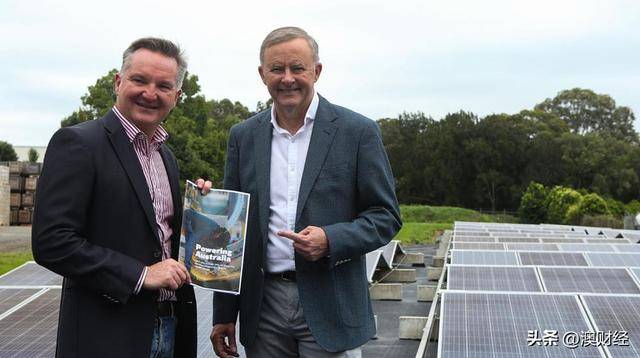
涨幅高达15%!澳又一电力零售商涨价,近50万人要多掏$330/年
Sou Hu Cai Jing· 2025-07-11 04:39
Core Viewpoint - The recent 15% price increase by Snowy Hydro's Red Energy in New South Wales (NSW) is the highest among major suppliers, significantly impacting nearly 500,000 customers with an average annual bill increase of 330 AUD, which offsets the federal government's rebate for 2025-26 [1][3][4]. Price Increase Details - Red Energy's price hike of 15% surpasses AGL's increase of 13.5%, indicating that NSW is facing the most severe impact in the latest round of electricity price hikes [1][4]. - The increase will negate the federal government's planned rebate of 150 AUD for 2025-26, which has been reduced from the previous year's 300 AUD [1][3]. Customer Impact - Many customers are expected to see their annual bills rise by 1,000 AUD compared to 2021, despite previous promises from the government to reduce electricity costs by 275 AUD by 2025 [3]. - The NSW government has also reduced state subsidies, with low-income household rebates decreasing from 350 AUD to 285 AUD for 2025-26 [3]. Competitor Price Changes - Other electricity providers have also raised their prices, with AGL increasing by 13.5%, Alinta by 11.5%, Origin by 9.1%, and EnergyAustralia by 8.7% [4]. - The price increases in NSW are attributed to higher network costs and additional investments in renewable energy infrastructure [4]. Customer Reactions - Customers have expressed anger over the price increase, with some indicating they will switch suppliers due to dissatisfaction with Red Energy's decision [5][6].