
新能源上网电价市场化改革

Search documents
中来股份(300393) - 300393中来股份投资者关系管理信息20260318
2026-03-18 13:58
Group 1: Technology and Cost Advantages - The company's modified BC battery technology utilizes ultra-fine aluminum paste instead of silver paste, which significantly reduces metallization costs due to the high price of silver paste [2] - The technology features a "nano armor protective layer" that prevents aluminum diffusion into polycrystalline silicon, providing excellent vertical conductivity and very low horizontal conductivity [2] Group 2: Production Capacity and Plans - The company has an annual production capacity of 16GW for TOPCon batteries in Shanxi and plans to implement silver reduction technology on the back of TOPCon batteries to enhance market competitiveness [3] - A gradual transformation of an 8GW TOPCon battery production line is set to begin this year, with further modifications depending on business developments [3] Group 3: Business Strategy and Market Adaptation - Following the release of the "Document 136" on market-oriented pricing for renewable energy in 2025, the company is adopting a cautious strategy for its distributed EPC business while actively pursuing operations and maintenance for power plants [3] - The subsidiary, Zhonglai Zhilian Energy Engineering Co., Ltd., has obtained qualifications as an operator for virtual power plants in Shanghai, aiding in business expansion [3]

新风光电子科技股份有限公司2025年度业绩快报公告
Shang Hai Zheng Quan Bao· 2026-02-27 21:27
Financial Performance Summary - In 2025, the company achieved operating revenue of 2,008.52 million RMB, a decrease of 9.87% year-on-year [3] - The net profit attributable to the parent company was 95.21 million RMB, down 47.11% year-on-year [3] - The net profit attributable to the parent company after deducting non-recurring gains and losses was 91.13 million RMB, a decrease of 46.69% year-on-year [3] - Basic earnings per share were 0.69 RMB, down 46.51% year-on-year [3] - Total assets at the end of the reporting period were 3,747.24 million RMB, an increase of 9.70% year-on-year [3] - Equity attributable to the parent company was 1,379.44 million RMB, a decrease of 2.26% year-on-year [3] - Net asset value per share attributable to the parent company was 9.90 RMB, down 1.79% year-on-year [3] Factors Affecting Performance - The company's performance was impacted by the market-oriented reform of new energy grid connection prices, leading some customers to delay project connections to avoid potential losses from price fluctuations, resulting in reduced revenue recognition [4] - Increased market competition exerted downward pressure on prices of the company's main products, further squeezing profit margins [4] - The increase in asset impairment losses and credit impairment losses during the reporting period contributed to the decline in profits [5]

三一重能股份有限公司2025年度业绩快报公告
Shang Hai Zheng Quan Bao· 2026-02-27 20:36
Core Viewpoint - The company reported significant revenue growth in 2025, but net profit declined sharply due to increased competition and falling prices in the wind turbine market [2][3][4]. Financial Performance and Indicators - The company achieved operating revenue of 2,736,594 million yuan, a year-on-year increase of 53.81% - Net profit attributable to shareholders was 73,485.50 million yuan, a decrease of 59.44% year-on-year - Net profit excluding non-recurring gains and losses was 47,231.20 million yuan, down 70.38% year-on-year - Total assets at the end of the reporting period were 4,554,418 million yuan, a 10.00% increase from the beginning of the period - Shareholders' equity attributable to the parent company was 1,386,349.80 million yuan, a 1.02% increase from the beginning of the period - Earnings per share attributable to shareholders was 11.30 yuan, an increase of 0.98% from the beginning of the period [3]. Factors Affecting Operating Performance - The domestic wind power installation scale grew rapidly, and overseas sales increased significantly, contributing to substantial revenue growth - However, the overall profit levels declined due to: 1. Increased competition in the domestic onshore wind turbine market leading to lower bidding prices and rising costs of key components such as large castings, blade resins, and tower steel [4] 2. Market reforms in renewable energy pricing resulting in lower profit margins for wind power projects [4].

新风光2025年度归母净利润9520.88万元,同比减少47.11%
Zhi Tong Cai Jing· 2026-02-27 14:51
Core Viewpoint - The company reported a decline in both revenue and net profit for the fiscal year 2025, indicating challenges in the market and operational environment [1] Financial Performance - The company achieved an operating revenue of 2.009 billion yuan, a year-on-year decrease of 9.87% [1] - The net profit attributable to the parent company was 95.2088 million yuan, reflecting a year-on-year decrease of 47.11% [1] Factors Affecting Performance - The company's performance was impacted by the market-oriented reform of new energy grid connection prices, leading some SVG product customers to delay or postpone project grid connection to avoid potential losses from price fluctuations, resulting in reduced revenue recognition and profit [1] - Increased market competition exerted downward pressure on the prices of the company's main products, further squeezing profit margins and contributing to the year-on-year decline in profit [1]
新风光(688663.SH)2025年度归母净利润9520.88万元,同比减少47.11%
智通财经网· 2026-02-27 14:47
Core Viewpoint - The company Xin Fengguang (688663.SH) reported a decline in both revenue and net profit for the fiscal year 2025, indicating challenges in the market due to regulatory changes and increased competition [1] Financial Performance - The company achieved an operating revenue of 2.009 billion yuan, a year-on-year decrease of 9.87% [1] - The net profit attributable to the parent company's shareholders was 95.2088 million yuan, reflecting a year-on-year decrease of 47.11% [1] Factors Affecting Performance - The decline in operating performance was primarily influenced by the following factors: 1. The market-oriented reform of new energy grid connection prices led some SVG product customers to postpone or delay project grid connection progress to avoid potential losses from price fluctuations, resulting in reduced revenue recognition and profit [1] 2. Increased market competition exerted downward pressure on the prices of the company's main products, further squeezing profit margins and contributing to the year-on-year profit decline [1]
三一重能发布业绩快报:2025年营业收入273.66亿元,净利润7.35亿元
Cai Jing Wang· 2026-02-27 10:11
Core Insights - The company reported a significant increase in revenue for 2025, achieving 27.366 billion yuan, a year-on-year growth of 53.81% [1] - However, the net profit attributable to the parent company decreased to 735 million yuan, a decline of 59.44% year-on-year [1] - The net profit excluding non-recurring gains and losses also fell to 472 million yuan, down 70.38% year-on-year [1] Revenue and Profit Analysis - The increase in revenue was attributed to rapid growth in domestic installed capacity and high-speed growth in overseas sales [1] - Despite the revenue growth, the operating profit, total profit, net profit attributable to the parent company, and basic earnings per share all saw declines compared to the previous year [1] Market Conditions and Challenges - The decline in profitability is primarily due to intensified competition in the domestic onshore wind turbine market, leading to a decrease in bidding prices [1] - The delivery and sales of orders won in 2024 are expected to concentrate in 2025, alongside rising prices for key components such as large castings, blade resins, and tower steel, which will negatively impact the company's gross margin and profit levels [1] - The market reform of grid-connected electricity prices for new energy is expected to further reduce profit levels for wind power projects in 2025 [1]
新风光(688663.SH):2025年净利润9,520.88万元,同比减少47.11%
Ge Long Hui A P P· 2026-02-27 09:48
Core Viewpoint - The company reported a significant decline in both revenue and net profit for the year 2025, indicating challenges in the market and operational environment [1] Financial Performance - The company achieved operating revenue of 2,008.52 million yuan, a year-on-year decrease of 9.87% [1] - The net profit attributable to the parent company was 95.21 million yuan, down 47.11% year-on-year [1] - The net profit attributable to the parent company after deducting non-recurring gains and losses was 91.13 million yuan, a decrease of 46.69% year-on-year [1] - Basic earnings per share were 0.69 yuan, reflecting a decline of 46.51% year-on-year [1] Factors Affecting Performance - The company's operating performance was primarily impacted by the market-oriented reform of new energy grid connection prices, leading some SVG product customers to delay or postpone project grid connection to avoid potential losses from price fluctuations, resulting in reduced revenue recognition and profit [1] - Increased market competition has intensified price pressure on the company's main products, further squeezing profit margins and contributing to the year-on-year decline in profits [1]
新风光:2025年净利润9,520.88万元,同比减少47.11%
Ge Long Hui· 2026-02-27 09:40
Core Viewpoint - The company reported a significant decline in both revenue and net profit for the year 2025, primarily due to market reforms and increased competition in the industry [1] Financial Performance - The company achieved an operating revenue of 2,008.52 million yuan, a year-on-year decrease of 9.87% [1] - The net profit attributable to the parent company was 95.21 million yuan, down 47.11% year-on-year [1] - The net profit attributable to the parent company after deducting non-recurring gains and losses was 91.13 million yuan, a decrease of 46.69% year-on-year [1] - Basic earnings per share were 0.69 yuan, reflecting a decline of 46.51% year-on-year [1] Factors Affecting Performance - The company's operating performance was significantly impacted by the market-oriented reform of new energy grid connection prices, leading some SVG product customers to delay or postpone project grid connection to avoid potential losses from price fluctuations [1] - Increased market competition has resulted in downward pressure on the prices of the company's main products, further squeezing profit margins and contributing to the year-on-year decline in profits [1]
2026年风光储网行业投资策略:全球储能电网设备需求持续共振
Sou Hu Cai Jing· 2026-02-26 23:13
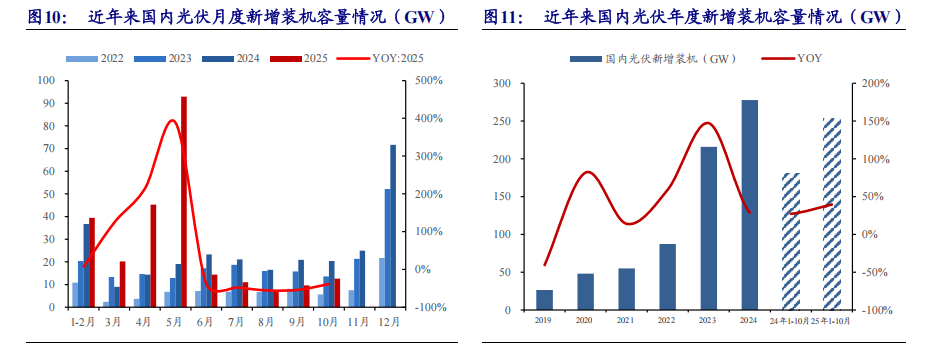
Group 1: Solar Industry Overview - The core viewpoint is that the solar industry is experiencing a gradual improvement in supply-demand dynamics, with ongoing measures to address "involution" competition [1] - By 2025, the solar industry is expected to reach a bottoming out phase, with significant changes in the supply side and a notable recovery in upstream raw material prices [1][13] - The domestic solar demand is projected to see explosive growth in the first half of 2025, primarily driven by the implementation of the 136 document [2] Group 2: Policy and Market Dynamics - The National Development and Reform Commission and the National Energy Administration issued a notification to promote market-based pricing for renewable energy, which will significantly impact the solar market [2] - The notification distinguishes between existing and new projects, with different pricing mechanisms to be applied based on their operational dates [2] - The entry of renewable energy into market trading is expected to lay a solid foundation for the long-term development of the industry [3] Group 3: International Market Trends - In the European market, the solar installation capacity is expected to remain high, with an estimated 65.1GW of new installations in 2025, showing a year-on-year stability [7] - The U.S. solar market is projected to face challenges, with expected new installations of 49GW in 2025, reflecting a year-on-year decline of 2% [11] - Emerging markets are showing robust growth, with a stable export scale of 208GW in the first ten months of 2025, despite a 10% decline in export value [10] Group 4: Supply-Side Improvements - The domestic measures to rectify "involution" competition have been strengthened since 2025, with relevant policies being implemented [13] - The supply side is showing positive signals, with a focus on limiting existing production capacity to stabilize the market [1][13] Group 5: Wind Energy Overview - The wind energy sector is experiencing significant growth, with a projected installation capacity increase of around 40% in 2025 [16] - The domestic wind turbine market is expected to maintain high growth, with a notable increase in the proportion of larger turbines [18] - The export of wind turbines has also seen substantial growth, reaching an export value of approximately 1.6 billion USD in 2025 [17] Group 6: Grid Investment and Development - Domestic grid investment is expected to continue stable growth, with a completion amount of 482.4 billion CNY in the first ten months of 2025, reflecting a 7% year-on-year increase [29] - The focus on high-quality development of distribution networks is anticipated to drive an increase in investment in this area [29]

京能清洁能源股价七日涨2.17% 政策与基建利好行业发展
Jing Ji Guan Cha Wang· 2026-02-26 06:10
Group 1 - The recent developments in the renewable energy sector and energy infrastructure are expected to positively impact the business environment for Jingneng Clean Energy (00579.HK) [1] - The State Grid Jibei Electric Power will implement market-oriented reforms for renewable energy grid connection prices, enhancing digital support capabilities for the grid and promoting key projects like energy storage bases and pumped storage power stations [1] - The cumulative gas transmission volume of the Shan-Jing pipeline system has surpassed 800 billion cubic meters, achieving 28 years of uninterrupted operation, with an average daily gas transmission of approximately 200 million cubic meters, ensuring stable natural gas supply for the Beijing-Tianjin-Hebei region [1] Group 2 - Jingneng Clean Energy's stock price has risen by 2.17% over the past seven trading days (February 20 to 26, 2026), closing at HKD 2.35 on February 26, 2026, with a daily increase of 1.29% and a trading volume of approximately HKD 6.34 million [2] - Technical indicators show a positive MACD histogram, with the stock price above the middle band of the Bollinger Bands and short-term moving averages in a bullish arrangement, reflecting strong market sentiment [2] - The renewable energy sector has increased by 1.22% during the same period, slightly outperforming the Hang Seng Index [2]