科技股行业

Search documents
宏观-经济-近期外资机构观点荟
2026-02-11 05:58
Summary of Key Points from Conference Call Records Industry Overview - Recent adjustments in the US stock market were primarily driven by a sell-off in AI software stocks, with Goldman Sachs predicting that the downward trend may continue, although the peak volatility has passed [4][1] - Foreign institutions are optimistic about gold, with Deutsche Bank and JPMorgan raising their 2026 target prices to $6,000-$6,300 per ounce, while maintaining a cautious stance on silver and copper [5][1] - UBS has revised its GDP growth forecast for the Eurozone in 2026 from 1.1% to 1.3%, mainly due to expansive fiscal policies, particularly defense spending [6][1] Core Insights and Arguments - The stability of the US stock market requires an improvement in earnings prospects, and the recovery of investor sentiment may need several quarters of solid fundamentals to support it [4][1] - AI technology stocks face risks of valuation corrections and exit difficulties, with some listed companies experiencing significant declines. However, Deutsche Bank believes that AI-driven private credit transactions will promote the development of the real economy and reduce risks in the long term [7][1] - Foreign institutions are focusing on major asset classes, including US stocks, commodities, and foreign exchange, with a bullish outlook on precious metals (gold and silver) and copper, while being cautious about silver [8][1] Additional Important Insights - The trend of the Chinese yuan strengthening in the medium term is expected to remain unchanged, driven by improved growth prospects and increased policy tolerance in China. The appreciation of the yuan is characterized by a slow and steady pace, with increased stability in the central parity and a decoupling from the US dollar [9][1] - Foreign institutions view the recent pullback in the A-share market at the end of January as a healthy technical adjustment, optimistic about the transition to a stable liquidity environment in the Chinese stock market, supported by the strengthening yuan and positive regulatory signals [10][1][11]


日本经济政策转向!美资追涨日股 花旗警告风险
Guo Ji Jin Rong Bao· 2025-11-10 20:58
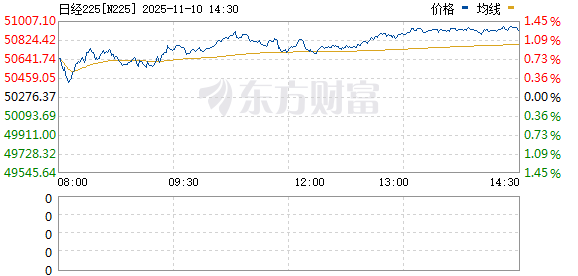
Core Viewpoint - The Japanese government is signaling a significant shift in fiscal policy, moving away from strict budget balance targets to a more flexible multi-year spending plan aimed at stimulating economic growth [1][8]. Fiscal Policy Shift - Prime Minister Sanna Takashi announced plans to abandon the current annual budget balance target in favor of a new multi-year fiscal goal [7]. - This change effectively weakens Japan's long-term commitment to fiscal consolidation, providing the government with greater spending flexibility [8]. - The government aims to restore market confidence in Japan's finances while increasing investments to boost economic growth [9]. Market Reaction - Following the announcement of the new fiscal policy, there has been a significant influx of capital into the Japanese stock market, with the Nikkei 225 index rising by 1.26% to 50,911.76 points [2][3]. - Goldman Sachs noted that the speed of capital inflow from the U.S. into the Japanese stock market is the fastest since the "Abenomics" era, with returns in U.S. dollar terms reaching approximately 30% this year, significantly outperforming the S&P 500 [5]. Investment Trends - The shift in fiscal policy has reignited market confidence, leading to increased participation from U.S. investors, particularly in technology and AI sectors [12]. - Since 2021, Japanese value stocks have consistently outperformed growth stocks, aided by government initiatives to improve capital efficiency [12]. Valuation Concerns - Citigroup has raised warnings about potential overheating in Japanese tech stocks, indicating that valuations have surpassed those of the U.S. "Big Seven" tech companies [13]. - Analysts suggest that the current rise in Japanese tech stocks lacks sufficient profit support, which could lead to unsustainable growth [13]. - Despite maintaining a long-term optimistic outlook on Japanese stocks, there are concerns about short-term risks such as yen appreciation and potential market corrections [14].

A股:科技股,需要小心高位陷阱!
Sou Hu Cai Jing· 2025-10-04 04:19
Group 1 - The current A-share market is experiencing a surge in indices, creating an illusion of a bull market, while blue-chip and high-quality stocks remain stagnant, with the real drivers being speculative stocks with high valuations but poor financial performance [1][3] - Many of these speculative stocks are marketed as "high-tech" or "AI pioneers," yet their financial reports often lack substantial profits or cash flow, relying instead on vague promises about the future [1][5] - The article emphasizes the importance of adhering to investment principles, warning against the common belief that "this time is different," which has historically preceded market crashes [3][5] Group 2 - The article critiques the lack of safety margins in current investments, highlighting that many "tech stocks" are trading at exorbitant price-to-earnings ratios while still incurring losses, indicating a trend of high-risk investments rather than value buying [5][7] - It questions the existence of a competitive advantage, noting that while some companies invest significantly in R&D, others fall short, raising concerns about their ability to compete in the technology sector [5][7] - The article warns that when the majority of investors are focused on the same trend, it often signals a buildup of risk, suggesting that true investment wisdom lies in contrarian thinking rather than following the crowd [7]