财政政策转向

Search documents
中国股票策略:A 股情绪小幅回升,但或难持续-China Equity Strategy-A-Share Sentiment Marginally Up But May Not Sustain
2025-12-19 03:13
Summary of Key Points from the Conference Call Industry Overview - **Industry**: A-Shares Market in China - **Date**: December 18, 2025 Core Insights and Arguments - **Market Sentiment**: A-share sentiment has increased marginally, with the weighted MSASI rising by 4 percentage points to 51% compared to the previous cutoff date of December 10, while the weighted MSASI 1MMA decreased by 3 percentage points to 52% [2][4] - **Turnover Growth**: Average daily turnover (ADT) for A-shares increased by 3% to RMB 1,854 billion, and equity futures turnover surged by 29% to RMB 451 billion. ChiNext turnover remained stable at RMB 502 billion, and margin transaction outstanding turnover was unchanged at RMB 2,480 billion [2] - **Net Inflows**: Southbound trading saw net inflows of US$0.8 billion from December 11-17, with year-to-date net inflows reaching US$170 billion and month-to-date inflows at US$1.4 billion [3] - **External Risks**: Global market volatility, particularly in the US equity market, poses a risk to sentiment, as evidenced by a ~3% drop in the S&P 500 over the past five trading days [4] - **Domestic Economic Challenges**: November retail sales growth was disappointing, slowing to a post-COVID low of 1.3% year-over-year. The China Economics team has revised its 4Q real GDP tracking down to ~4.3% year-over-year from 4.5% [5] Additional Important Insights - **Fiscal Policy**: A more decisive fiscal shift, especially measures to accelerate housing inventory absorption, is seen as a potential driver for improved market sentiment [17] - **Technology Sector**: Breakthroughs in China's technology sector could expand addressable markets and support a meaningful re-rating of the market [17] - **Earnings Estimates**: The breadth of consensus earnings estimate revisions remains negative but has shown slight improvement compared to the previous week [2] - **Market Volatility**: The expectation is for sentiment to remain range-bound amid higher market volatility, influenced by external uncertainties and challenging domestic macroeconomic conditions [4] Conclusion - The A-share market is experiencing marginal improvements in sentiment and turnover, but faces significant external and domestic challenges that could impact future performance. Key drivers for a more bullish outlook include fiscal policy shifts and advancements in technology.
日本经济政策转向!美资追涨日股 花旗警告风险
Guo Ji Jin Rong Bao· 2025-11-10 20:58
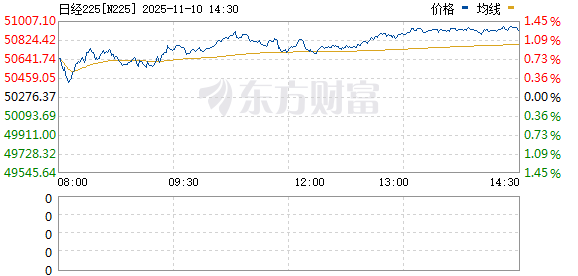
Core Viewpoint - The Japanese government is signaling a significant shift in fiscal policy, moving away from strict budget balance targets to a more flexible multi-year spending plan aimed at stimulating economic growth [1][8]. Fiscal Policy Shift - Prime Minister Sanna Takashi announced plans to abandon the current annual budget balance target in favor of a new multi-year fiscal goal [7]. - This change effectively weakens Japan's long-term commitment to fiscal consolidation, providing the government with greater spending flexibility [8]. - The government aims to restore market confidence in Japan's finances while increasing investments to boost economic growth [9]. Market Reaction - Following the announcement of the new fiscal policy, there has been a significant influx of capital into the Japanese stock market, with the Nikkei 225 index rising by 1.26% to 50,911.76 points [2][3]. - Goldman Sachs noted that the speed of capital inflow from the U.S. into the Japanese stock market is the fastest since the "Abenomics" era, with returns in U.S. dollar terms reaching approximately 30% this year, significantly outperforming the S&P 500 [5]. Investment Trends - The shift in fiscal policy has reignited market confidence, leading to increased participation from U.S. investors, particularly in technology and AI sectors [12]. - Since 2021, Japanese value stocks have consistently outperformed growth stocks, aided by government initiatives to improve capital efficiency [12]. Valuation Concerns - Citigroup has raised warnings about potential overheating in Japanese tech stocks, indicating that valuations have surpassed those of the U.S. "Big Seven" tech companies [13]. - Analysts suggest that the current rise in Japanese tech stocks lacks sufficient profit support, which could lead to unsustainable growth [13]. - Despite maintaining a long-term optimistic outlook on Japanese stocks, there are concerns about short-term risks such as yen appreciation and potential market corrections [14].