线控底盘

Search documents
线控底盘-解锁高阶智驾-迈入放量周期
2026-03-03 02:52
Summary of Key Points from the Conference Call Industry Overview - The steer-by-wire chassis industry is transitioning from "technology introduction" to "mass deployment," with market size expected to grow from billions to trillions, driven primarily by electronic braking and steering systems [1][3]. Core Insights and Arguments - The steer-by-wire chassis is expected to unlock advanced driving capabilities, with significant growth anticipated by 2026 as the industry moves from L3 to L4 autonomous driving and begins to explore Robot Taxi applications [2]. - The market for steer-by-wire chassis is projected to reach approximately 40 billion by 2025 and nearly 120 billion by 2030, indicating a high growth phase with increasing penetration rates [1][9]. - Key technologies in steer-by-wire braking include EHB and EMB/EMV, with EHB currently dominating due to its high integration, lower costs, and strong energy recovery capabilities [1][12]. Market Dynamics - The steer-by-wire industry is characterized by a competitive landscape primarily dominated by foreign manufacturers, but domestic companies are making significant progress in technology and market penetration [3][18]. - As of January to July 2025, the penetration rate for steer-by-wire braking reached 47.3%, with One Box systems accounting for 86.6% of that market [13]. Technological Evolution - The steer-by-wire system represents a shift from traditional mechanical systems to an electronic architecture that allows for multi-system interconnectivity and collaboration, enhancing response times to milliseconds [6]. - The transition from mechanical to steer-by-wire systems is crucial for meeting the demands of advanced driving systems, with the steer-by-wire system offering faster response times and improved safety features [17]. Policy and Regulatory Support - Since 2020, various policies have been introduced to encourage the development of steer-by-wire systems, with new national standards for braking and steering expected by 2025 [8]. - Regulations have clarified definitions for L3 and above autonomous driving, laying the groundwork for future advancements [8]. Investment Opportunities - The year 2026 is seen as a pivotal moment for the steer-by-wire chassis industry, with a focus on companies that have technological capabilities, product reserves, and production capacity, such as Bertel, Nexteer, and Zhejiang Shibao [19]. - The industry is expected to see accelerated penetration rates in electronic braking and steering systems, with significant opportunities for domestic replacements [19]. Additional Insights - The steer-by-wire braking system's core principle involves a fully electric control architecture that enhances response speed and control precision compared to traditional hydraulic systems [10][11]. - The EMB/EMV systems are emerging as a key trend, with their ability to meet the demands of L4 and above autonomous driving [14]. This summary encapsulates the critical insights and projections regarding the steer-by-wire chassis industry, highlighting its growth potential, technological advancements, and investment opportunities.


美银证券:汽车供应链首选激光雷达、自动驾驶芯片、线控底盘 看好地平线(09660)等
智通财经网· 2025-06-28 11:05
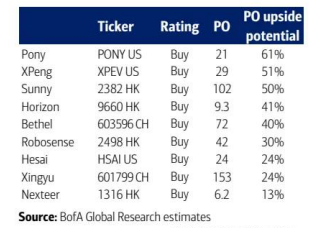
Core Insights - The report from Bank of America Securities highlights the rapid transformation in China's smart automotive industry driven by intense competition and the accelerated application of autonomous driving technologies by companies like BYD [1][2] Industry Overview - The penetration rate of L2+/L3 autonomous driving in China is projected to rise from 27% in 2025 to 80% by 2030, with sales of vehicles equipped with these features expected to grow from 6.1 million units in 2025 to 18.4 million units by 2030, reflecting a CAGR of 25% [2] - The Robotaxi market is anticipated to see explosive growth, with sales expected to increase from 2,500 units in 2025 to 400,000 units by 2030, representing a CAGR of 176% [3] Key Companies and Technologies - Companies such as Hesai (HSAI.US), Horizon (09660), and NIO (01316) are identified as key players in the smart automotive supply chain, particularly in laser radar, autonomous driving chips, and drive-by-wire chassis [1][4] - The report emphasizes that the integration of sensing, processing, and control systems is crucial for autonomous driving capabilities, while smart cockpit systems include components like cockpit domain controllers and heads-up displays [3] Component Market Insights - The estimated value of smart automotive components is $2,400 for entry-level vehicles and $6,000 for high-end models [4] - The penetration rate of laser radar in Chinese passenger vehicles is expected to increase from 6% in 2024 to 40% by 2030, driven by safety considerations and decreasing costs [4] - The market for autonomous driving and advanced driver-assistance system chips is projected to grow at a CAGR of 25% from 2024 to 2030 [4] Ratings and Price Targets - Bank of America Securities has provided ratings and price targets for several companies, indicating strong upside potential for stocks like PONY US, XPEV US, and HSAI US, with potential increases ranging from 24% to 61% [5][6]

VC迷上“种果子”
投中网· 2025-05-21 06:38
Core Viewpoint - The traditional "sniper-style" investment approach of PE/VC is gradually losing effectiveness, leading to a concentration of capital in a few hot industries and a significant disparity in project financing success rates [1][2][15]. Group 1: Market Dynamics - There is a noticeable phenomenon where hot money is highly concentrated in a few popular industries, resulting in a severe polarization of projects [1]. - The funding structure in the primary market has fundamentally changed, with both projects and VCs increasingly pursuing "certainty" [2]. - The scarcity of quality projects has led to a situation where good projects are now "choosing" their investors, necessitating a combination of different types of capital to secure funding [7]. Group 2: New Investment Strategies - A new investment strategy termed "nurturing projects" has emerged, where VCs focus on cultivating promising startups rather than competing for already established head projects [2]. - The "relay irrigation" model has gained traction, where market-oriented funds, industrial capital, and state-owned capital collaborate to nurture projects at different stages of growth [6]. - This model allows for a clear division of roles: market-oriented funds take on early high risks, industrial capital provides order validation, and state-owned capital supports regional industrial upgrades [6]. Group 3: Deep Incubation - Some institutions are shifting their investment strategies to focus on early-stage incubation, aiming to identify promising projects sooner to improve investment success rates [9]. - For instance, a seed training camp was launched by a venture capital firm to provide early-stage entrepreneurs with training and funding, along with access to a network of established companies [10][11]. - The deep incubation approach requires investment institutions to engage more deeply in the operational aspects of the companies they invest in, which may not align with traditional PE decision-making processes [9][12]. Group 4: Demand for Certainty - The increasing demand for certainty in investments has led to a paradigm shift from "picking fruits" to "growing trees" in the investment landscape [15]. - Limited Partners (LPs) are now more focused on how to make funds more resilient to risks rather than just seeking extreme returns [15]. - The "nurturing" investment approach not only aims to enhance investment success rates but also helps funds build a competitive edge in the market [15].